Yesterday I traveled all day, moving my family back to Lulea from Padova. The trip is long because there is no direct connection from Venice to Stockholm (Norwegian has one, but I prefer to avoid them as they canceled my flight recently). So it's Venice-Copenhagen at 9AM, followed by Copenhagen-Stockholm, and then finally Stockholm-Lulea, reaching destination at 8PM. With two 9-months infants and a small dog, plus all the stuff you need to answer their daily needs, it is a physically extenuating experience; fortunately, I have a gold card with Air France that at least allows me to enjoy lounge access and priorities from SAS, which is the company that brought us from south to north Europe.
Of course, I kept both the Radiacode Zero and the Radiacode 103 switched on while travelling. These instruments are two really nice radiation counters that are designed to record x-ray and gamma rays in the energy range of relevance for radioactive decays of unstable elements -making them invaluable both for surveys and for emergency response. I described the instruments in previous articles in this column, and in particular I showed a few times energy spectra of gamma rays recorded by the Radiacode 103 during flights of various length and direction, giving me a chance to highlight several interesting features. So naturally I did the same this time with both instruments.
Before the flight - and that was the test I really wanted to make - there is an occasion to test x-ray counters with high fields: they naturally get screened under the scanners at the airport. The scanners produce significant radiation fields, so that is a good occasion to see if the Radiacode 103 saturates while the Radiacode Zero continues to report accurate readings. And indeed, I have evidence that this is so: compare the graphs below.
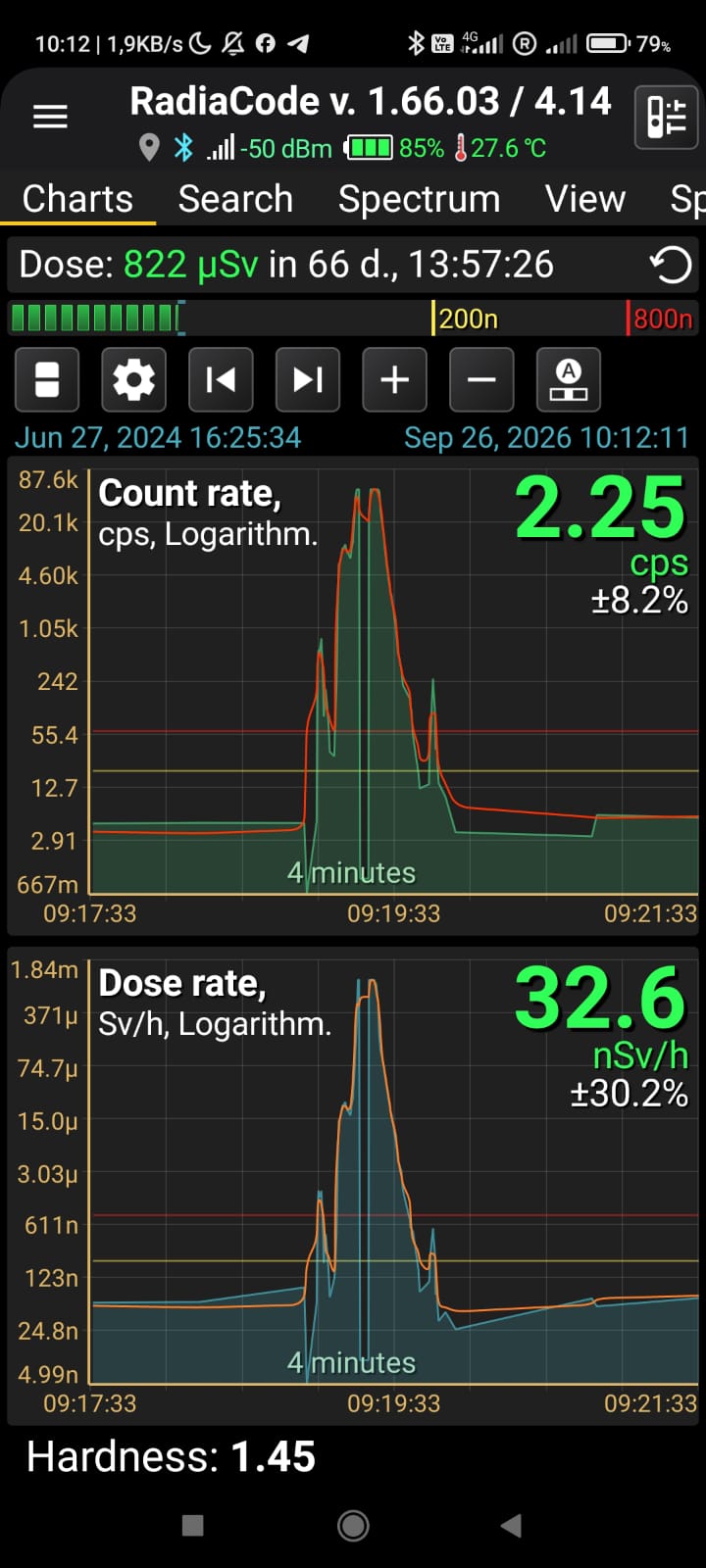
[Above: the dose rate and count rate readings reported by the Radiacode 103. A peak of 1 microSievert/hr is visible.]
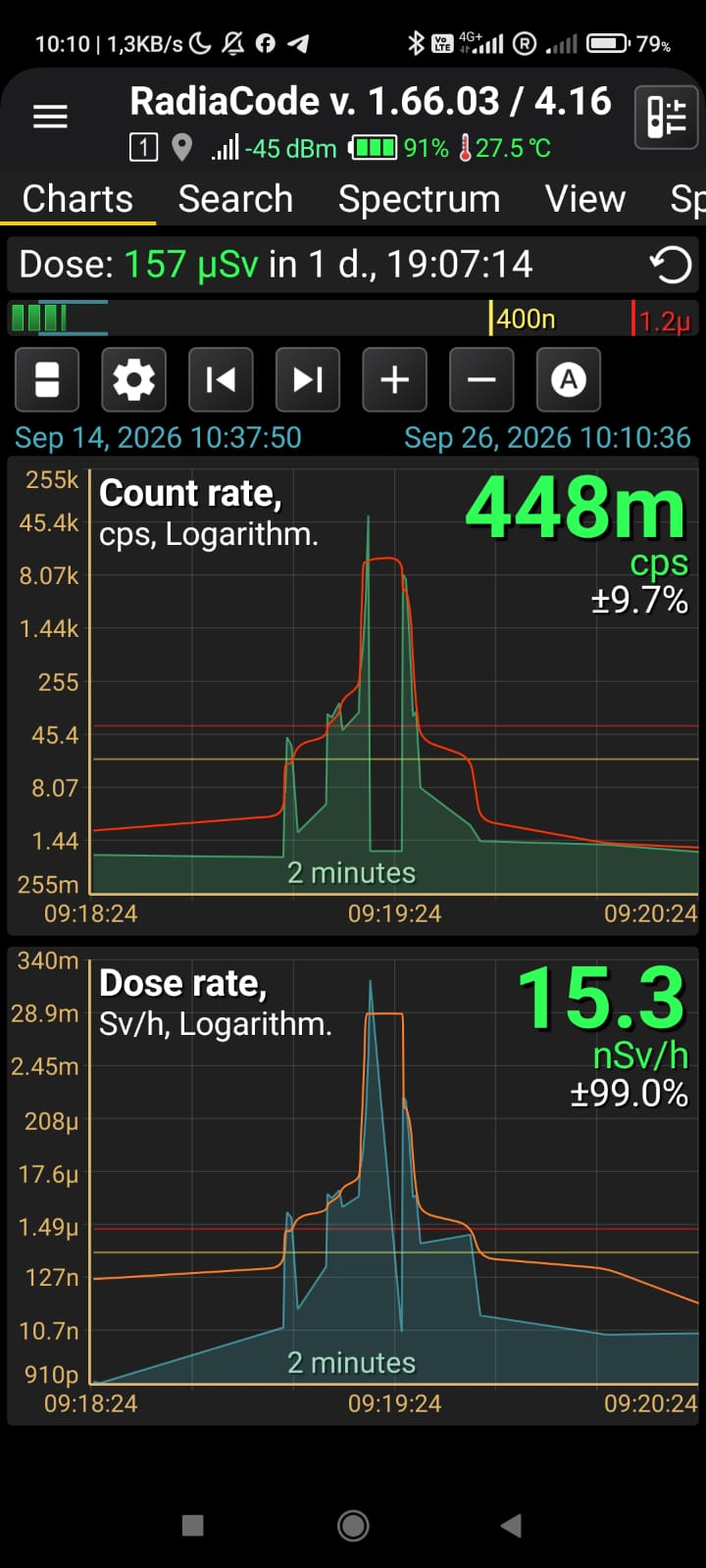
[Above: the dose rate and count rate readings reported by the Radiacode Zero, which was traveling side by side with the Radiacode 103 inside the bag being scanned. In this case, the peak measures about 100 milliSievert/hr, roughly 100 times higher than that reported by the other instrument.]
As you can see, the Radiacode 103 reports seeing not much more than 1 microSievert per hour at peak, when it traveled on the belt inside the x-ray scanner. In the same trajectory, the Radiacode Zero reports readings of up to 100 microSieverts per hour. The Radiacode 103 cannot sustain the large flux, as its measurement of radiation is "count-based" - a too high flux makes its counting capabilities ineffective. This confirms my expectations, as well as the claims made by the company.