A vacuum to most people means emptiness, as in 'nature abhors a vacuum', but in cosmology, a vacuum can instead mean only mostly empty.
Professor David Wands of the University of Portsmouth likens it to a landscape filled with valleys; the true vacuum is the lowest valley, the rest are similar but not the same. That's how physics sees energy in a vacuum; there can be only one minimum in a field, the rest are local minima, a false vacua.
Welcome to quantum fields, where energy can be trapped in a valley even if a lower energy state exists somewhere else.
We all know that a classical field, like a magnetic one, has a value at every position in space and so its strength changes from point to point. it turns out quantum fields can behave in similar fashion, but their excitations exist particles. Since we are in an expanding universe, that is when things get strange.
What if the Higgs Field is not the lowest energy state
The authors of a new paper invoke the Higgs field, called The God Particle by some. In the Standard Model, its vacuum value helps give mass to the known elementary particles and three of the four fundamental forces and remains the best explanation for low-energy physics.
Some argue the Higgs field does not reside in the lowest possible energy state, it is instead in one of those false vacuum valleys and in a very large field values a second, deeper minimum could exist.
If so, transitioning to a deeper minimum would take the Universe into a radically different state. That's when things could go bananas; dinosaurs ruling a planet and a universe where socialism can work.
That's possible with a quantum phenomenon. In a classical physics valley, you only get to a deeper one if you have enough energy to climb the mountain between them. But in quantum mechanics, quantum tunneling means a possibility that the state of a system in one valley could just appear in another.
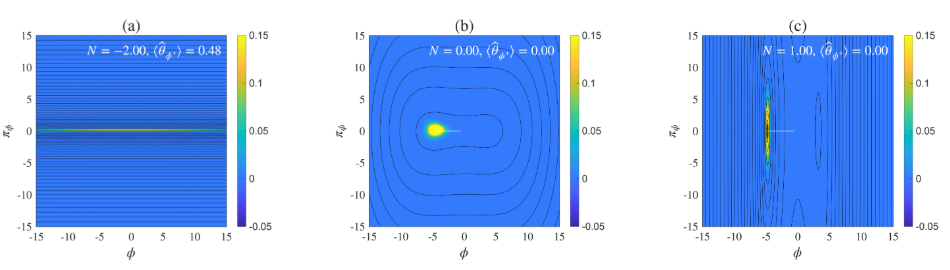
Adiabatic limit ( μ ~ → ∞ ). Wigner functions showing the instantaneous Hamiltonian (2.7) ground state at three snapshot times. Panel (a) is the instantaneous ground state at e-fold N = − 2 , which is the initial state used in every simulation in this paper. The black curves are equal-energy contours of K S ( N ) . Axes are ϕ and π ϕ . In-panel text reports the e -fold N and the false-vacuum projector expectation value ⟨ θ ^ ϕ + ⟩ = Tr [ θ ^ ϕ + ρ ^ ( N ) ] . The white line corresponds to the evolution prior to the snapshot of the phase-space expectation values ⟨ ϕ ^ ⟩ and ⟨ π ^ ϕ ⟩ . The sonified video corresponding to these plots is available via this link with the sonification method described in Christie and Trayford (2024).
Quantum tunneling saves the universe
Most models of tunneling treat it as an isolated thing but there is no perfect isolation. Everything interacts with everything if you drill down far enough. That's why the big concern of quantum computing is getting close to peak isolation; a leak, even a weak interaction, will change the quantum state; decoherence. When you have a superposition of different possibilities, there is no heads or tails on a coin flip, they are both at once. The environment changes that and superposition erodes to where our perception exists; a coin will land on heads. Or tails.
The environment does not play a decisive role in the initial choice of vacuum but can impact the resulting one, and that's shaped by whether the field is “light” or “heavy” relative to the Hubble scale - the rate at which the Universe is expanding. A heavy energy field relative to the Hubble scale adjusts quickly as the universe expands and moves quickly toward the true vacuum state, the deepest value in our landscape example, but when expansion is too rapid, the dynamics of the system cannot keep up with the changes and the field may end up in the false vacuum.
If we're trapped in a false vacuum, there's still hope to break free of cosmic lockdown
If we could be stuck in a perfectly isolated quantum system, tunneling toward the true minimum energy valley would always be about to or never happening all at once, but when decoherence occurs due to environmental interaction, superposition begins to deteriorate. Tunneling is suppressed so even if the environment didn't decide where the energy field ends up, decoherence will keep it there.
They call this stabilization “cosmic lockdown”, quasi- quantum Zeno effect where the wave function collapses and unstable quantum evolution becomes frozen.
That doesn't mean any of this is real, there is no evidence our current Higgs vacuum is protected by cosmic lockdown and we'd otherwise be quantum tunneling to a new energy valley. Yet even if it is, current interaction makes transition to a radically different state even more difficult. So don't stop paying your mortgage.
Citation: Robson Christie, Jaewoo Joo, Greg Kaplanek, Vincent Vennin, David Wands, Cosmic Lockdown: When Decoherence Saves the Universe from Tunneling, arXiv:2512.14204