In the world of activists and pundits, companies making changes involve all reward and no risk, and if companies don't do it they are just greedy. That thinking is why poor people are subsidizing electric cars and solar panels for the rich, which has made reliance on fossil fuels greater in the past decade.
In the real world, companies hesitate because there are no answers to the questions that smart people have. When it comes to reusable packaging, there are more science and technology questions than answers, and there are four reasons companies are hesitating.
1.The potential to hurt brand reputation if this new environmental scheme doesn’t turn out to be better for the environment.
Natural gas, hydroelectric power, corn ethanol - those are all solutions to energy issues promoted by groups until they became popular. Then those groups turned on them. When activists manufactured fear and doubt about BPA after 60 years in use, companies switched despite science showing the compounds are safe. Then activists targeted the replacements. This is also the case in pesticides, where targeted seed treatments called neonicotinoids were created to replace broad spraying, and then groups claimed the safer replacement was killing bees.
2. Government regulations penalize heavier containers.
Current regulations make single-use containers more competitive because packaging taxes are based on weight. A company that adopts reusable packaging is penalized because improving durability often results in heavier containers and greater costs. Costs that are not in place for cheap good imported from Russia or China.
3. Activists have created a Precautionary Principle culture, where nothing should be tried unless it is first proved 100 percent safe.
Reusable packaging sounds ideal in press releases but universities don't have to think about lawsuits if there are later complications for health and safety - including claims about environmental health. In the U.S. there is no need to show harm, you only have to convince a jury a product may have caused harm, like in the cases of baby powder or Roundup.
4. Cost versus benefit.
No one is going to pay extra for reusable packaging, most don't even realize that recycled goods are never actually recycled. Consumers who see a lower price for what is essentially the same product are going for that one, which benefits those who keep single-use packaging.
As we saw with the reusable shopping bag craze, the environmental cost of manufacturing may never be recovered, even if the economic cost is.
A reusable container may require many uses for its environmental footprint to compare favourably with single-use alternatives, and so accurate accounting for refills is core to useful life cycle assessments.
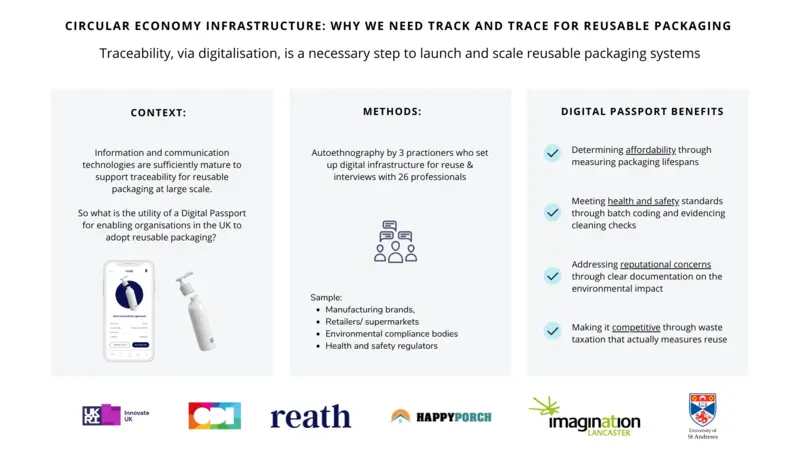
Cost versus benefit may be the easiest to solve. Barcodes for packaging rather than just products may allow business to calculate packaging lifespans and return rates from customers. Both are crucial to determining affordability. A reusable container may require many uses for its environmental footprint to come close to single-use packaging, and so accurate accounting for refills is core to useful life-cycle assessments.
Barcodes, framed as ‘digital passports’, would enable businesses to tell packaging stories in an appealing way, as they are able to verify and quantify their reuse activities for marketing purposes. How many people make purchasing decisions based on sustainability and reusability will remain unclear until data are available, but organic food is a $120 billion business built entirely on marketing, which shows proof of concept.
Companies are also paying environmental taxes on packaging. Digital trackers would allow companies to lobby for exemptions every time their packaging is re-filled. A track and trace allows companies to ask for taxation that incentivizes reuse rather than penalizing it, as happens now.