This is a DRAFT for a new blog post for my Science20 blog http://science20.com/robertinventor - sharing it here as this blog has few views, to work on it and discuss it with friends etc.
The news stories are so full of plans to send humans to Mars at the moment, hoping to colonize the planet, that other long term ideas for humans in space tend to get forgotten. Elon Musk even has plans to send a hundred people at a time in his proposed "Mars Colonial Transporter" and found a city of 80,000, and eventually a million. He is due to reveal these plans at the IAC conference this September. And NASA, though they don't have such a large scale vision, do aim to land human boots on Mars, with an eye to permanent Mars settlement in the future. But what if you are one of those who don't think we have any realistic chance of colonizing the planet, and think even "boots on Mars" has significant planetary protection issues? What then can your future vision be?
Well first, you can present the planetary protection and practical issues. You can say that it is sure to be much harder to live on Mars than to set up home in Antarctica, the Atacama desert, or the top of Mount Everest. You can point out that Mars is far more like the Moon than it is like Earth in terms of habitability, with its vacuum for an atmosphere, hard radiation, and extremes of cold; so cold that carbon dioxide freezes out in dry ice / water ice frosts at night for 200 days of the year even at the equator. You can point to the additional issues of the dust storms, and poisonous perchlorates in the dust.
I think everyone agrees there. The difference is that prospective colonists see all these issues as challenges to be overcome, rather than as reasons not to colonize the place.
You can go on to ask them, would that really work as a place where a million people, or even a thousand people could live and be self sufficient without constant expensive resupply from Earth?
And you can also ask, why land our trillions of Earth microbes in every spaceship landing there, while searching for Mars life?
The trend for robotic missions is to sterilize as carefully as before, with more special regions than before, and with no sign of any suggestion that we can relax the planetary protection requirements for robots.
So, what is special about the microbes that hitch a lift in human occupied spacecraft? Would it not be more sensible to keep them well away from the planet too, until we know what effect they will have?
But that is all negative vision. It's not going to inspire people.
Humans need vision and inspiration, I agree. If you just say "can't do this, don't do that" that's a negative vision that can't inspire anyone. We need a positive vision if we are going to have any alternatives to this Mars colonization idea for the future.
So, I think I'm trying to develop an alternative positive vision here. Whether it works or not is something I'm finding out. It's getting enough favourable attention to be encouraging. In the process I've also come across others with alternative visions of their own. So perhaps it might encourage them too to continue to develop their visions.
The more visions we have, the more options we have for the future. And it can't do any harm to have more options, can it?
It is hard to present a vision like this in a short period of time. Remember that the positive vision of Mars colonization is also one with many details to support it, built up by its advocates over many books, talks, television programs and so on. So an alternative positive vision also has to be quite detailed. This article, though it is quite long, is a rapid summary of just the main ideas.
Also, I'd also just like to say at the outset to humans on Mars enthusiasts, that "This approach doesn’t mean that humans can never land on Mars ever". It's the microbes that are the planetary protection issue here, not humans.
I will suggest that whether microbes continue to be an issue in the future, or whether we can relax planetary protection measures for Mars, is something we can only find out by studying the planet in much more detail than we have so far.
[[MORE]]
POSITIVE VISION FOR HUMANS IN SPACE
The key point here is, that while we continue to explore other places in the solar system with robots, we start with the Moon, for humans, as a place of great interest in its own right, and not just a step on the way to Mars.
This is an important part of the vision, so I'll open out by talking about how interesting the Moon is, in some detail. It's our first place to explore on foot outside of Earth, and a gateway for humans to Mars, Venus, Mercury, the asteroids, Jupiter and further afield.
I've added links to my online articles to find out more. I have also made some of them into kindle booklets for those who prefer to read them on kindle - these are identical to the articles, with addition of a table of contents and cover image. I've included the cover images here, and you can click on the image to go through to the booklet.
In this article I use "space settlement" as the more general term, to refer to any humans living in space in permanent or semi-permanent bases, as they do in Antarctica - and space colonization for some later stage when they may become more self sufficient and also have children born in space.
So the main points are (with links to my articles here to find out more):
- The Moon is turning out to be far more interesting than most realized. We are at the same stage there as the very first Antarctica explorers, setting foot on a continents sized land mass that we know little about first hand.
It has lunar caves to explore, which could be large enough to fit in an entire city within in the low lunar gravity.

Lava tube caves on the Moon could be stable up to five kilometers wide in the lower lunar gravity. The black silhouette here shows the city of Philadelphia superimposed in one of these suggested tubes. We know there are rills on Mars this wide and can see cave entrances into them on the surface in, photographs taken from orbit, but we can't see far into them so don't know how large the caves are yet. They may have been spotted through gravitational anomalies in the Grail spacecraft measurements: Scientists May Have Spotted Buried Lava Tubes on the Moon - see also Grail data points to possible lava tubes on the moon.We have pretty good evidence now of ice at the poles, in permanently shadowed craters, thought to be relatively pure and at least a couple of meters thick. And not just a little ice; there are estimated to be at least 600 million metric tons of this, and possibly much more. It also contains other volatiles. Relative to H20 at 100% they found H2S at 16.75%, NH3 at 6.03% SO2 at 3.19%, C2H4 at 3.12%, CO2 at 2.17%. So, if the rest of the ice at the poles has a similar constitution to the impact site that's a lot of nitrogen (in the ammonia) and CO2 on the Moon at the poles.

The green circles here surround craters at the lunar north pole thought to have layers of ice, with an estimated total of at least 600 million metric tons of water.The ice at the poles of the Moon could be the "Record keepers of the early solar system" as Greg Delory put it.Then there is more ice offset from the north and south pole. According to one hypothesis, this may be ancient deposits from over three billion years ago before volcanic activity, which changed the polar axis slightly by shifting material.
There are other surfaces on the Moon that are recently formed with few craters - changed by some activity, perhaps emissions of gas, in the very recent geological past Some think it may still have ice, deep down, or even trapped water, from a layer of water rich material that might have accumulated on the early Moon at the same time our oceans formed soon after the original impact of the Mars sized protoplanet with early Earth - Water on the Moon, Yvonne Pendleton, page 3.
We don't yet know the age of the ancient South Pole - Aitken basin, a huge 2500 km diameter crater on the far side of the Moon, the "oldest, deepest and largest basin recognized" on the Moon. Just a few samples of rocks returned from this crater would establish this.
The Moon might also be of interest for evolution and exobiology. That's because meteorites from Earth must hit the Moon in large numbers, after huge impacts on Earth such as the dinosaur extinction Chixculub event, ( perhaps a million fragments around a cm in size). Though there is no atmosphere, the gravity is so low that meteorites from Earth can hit the surface at quite slow speeds (comparatively). This has lead to many ideas in the literature of ways that organics from life on Earth or other sources of interest to biology may be there for us to discover. We can only find out for sure by exploring the Moon on the surface:
- Possibility of an ancient regolith layer buried beneath later lava preserving actual organics from the first few hundred million years of Earth evolution.
- Suggestion that the lunar ice at the poles could preserve ancient biogenic organics.
- Suggestion that effects of cosmic radiation on the ices and other chemicals at the poles of the Moon may be creating complex organics - not quite life probably but the ingredients for life.
- Possibility of meteorites from Earth on the Moon from more recent impacts - which again, if they landed in the frozen areas of the Moon, may preserve organics from millions or even billions of years. They could also preserve fossils as in experiments fossil diatoms are still recognizable, and the smallest ones intact after an impact on the Moon.
- Must have organics from meteorite and comet impacts at least and probably from the solar wind too which brings not just hydrogen but also heavier elements to the Moon.
The Apollo samples were recently re-analysed and the composition of amino acids suggests some extraterrestrial sources, Though the analysis was a tricky one due to contaminants from Earth in the form of rocket fuel, organics taken to the Moon by the astronauts and organics introduced while handling them on Earth, which suggests we need to take care as we explore the Moon.
So, another thing we can do on the Moon is to find out how much organic contamination accompanies human explorations. E.g. before we send humans to Phobos or Deimos or wherever they go next, we'd better know what humans will do to a celestial body when they set up a settlement there. Especially if the aim is to study ice deposits in craters and such like. Organic Measurements on the Lunar Surface: Planned and Unplanned Experiments
The far side is the best place to build radio telescopes anywhere near to Earth because it is radio dark, shielded from Earth by the Moon. Long wave telescopes could be built simply by rolling out lines of cable across the surface. It is a particularly good site for frequencies below 100 MHz, as these are blocked by the ionosphere on Earth. This would open up the last unexploredfrequency regime. in our radio observations of the universe.
Further into the future, we could build Aceribo dish type radio telescopes in natural craters on the Moon. Frank Drake once calculated that it should be possible to create Arecibo type telescopes with a diameter of 30 km or more on the Moon (see abstract on page 91) - Arecibo is 305 meters in diameter.
We can also construct infrared passively cooled telescopes at the poles, for instance using liquid mirrors

Artist's impression of a large liquid mirror infrared telescope on the Moon, passively cooled near the lunar poles. The dish rotates to make a natural parabolic shape.Because the Moon librates so much - rocks up and down and back and forth relative to Earth as it orbits us - a telescope like this would see much more of the sky than a comparable telescope on Earth. See Liquid Mirror Telescopes on the Moon (NASA news, 2008). This infrared telescope could detect objects a hundred times fainter than the James Web Space Telescope.
It would have a mirror like this

which keeps its natural perfect parabolic mirror shape through rotating the disk slowly. The photo shows the six meter diameter Large Zenith Telescope in Canada. On the Moon, this mirror would be made of ionic fluids (salts in a liquid state) rather than mercury, due to their very low vapour pressure which would let them work in the vacuum conditions of the Moon.The Moon may be the key not just to habitats on the Moon, but also for habitats in free space. The original plan for the Stanford Torus was to use a rail gun on the Moon to fire material away from the surface to use for the radiation shielding of the Torus - the most heavy part of the structure. With the low lunar gravity - this seems possible, solar powered or nuclear powered rail guns on the Moon. This is something we could test with a lunar base, to find out if it is indeed practical, as it seems to be on paper in the Stanford study from the 1970s. There are other ideas also for exporting materials from the Moon, such as the lunar tether. Though we don't yet have the technology to build a space elevator on Earth, we could in principle build a space tether on the Moon - it would extend through the Earth Lunar L1 points.
Then, there's the possibility of generating fuel using the ice at the lunar poles. With 600 million metric tons at least, then it seems that we could make fuel without significantly impacting on the amount of ice there. Agreed, if you want to go to Mars and it's your only destination that you want to send humans to outside of Earth, then you wouldn't start by mining fuel on the Moon. It wouldn't make sense to set up all that infrastructure just to get to Mars. But if you are visiting the Moon because it is interesting in its own right, then the fuel on the Moon could then easily become a key towards opening the rest of the solar system out to easier spaceflight, as well as supplying fuel and water to LEO as well. Perhaps just for a few decades, until we find an easy way to access other sources in the asteroid belt or find easy ways to lift it from Earth.
And on top of that you also have the unexpected - those are just things we can expect on basis of what we know so far. But we usually get surprises when we explore new places in the solar system. And though in some ways the Moon is well understood, in other ways it is barely explored at all on the surface and may still have many surprises in store. It wasn't that long ago that ice on the Moon was a big surprise to many astronomers. It may have other surprises in store too.
In this vision,the Moon is an obvious first place for in situ human exploration, of great interest for itself, and not just a stage on the way to Mars. Indeed, it is a first step towards human exploration of the whole solar system, which may see human expeditions not just to Mars, also Venus, Mercury, the asteroid belt, Jupiter, and further afield eventually.
We have spent hardly any time exploring the Moon so far, with only one expedition with a geologist on it. Imagine if we had given up on Antarctica as "done" after the first expeditions that succeeded in landing a human on the continent?
The ESA has come out firmly in favour of sending humans to the Moon first.The Canadian astronaut and former ISS commander Chris Hadfield has come out firmly in favour of Moon first also, as reported by Wired Magazine: "I expect we'll treat the Moon, for the next 100 years, like we've treated Antartica for the last 100 years. With an initial outpost briefly and then longer stays and people staying through the entire winter, and eventually we will have permanent habitation on the Moon." Then, he says, humans will go as far as Mars.
This is also the message of former ISS commander Leroy Chiao who wrote an article about it for Space.com and Buzz Aldrin also says we should start with a permanent base on the Moon. And Jeffrey Hoffman is another astronaut who says we should go to the Moon first.
More about some of this in Human Spaceflight At "Coastline Hugging Phase" - Lunar Villages Not Interplanetary Voyages - Op. Ed.
- Possibility of an ancient regolith layer buried beneath later lava preserving actual organics from the first few hundred million years of Earth evolution.
- Robots and humans work well together. Our robots are our collective sense organs in the universe, and they can go to places humans can't go. On Earth they can explore volcanoes, sea bed etc. In space they can explore places that are either too dangerous to go to, to remote, or places where we don't want to introduce Earth life quite yet.
- We have potential for superpositive outcomes of great value for humanity from the search for life in our solar system from discoveries of origins of life, earlier forms of life, or alternative exobiology. And life on Mars can be vulnerable to Earth life - to get people excited about this.
"Super Positive" Outcomes For Search For Life In Hidden Extra Terrestrial Oceans Of Europa And Enceladus
Why Mars Microbes Matter - Like Tigers - And More So? - Microbial ETs - One example of what we might find on Mars is an early form of life that on Earth has been made extinct by DNA based life - I like this example because it makes it clear that what we search for can be vulnerable to Earth life - you often get the argument that it has to be better adapted to Mars so Earth life can do it no harm - so this just blows through that argument in one go.
This could for instance be RNA life using the much smaller ribozymes (made up of many fragments of RNA) in place of ribosomes (made up of protein fragments mixed with RNA),

The 2.2 a structure of a full-length catalytically active hammerhead ribozymeThis early RNA based life could be similar in size to the contested microbe "fossils" in ALH 84001.
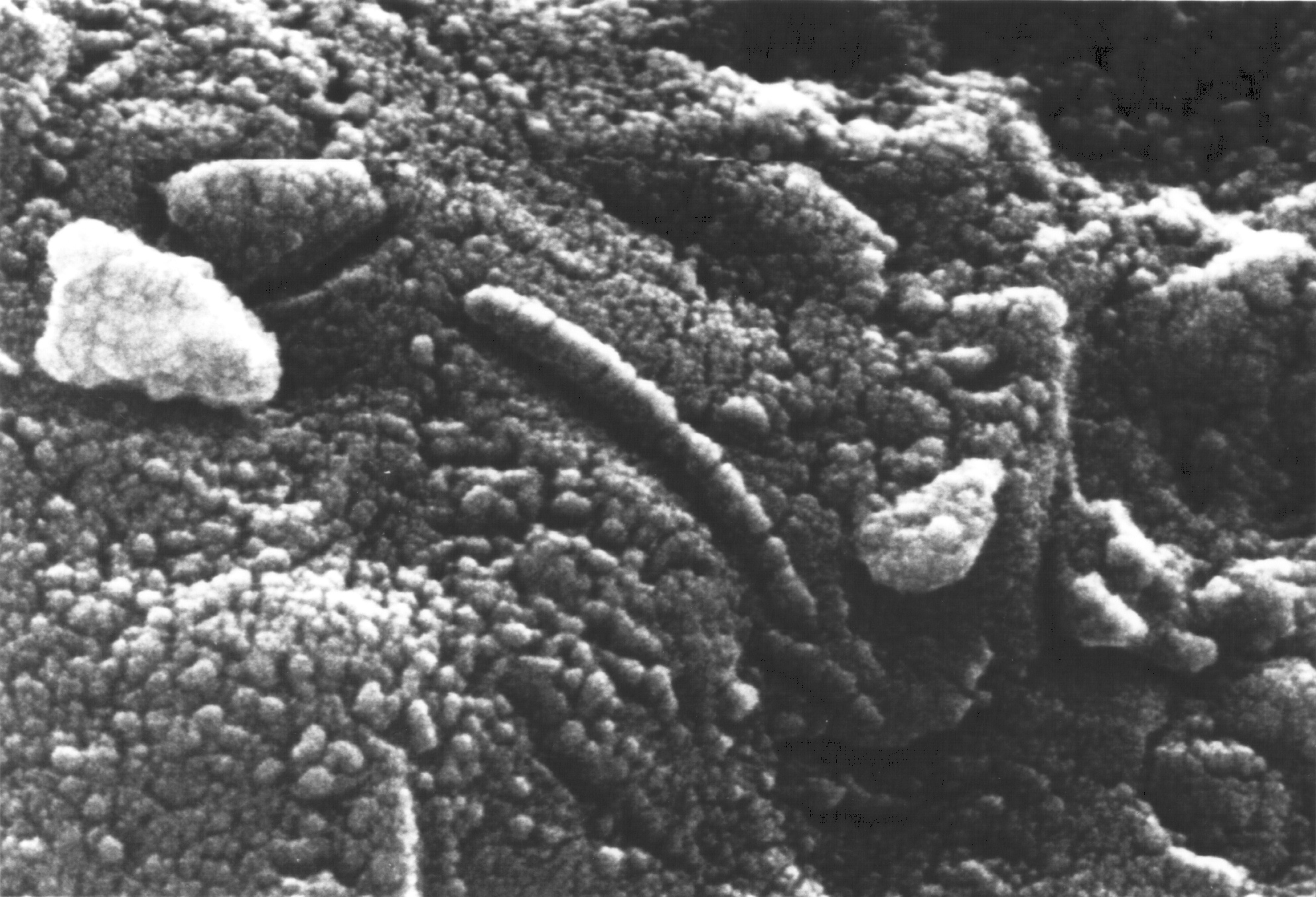
If life evolved independently on Mars, and if it went through a similar vulnerable stage to the ones hypothesized for Earth life, but with the different history and timeline, there is a chance that earlier forms of life may still be there.
- Yes Earth could have shared microbes with Mars. But we don't know which microbes have got there, if any. Mars life could still be vulnerable. A primary producer autotroph like chroococcidiopsis, excellent candidate to get transferred to Mars could play nicely with other lifeforms, even be food for them. It doesn't mean that all Earth microbes are okay for Mars life if introduced to Mars.
Arctic terns fly over both Europe and Australia but that didn't mean that rabbits could do no harm to the wildlife of Australia. And we don't know if any life has been transferred to Mars, though it's possible in theory. There are formidable barriers in the way - the century passage in the vacuum of space for the fastest transit from a giant asteroid impact on Earth, the cosmic radiation, and harsh conditions there that only a few Earth species could survive.
They have to be anaerobes (can survive without oxygen), able to grow in a place with a near vacuum for an atmospheric and high levels of UV light and cosmic radiation, tolerant of perchlorates, and probably salt loving, and also to be autotrophs capable of forming single species ecosystems, amongst a few of the capabilities needed for a pioneer microbe to survive on Mars.
There are microbes with all those qualities but did they got to Mars on meteorites? And did they find a habitat when they got there? At present, nobody knows.
Does Earth Share Microbes With Mars Via Meteorites - Or Are They Interestingly Different For Life?
Could Microbes Transferred On Spacecraft Harm Mars Or Earth - Zubrin's Argument Revisited
No Simple Genetic Test To Separate Earth From Mars Life - Zubrin's Argument Examined - So we have to be careful when exploring Mars, also Europa and Enceladus and anywhere likely to have alternative exobiology. Why start our new phase of human exploration in space by sending humans with our microbe hitchhikers to the one place in the inner solar system that is most vulnerable to introduction of Earth microbes?
- Space development can be of great benefit to Earth through new discoveries, also moving heavy industry into space, providing solar power from space etc.
- Most successful colonization of Earth has been of places already occupied by humans, for the last thousands of years. We don't have any examples of large scale colonization of Earth deserts or ice fields or mountain tops or other uninhabited regions, since neolithic times.

Overview of Pre-modern human migration - there is debate and controversy about the details, but generally agreed that humans were already present world-wide by the end of the neolithic period (which ends around 2000 BC) or shortly after. Large scale colonization since then has always been of areas where humans can survive with stone age technology, and more hostile places such as Antarctica, the highest mountain summits, and the sea floor have not been colonized.So the analogy of colonization on Earth is of limited relevance to space exploration. Which isn't at all to say that it is impossible, but it's a new kind of thing that we have never done before, like colonizing the sea floor, and analogy with the past can't really tell us if it can be done or not.
- There have also been many failed colonizations such as the attempt of the Vikings to colonize America, and the attempt by the Scottish to colonize Panama which was so disastrous it lead much of the lowland population of Scotland to bankruptcy and resulted in an urgent need for unification with England to save them.

Flag of the Company of Scotland Trading to Africa and the Indies. Their "Darien Scheme" an attempt to colonize Panama, lead the death of nearly all the colonists, and it also drained Scotland of an estimated quarter of all its liquid assets. Scotland was saved from bankruptcy by England, in exchange for unification with England, higher taxes, and agreement to service the English national debt.If you focus just on the ones that succeed you get only a partial picture, which may be over optimistic.
- Mars is far more like the Moon than it is like Earth. It's more inhospitable than deserts and Antarctica and we don't colonize those places.
- So, I think that space settlement in early stages at least would be like an Antarctic base - where you are there because you are doing something of value to Earth. I suggest our focus should be on creating settlements that are of value for Earth rather than colonization for its own sake.
- Yes we might get future tech that lets us build self sufficient habitats on Mars. But before then we'd be able to reverse desertification, build self sufficient sea colonies far more easily than on Mars, and do many other things. We don't have that technology yet, and it is not yet the time to consider colonizing hostile places with vacuum for atmosphere when we can't yet make even a self sufficient floating sea colony - that is to say one that only uses sea water and the atmosphere,and maybe a few rocks, far easier than a Mars colony.
Can You Suggest A Second Earth Apart From Mars? - Other places require a lower level of technology and may be better for in situ resources
Using materials from the asteroids, and the moon has many advantages. You don't need to build a human rated lander for the Mars surface - the hardest place to land in the inner solar system without crashing, with automatic systems needed to respond in 90 seconds to land safely, way beyond any possibility of human recovery in case of error.
".. with current EDL (Entry Descent Landing) capability, a large vehicle plunging through the tenuous Martian atmosphere has about 90 seconds to decelerate from Mach 5 to Mach 1, flip over from being a spacecraft to being a lander, open the chutes to decelerate some more, then fire those thrusters to navigate to the landing site before touching down". - page 137 of SpaceX's Dragon: America's Next Generation Spacecraft, by Eric Seedhouse
It may well be possible to solve this. SpaceX hope to solve this with supersonic retropropulsion. But if you send humans to the Moon or asteroids, you don't have to solve these problems. One less thing to deal with.
All the resources you can find on Mars are also available on the Moon or in asteroids. The Moon has a shortage of nitrogen, but is not as thoroughly explored as Mars in many ways, and may still have it, e.g. it does have some ammonia in the polar ices from the LCross results . Nitrates are rare on the Mars surface also.
Also, if your main aim is to have the least technological possible solution, Venus cloud colonies have many advantages - surprising, but if you look at it closely, they may be the easiest of all the extra terrestrial colonies to set up.
At least, Venus cloud colonies certainly have the lowest level of technology requirements for the inhabitants. To go outside your floating habitat you need an acid resistant suit and a closed system air breather like an aqualung, not a millions of dollars spacesuit like a mini spaceship. And the first habitats there would be lightweight and inflatable, and would also require much less mass launched from Earth per person than an equivalent habitat anywhere else in the solar system apart from Earth, even with in situ resource utilization. That's because the pressure is the same inside and out, like a hot air balloon or an airship - and because you have shielding from cosmic radiation and solar storms by the atmosphere, equivalent to ten meters thickness of water, above you.
Getting there is easier too. There is no hard surface to crash on as your target altitude is many kilometers above the surface. Russia had ideas for sending humans to Venus in the 1970s, and NASA has considered sending robotic missions to the Venus atmosphere followed by humans exploring the atmosphere using airships in its HAVOC program. See project home page. This is an internal study, so it's at an early stage at present.
Right now, I think this of most interest for space settlement - and because it helps highlight how high tech and difficult Mars colonization would be and the level of support it would need from Earth with present day technology - rather than practicality of Venus colonization in the very near future. Again, self sufficient floating sea cities on Earth using only sea water and the air from the atmosphere and a few rocks would be far easier to build, and we don't have them yet.

Will We Build Colonies That Float Over Venus Like Buckminster Fuller's "Cloud Nine"? - Yes, we can build human settlements in space using resources from space. But the reasoning of the 1970s is still valid - that the most abundant and easiest resources to access in space, are those on the Moon and in the asteroids. Lunar material can be launched to orbit more easily than any other material apart from asteroids (consider how small the rocket was in the lunar ascent module, able to launch two astronauts from the Moon to lunar orbit).
Also some asteroids consist almost entirely of pure metals including iron, nickel, and heavier metals such as the industrially useful platinum, and gold (a small asteroid 452 by 1011 meters across, to take an example, was estimated to contain 90 million tons of platinum). These metals may also be capable of being extracted without physical mining using carbon monoxide at low temperatures to convert metals to gas (second half of the Mond process with no need to extract the pure metal first), and perhaps directly converted back to metal parts again from the extracted metal carbonyls in 3D printers. And working in zero g has advantages when it comes to moving large masses around.
The Moon has advantages too. For instance, because of all the micrometeorite impacts, it's "soil" or regolith contains large quantities of glass, and as a result can be melted using microwaves, as easily as you can boil water using the microwave in your kitchen. This only works with genuine lunar soil and not the simulants, because we have nothing analogous to lunar soil on Earth, as the author of this paper found: Microwave Sintering of Lunar Soil: Properties, Theory, and Practice. This could be useful, for instance, for making solar panels and other applications.
Then there is enough material in the asteroid belt to eventually build the equivalent of a thousand times the surface area of the Earth. (I find this is often the most telling point in the argument).

Asteroid Resources Could Create Space Habs For Trillions; Land Area Of A Thousand Earths - Settlements on the Moon or using materials from the asteroid are likely to be easier to support economically - it's much easier to export materials from to sell on Earth. It's not yet clear whether settlement in space can be supported by export of materials to sell on Earth due to the high transport costs. But if this is possible, then the launch costs from an asteroid or the Moon are far lower, and they could use ballutes (lightweight inflatable parachutes), large parachutes or similar to land the materials on Earth, with total export cost likely to be lower than from anywhere else in space.
- We don't yet know how humans tolerate artificial gravity, or what the gravity prescription is . The problem is that though we can simulate the physics easily, we can't simulate the human body, but can only find out human tolerances for spin rates, and the "gravity prescription" for health with experiments in space. The models with spinning bed rest patients on Earth may or may not apply to space - we need ground truth from space to evaluate them.
There are many experiments we could do in space to resolve this. But until then, it's not really possible to say for sure whether humans will do best in lunar gravity, Mars gravity or spinning habitats in space, and which are easiest to build and what spin rate is needed. Might even be that the optimal place for humans is a zero gravity module with a rotating sleep habitat - as this has never been tested. We don't know the optimal artificial gravity or real gravity level for health. We know almost nothing except that humans are not healthy long term in zero g unless they do at least two hours of exercise a day and even that still keeps you less healthy than someone confined to a bed on Earth - and that a few days of lunar gravity can be tolerated with no apparent ill effects.
I'd argue that it is just too soon to say what is the optimal type of habitat to build for humans in space.
Can Spinning Habitats Solve Zero g Problem? And Answer Low g Questions?
Could Spinning Hammocks Keep Astronauts Healthy in Zero g?
Ingenious Idea: Soyuz Crew in Tether Spin On Way to ISS - For Artificial Gravity - Almost No Extra Fuel
Crew Tether Spin - With Final Stage - On Routine Mission To ISS - First Human Test Of Artificial Gravity?
Crew Tether Spin For Artificial Gravity On Way To ISS - Stunning New Videos - Space Show Webinar - Sunday - We haven't yet attempted a self sufficient habitat in space. Several ground experiments suggest it may be possible, and that we could produce all our own food and oxygen from plants in a closed system with minimal supply of materials. It's surprisingly small also, only 13 square meters of growing area per person to produce most of their food and all their oxygen. But though this works on the ground, this has not yet been tested in space.

See Could Astronauts Get All Their Oxygen From Algae Or Plants? And Their Food Also?
Beautiful Edible Orange Zinnia - First Zinnia But Not First Flower In Space - And Astronaut Choices - So before developing grand visions of the future of humans in space, we need to look closely at those two points. And do them in a location where we can do it safely. In my view, it's not the time to send humans on deep space missions until we know how to send them safely, say, as far as the Moon, and to live there for years on end. It's neither safe, nor is it sensible. We have been sending humans back and forth to LEO with a lifeboat always attached to the space stations so that they can get back to Earth within hours. From the Moon, they can get back within a couple of days. That is already a demanding step up from what we had before. From Mars, with present day rockets, they might find that they can't get back in less than a year.
The key to Apollo was to do things on a step by step fashion, first showing that humans can survive a few days in zero g, which was not known at the start of the program, then building up to longer and more demanding missions. What we do next may depend on what we find out in the process.
Human Spaceflight At "Coastline Hugging Phase" - Lunar Villages Not Interplanetary Voyages - Op. Ed.
Flags On The Moon - Like A Space Exploration Olympics - And Olympics Style World Flag - We are bound to have fewer people in space than on Earth in the near future. Just as Antarctic settlements are not self sufficient, but are supported by many people not in Antarctica - same will be true for space settlements, in the near future at least. Whatever the ratio is - if you need a hundred people on Earth to support each space settler, for instance - it doesn't matter how valuable the materials are that are returned from space, what matters is how many people on Earth are needed to support you there. So, that would be a limit of 7.5 million people in space. Or 750,000 if you have 1000 on Earth for each in space, or could be a higher ratio as unless space settlers have some big hold over Earth dwellers, we might not get everyone on Earth just involved in supporting them. I think therefore in the near future that we will have possibly tens, even hundreds of thousands in space but not billions. This would change if we can make self sufficient colonies in space - but before that, we would have self sufficient sea colonies etc.
- Earth is the best place for a backup and to rebuild civilization for those that worry about end of the world disasters. That's because no disaster could make Earth as uninhabitable as Mars and some humans would survive anything that is likely to happen. Because we live in a relatively quiet time in our solar system and relatively quiet region of the galaxy.
For asteroids, then the large impacts in our solar system all date back to well over three billion years ago. There is no risk of an asteroid large enough to make such an adapatable species as tool using homo sapiens extinct. With just the most primitive of tools we can survive anywhere from the Kalahari to the Arctic. Turtles, crocodiles, alligators, flying dinosaurs (birds), dawn redwood, pine trees, all survived the Chixculub impact event. We would also.
And Mars is already far more inhospitable than Earth could possibly be even after the very worst asteroid impact - we'd have a nuclear winter - darkness - but still, air to breathe, cosmic radiation protection, water, seas, and surely a fair bit of food also available. Those left on Earth after such an event would be way ahead of the curve compared to anyone trying to survive on Mars.
Giant Asteroid Headed Your Way? - How We Can Detect And Deflect Them
And for the cosmological disasters like a gamma ray burst - why go to Mars? Here on Earth at least we are protected by the 10 tons per square meter Earth atmosphere. On Mars only protected if you dig deep underground. This motive just doesn't add up in my view. And wherever you had your backup, Earth is the obvious planet to rebuild, no matter what happens of the possible disasters.
At the very least, anyone in a nuclear sub deep under the sea would survive nearly all those disasters. Most would be survived by anyone who happens to be on the other side of Earth at the time. So why go to Mars?
Could Anything Make Humans Extinct In The Near Future?
Why Elon Musk's Colony on Mars in 2020s is Unfeasible - What Could We Do - Really?
No Escape From Problems in Space Colonies - Earth is Des Res - Even After Nuclear War or Asteroid Impact
Why We Can't "Backup Earth" On Mars, The Moon, Or Anywhere Else In Our Solar System

End Of All Life On Earth - A Billion Years From Now - Can It Be Avoided - And Who Will Be Here Then? - As for self created problems, again we can't escape from them in space. A future with many humans in space will have much communication back and forth, so we don't achieve a significant level of quarantine that way. And the high tech space colonies would be the most likely places to create and use the most advanced technology - in my view again, if technology is our problem, escaping into space to set up an even more highly technological society is not likely to be our solution.
- A future with large numbers of humans in space with high technology is not necessarily the best thing to aim for. If you have millions of people in space, you will certainly have ISIS and North Korea in space also, with the technology greater than that of ICBMs at their disposal. Rushing into space could create the very problems we would want to run away from. You can't restrict it to just the "good guys" whoever you think they are if you have millions in space. There is a chance we can achieve millions in space peacefully, but exactly how we do it surely matters.
Projects To Get To Space As Easily As We Cross Oceans - A Billion Flights A Year Perhaps - Will We Be Ready?
Will Anyone Ever Own Their Own Land In Space - And May We Get Wars In Space In The Future? - Space settlement is neutral just like settlement anywhere - could be good or bad. I don't think settlement and colonization is an "intrinsic good" in the sense of philosophy and ethics, but rather an extrinsic or instrumental good, good only because of its benefits (Intrinsic versus extrinsic good in Stanford online Encyclopedia of ethics).
It could be hugely positive if done well. It could be very harmful if it goes wrong. And the details of how we do it could swing it either way.
It seems likely to be more healthy if the main aim is to help and protect Earth or to expand our understanding. For instance to go into space to explore and discover new things, as we do in Antarctica, or to build solar panels to supply electricity to Earth, or to mine resources from asteroids, which can help move heavy industry into space, or if low g turns out to be beneficial to human health for some sick people e.g. with heart conditions, or for tourism, or adventure, or to discover asteroids and to protect against them. All of these could make space settlement positive in its effect, if done well, and with consideration of the effects on Earth.
- It's not likely to be a "new form of society" in space in the near future. This is an argument given by some space colonization enthusiasts. The idea is that we can make a fresh start, perhaps a more anarchic (in the good sense), or more fluid society in space.
But the space environment seems the least likely of all places to achieve this, in the near future at least. It would make more sense, I think, to try such things on islands on Earth. There are many remote islands, uninhabited, where you could attempt to start up such a society.
The reason this seems unlikely in space is that you have to be extremely disciplined in space. Astronauts for the ISS are evaluated for their ability to fit into a team, and follow orders. They are relaxed and happy on the ISS because they are people that are content in such a situation. But if the commander says they have to evacuate to the Soyuz, for instance, that is what they have to do, following a detailed procedure that they have trained extensively to be able to do without error and quickly.
It is like living in a nuclear submarine, you have to be able to follow orders and have someone in charge, for safety reasons, since life threatening situations can arise quickly. You also have to follow careful procedures to put on your spacesuit, takes a long time, then during space walks each movement you make needs care and attention. And if mission control say you have to end the space walk, then there is no arguing, you just go back in right away. There is room for improvisation by the individual astronauts, and finding new solutions and creative approaches, but for safety reasons this is done within a framework of a clear chain of command.
It may get easier as time goes on, but it would still be the most regulated modern society of any, just for safety reasons and because you are surrounded by very dangerous high technology if misused, and with the vacuum of space separated from you by a few cms of metal.
The same is also true of other hazardous environments on Earth. In Antarctica, then inhabitants of the settlements have to be able to follow rules and guidelines carefully, especially in the Antarctic winter when it gets extremely cold outside the habitats and dangerous if you don't follow proper procedures.
This may change in the future, but I suggest that currently this is the situation for space settlements or attempts at colonization.
- Mars has turned out to be a much more likely habitat for present day life than previously thought, as are some other places in the solar system.
Though it is so cold and inhospitable for humans, and extremely dry, yet it may have habitats for microbes and even lichens capable of surviving in extreme conditions. There are seasonal changes when observed close up not caused by dust storms, winds, or by dry ice, that may be due to liquid water. And, since Phoenix in 2008, many independent lines of evidence suggest potential present day surface habitats on Mars. Liquid water has been confirmed by Curiosity, though most think that the particular liquid water layer it discovered indirectly is not habitable. Other liquid water layers on Mars may be habitable, and it is possible that life could even use the 100% night time humidity. This is great news for exobiology, if it turns out that there is some form of life still existing on Mars. It will mean however that we need to take great care with human exploration because of the microbial hitchhikers that accompany us everywhere.
Might there be Microbes on the Surface of Mars?
Our Spacecraft Could Look Straight At an Extraterrestrial Microbe - And Not See a Thing!
Rhythms From Martian Sands - What Did Our Viking Landers Find in 1976? Astonishingly, We Don't Know
UV&Cosmic Radiation On Mars - Why They Aren't Lethal For The "Swimming Pools For Bacteria"

Why Mars Surface Life May Leave No Traces In Its Atmosphere: Our Rovers May Need To Go Up Close To See It
Where To Search On Mars For Droplets,&Shallow Flows Of Liquid Water - Where Microbial Life May Flourish
Will We Meet ET Microbes On Mars? Why We Should Care Deeply About Them - Like Tigers
Are There Habitats For Life On Mars? - Salty Seeps, Clear Ice Greenhouses, Ice Fumaroles, Dune Bioreactors,... (long detailed survey article with many cites)
As Philae Awakes - Where Might Life Hide In Our Solar System?
NASA Says Mars Mystery Solved - What Is It? - Three Mysteries About Recursive Slope Lineae
Why Are Hydrated Salts A Slam Dunk Case For Flowing Water On Mars? And What Next? - It is tricky to explore places with life without introducing Earth life. We are still figuring out how to explore the subglacial lakes in Antarctica.
We shouldn't just assume we know how to do this on other planets, yet. Some places, like Europa's oceans may be currently unreachable with our technology, until we can manage 100% sterile robots. Perhaps the same might be true for liquid water habitats on Mars also for similar reasons.
Lake Vostok is only 4 km below the surface, 0.5 km above sea level. Less than half the depth reached by the Trieste Bathyscape, in 1960, yet the Russians wouldn't think of sending a bathyscape down there. They stopped drilling for several years, mainly to avoid contaminating the lake with drilling fluid. However another concern is not to contaminate it with surface life to avoid confusing the results.

The bathyscape Trieste reached a depth of over 10 km in the Challenger deep in the 1960s, with Jacques Piccard and Don Walsh on board. But we don't send even a robotic sub into Lake Vostok to avoid contaminating it with surface life.
The Russians drilled down nearly all the way to lake Vostock, but then stopped until they figured out how to do it safely, preserving the science value.Scientists at the National Research Council have prepared guidelines to protect the lakes, similar to planetary protection guidelines. So, nobody would think of sending humans down there quite yet.
It's not an exact analogy. In some ways Mars is less vulnerable than lake Vostok, because of the harsh conditions there. In other ways it is potentially more vulnerable because of the wider range of possibilities including some vulnerable form of early life, and whatever is there has been isolated from Earth for a lot longer than lake Vostok.
However, I suggest that it shows that we can sometimes halt exploration because we don't yet have the technology to do it successfully, without impacting on the science - and may need to wait until the technology is developed until we can continue further. And that there are places we wouldn't send humans to, even on Earth, to protect them from introduced microbial life. So why not have the same situation in space?
- 100% sterile robots are possible in principle. You just need to build the robots without organics, and then sterilize them of all organics. But we don't yet have a 100% reliable way to do this. Heat sterilization to a high enough temperature works, but destroys the robot also. Ionizing radiation is similar as electronic circuits are vulnerable to ionizing radiation. Supercritical CO2 snow is promising and being investigated by ESA, it's interesting as it not only sterilizes at low temperatures, and has no effect on electronics, but also removes the organics completely if the robot is already reasonably clean. So if something along those lines could some day be made 100% effective, you not only get no life on the spacecraft, but no DNA fragments or GTAs or anything organic at all.
- A human crash on Mars putting debris all over the planet would introduce Earth microbes and has to be avoided. We don't yet have the technology to build 100% reliable spacecraft, and even a 1 in 100 chance of a crash, which some volunteers might be willing to take on as a personal risk, is far higher than the 1 in 10,000 probability that's often used for planetary protection.

Can We Risk Microbes From Human Crashes - On Mars? If Not, What Happens To Dreams To Colonize The Planet? - There is no urgency to send humans to the Mars surface. Even if we send humans there, it is best to understand Mars better first. The best way to do it for planetary protection is to send robots, either controlled from Earth or from Mars orbit.

Ten Reasons NOT To Live On Mars - Great Place To Explore
Mars, Planet Of Surprises, Great To Explore Not So Great To Colonize - 1. Is It As Good A Place To Live As A Desert?
"Ten Reasons Not To Live On Mars, Great Place To Explore" - On The Space Show
Life On the Edge In Cold Dry Deserts Of Mars - Dust Storms, And Contamination By Microbes From Leaky Spacesuits
If Mars Is For Hardy Explorers Only, Where Is The Best Place In The Solar System For First Time Colonists?
Space Habitats For Colonists - And Contamination Free Boots On Mars - With Telerobotic Avatars
Would Microbes From This Astronaut Make It Impossible For Anyone To Terraform Mars - Ever?
Telerobotic Avatars On Mars With Super-Powers ("Teleporting" from orbit) - Search For Life - And Long Term Exploitation
Soaring, Buzzing, Floating, Hopping, Crawling And Inflatable Mars Rovers - Suggestions For UAE Mars Lander
- It is not at all clear that we can terraform Mars, and if it is possible, with current technology, it's a thousands of years, or perhaps a 100,000 year megatechnology project. There are so many questions. How sure can we be that we will continue such a project, when it is likely to cost billions of dollars a year and need support from Earth for thousands of years?
The Mars trilogy is science fiction and the optimistic real world estimate from the Mars Society takes a thousand years to a stage where trees can grow but no animals or birds yet, and humans need aqualung like closed system breathing kits to get around. And is based on assumptions about the amount of dry ice on Mars which are not yet confirmed, and doubts have been cast about how much dry ice still remains there.
Do we have the scientific understanding needed for it? We have never terraformed a planet, and with all our technology on Earth, we find it hard to just keep the CO2 levels on Earth from rising by tens of parts per million. Would it unterraform as easily as it terraformed or go to some undesirable end state. Is it possible at all?
What about accidental planet transformations, where lifeforms we didn't mean to introduce change the climate in unexpected ways? And Mars gets much less light than Earth, so an Earth atmosphere would not be warm enough for Mars without planet scale thin film mirrors to double the amount of light reaching Mars, or industrial levels of production of artificial greenhouse gases (200 half gigawatt nuclear power stations to supply power, and 11 kilometers of fluorite ore mined per century to make the gases).
Are we confident that this is what our descendants a thousand years from now will want us to do for them? Will they be pleased that we started the project so soon and made Mars just as they wanted it, or will they be frustrated by our failed projects, and lament the pristine Mars they would wish to be able to study and possibly transform for themselves?

Trouble With Terraforming Mars

Imagined Colours Of Future Mars - What Happens If We Treat A Planet As A Giant Petri Dish?

To Terraform Mars with Present Technology - Far into Realms of Magical Thinking - Opinion Piece

Why Nukes Can't Terraform Mars - Pack Less Punch Than A Comet Collision
Our Ethical Responsibilities To Baby Terraformed Worlds - Like Parents
How Valuable is Pristine Mars for Humanity - Opinion Piece? - Introducing life to Mars as a result of a human crash or landing on Mars is likely to be biologically irreversible. As a result, the situation is asymmetrical here.
If you hold off from landing humans on Mars to protect it from our microbial hitchhikers while you study it carefully for the science and to learn about exobiology and the origins of life, you still have the option to introduce Earth life in the future at any time.
But if you introduce Earth life to Mars right away in a biologically irreversible fashion, then you never in the future have any chance of studying a Mars without Earth life on it. For the scientists, it might then become a race to try to find and study habitats on Mars before Earth life got to them through spores transported via the dust storms. You could create a new geological era on Mars, marked by the presence of Earth lifeforms brought to the planet by twenty first century humans.
If there is no life there. Mars is still of interest as a planet without life. Indeed it would be of a fair bit of interest to study what happens on a planet like Earth without life, especially if it has complex organics, and habitats for life but with no life in them - what happens in those situations, and why didn't life evolve there? We might learn a lot about exoplanets and the origins of life.
It's the same also with terraforming. Life introduced to Mars by mistake could send it on unexpected paths and interfere with your intended end state. E.g. methanogens producing methane which you might not want, or it might be you want the methane but methanotrophs eat it, or aerobes consuming the oxygen, or primary consumers eating algae that you are trying to use to transform the planet etc etc.
So again introducing Earth life before you study Mars in depth is closing off options for the future. While keeping it free of Earth life leaves all your future options open.
It seems a situation where we need to think about future consequences quite carefully before we act. Otherwise we may find we close of valuable potential futures before we know that they are possible.
- Perhaps we can send humans to Mars in a biologically reversible way - but if so - with this vision - we need to be really sure that it is reversible
The only way I can see that could be given some reasonable guarantee of planetary protection in the near future would be a metal sphere - that enters the Mars atmosphere at a shallow angle, so slows down to terminal velocity before hitting, with a human inside. Then even if all systems fail, it would hit the surface at at most a few hundred miles per hour - in that case the human would not survive - but hollow spheres (rocket parts) that re-enter in the much thicker Earth atmosphere survive intact to the surface - so perhaps a sphere could be guaranteed to remain intact, or at least, not breached, after a crash on the surface?
If all goes well, the human would land on Mars and then could be lifted off again - but of course can never leave the sphere or even look outside directly (as it is opaque), so I'm not sure if this would be thought worth doing.
Another suggestion is to send humans to Olympus Mons.
Olympus Mons Caldera Region This might be the area on Mars most biologically isolated from the rest of Mars of anywhere, due to the thin air, high altitude, and the caldera walls. But it is also a difficult place to land technically, and - would even this be a biologically reversible place for a human base on Mars? The idea is that it is so high above the surface that the air is very thin and there is almost no dust. This was suggested as a planetary protection measure in an article in The Space Review. It's a major challenge to do this with present day technology though, see Rob Manning's talk on the Space Show. In the space settlement article, they are suggesting a future with new technology with human bases already on Deimos. Some of the technologies Rob Manning mentions could be relevant such as deployable extending heat shields, or using larger parachutes than any of the ones tested supersonically to date.In any case, there's the same problem as with other human landings - that we are unlikely to have 100% reliable landing systems and even with your target the caldera at the summit of Olympus Mons, a failure during approach to Mars, entry, descend or landing could easily land you somewhere else. And would a human party - say inside the Olympus Mons caldera - really be biologically insulated from the rest of Mars? Also after a crash there? And would such a landing be biologically reversible in the future?
Yes if there is anywhere on Mars where humans can land in a biologically reversible way - or at least in a way that keeps the landing site separate from the rest of Mars so only one area is contaminated - then this might be it.
I think though, it would take a lot of research to be sure of this. If not biologically reversible, you have the possibility of an "oops" moment where you realize you have introduced Earth life to Mars, can't remove it, and have found a lifeform there you want to preserve or a biology such as ancient RNA based life, and can't do anything to prevent its eventual extinction.
- We can do a lot more in situ exploration of Mars from Earth than we can currently. The main bottleneck at present is not the light speed time delay, but the bandwidth. If we could communicate back and forth every 40 minutes, decreasing sometimes to 8 minutes we could do a lot more much more quickly than the present situation where we communicate back and forth every day. We could probably complete Opportunity's ten year mission in a matter of months. Perhaps even faster with rovers with more autonomy and use of artificial real time (technique from computer gaming that builds up a model of the landscape on Earth, and then you drive around and explore the virtual model at the same time the rover explores it on Mars, with warning colours to indicate regions that are imperfectly modeled).
- The search for life on Mars is also best done in situ at present. It is more practical, can study many different regions at different depths over the rover's exploration region, and we do have many space capable instruments now for sensitive searches for life in situ, which we didn't have as recently as a decade ago.
Mars has organics from meteorites which are easily confused with life unless we have in situ life detection. The organics found so far are thought to be from meteorites. As a result, early sample returns are unlikely to contain present day life unless it is already identified as life in situ, or unless life is abundant on Mars.
Returning exobiology in a sample return is one of the few things we could do that could potentially make us extinct or severely reduce future human life prospects on Earth. It has similar risks to creating artificial lifeforms in a laboratory. It is also potentially tremendously positive, especially if we do find some other form of life on Mars or in the Europa oceans etc, but we have to take care.
This is not something we "know how to do" as we have never had to return biology from another planet before.
It seems easy when you first think about it, but when you look at it in more detail there is much more involved than you might think and the expert studies of this topic by the ESF and NRC conclude that methods used to contain DNA based life in biohazard level 4 laboratories can't be guaranteed to work for all possible forms of non terrestrial biology.
For instance cells based on another biology may be smaller even than ultramicrobacteria, impossible to see except with an electron microscope, only 50 nanometers across or less. You also have the unusual requirement to exclude all Earth biology and organics from the sample requiring a double wall technology never used before.
The main problem here is the need to contain any conceivable exobiology when we have no empirical data to work on except Earth biology.
It would be much easier to contain a known exobiology once we have a chance to study it for a while. For instance if Mars only had early life, made extinct on Earth by DNA, then after some careful study, we might decide there is no way it could survive on Earth and it might not need any special precautions to return it.
Other forms of exobiology might need elaborate precautions or we might decide it is simpler to just return it to telerobotic facilities above GEO. Bear in mind that by the time we can do a sample return, it is probably going to be easy to send hundreds of tons to above GEO, that our telerobotic capabilities which are already impressive will be advanced much further by then, that one of the ways to return it to Earth involves a rendezvous spacecraft anyway, that we can return sterilized material right away, and that if we become totally sure it is safe to return unsterilized samples, we can still do so after examining it in orbit first telerobotically.
The key, I think, is to study it in situ on Mars first. Which is also what some exobiologists recommend as the best and fastest way to discover either past or present life on Mars and find out the most we can about it most quickly in the initial stages of the direct search for exobiology on Mars.
See my
Need For Caution For An Early Mars Sample Return - Opinion Piece
Concerns for an Early Mars Sample Return - background material
Mars Sample Receiving Facility and sample containment
Mars Sample Return - Legal Issues and Need for International Public Debate

If there is Life in Venus Cloud Tops - Do we Need to Protect Earth - or Venus - Could Returned XNA mean Goodbye DNA for Instance?

Will NASA's Sample Return Answer Mars Life Questions? Need For Comparison With In Situ Search
How To Keep Earth Safe - Samples From Mars Sterilized Or Returned To Above Geostationary Orbit - Op Ed - Broadband communication would need to be set up to send humans to Mars. Why not prioritize this and use it for our robots first, and see what we can do with robots with broadband to Mars?
- Then humans in Mars orbit would be an exciting mission, psychologically good for the crew, like orbiting in the ISS but above another world. Controlling avatars on the surface via telepresence, with binocular vision, binaural sound if you like, haptic feedback, and digitally transformed vision so you can experience the surface with bright colours as if lit by a midday sun, even a blue sky if you like.
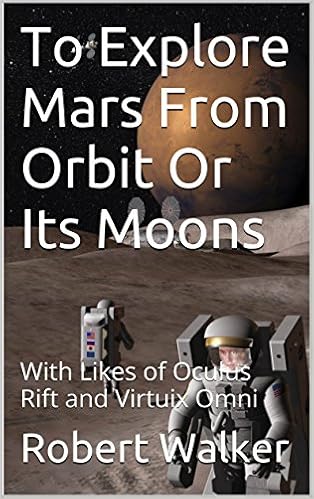
Exploring Mars By Telepresence From Orbit Or Phobos And Deimos - As for exploring a galaxy, robots are far safer. We should start with robots and think very carefully before considering setting up new colonies of humans around other stars. Because uncontrolled self replication is an issue in the galaxy whether the self replicators are robots or humans. We could make ourselves extinct indeed in this way, out evolved, maybe by something that we would consider to be worse than ourselves. Or maybe it can be done in a way that is safe for ourselves and the galaxy - but it probably depends how it is done.
While robots can either be mass produced with identical copies sent to many destinations - or if we can make self replicating machines, designed with many replication safety restrictions so that they can't be a nuisance to the galaxy (e.g. telomere style maximum number of generations, and a "keep alive" signal from Earth so that they stop functioning if they no longer get it). This is surely the safest way to start galactic exploration, and may explain why we don't find our solar system already filled to the brim with ETs along with the rest of the galaxy.
Self Replicating Robots - Safer For Galaxy (and Earth) Than Human Colonists - Is This Why ETs Didn't Colonize Earth? - Generally, sending humans into space is something new, that humans have never done before. We are capable of making mistakes, even huge ones, and this could even cause our extinction. Or it could have hugely beneficial consequences. The universe is not set up in such a way as to make it impossible for us to make mistakes. We need to think things through, and consider the long term future consequences of our actions.
Why ET Populations Can't Continue To Expand For More Than A Few Millennia
Why Only Very Young ET Civilizations Will Have Expanding Populations - Opinion Piece - Grand plans such as terraforming ideas, and ideas for ways that humans might be able to survive on Mars etc are well worth studying. Not at all suggesting that we should stop studying such ideas. As we study how to terraform Mars for instance, maybe we find a way to terraform the planet easily, and gradually gather the technology and knowledge to do it safely. Or maybe we don't. But either way we find out more about how planets work, learn about other potential futures for Mars, may help with studies of exoplanets, and help us understand how Earth works, and it may have many other benefits.
And whether or not they are eventually used for humans on Mars, all these studies could have many other spin off benefits. Studies for in situ resource utilization on Mars for humans could be directly useful for robotic exploration, e.g. methods to create fuel for human rovers could help robots to travel faster, return materials to orbit and so on. Studies for ways to grow plants on Mars could be used for sterile hydroponics on Mars which might even in the future be useful for astronauts in orbit around the planet - plants can be grown safely on Mars in principle without any planetary protection issues as seeds can be sterilized. And many of those ideas can be applied directly to other places with no planetary protection issues such as the Moon, asteroid belt, or even Jupiter's outer moon Callisto orbiting outside its harmful radiation zone (which is currently thought to not need planetary protection as though it has a deep subsurface ocean, there is thought to be no communication with the surface).
- For all these reasons our human and robotic space exploration strategies should be open ended and capable of being changed quickly and easily based on new discoveries. They should also involve long term future thinking to avoid mistakes that we could make by rushing in "where angels fear to tread".
- The best place to start surely is the Moon and the Earth Moon system - where we know that we can do it, with minimal risk of contamination, and the maximum of safety for humans.
In the process we can discover what role humans have in space alongside the robots that are already exploring the solar system as our remote sense organs in space. We can also get some ground truth about how much contamination human missions cause in a pristine extraterrestrial environment where it doesn't matter so much, as there are no global processes to move the materials around the surface.
If the first few square kilometers get so contaminated with Earth organics that it is hard to study the faint traces of lunar organics in the regolith - as seems likely from the experience of the lunar sample studies - well there's always another cleaner square kilometer further away. With no risk at all that our microbes could grow exponentially and colonize some habitat or other on the Moon.
We can also develop the technologies needed to permit safe deep space missions and appropriate and safe space settlement in the solar system. These settlements would surely be more like an Antarctic base than a pioneer's log cabin in the near future.
Let's Plan For Exploration and Discovery of Space with no End Date - NOT Escape from Earth - Opinion Piece

MOON AS OUR GATEWAY
So, the Moon in this vision is a gateway to the solar system, where we can develop techniques we need, and also at the same time explore a celestial body that is proving much more interesting than expected.
By the time I get to the end of that, then it comes over as an interesting and positive alternative. But there are many steps to it before readers can see the vision.
It's a matter of familiarity. We've had decades to get used to the Mars colonization ideas. These ideas may seem unfamiliar, even unlikely and implausible, but give them some time, to think them over, and perhaps you too will find this an exciting and interesting future too?
Perhaps this can help towards a future where humans in space is not all about colonization and making the universe into a place for humans to live in, but one where we can find out and explore and learn from this amazing universe we live in.
Along the way, settlement is sure to happen. Eventually colonization may happen also.
But I'd like to suggest, it doesn't need to be the main driving force behind our space exploration, no more than it is the driving force behind Antarctic study and exploration, or exploration of the sea bed and so forth. And that this future with scientific exploration, and humans working together with robots for remote exploration, our mobile eyes on the solar system and galaxy, is an equally exciting one. And one that is likely to lead to be much more interesting in many ways than a future where we try to turn all the planets and everything else into the closest possible copies of Earth that we can manage, or at least, habitats for humans, as quickly as possible, as our main motivation.
And also I'd suggest it is more practical, and less likely to lead to disappointment. When you look at Mars and your main thought is "how can I turn this into something like Earth?" you may miss many other possible futures that may be far easier to achieve and may perhaps be of great benefit for humanity in ways you can't anticipate.
If you plan everything out and set a goal to achieve before you know what is there, then your plans may not match the reality, and you may miss out on things that you couldn't plan for because there was no way for anyone to know about them in advance.
So, rather than a grand overarching plan, I think human space exploration has to be flexible, continually adjusted based on new discoveries. And that at each stage we plan carefully for the near future, but also do many tests and experiments and explore different avenues, because the most likely thing is that we don't know everything yet that needs to be known, so can't plan for the future in detail in space.
THIS APPROACH DOESN'T MEAN THAT HUMANS CAN NEVER LAND ON MARS EVER
The idea isn't at all to prohibit humans on Mars. The humans are not the problem, just their microbes.
And the idea is to do it step by step and to make sure we understand Mars and understand the implications of our actions before making a decision about whether it is okay to have human boots on Mars.
I'm a spaceflight and science fiction enthusiast myself and I'd love to be able to cheer on humans on an expedition to Mars. Just for the childlike wonder about seeing humans doing things like that in space.
So it would be fun to see humans go to Mars. And at least we can send them to Mars orbit whatever we might discover about Mars - so long as it is done with care to make sure they can't crash on Mars
I suggest ballistic capture for human missions to Mars - this new alternative to Hohmann transfer can save fuel for some target orbits, but more importantly for planetary protection - it lets you get there with no insertion burn. You spiral down using ion thrusters, so surely the safest of all the orbits to Mars proposed for preventing a crash on Mars.
Telerobotics lets us explore Mars much more quickly with humans in the loop. And it's a spectacular and exciting orbit for the crew, proposed for early stages of telerobotic exploration of Mars. It comes in close to the poles of Mars, swings around over the sunny side in the equatorial regions and then out again close to the other pole, until Mars dwindles again into a small distant planet - and does this twice every day.
Imagine the view! From space Mars looks quite home-like, and the telerobotics will let you experience the Martian surface more directly than you could with spacecraft, actually touch and see things on the surface without the spacesuit in your way and with enhanced vision, blue sky also if you like. It's like being in the ISS, but orbiting another planet.
This is a video I did which simulates the orbit they would use - in orbiter. I use a futuristic spacecraft as that was the easiest way to do it. Apart from that, it is the same as the orbit suggested for HERRO.
It would be a spectacular orbit and a tremendously humanly interesting and exciting mission to explore Mars this way. The study for HERRO found that a single mission to explore Mars by telepresence from orbit would achieve more science return than three missions by the same number of crew to the surface - which of course would cost vastly more. Here is a powerpoint presentation from the HERRO team, with details of the comparison.
That's not to say that humans to orbit would be better than robots. I don't know if anyone has done a comparison study there.
You might be able to compensate for the advantage of humans in orbit by having many more robots on the surface for the same cost, especially if broadband communication is possible, better robotic autonomy, and techniques from gaming such as artificial real time (building up a copy of the Mars surface explored by your robot in your computer on Earth and navigating that to help speed up movement from a to b on Mars).
But a human expedition might well capture the public imagination and so permit a much faster exploration of Mars from orbit. And would be an exciting and fun expedition to follow, and interesting for the crew too.
For more on this, see my:
Exploring Mars By Telepresence From Orbit Or Phobos And Deimos
Later on we could then decide what to do based on what we find. If we find that there is some vulnerable early RNA life on Mars for instance, I think that public opinion might well swing in the direction of saying we need to go slow here, and study it first before doing anything that could make it extinct on Mars.
In the other direction, there might be other findings that show that microbes would have minimal impact on Mars. For instance if none of the proposed habitats turn out to be habitable for Earth life. I think that's an unlikely scenario myself, and it would be disappointing for exobiologists, but it's a possible future as of writing this.
Or maybe new technology gives us the capability to send humans to Mars in a biologically reversible way. Again hard to see that with present day technology, but that human in a steel sphere idea shows that it is at least possible in a very minimal rather uninteresting way.
Could there be other more flexible and more interesting ways to achieve the same thing? I can't imagine how that would happen but there are many technologies today that I couldn't even have imagined in the 1960s when I watched the Apollo landing on the moon on TV as a child of 14. Indeed right up to not that long before the landing, the science fiction writers never imagined that it would be watched on global TV as it happened. So sometimes your ideas about the future can be upturned like that, suddenly, in just a couple of years.
If you have any other ideas for biologically reversible human exploration of Mars, do share in the comments!
WHEN WILL WE KNOW ENOUGH ABOUT MARS?
I don't think we can answer this at this stage. It's asking us to predict future science. You can't know what direction it will go and what we will learn about Mars. So it can't be timetabled.
Let's take it step by step, send humans to the Moon and asteroids and Mars orbit first, and make the next decision based on what we find out from that first phase.
The main thing should be not to close off future possibilities. If we make that decision in the future, it will be an informed decision.
We wouldn't know Mars completely, as that would take for ever. We don't understand Earth completely yet. But we'd know a lot more than we do today.
We need to leave it to our future selves or descendants to evaluate what they know then, and to decide whether they know enough yet to make this decision. I think that with the rapid pace of science, you can only foresee the future perhaps 10 or 20 years ahead in detail, and even on that timescale, surprises are likely.
PRECAUTIONARY PRINCIPLE AND SUPER POSITIVE OUTCOMES
The main principle here is that we should advance by increases of knowledge until we have sufficient to make informed decisions, rather than use ignorance of conditions on Mars, in the Europan ocean or anywhere else to justify sending humans there. For me that's not a strong enough justification for landing on Mars if there are significant unanswered questions about whether it could cause problems.
It's similar to the Precautionary principle guideline in International Law
"When an activity raises threats of harm to human health or the environment, precautionary measures should be taken even if some cause and effect relationships are not fully established scientifically.
"In this context the proponent of an activity, rather than the public, should bear the burden of proof.
"The process of applying the Precautionary Principle must be open, informed and democratic and must include potentially affected parties. It must also involve an examination of the full range of alternatives, including no action."
I suggest we should have similar guidelines for super positive outcomes - things of overwhelming positive value that we could discover:
"When an activity impacts on a super positive outcome, precautionary measures should be taken even if some cause and effect relationships are not fully established scientifically.
"In this context the proponent of an activity, rather than the public, should bear the burden of proof.
"The process of applying the Precautionary Principle must be open, informed and democratic and must include potentially affected parties. It must also involve an examination of the full range of alternatives, including no action."
So I'm not saying we should never land there. But that if we do, it has to be on the basis of knowing clearly the consequences of our actions and public debate and open and informed democratic discussion of whether we should do it.
But to have informed public discussion, first we have to know what is there. For that we need an explore and discover first approach before making any irreversible decisions such as whether to introduce Earth life to a planet.
For more about this see my "Super Positive" Outcomes For Search For Life In Hidden Extra Terrestrial Oceans Of Europa And Enceladus
SUMMARY OF THE VISION
Here are some of the main points again:
- The Moon is turning out to be far more interesting than most realized. We are at the same stage there as the very first Antarctica explorers, setting foot on a continents sized land mass that we know little about first hand.
- So we have to be careful when exploring Mars, also Europa and Enceladus and anywhere likely to have alternative exobiology. Why start our new phase of human exploration in space by sending humans with our microbe hitchhikers to the one place in the inner solar system that is most vulnerable to introduction of Earth microbes?
- Robots and humans work well together. Our robots are our collective sense organs in the universe, and they can go to places humans can't go.
- We have potential for superpositive outcomes of great value for humanity from the search for life in our solar system from discoveries of origins of life, earlier forms of life, or alternative exobiology. And life on Mars can be vulnerable to Earth life.
- So we have to be careful when exploring Mars, also Europa and Enceladus and anywhere likely to have alternative exobiology. Why prioritize a mission with our microbe hitchhikers to the one place in the inner solar system that is most vulnerable to them?
- Space development can be of great benefit to Earth through new discoveries, also moving heavy industry into space, providing solar power from space etc.
- Most successful colonization of Earth has been of places already occupied by humans, for the last thousands of years and there have been many failed colonizations. If you focus just on the ones that succeed you get only a partial picture, which may be over optimistic.
- Mars is far more like the Moon than it is like Earth. It's more inhospitable than deserts and Antarctica and we don't colonize those places.
- So, I think that space settlement in early stages at least would be like an Antarctic base - where you are there because you are doing something of value to Earth.
- Yes we might get future tech that lets us build self sufficient habitats on Mars. But before then we'd be able to reverse desertification, build self sufficient sea colonies far more easily than on Mars, and do many other things.
- Yes, we can build human settlements in space using resources from space. But the reasoning of the 1970s is still valid - that the most abundant and easiest resources to access in space, are those on the Moon and in the asteroids.
- Settlements on the Moon or using materials from the asteroid are likely to be easier to support economically - it's much easier to export materials from to sell on Earth.
- We don't yet know how humans tolerate artificial gravity, or what the gravity prescription is . The problem is that though we can simulate the physics easily, we can't simulate the human body, but can only find out with experiments in space.
- We haven't yet attempted a self sufficient habitat in space. Several ground experiments suggest it may be possible, but though this works on the ground, this has not yet been tested in space.
- So before developing grand visions of the future of humans in space, we need to look closely at those two points. And do them in a location where we can do it safely. The key to Apollo was to do things on a step by step fashion, first showing that humans can survive a few days in zero g, which was not known at the start of the program, then building up to longer and more demanding missions. What we do next may depend on what we find out in the process.
- We are bound to have fewer people in space than on Earth in the near future. It doesn't matter how valuable the materials are that are returned from space, what matters is how many people on Earth are needed to support you there.
- Earth is the best place for a backup and to rebuild civilization for those that worry about end of the world disasters. That's because no disaster could make Earth as uninhabitable as Mars, the Earth surface is much better protected from cosmic disasters than Mars, and some humans would survive anything that is likely to happen.
- As for self created problems, again we can't escape from them in space. In my view again, if technology is our problem, escaping into space to set up an even more highly technological society is not likely to be our solution.
- A future with large numbers of humans in space with high technology is not necessarily the best thing to aim for. You can't restrict it to just the "good guys" whoever you think they are if you have millions in space.
- Space settlement is neutral just like settlement anywhere - could be good or bad. It could be hugely positive if done well. It could be very harmful if it goes wrong. And the details of how we do it could swing it either way.
- Mars has turned out to be a much more likely habitat for present day life than previously thought Though it is so cold and inhospitable for humans, and extremely dry, yet it may have habitats for microbes and even lichens capable of surviving in extreme conditions.
- It is tricky to explore places with life without introducing Earth life. We are still figuring out how to explore the subglacial lakes in Antarctica, and wouldn't send humans there.
- A human crash on Mars putting debris all over the planet would introduce Earth microbes and has to be avoided. We don't yet have the technology to build 100% reliable spacecraft, and even a 1 in 100 chance of a crash, which some volunteers might be willing to take on as a personal risk, is far higher than the 1 in 10,000 probability that's often used for planetary protection.
- There is no urgency to send humans to the Mars surface. Even if we send humans there, it is best to understand Mars better first. The best way to do it for planetary protection is to send robots, either controlled from Earth or from Mars orbit.
- It is not at all clear that we can terraform Mars, and if it is possible, with current technology, it's a thousands of years, or perhaps a 100,000 year megatechnology project. Are we confident that this is what our descendants a thousand years from now will want us to do for them? With our clumsy early attempts, we may close off future options for Mars that our descendents would prefer.
- Introducing life to Mars as a result of a human crash or landing on Mars is likely to be biologically irreversible. You could create a new geological era on Mars, marked by the presence of Earth lifeforms brought to the planet by twenty first century humans. Introducing Earth life before you study Mars in depth is closing off options for the future. While keeping it free of Earth life leaves all your future options open.
- We can do a lot more in situ exploration of Mars from Earth than we can currently. The main bottleneck at present is not the light speed time delay, but the bandwidth.
- The search for life on Mars is also best done in situ at present. It is more practical, can study many different regions at different depths over the rover's exploration region, and we do have many space capable instruments now for sensitive searches for life in situ, which we didn't have as recently as a decade ago.
We don't have any prior experience of containing exobiology returned from another planet in our labs. It will be much easier to do this safely if we know what is there first, at least in a preliminary way.
- Then humans in Mars orbit would be an exciting mission, psychologically good for the crew, like orbiting in the ISS but above another world. Controlling avatars on the surface via telepresence, with binocular vision, binaural sound if you like, haptic feedback, and digitally transformed vision so you can experience the surface with bright colours as if lit by a midday sun, even a blue sky if you like.
- As for exploring a galaxy, robots are far safer. We should start with robots and think very carefully before considering setting up new colonies of humans. Because uncontrolled self replication is an issue in the galaxy whether the self replicators are robots or humans.
- Generally, sending humans into space is something new, that humans have never done before. We are capable of making mistakes, even huge ones, and this could even cause our extinction. Or it could have hugely beneficial consequences. We need to be able to look ahead and need to be adaptable.
- Grand plans such as terraforming ideas, and ideas for ways that humans might be able to survive on Mars long term are well worth studying as we find out more about how planets work, learn about other potential futures for Mars, may help with studies of exoplanets, and help us understand how Earth works, and it may have many other benefits. Many of the ideas will be of benefit early on for robotic exploration and human missions closer to Earth. But anything that closes off other options for all future time needs to be approached with caution at this stage, until we know more about Mars.
- For all these reasons our human and robotic space exploration strategies should be open ended and capable of being changed quickly and easily based on new discoveries. They should also involve long term future thinking to avoid mistakes that we could make by rushing in "where angels fear to tread".
- The best place to start surely is the Moon and the Earth Moon system - where we know that we can do it, with minimal risk of contamination, and the maximum of safety for humans.
SO MANY EXCITING NEW THINGS TO DO IN SPACE WITH THIS VISION
We have so many other things humans can do in our solar system, apart from the usual objective of colonization and boots on Mars. Including exploring the Moon, asteroids, Venus, Mercury, Jupiter's Callisto, Mars from orbit and its two moons, maybe even further afield. Plenty to sustain interest.
If the aim is just to "land boots on Mars / Moon / Venus / Mercury / Callisto" I think our space explorations will be short lived as they were for the Moon. And I happen to think that attempts at colonization would be short lived also, as they run out of funds, and can no longer get people from Earth to support their expensive attempts to live in places with a near vacuum, where they have to create all their own oxygen to breathe, etc etc, and many of their needs, can only be met by supplies sent to them on rockets.
While settlement in space supported because of their benefits to Earth, and accompanied by robotic explorers finding out new things about our solar system, would grow and grow. Look at how much interest there is in Curiosity, the Dawn mission, Philae the comet lander, and the New Horizons mission to Pluto? And there's no sign that any country wants to pull out of scientific exploration of Antarctica.
We need some longer term positive vision, and what I outlined here is a suggestion for first steps towards an alternative to the usual colonization motivation.
SO WHAT DO YOU THINK, IS THIS A POSITIVE VISION?
This is work in progress, and I'm interested to hear whether you think it is a positive vision for the future. Or is there anything else that could make it more positive? It might well be missing something that I just haven't seen yet.
Also do share your own visions for the future too.
And - what do you think about "boots on Mars"? Do you think there's a chance we will find a way to land humans on Mars compatible with planetary protection and preserving its interest for science? Or is this likely to be impossible? What about a crash on Mars, how does the potential for that change the situation?
Should we explore Mars in a biologically reversible way until we understand it better? If so, can you think of any way that could be done with humans on the surface, or should they remain in orbit?
Some think we should just land humans on Mars anyway. Do our best we can to study it scientifically first, and then, whatever the state of science, once the technology is there to land humans, forget about planetary protection and just land humans, taking the best precautions we can in the circumstances. Is that your view? If so do say so. Don't be shy. I'm interested to hear all views on the topic.
PLEASE KEEP THE DISCUSSION CIVIL
THIS SECTION IS FOR THE NEW SCIENCE20 POST WHEN IT IS READY
(I'm not very familiar with Tumblr, don't know how commenting works, but you are welcome to comment here as well of course)
I know that this is a topic that can often lead to heated discussion on the internet. It's not surprising. But please be civil in your comments here.
The main rules are
- No personal attacks
- Treat each other with respect and civility
- You can argue all day long about views and theories and ideas, but please, no negative remarks about each other as people. E.g. it's fine to say that someone's views are nonsense, but to go on and say that as a person they are irrational, or need psychic evaluation or are delusional or whatever is going over the mark.
- We have all probably had the experience of finding we are mistaken on things we believed and even perhaps holding inconsistent views. It can be a great surprise sometimes. What you see as inconsistency in someone else's views may sometimes actually just show that you haven't yet understand them properly, and may be confusions in your own thinking. It is for the other person to decide for themselves if their views are inconsistent or they've made a mistake or whatever it is. All anyone else can do is to present lines of argument and thoughts and ideas to consider.
- I delete any comments that are just plain rude and uncivil , as well as trolling remarks. It shouldn't be a problem for sincere commenters. You will find you put your points forward more effectively and are more likely to be listened to if you are civil.
Any other comments whatever your views are warmly welcomed. It's also okay to go off on tangents in discussions. No need to keep strictly to the subject of my posts :).
Thanks, and I look forward to your comments. And if anyone wants to talk to me personally, you can message me via my personal profile at Quora. It is easy to join, especially if you already belong to some other social media site - and you can then go to my profile and message me. Or you can message me on facebook, or just send an email to support@robertinventor.com. And those rules don't apply at all for personal emails or messages to me. I'm not bothered if you want to attack me or say anything you like, just please don't clog up the comments area here with such messages. The reason is just because it obscures the discussion and makes it hard for others to understand what it is about.
Thanks.
SO WHAT DO YOU THINK?
THIS SECTION IS FOR THE NEW SCIENCE20 POST WHEN IT IS READY
The main reason for writing this is to stimulate debate on these topics, and to help make sure the debate is done with an informed background.
What do you think about these ideas? Do say in the comments.
Also if you see any errors at all, whether typos, or more fundamental errors, please don't hesitate to let me know or say so in the comments. Thanks!
SEE ALSO
- TheSpaceShow Broadcast 2663 Dr. Catharine (Cassie) Conley: Topics: Planetary protection
- TheSpaceShow Broadcast 2660 Robert Walker: Topics: Planetary protection and human spaceflight to Mars
- Why We Can't "Backup Earth" On Mars, The Moon, Or Anywhere Else In Our Solar System
- Will We Meet ET Microbes On Mars? Why We Should Care Deeply About Them - Like Tigers
- No Simple Genetic Test To Separate Earth From Mars Life - Zubrin's Argument Examined
- Can You Suggest A Second Earth Apart From Mars?
- Does Earth Share Microbes With Mars Via Meteorites - Or Are They Interestingly Different For Life?
- Are There Habitats For Life On Mars? - Salty Seeps, Clear Ice Greenhouses, Ice Fumaroles, Dune Bioreactors,...
- Could Microbes Transferred On Spacecraft Harm Mars Or Earth - Zubrin's Argument Revisited
- Asteroid Resources Could Create Space Habs For Trillions; Land Area Of A Thousand Earths
- To Explore Mars With Likes Of Occulus Rift&Virtuix Omni - From Mars Capture Orbit, Phobos Or Deimos
- "Super Positive" Outcomes For Search For Life In Hidden Extra Terrestrial Oceans Of Europa And Enceladus
Get notifications of new blog posts
THIS SECTION IS FOR THE NEW SCIENCE20 POST WHEN IT IS READY
If you want to get alerts every time I do one of these posts, join my Robert Walker - Science20 Blog Alerts facebook page.
To get a red facebook alert every time I post a new science20 article, or post an idea for a new article, then select "all on" in the page's Liked drop menu above.
Or subscribe to the associated twitter feed.
For email alerts about once every month or so, subscribe to Robert Walker's Science 20 blog Monthly Alerts on Google Groups.