This is an exciting field which developed over just the last six years or so. There are many academic papers - but I haven't been able to find a good overview of the field in non technical language. So, let's do that. I'm drawing heavily on Nilton Renno's technical overview from last year, together with more recent results.
Let's start with the Flow Like Features associated with the dark dune spots in the southern polar region. These are lesswell known than some of the other candidates but rather interesting, as the best explanation involves melt water at 0°C, warm for liquid water on Mars, also (at its source) pure water, unusually for Mars.
CONTRIBUTION TO MARS ATMOSPHERE
Before we start, I think it's important to realise, that the contribution of any life in these habitats to the atmosphere would be so negligible as to be almost undectectable, except perhaps through subtle long term effects (perhaps isotope ratios).
With the rarer types of habitat here, there may be no more than a few square kilometers of habitat over entire surface of Mars, for a few hours a year.
Even if the entire surface of Mars was covered with thin layers of water and droplets of water, say, just a cm or so below the surface, and the life there is as active as it is in the ice covered ponds of the McMurdo dry valleys in Antarctica, it might be hard to detect the life through its effects on the atmosphere.
If it was all photosynthetic life, the oxygen produced would contribute at most a few hundred kilograms of gases per surface square kilometer of habitat. If entire surface of Mars is habitat (which surely it isn't), that contributes less than 0.0002% of the Mars atmosphere if left to build up over a "residence time" of 4,500 years. That compares to a measured 0.145% of oxygen in the atmosphere - so any seasonal effect is likely to be hidden in the noise. For the calculation, see my How Life May Exist On Mars With Atmosphere Close To Equilibrium.
Also other gases such as methane and ammonia - likely to be well below the parts per billion detection thresholds - unless the life is very abundant on the surface. So for instance, the methane plumes, if they exist, perhaps are more likely to come from a more prolific deep down habitat than these ones.
FLOW LIKE FEATURES ASSOCIATED WITH THE DARK DUNE SPOTS
These features are associated with the dark dune spots on the polar dunes, so let's introduce those first.

These look quite a bit like trees and vegetation don't they! Famously, Arthur C. Clarke called them "Banyan trees" and wrote, only half joking
"I'm now convinced that Mars is inhabited by a race of demented landscape gardeners,"
See Popular Science email interview 2001 "The Banyan Trees of Mars"
Of course many life like things can be created by non life processes. Just about everything here is probably the result of dry ice effects. See On Mars, Dry Ice 'Smoke' Carves Up Sand Dunes
It might though just possibly have life involved as well, by the solid state greenhouse effect for translucent ice. That's where the "Flow Like Features" - tiny tens of meters scale detailed features - come in.
Let's start with the dark dune spots in the colder Southern polar cap which has thick layers of dry ice in winter.
In this case, the idea is the sun shines through the translucent dry ice. We are all familiar nowadays with CO2 as a greenhouse gas in the atmosphere. Well, when it's in the form of dry ice, it creates a "solid state greenhouse" as well, and that seems to be what happens here on Mars.
The sun shining through thick layers of translucent dry ice heats up lower layers which turn directly into gas (because that's what dry ice does as it warms up in these conditiobs). It's trapped under the layers of dry ice, so forms a gas pocket.
Pressure builds up until eventually the sub surface gas pocket "explodes" to the surface as a geyser.

Dark dune spot in Richardson crater, S. polar region of Mars.
This happens at temperatures far too low for water.
However, as it continues through to spring, as the surface gets warmer, in the second, third and fourth images, then that's when it's possible that water may begin to flow.
What we see from orbit are "Flow Like Features" or FLF for short, which you can see here, gradual progression from left to right in the sequence of images. This is in Richardson Crater again, in the South polar region.
They are small features only a few tens of meters in scale, and grow at a rate of around 1.4 meters per Martian sol.
Here is a high resolution animation of one of them through a Martian spring.

From Collegium Budapest, Mars Astrobiology Group
All the models to date involve some form of water.
The most interesting one for us though, is the one that involves melt water.
Möhlmann models these using a solid state greenhouse effect, but this time one that involves translucent ice rather than dry ice as the solid state greenhouse.
The way it works is, according to his model - that the ice forms a thin translucent layer - and as it warms up in summer - then the ice melts a layer of water beneath it, a process that is reasonably well known on the Earth.
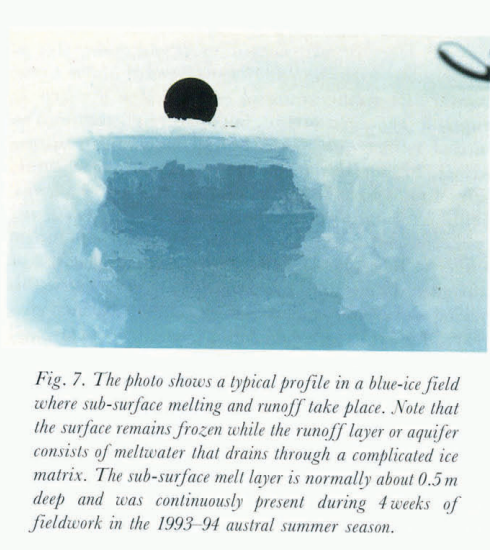
This picture shows ice melt in Antarctica by solid state greenhouse effect - the surface stays frozen, and deeper down, it melts, in a layer about 0.5 m deep - because the translucent ice above it acts as a greenhouse. Taken from: Melting, runoff and the formation of frozen lakes in a mixed snow and blue-ice field in Dronning Maud Land, Antarctica
In his model the ice, even in the polar regions, reaches 0°C, enough to melt ice to water. Then as it flows down the slope, and cools down, it mixes with salts to form salty brines.
On Mars this process is especially interesting, as it is a way for the water to stay liquid under pressure. After all, the dry ice geysers have CO2 gas sublimate under enough pressure to escape from the surface as geysers.
Another model for these features involves ULI water (undercooled liquid interface water) which then feeds brines that form the feature. This is a thin layer of water over the surface of something, which can melt at a lower temperature than the melting point of ice.
If it is indeed subsurface melt water, the source of the water is particularly warm at 0°C - making the flows quite a promising habitat for life on Mars.
Then - a slightly different process seems to form flow like features in the Northern polar region, this time using the solid state greenhouse effect in dry ice to create the brines themselves:

The flows increase at between 0.3 meters and 7 meters a day. The feature marked with the arrows grows at a rate of about 5 meters a day.
Here, the features form at around -90°C for the surface temperatures. You might think that is too cold for liquid water, even as brines. But in their models they did get liquid water beneath a layer of dry ice - as the thermal infra red penetrates the dry ice. The orbiting satellites are not able to see this increase in temperature because their resolution is too low at this wavelength to pick out such small features amongst the much colder surrounding dry ice landscape.
One of the research papers on these features postulates dry ice and sand cascading down the slope but most of the models involve liquid brines.
For details see the Dark Dune Spots section of Nilton Renno's paper Water and Brines on Mars: Current Evidence and Implications for MSL
WARM SEASONAL FLOWS
These, again, are exceedingly rare. Each asterisk on this map shows one of the sites

Sixteen sites in total marked, over entire surface of Mars. See Water seems to flow freely on Mars
So there aren't many of them. And the habitats themselves consist of just thin streaks on the slopes like this

There are many other features discovered on Mars such as the dry gullies (dry ice phenomenon most likely). So is important not to confuse them, as often similar looking features have very different explanations.
The warm seasonal flows are easily confused for instance with the linear gullies

These are probablyt caused by tobogganing blocks of dry ice, see Grooves on Mars may be result of blocks of dry ice sliding down slopes
Here is a movie of the warm seasonal flows - notice how they are much flatter - no 3D structure - just a darkening of the slope basically, also they change slowly and gradually through the season - this video goes through a Martian year.
They get gradually longer in the spring. In autumn they fade away.

Why this is, nobody knows. It's not likely to be damp sand directly, because there wouldn't be enough water to make it as dark as this. So some secondary effect of some sort.
Still, seems it must be caused by water indirectly, almost certainly.
That's because of the temperature, far too hot for dry ice, and because there is no correlation at all with wind, or dust - and the seasonal nature of it. Researchers have simply run out of other plausible hypotheses. The only one that makes much sense is water - though that one is also quite hard to fit to the phenomenon.
The problem with water is that it needs to be replenished. Even tiny amounts of water like this - if it's been going on for millions of years, then the resevoir of ice or water would get exhausted, at the top of the slope, and is no rain - no mists here either (are at lower elevation), no way for the water to get back up to the top of the slope. So how did it get there in the first place?
The ice could have got there, perhaps tens or hundreds of millions of years ago during one of the periodic changes of the Mars climate because of changing axial tilt and changing orbital eccentricity etc. But that's so long ago - is surprising there is any water left.
It could be deliquescing salts - perhaps it comes, originally, from the high humidity in the night time atmosphere on Mars. After all you don't need that much water to feed the streaks, probably.
Or maybe it comes from deep below the surface? Maybe these are places where the land is somewhat warmer, a geological hot spot? That's one possible theory, so that the ice rises, sublimates, freezes, sublimates, and freezes, perhaps all the way to the surface from the deeper hydrosphere, over a geological hot spot.
Whatever the explanation, another puzzling thing is - that you get apparently identical spots, apparently, and some have these streaks and some don't, and nobody knows why that is.
It could be perhaps because of subsurface salt deposits - at the head of the streaks - (just a short way below the surface) - or geological hot spots - or some other unusual local phenomenon we can't see from orbit, which somehow feeds new water (in tiny quantities) to the heads of the streaks each spring.
Nobody really knows - one of many puzzles about Mars :).
There's another rather similar phenomenon, the dark slope streaks

They look quite similar to warm seasonal flows, don't they? But they are much broader, and to experts in the field, only superficially similar.
They may be caused by avalanches of dry sand, perhaps in combination with some ice / water effects.
GULLIES
Mentioning these for completeness as, though probably dry ice phenomena, for a long time these were thought to be liquid water, and perhaps it is not yet totally settled, that some of them could be due to liquid water.
This is an image which suggested ground water because the gully seems to be associated with a fault, a likely place for ground water to seep out. NASA - Groundwater May be Source for Erosion in Martian Gullies

However recent observations of newly formed gullies strongly suggest dry ice, as probably the only explanation:

This pictures shows a newly formed gully on Mars. It's hard to see how dry ice can form gullies like this, but new gullies form in winter at temperatures that seem too low for water to melt. So - dry ice seems to be the preferred explanation. Possibly some kind of flow of the soil mixed with gas and dry ice.
DROPLETS OF WATER ON INTERFACE OF SALT AND ICE
This is a new idea for a habitat suggested earlier this year. But its origins trace back to the discovery of the drops on the legs of Phoenix back in 2008. It's especially exciting for habitability as we'll see.

So - originally the model used here was of deliquescing salts - salts taking in the moisture from the atmosphere. Though Mars' atmosphere is almost a vacuum, still it has some water vapour, and because of the huge temperature fluctuations, it reaches 100% humidity at night.
But Nilton Renno and his team later tried another idea, droplets forming on the interface between perchlorate salts and ice. That's what lead to his "swimming pools for bacteria" announcement recently.
""Based on the results of our experiment, we expect this soft ice that can liquify perhaps a few days per year, perhaps a few hours a day, almost anywhere on Mars. So going from mid lattitudes all the way to the polar regions. This is a small amount of liquid water. But for a bacteria, that would be a huge swimming pool - a little droplet of water is a huge amount of water for a bacteria. So, a small amount of water is enough for you to be able to create conditions for Mars to be habitable today'. And we believe this is possible in the shallow subsurface, and even the surface of the Mars polar region for a few hours per day during the spring." (transcript from 2 minutes into the video onwards)"
See also Martian salts must touch ice to make liquid water, study shows
For his paper see Experimental evidence for the formation of liquidsaline water on Mars
This is the Mars simulation chamber they used for their experiments

These ideas are really exciting for potential for life on Mars. Both perchlorates and ice are abundant on Mars. So there may, as he says in his video, be Phoenix type droplets scattered over large areas of Mars. Just a few droplets of water here and there, and for a few hours a year when the conditions are right - but each one would, as he said, be a swimming pool for bacteria.
TRANSGRESSING SAND DUNES
This is another idea, not mentioned in Nilton Renno's survey, published around the same time last year, HABITABILITY OF TRANGRESSING MARS DUNES which suggests that the sand dunes churn up salt layers and bring them to the surface - where they might then provide habitats for life by deliquescence.
Here is an image of dunes moving on Mars.

Rippling Dune Front in Herschel Crater on Mars
This rippled dune front on Herschel Crater on Mars movedf about one meter between March 3, 2007 and December 1, 2010 - and the pattern of ripples changes completely between the two images. Herschel Crater is just south of the equator in the cratered highlands. (More animations of moving sand dunes on Mars)
This habitat is unusual as it is one of the few suggestions for ways you could have life on Mars even in the dry equatorial regions where Curiosity is right now.
VIKING EVIDENCE AND GILBERT LEVIN'S EXPERIMENT
Gilbert Levin of course remains sure that Viking discovered life. And, he is no longer a "lone voice" saying this, a few others have started to wonder if just possibly they did.
There are intriguing signs - the recently discovered diurnal variations in the signal. See my Rhythms From Martian Sands - What Did Our Viking Landers Find in 1976? Astonishingly, We Don't Know
If that is life - then that means life at Vikings location - which is surprising as it is very dry - but does have its morning frosts. And does have night time humidity 100% obviously.
If otherwise habitable, sand dunes seem interesting as a way to supply nutrients to life, because it gives an opportunity for materials to be churned to the surface from deeper deposits.
Then, Nilton Temmo's "swimming pools for bacteria" - they could be anywhere on Mars so including in the sand dunes, so long as it is far enough from equator to have ice, and so long as there are salt deposits as well.
One thing I wondered, just a question, I don't know the answer - might they also happen on the interface between the Martian frosts and perchlorate salts on the surface? Those happen in equatorial regions too.
DLR EXPERIMENTS
There are the DLR experiments also, with lichens and cyanobacteria able to continue to metabolize almost anywhere on Mars - though not done very long experiments yet last time I read about it, months rather than years of Mars surface conditions simulation. And is a major challenge to simulate everything we know about surface of Mars in a laboratory. But - if they are right - then there could be life anywhere including equatorial regions and so in the sand-dunes - again depending on availabiity of nutrients.

Remarkably the lichens they studied can metabolize and photosythesize right down to -40°C! See the end of this talk
They can survive partial shade right on the surface in simulated Mars environments.
Perhaps they might occur on Mars, as Endoliths - microbes living within rocks, similar to this, with partial sunlight filtering through the rocks:
Cryptoendolith inside rock in Antarctic
EXPOSE E EXPERIMENTS
This is an on going series of experiments on the ISS to test microbes under space and Martian conditions.
Expose E Experiment on the ISS. Used for some of the Mars UV and cosmic rays simulations.
In one experiment (2011), C was exposed to simulated space, and Martian conditions for 1.5 years. Survivors from a strain taken from the coastal desert in Chile (Chroococcidiopsis sp. Ccmee, 123) were able to form colonies, and repair DNA damage on rewetting after 1.5 years in space or martian conditions.
A new series of experiments launched in July of this year, Expose R2
"BIOMEX contains numerous chambers that are filled with biomolecules and organisms that include bacteria, archaea, algae, fungi, lichens and mosses. Replicate samples spread across the compartments are subjected to a range of environmental conditions. Some samples of each biomolecule or organism are embedded in a simulant Mars soil (ranging from just a single layer of soil to multiple layers), and other samples are left on their own to face the space environment without protection"
BIOMEX: Exploring Mars in Low Earth Orbit
MARS ANALOGUE LIFEFORMS
Some extremophiles on Earth can probably live on Mars just as it is. The DLR experiments used Chroococcidiopsis. This is especially interesting as it sometimes forms single species ecosystems beneath rocks in the Atacama desert and Antarctic McMurdo dry valleys. All it needs is water, carbon dioxide, sunlight, and trace elements and it creates everything else for itself. Has a wide range of different metabolic pathways it can use in different situations. It can fixate nitrogen - though on Mars there isn't much nitrogen in the atmosphere, so it probably needs a source of nitrates.
This is an extraordinarily ionizing resistant microbe, able to withstand tens of thousands of years of dormancy on the surface of Mars and repair the damage from ionizing radiation within a few hours. It can repair, 2.5 kGy of damage within 3 hours given the opportunity to wake up for a few hours and metabolize.
Here a kGy is a thousand Grays, and a mGy is a thousandth of a gray. So 2.5 kGy corresponds to 2500/0.076 or over 32,000 years of radiation on the surface of Mars

Another single species ecosystem which could exist on Mars, is Desulforudis audaxviator the only known ecosystem to rely on radioactivity (indirectly) as a source of energy. All it needs is radioactivity, sulfide minerals, water, nitrates and and carbon dioxide. So it could find those on Mars.
Then another single species ecosystem, the red halobacteria (or haloarchaea as more properly called).
Halobacterium at a salt works near San Quentin, Baja California Norte, Mexico. Credit: University of California Museum of Paleontology.

Various salts (mainly sulfates, chlorates and perchlorates) are common on Mars, and it could cope with those. Photosynthesizing so can get energy from sunlight. Has an advantage that it often forms a thin crust of salt which would help filter out the UV light. Also the salt itself has deliquescing properties and in the Atacama desert, haloarchaea are able to survive without any liquid water at all, just using the deliquescing capabilities of the salt.
Then, some halite endoliths can manage even at less than 100% humidity in the extremely dry core of the Atacama desert.
Novel water source for endolithic life in the hyperarid core of the Atacama Desert. In this picture, the salts are show in context in the top photograph (a). In b, then the colonized layer is marked Co.. In c, then the life is highlighted through fluorescent microscopy (red autofluorescence). In d, staining of the DNA shows the bacteria that live by eating the cyanobacteria (this particular specimen isn't a single species ecosystem).

They seem to do it through micropores in the salt deposits. Theoretically, these could take in water from the atmosphere at relative humidities as low as 50-55% through capilliary water condensation. The researchers used miniature weather stations inside the pinnacles, and were able to observe this happening, that the deposits became damper as soon as the relative humidity of the atmosphere went above 50-55%.
I haven't seen studies like this for Mars, but the potential for micropores in the salts to assist with capture of water vapour from the atmosphere seems well worth studying.
PRESENT DAY LIFE ON MARS LIKELY TO BE HARD TO FIND
One thing that has come out of the field expeditions to the Mars analogue habitats on Earth - that life is likely to be hard to find. Even once you've identified potentially habitable areas of Mars, then, if there is life there, it may take a long search to find the life itself within that area, and at first, and even after a fair bit of searching, it may seem totally lifeless.
Clearly this is a task for mobile rovers rather than for sample return (this leads into my next article which is going to be on the value of in situ exploration on Mars).
In the McMurdo Dry Valleys in Antarctica and in the hyper-arid core of the Atacama Desert in Chile rockinhabiting communities are dominated by cyanobacteria, mostly belonging to the genus Chroococcidiopsis; the study of these communities is gathering appreciation in astrobiology since they are considered the closest terrestrial analogous of two Mars environmental extremes: cold and aridity [19]. Field expeditions have also taught us that life is not obvious at large scales but rather rare in isolated islands amidst a microbially depauperated bare soil, thus suggesting that if life ever existed or exists on Mars, microhabitats would probably be widely dispersed among virtually lifeless surroundings
INDIRECT EVIDENCE FOR SURFACE OR NEAR SURFACE WATER IN RECENT GEOLOGICAL PAST
Of course, we haven't yet conclusively found water in any of these habitats. The features are too small to analyse from orbit with the instruments we have at present - especially since the water is likely to be present in small quantities.
For instance, with the warm seasonal flows, - you might think the dark patches are simply sand darkened with water. But - it's not likely that there is enough water for that. Rather is some other effect of the water interacting with the sand. So most of what you see there is still sand. Most probably salty water involved in some way as that's the only way to explain the dependence on temperature and seasonal lengthening. So - think of it more as a seasonal slight seep of a thin layer of salty water, with associated darkening effect on the sand. They are thin anyway. So obviously going to be a challenge to detect the spectral signature of water from orbit, and so far this has not yet been achieved.
But we do have indirect evidence that there is liquid water on the surface of Mars, in the geologically recent past. The measurements don't tell us if it is there all the time, or episodically, but shows it is there at least sometimes.
This evidence came about thorugh a reinterpretation of the Phoenix lander result sin 2010 by Paul Niles, a space scientist at NASA's Johnson Space Center in Houston,. He found intriguing indirect evidence that CO2 in the atmosphere has interacted with water in the geologically recent past.
The low gravity of Mars favours loss of carbon-12 to space compared with carbon-13. The ratio of carbon-13 to carbon-12 measured by Phoenix is at a level that suggests that the atmosphere of Mars must have been replenished from volcanoes recently. The proportions of the isotopes of oxygen-18 and oxygen-16 in the CO2 however show a signature characteristic of oxygen that has had a longer period of time to get lost to space. This suggests that the CO2 must have reacted with liquid water in the geologically recent past.
" Niles and his team theorize this oxygen isotopic signature indicates liquid water has been present on the Martian surface recently enough and abundantly enough to affect the composition of the current atmosphere. The findings do not reveal specific locations or dates of liquid water and volcanic vents, but recent occurrences of those conditions provide the best explanations for the isotope proportions."
This may be an indirect observation of these habitats with liquid water on the surface of Mars.
PROBLEM OF NITRATES
Of the main elements needed for life on Earth, the one element in short supply on Mars is nitrogen. There is some in the atmosphere but only 0.2 mbar. Can life use that? Or is there some other source of nitrogen on Mars?
Life on Mars need not be based on DNA - but nitrogen plays a special role in our biochemistry, for instance, is essential to structure of DNA. So, if life on Mars is based on organics like Earth, seems likely, apparently, that it would also use nitrogen, even if based on some form of "XNA".
Nitrogen can be fixed by volcanic processes and lightning.
Another idea suggested recently is nitrogen fixation in pure water metastable thin liquid films (different from the salty brines habitat) on Mars (cooled below the point where they would normally freeze). See An active nitrogen cycle on Mars sufficient to support a subsurface biosphere
Another source of nitrogen - it might have deposits of nitrates from the early Mars. These might be deep underground. For instance some of the worlds richest deposits of nitrogen are in the Atacama desert, and for a long time supplied the global fertilizer trade - but they are deep underground. You can still find ruins of nitrate mines in the Atacama desert.
Deposits like that would be hard for our rovers to find on Mars, since they can't dig below the surface, to date anyway.
Nitrates can also be delivered by meteorites.
These ideas for nitrates on Mars were just a hypothesis until last year -when Curiosity discovered the first conclusive evidence of nitrates.
So - it does have nitrates - patchy surely, low levels - but are present. And remember Curiosity can't drill even cms below the surface.
The McMurdo dry valleys and the Atacama deserts are similarly challenging in this way also - not much at all by way of nitrates - unless a micro-organism is nitrogen fixing.
There is a small amount of nitrogen in the Mars atmosphere, 0.2 millibars. One study found that microbes could continue to do nitrogen fixation at 5 millibars, but they found no evidence of fixation below 1 mbar. This was done at Earth normal atmospheric pressure. This is a 1989 paper: Biological nitrogen fixation under primordial Martian partial pressures of dinitrogen.
Can any extremophiles handle nitrogen fixation in the Mars atmospheric condtions? I've asked around but nobody seems to have studied this.
An obvious follow up experiment would be to do the same tests, but with Antarctic nitrogen fixating extremophile micro-organisms. The authors of this paper propose the experiment to do that, but as far as I can see, haven't actually done it.
If anyone reading this knows of any studies of nitrate fixation in Mars analogue atmospheres (especially, not just low partial pressure of nitrogen, but of the CO2 also) - would be really interested to hear about it - either way - whether it is possible or likely to be impossible.
However one way or another seems at least possible that surface life on Mars may have access to enough nitrogen, at least in places, at levels similar to nitrogen poor dry deserts on Earth.