Elon Musk hopes to land a hundred colonist hopefuls at a time as soon as the early 2030s. NASA also proposes its "Road Map to Mars" which could see human "boots on Mars" in the near future. It is hard enough to sterilize robots sufficiently to search for life on Mars. We can't sterilize human missions to the same standards.
If we go ahead with these plans, we will have to relax planetary protection measures. But is it the right time to do this?
If we "win the exobiology lottery" here, it would revolutionize biology for sure. Also, look at the wood, plastics and other products of biology that surround you, and think about your own body and life processes. It could lead to new developments, in medicine, agriculture, nanotechnology, create new products for industry, and lead to new understanding of the origins of life and the possibility of life on other planets.
How can this be the right time to relax our standards for protecting Mars from Earth life, when we may be just about to make such a discovery?
The best way to protect Mars from Earth life is either not send humans to Mars at all yet, or send them to Mars orbit. That way, the only risk is from our robots, which can be sterilized to whatever levels are required.
I'd like to suggest that on Mars, planetary protection should be our top priority, and we should start by taking the best precautions available, until we understand the planet a lot better than we do today.
Before getting down to the details, let's quote from "Where Biospheres Collide" - as I think it's a great way of motivationg this planetary protection centric approach to space exploration.
"One of the most reliable ways to reduce the risk of forward contamination during visits to extraterrestrial bodies is to make those visits only with robotic spacecraft. Sending a person to Mars would be, for some observers, more exciting. But in the view of much of the space science community, robotic missions are the way to accomplish the maximum amount of scientific inquiry since valuable fuel and shipboard power do not have to be expended in transporting and operating the equipment to keep a human crew alive and healthy. And very important to planetary protection goals, robotic craft can be thoroughly sterilized, while humans cannot. Such a difference can be critical in protecting sensitive targets, such as the special regions of Mars, from forward contamination.
Perhaps a change in the public's perspective as to just what today's robotic missions really are would be helpful in deciding what types of missions are important to implement. In the opinion of Terence Johnson, who has played a major role in many of NASA's robotic missions, including serving as the project scientist for the Galileo mission and the planned Europa Orbiter mission, the term "robotic exploration" misses the point. NASA is actually conducting human exploration on these projects. The mission crews that sit in the control panel at JPL, "as well as everyone else who can log on to the Internet" can observe in near real-time what is going on. The spacecraft instruments, in other words, are becoming more like collective sense organs for humankind. Thus, according to Johnson, when NASA conducts it's so-called robotic missions, people all around the world are really "all standing on the bridge of Starship Enterprise". The question must thus be asked, when, if ever, is it necessary for the good of humankind to send people rather than increasingly sophisticated robots to explore other worlds"
It's a similar idea for telerobotic exploration. With humans in orbit around Mars, their robot avatars on the surface are their and our collective sense organs, so we can all follow along, as they explore the surface. They can to explore both sides of the planet, on the sunny side, every day - and control robots all over Mars.
The only study I know of came to the conclusion that humans in orbit like this could do as much surface exploratiom as three teams on the surface, for less cost than a single surface mission to orbit. You save a lot by not needing to suit up, and by leaving your robot avatars in situ, so you can start work immediately where you left off the previous day - no matter where it is on Mars by then.
It also has less danger for the humans (you don't have the risks of landing on Mars, of using spacesuits on the surface, and can return to Earth more easily in case of problems). That way you use the best talents of both humans and robots in collaboration to find out about Mars..
WHAT WE COULD FIND ON MARS
There are many ideas for how life may have started on our planet - but those simpler forms of life are all gone now, as far as we know. Most think they were made extinct by DNA based life when it evolved.
Those simpler forms of life may still exist on Mars, and maybe are still alive to this day. Or life there may have evolved in some radically different direction from Earth life, or it might even have had a new origin of life from scratch, with no connection at all with the evolutionary tree of Earth life. It is a discovery of this magnitude which we could potentially find on Mars.
It is thought that Mars was as habitable as Earth in the early solar system. If early life on Mars evolved far enough to be reasonably hardy and versatile, and if there are habitats for it still present on Mars, then it is probably still there today.
EXAMPLE OF LAKE VOSTOCK - WHY WE CAN'T PROTECT MARS WITH A COMPROMISE
This may seem rather a black and white position that I'm presenting, the idea that we shouldn't land humans on Mars at all until we know what we are doing. Could we not compromise with enthusiasts who are so keen to land humans there? Could they not land for a short visit of a year perhaps, so long as they take special precautions to reduce the risk?
This seems to be the approach COSPAR and NASA are following.
But how can you protect Mars with a compromise solution? It sounds a bit like saying you can import diseased plants, but only for an hour on Monday afternoons. That would be less risky than permitting import any hour and any day of the week. But why run the risk at all, if it can be avoided?
It's rare that you need to prevent contamination by microbes. But it does happen, even on Earth. Take the example of Lake Vostock in Antarctica.
Lake Vostock - subglacial lake in Antarctica, separated from the surface probably for millions of years. This lake is kilometers below the ice, and is probably the most oxygenated water on Earth. The oxygen gets there in a kind of conveyer belt of ice, slowly driving bubbles of air into the lake under huge pressure.
The Russians drilling into Lake Vostock would love to to explore this unique lake and find out what kind of life is there, and whether it has hydrothermal vents (as some think), and if so, what communities of life live around them. It has been separated from the surface probably for millions of years.
You might ask why they don't drill down and drop a sub into the lake, such as is used for exploring the deep sea bed. But they can't do that, because we don't yet have the technology to sterilize even a robotic submarine sufficiently.
They waited a decade before doing anything, with the drilling stopped a few meters from the water, while they searched for a solution. Finally, they drilled into it momentarily, enough to cause a geyser of water to rush up 40 to 80 meters before it froze over, and sampled this instead. It's rather similar to plans to sample the geysers of Enceladus. They believe that this action had no risk of contaminating the lake.
And that's it. They still haven't sent a submarine down, and have no plans to do so, as far as I know.
PROBLEM WITH STERILIZING ROBOTS AND HUMANS
Actually we can sterilize robots 100%. It's easy, just heat your robot to a few hundred degrees C, or zap it with lots of ionizing radiation, and there will soon be no life left at all. The problem is, that this will also destroy the delicate electronic equipment - the instruments we want to use, the computer chips, the navigation system and so on. So the problem is, to find a way to sterilize our robots that doesn't also destroy them.
All life depends on organics, and robots can be made of metals. So if you could design the robot so that it doesn't use organics in its construction, and then find some way to remove all the organics, that would do the trick, and would be a perfect solution.
But we don't know a way to do this yet. The ESA is exploring one solution that is close to being able to achieve this, using supercritical CO2 snow, but it's still work in progress.
There are many other methods - heat treatment, low pressure hydrogen peroxide vapour, ionizing radiation, etc. But they all have the same drawback, that none of them are yet 100% effective. Either that or they destory the robot.
So, we can't yet sterilize our robots 100%.
It's the same with humans. But it's a harder problem to solve for us, as we are made up of organics like microbes. We have no hint of a method so far that could sterilize humans of microbes without killing us.
I think it's important to realize that humans are not the problem here, but rather the microbes that always come with us.
MARS THOUGHT TO BE EASIER THAN LAKE VOSTOCK
So when we can't use them in lake Vostock, why can we send robots to Mars, and why are we even considering sending humans to Mars?
Well the reason is that lake Vostock, as a liquid water environment is especially challenging.
Most of Mars is thought to be far less hospitable to life than lake Vostock, and indeed less hospitable than anywhere on Earth, even our driest deserts. Indeed it used to be thought that the surface of Mars was likely to be completely sterile. Even as recently as 2008, that was the accepted view of almost everyone. About the only voice saying anything different was Gilbert Levin who is to this day reasonably certain that his labelled release experiment already found life on Mars in the 1970s.
The view prior to 2008 was that water is impossible on the Mars surface. They said this with what seemed to be good reasoning at the time.
Water boils at 0 °C over most of Mars due to the low atmospheric pressure for a similar reason that mountaineers climbing Mount Everest can never make a piping hot cup of tea). On Mars even at the lowest depths of the Hellas Basin, tea would boil at just a few degrees centigrade. Indeed, it's so close to boiling that any water would evaporate quickly, faster than clothes drying on a sunny day in the Sahara desert. Even ice would evaporate into the atmosphere pretty quickly. For this reason, back then they thought there was no water or ice in the equatorial region down to depths of hundreds of meters, perhaps kilometers.
So, they thought, stable ice only occurs on the surface in polar regions where it is extremely cold.
You do get a form of ice in the equatorial regions, frosts, present for 200 days of the year, photographed by Viking. This is very temporary though. It forms when the night atmosphere gets so cold that CO2 freezes out as dry ice, taking some water ice with it, which then remains behind briefly as the dry ice evaporates in the morning sunshine. But most researchers (except Gilbert Levin again) thought it was impossible for life to exploit this frost before it evaporates, because it never turns liquid
.They did think that there could be liquid water on Mars kilometers down. The Mars crust gets warmer with depth, just as it does on Earth, and deep down water could be trapped from evaporating to the surface so could be liquid.
They also thought that there could be liquid water even close to the surface, perhaps in caves, if heated by geothermal hot spots. But if so it would have to be trapped from the surface, otherwise it would evaporate.
HUMAN MISSIONS TO THE SURFACE OF A STERILE OR NEARLY STERILE MARS
With this picture of Mars, humans could land on the surface, and they would not risk contaminating these deep subsurface habitats so long as they were careful, especially when drilling.
The spores from their habitat would be bound to spread a bit in the global dust storms that happen occasionally (the dust season comes every two years in the Southern summer, and sometimes covers the whole planet as happened in 2001). This is an issue that Carl Sagan raised - that a spore imbedded in a dust grain would be protected from the UV light by the iron oxides in the dust, and could be carried at hundreds of miles an hour in the winds. But this wouldn't matter as the spores would never find their way down to these subsurface habitats.
So back then before 2008, there were detailed plans for human landings on Mars. Because life can't be totally disproved by these arguments, there was a requirement to return a few samples from Mars first, in the "Safe on Mars" report, to check that there really is no life there, before sending humans there.
But they expected a "green to go" result from this sample return, and then after that, to just send humans there to study on the surface. The advantage of sending humans is that we are great at making on the spot decisions, which is not so easy for robots. Even things like driving - so far our rovers on Mars haven't been able to drive around on the surface by themselves.
WHY IT IS NOW SO MUCH MORE COMPLICATED AFTER THE PHOENIX LANDER
That all changed dramatically with the discoveries of the Phoenix lander in 2008. The first of its discoveries that got everyone rethinking their ideas about Mars was an accident - when what looked like droplets of liquid formed on its legs. They couldn't analyse them directly sadly, they were just in the wrong place to do that. But one hypothesis is that salt thrown up by its landing on Mars ended up on its legs then deliquesced, took up water from the atmosphere. The droplets, or whatever they were, grew, sometimes merged together, and eventually disappeared abruptly (probably fell off the leg) and then never formed again in the same place.
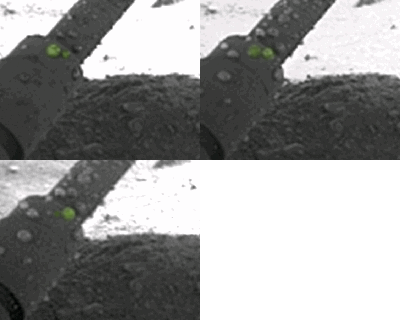
Then as well as that, through isotope measurements of the CO2 in the atmosphere, they proved that, Mars is geologically active in the recent past (continually producing CO2) - so presumably will be again in the future too, and also, that the oxygen from the CO2 has exchanged chemically with some liquid on the surface. - almost certainly water. They couldn't tell if this happens only sporadically, after meteorite strikes, or volcanic eruptions forming temporary lakes - or is present all the time. But one way or another it suggested liquid water, which perhaps life could use, on the surface of present day Mars.
This lead researches to the question: "Could salts take up enough water from the atmosphere to create habitats for life on the surface of Mars?"
NEW IDEAS FOR MARS HABITATS
It turns out that the atmosphere on Mars, though it has hardly any water vapour in it, nevertheless reaches hundred percent relative humidity at night. That's because of the temperature changes. Here on the West coast of Scotland, next to the sea, where I'm writing this, the air is nearly always very damp due to the sea air. and due to the low temperatures, especially in winter. But if you could make the air here as hot as in the Sahara desert, it would be very dry, even with the same amount of water vapour in the air.
On Mars, the air and surface temperatures plunge by 80 C or more at night frequently. This makes the air suddenly very humid, 100% relative humidity - and is the reason it can have these frosts in the equatorial regions. So the researchers asked if salt deposits on Mars - there are lots of those - could take up this night time humidity. And turns out they can. They have to experiment with unusual mixtures of chemicals for Earth as nearly all the salts there are highly oxygenated. For instance instead of the sodium and potassium chloride of table salt, you have chlorates or perchlorates. Anyway it turned out that yes, they can deliquesce, though often at temperatures far too low for life.
Then the DLR team in Germany studied some lichens from high mountain ridges in Antarctica - which have to live in an environment with no liquid water at any point in their growth cycle. They manage this feat by using humidity in the atmosphere. They wondered if they could do the same feat on Mars. They also have several special pigments that protect them from UV light, which is much stronger in these situations than elsewhere on Earth. They also hide in cracks in the rock, so the partial shade + pigments gives them the conditions they need to photosynthesize even with the high levels of UV light.
Pleopsidium chlorophanum collected at an altitude of 1492 m above sea level at "Black Ridge" in North Victoria Land, Antarctica. This lichen lives at altitudes of up to 2000 meters in Antarctica. It never encounters liquid water. It has special pigments that shield it from the high levels of UV light.
The photograph shows its semi-endolithic growth pattern in Antarctic conditions where it mainly occurs in fissures and cracks - here you can see the granite rock partly covering it. This lichen was able to photosynthesize and metabolize in similar partial shade conditions in Mars simulation chambers using the 100% night time humidity.
Anyway the outcome of those researches was surprising - yes they did manage to survive in a Mars simulation chamber, could handle the vacuum conditions, the plunges of temperature at night to temperatures cold enough for dry ice. Also when in partial shade similarly to their Antarctic habit, they could survive the high levels of ultraviolet light, and the complete lack of any liquid water at all. And what's more they actually metabolized and photosynthesized, so were actually still growing as well. Remarkable. And the fungal component of the lichen managed okay even with no oxygen - it got the low levels of oxygen it needed from the algae component.
They also found that some extremely hardy single cell cyanobacteria could survive in the same conditions.
CONFIRMATION OF LIQUID SALTY WATER ON MARS
Then we also got indirect confirmation of liquid water on Mars. First the Recurrent Slope Lineae - these are dark streaks that form in spring, spread down the slope and widen through the summer, and fade away in winter. Unlike other streaks and seasonal features on Mars, they form on sun facing slopes, and only when local temperatures reach above 0 C. This is far too warm for them to be anything to do with dry ice. Also there is no correlation at all with winds or dust storms. With the slow seasonal growth also - the only explanation that made much sense was that it has to be a feature caused by water mixed with salts, which flows down the slopes. The dark patches are not "damp patches" but some other effect on the dust grains of the surface. But thought to be caused by thin films of salty liquid flowing beneath. As to where the water comes from, the jury is out, main hypotheses are deliquescing salts at the head of the streaks, or else, from below through geothermal hot spots, possibly all the way from the kilometers deep hydrosphere if it exists, or there could be reservoirs of ice just below the surface, accumulated in the distant past when Mars had ice in these regions.

Dark Flows in Newton Crater Extending During Summer (animated)
Anyway - sadly the spacecraft that took these photos of them can only take photographs in early afternoon as it is in an eccentric orbit that takes it close to the sunny side of Mars at that time. So it can't photograph them in early morning which is when the liquid water is likely to flow. It was a big challenge to find out much more. But then last year, some scientists managed to tease out the signal of hydrated salts - which correlate with the streaks, and this hydrated salts signal disappears when they fade away. They didn't have the resolution to prove that this signal comes from the streaks themselves, but because of this correlation, and all the other things known about the streaks, it is thought to be reasonably conclusive evidence that there is liquid water there at times.
Then there were a couple of other developments, just last year. First, a team lead by Nilton Renno have found that in a Mars simulation chamber, liquid water can form very quickly on salt / ice interfaces - his widely reported "swimming pools for bacteria on Mars". So this is not deliquescence, as the water doesn't come from the atmosphere, but rather from the ice. It happens much more quickly than it does from deliquescence. These habitats could occur anywhere on Mars where there is both salt and ice potentially in contact with each other. Basically anywhere in the higher latitudes of Mars.
"The results of our experiments suggest that the spheroids observed on a strut of the Phoenix lander formed on water ice splashed during landing. They also support the hypothesis that “soft ice” found in one of the trenches dug by Phoenix was likely frozen brine that had been formed previously by perchlorates on icy soil.
Finally, our results indicate that liquid water could form on the surface during the spring where snow has been deposited on saline soils. 'These results have important implications for the understanding of the habitability of Mars because liquid water is essential for life as we know it, and halophilic terrestrial bacteria can thrive in brines'"
from: Experimental evidence for the formation of liquid saline water on Mars
Then as well, Curiosity found out that it has been driving just a couple of cms above a layer of liquid water in the sands of Mars. It can tell by variations in humidity of the air as it drives. This layer is thought to be due to deliquescing salts again. The liquid dries out as the day progresses, then forming again each morning. This layer is warm enough for life some of the time - but too salty. At other times the water is not quite so extremely salty so life could just about manage - but is too cold. So most think it can't be habitable. But Nilton Renno, who is in charge of the Curiosity REM "weather station" on Mars has suggested that life, because it can modify local climate, and create its own microclimates, could perhaps find a way to survive in this layer.
ARE ANY OF THESE LIQUID WATER LAYERS HABITABLE?
That leads in to the big question here. We now know for sure that there is liquid water on Mars, even in equatorial regions - the Curiosity measurement is particularly conclusive. But is any of it habitable for Earth life? And if not, could any of it be habitable for Mars life - which might have evolved to be able to take advantage of liquid water at lower temperatures than Earth life, for instance?
Nobody knows .But there are so many proposed habitats for life on Mars, that it will probably be a long time, some decades at least, before we know for sure, except of course if we find a confirmed habitat, which would prove that they exist.
There are many other proposals over and above the ones I just described. One of the most intriguing that is seldom mentioned - is the possibility that the flow like features in Richardson crater could be caused by trapped liqud water at 0 C heated by the solid state greenhouse effect, like similar liquid layers in Antarctica. Another intriguing suggestion, just mentioned briefly in a paper, is an idea for life in salt pillars using micropores in the salt, which trap water even at rather low relative humidities. This is another process we can observe on Earth, in the dry Atacama desert. For a survey of most of the proposed habitats up to 2015, see my Are There Habitats For Life On Mars? - Salty Seeps, Clear Ice Greenhouses, Ice Fumaroles, Dune Bioreactors,....
NO LONGER EASY TO FIND OUT IF MARS IS SAFE FOR HUMANS OR VICE VERSA
With the earlier rather simple idea of the Mars surface, you could hope to get a decent idea from just a few samples. Though even back in 2002 they said that an in situ search would work better, if we had equpiment light enough to send to Mars to do it.
Nowadays we do have those instruments now as a result of technology advances and miniaturization in the last decade. Since the 2002 survey already said an in situ search would be better, I'm pretty sure that if it was redone they would say that an in situ search was the way to go, especially with these new ideas for habitats on Mars. The problem is that present day life is hard to detect, and organics are expected on Mars anyway from meteorite impacts, so if you find organics on Mars it doesn't follow that you have found life, or a life habitat. Also in such harsh conditions there may be seemingly identical habitats with some inhabited and others uninhabited. You can only check for this with in situ searches.
IMPLICATIONS FOR "ROAD MAP TO MARS"
As you can imagine, this is exciting news for astrobiology. It now really beings to seem possible that we might have a chance to encounter present day "micromartians".
But I think it might mean we need to modify plans for human landings on Mars.
NASA and COSPAR seem confident that it will be okay, but I don't see a clear basis for this confidence myself at this early stage.
The main difference I think is that they are still working with the idea that the surface of Mars is almost completely sterile. I suppose it depends how impressed you are by the new ideas for habitats on Mars. I look at those ideas and think "Wow, there are now possibilities for habitats almost anywhere on Mars, even in equatorial regions". While others look at them with skepticism and expect that perhaps all of them will be disproved and life on Mars shown to be possible only underground.
If you think habitats on Mars could be common and widespread, as a few researchers do, then the problem of planetary protection becomes far more acute and immediate.
I know many people are really keen to go to Mars, in the States. Here in Europe we don't have that at all, not the fevour of anticipation that you have in the States as I understand it. There are large conferences in the States, speeches and congressional hearings all devoted to finding ways to send a human mission to the Mars surface. We don't have any of that here in Europe.
Anyway, why Mars? Most of the solar system is completely free for human exploration, with a few natural restrictions just as you have on Earth.
The Moon is category II meaning you can do anything, so long as you document it. But there are ideas to set up the equivalent of "national parks" - vulnerable areas that need some care. Perhaps associated with ice at the poles or in caves, and the historical landing sites. That is not yet legislation and is "work in progress".
For asteroids particularly - you can go anywhere.
And same also for Callisto (moon of Jupiter outside its intense radiation belts that some think might be a place to settle), Mercury, and many places in the solar system are not a planetary protection issue at all.
There are three top priorities for planetary protection: Mars, Europa and Enceladus. These are the ones that need especial care.
There is no legislation to prevent you taking risks wth your own life. If a private company wants to go to an asteroid, and take enormous risks, nobody will object, except perhaps the families of the astronauts. It's only becaues it impacts on others that these restrictions are in place in the Outer Space Treaty, as interpreted by COSPAR.
CURRENT IDEAS FOR MARS
You can read about current proposals and research towards human missions and planetary protection here - the 2015 workshop with many videos. And there are more documents available for download from the Planetary Protection office.
And listen to Cassie Connely talking about it here on the Space Show.
So, the current ideas are that we can still send humans to Mars, but that it has to be done on the basis of keeping the contamination restricted as far as possible to the region around the human landing site. They would then send sterilized rovers to explore further afield, perhaps controlled by telepresence.
What is possible here is a matter of further research. We'd want to know more about surface conditions on Mars. We need to understand whether spores can be spread in the dust and how easily, and so forth.
BIOLOGICALLY REVERSIBLE EXPLORATION
Chris McKay suggested in the past that we should explore Mars in a biologically reversible way. The idea is that if we find interesting life on Mars, we can remove all our contamination from the planet and leave it for the Martians instead - so that we can study the biology there etc. Maybe even get to restore the early Mars climate.
That would be an exciting prospect seems to me. It's like having our own exoplanet, with its distinct biology, in our own solar system. The nearest terrestrial planet like that, other than Mars, may be light years away. Depending on future technological progress, it might be centuries before we have a similar opportunity - or if life is rare in our galaxy, maybe even millions of years.
WITH THE ROAD MAP TO MARS, BIOLOGICALLY REVERSIBLE EXPLORATION IS IMPOSSIBLE
If we land humans on Mars, with present understanding, they think it would be possible to keep the contamination restricted to the landing site for long enough to do a scientific study of the rest of Mars. But the result would not be biologically reversible. This would mean we no longer have this future opportunity to engineer Mars for the micromartians.
Note that if we do change Mars by introducing Earth life - that is a binary thing, either you introduce life or you don't, no half measures. It doesn't seem possible that you could introduce life to just a quarter of Mars say. Not if it is biologically irreversible.
IT WOULD BE A NEW GEOLOGICAL ERA ON MARS
This means it would be nothing short of a new era on Mars. Maybe it needs a new name.You have the earliest Noachian period of high meteorite bombardment and seas, the Hesperian period of volcanic activity and huge floods, the Amazonian period, as it is now, dry with some liquid water, a bit volcanic activity and occasional floods - and then we'd need a new name, maybe call it the Anthropocene again, as on Earth - of a Mars with Earth life on it, introduced by humans. After all on Earth geological epochs are named according to the prominent biology on the planet. So why not on Mars?
From then on for all future time, our civilization and all future civilizations on Earth would never have the opportunity to study the Amazonian period, with whatever unique lifeforms it might have.
And - it is well possible that Earth life could make Amazonian period Mars life extinct. After all, according to most theories of the origins of life, DNA life made its precursors on Earth, whatever they were, extinct. And later forms of DNA life made many earlier forms extinct. So it's certainly possible for one form of life to make another extinct over an entire planet.
In the case of life exchanged between two planets which has never had the opportunity to make the trip before, then it seems possible this could happen in either direction.
It would be only small consolation if we get the opportunity to study this life before it goes extinct. Whether it takes a decade, or a century, or even a thousand years for the Earth life to reach every habitat on Mars, surely it would do so eventually.
Imagine what it would be like if we end up in that situation, where we find some unique form of life on Mars, perhaps for instance RNA based life using ribozymes instead of ribosomes, cells only 50 nm in diameter. Or even multicellular life, some unusual lichen, maybe again with minute 50 nm cells, but at that point we know we have already introduced Earth life to Mars in an irreversible way and that this newly discovered life will go extinct on Mars, with nothing we can do to prevent it? That the only thing we can do is to do our best to study it as quickly as possible before it goes extinct?
THROWING AWAY A TICKET FOR A LOTTERY WITH A PRIZE OF INCALCULABLE VALUE
I've no idea what the chance is of something as wonderful as this on Mars, or the chance that Earth life would destroy it. Probably nobody can know until we get a chance to explore Mars thoroughly.
But it's what I've been calling a "superpositive outcome" in my posts here - something so positive that even if it is low probability, we must not deny our future selves and other future civilizations of this opportunity.
You often hear about people who buy a ticket for a state lottery - and then find they have won, only to then find out that they have lost the ticket.
Introducing Earth life to Mars before we know what is there, and then finding some vulnerable early life or non DNA life there after it's too late - that's like throwing away a ticket for a lottery with an incalculably valuable prize, just before the prize is drawn.
It would be too late after that for some "good samaritan" to return the ticket to us. It's lost for good.
CRASHING ON MARS
So that takes us to the main issue. Can we land humans on the Mars surface without greatly increasing the risk of contaminating it?
I don't see how we can.
I know that the COSPAR committee and the NASA planetary protection office, and many experts are optimistic that we can find a way.
I am speaking only for myself here. And the aim is to get people thinking about this and debating it. Not saying that you have to accept what I say!
But I just can't see it myself, yet. I haven't seen any proposals or plans that seem watertight and convincing, to the point where you look at the plan and say "Yes, I see, this method will certainly protect Mars, I get it now!".
The various plans may look good on paper, but they lead to many questions we can't answer.
POSSIBLE DISCOVERIES THAT MIGHT MAKE HUMAN LANDINGS ALMOST INCONCEIVABLE EVEN FOR NASA AND COSPAR
To get an idea of why I say that we can't guarantee that humans will be able to land on Mars quite yet - let's try a thought experiment.
Suppose we find some interesting but feeble form of life on Mars before the proposed human landing, e.g. a precursor of Earth life, which got made extinct on Earth by more modern DNA based life.
Our first opportunity may be with Exomars, as the first rover sent to Mars since Viking sensitive enough to have a chance of this.

Artist's concept for ExoMars. Its Raman spectrometer was able to detect biosignatures in salt deposits in the Atacama desert. It is designed to search mainly for past life, but also for present day life as well if it is present in the equatorial regions. It will be sterilized to planetary protection standards for category IVc, to at least Viking post sterilization standard (at most 30 spores for the entire spacecraft). For details, see ExoMars - Searching for life on the Red Planet
So suppose it finds this life. I know most think this is unlikely, that we would find it so soon, but it's not impossible, if you think Gilbert Levin's labelled release already found life on Mars, or if you think that life in biolfims could exploit the layer Curiosity found, or think that equatorial life on Mars could use the 100% night time humidity.
After a discovery like that - could COSPAR continue to support human landings to the surface of Mars and say they are not an issue for planetary protection?
I think surely not, if Mars life was as interesting, and also as vulnerable as this.
But who can say this can't happen. There have been many surprising discoveries on Mars. Perhaps we will find something like this and it will wake everyone up! Stranger things have happened in science.
So - how can anyone say, yet, that we are confident that COSPAR will find suitable requirements to permit humans to land on the Mars surface?
And particularly how can they possibly hope to learn enough to be able to approve a human landing without first studying Mars very thoroughly to see if some such biology or habitat exists there, somewhere on the planet?
That's why I said in my Space Show guest appearance that I can't see them having enough information to approve a human mission to the Mars surface until they have first explored it thoroughly with robots, or with humans in orbit exploring it telerobotically.
If you have planetary protection policies at all, there must be a possibility of prohibiting humans landing, just as you would prohibit tourists, however wealthy and technically capable, from exploring Lake Vostock in a sub, or bathyscope.
WHY IT MAY BE HARD TO KEEP A HUMAN HAB BIOLOGICALLY ISOLATED FROM THE SURFACE
There are many things you can do to try to keep the hab isolated, with all the Earth microbes inside.
Yes they can clean the outside of spacesuits. Yes they can use suitports to reduce the amount of dust that gets into the habitat and life that escapes - though it still leaks a cubic foot of air every time it is used (that's a special type of spacesuit that is attached to the spaceship via its back so you crawl into the suit and then detach it eliminating the need for an airlock, and losing only a cubic foot of air to the Mars atmosphere each time you use it).
Yes, it's true, that though spacesuits leak all the time, the conditions on Mars are very harsh so long as they land in the dry equatorial regions. Yes, surely, most spores released from the spacesuit will be sterilized by the strong UV light in the only slightly filtered Mars sunlight.
But - first spores are very hardy. They just need to fall into the shadow of a boulder to be completely protected from UV light. They can also be protected by less than a millimeter of dust.
Some spores are especially hardy - if you have enough spores, a few will survive long periods of time in Mars conditions before they succumb. There will be some viable spores left after hours or even days of direct sunlight.
Or they could fall behind a boulder during a night time EVA - or just fall to the ground in the shadow of the astronaut.

Sojourner, the first rover to explore Mars, inspecting a boulder. If a human examined a boulder like this, a microbial spore could fall into the permanent shadow, and then would be protected from UV light until the next dust storm.
So long as a spore can get into a permanent shadow, it will remain there, unharmed until picked up by the global dust storms, maybe a few years later. The solar storms and cosmic radiation on Mars are not strong enough to sterilize spores completely over short time periods of a few years.
PROBLEM OF TRASH HEAPS AROUND THE HABS
Then - as well as that - how likely is it that in practice the Mars astronauts can keep their habs so contained and insulated from the surface of Mars as expected in the guidelines. Equipment has glitches, fails sometimes, has to be repaired. They would have bad air and problems in their recycling from time to time.
Sometimes they would need to vent the air. Sometimes food would go off and they wouldn't want to keep that in the habitat. Eventually after many uses, their clothes would get torn, and need to be replaced. They would need to replace equipment. Seed trays in the greenhouses would break, or the outer covering need to be replaced. They would receive shipments that need to be unpacked, and then they have to dispose of the packaging. From time to time there would be accidents on the surface with the spacesuits breached.
I just can't see it working that they just pile up all their refuse and no longer functioning equipment, spacesuits that don't work any more, broken seed trays etc inside the habitat for years on end. And there's no way they'd send all that back into orbit either.
And as well as that, how could you ensure that they follow these guidelines? Especially if we get Elon Musk's hundred colonists per trip landing on Mars - who ensures that they all follow the guidelines? What can you do remotely from Earth if someone just decides not to follow the precautions because they are not interested in exobiology and just don't see the point? Just chuck some useless bit of machinery out of their airlock, or some food that's smelly, or even a crew mates offensively dirty socks? Even perhaps just in a fit of temper?
I think we need experience of human settlements on the Moon first. If we do that, I wouldn't be surprised if we find we get a refuse tip builds up outside every habitat, eventually dwarfing it and needing to be buried or otherwise disposed of. At least if it is like the ISS, that's what would happen. Of the tons they dispose of every year from the ISS to burn up in the Earth's atmosphere - only some of that is because they haven't yet achieved perfect closed systems growing their food and generating all their own oxygen. There's lots of other refuse on top of that.
Sherpa removing trash from Everest. What will happen to all the trash from a Mars hab? Including broken equipment, bad food, packaging, wrappers and containers? Will it all be recycled without ever leaving the hab? Seems unlikely. And they can't just keep it inside or send it back to orbit. Seems inevitable, no matter how good the closed system that they will dump trash on the Mars surface eventually. Especially if we have would be colonists sent to Mars in spaceships one hundred at a time.

CRASH OF A HUMAN OCCUPIED SHIP
But - apart from that, the thing that makes it really very hard to see how a surface trip could be approved is the problem of a crash of a human occupied ship on Mars.
Unless, that is, they make it a requirement that all ships sent to Mars with humans must be proven to be 100% reliable. But how could that be enforced? How could we achieve 100% reliable landings with near future technology?
Curiosity's "seven minutes of terror" wasn't just hyperbole. There was a real risk that it would crash, especially with such novel technology, with many previous examples of crashes on Mars. It is especially tricky with its atmosphere too thin for a conventional parachute to work by itself - but too thick for a lunar module type landing. Once you hit the atmosphere you are totally committed and can't back away again if the landing starts to go wrong. But you can't just use parachutes either. It is surely the most difficult place to land, in the entire inner solar system, and maybe in the solar system altogether.
How can you be sure you won't get this sort of thing happening?

Debris from Columbia - broken into tiny pieces by the crash.
I know this brings back painful memories for many, and sorry about that. But we can't avoid this subject here.
Twice the space shuttle failed. Each time, they thought that the risk of this happening was tiny .
It doesn't prove that a spacecraft is safe, to land it say four times on Mars with cargo first. Even with a 50/50 chance of a crash, you can get four perfect landings in succession with probability of 1 in 16. And even learning on the job, using telemetry from previous landings, still, can you really and truly say it can't possibly crash?
I think the safety level needed for planetary protection should be far higher than for humans who are prepared to take risks. Perhaps many would be colonists would be willing to take on a 1 in 100 risk of a crash, around the levels of the estimated risk for the space shuttle after the redesign after the two crashes.
But for planetary protection - the usual aim is a 1 in 10,000 risk of contaminating a planet per mission. With ideas of a super positive outcome, I would say that even that is not low enough myself - but that much is already accepted internationally as a consenus from COSPAR.
A HUMAN LANDING AT LEAST INCREASES THE RISK OF CONTAMINATION
It seems pretty clear that the only way to approve a human landing is to permit an increased risk of contamination of Mars by Earth life to greater than the notional 1 in 10,000. And bearing in mind the possibility of a crash, perhaps it's a greatly increased risk.
Why do that? NASA especially, with science as such an important part of their remit - why accept this increased risk of contaminating Mars in its roadmap? And why do it in such a way that if you do find interesting and vulnerable early life on Mars, there is no future possibility of reversing the contamination? When you can do it using telerobots instead?
NO URGENT NEED FOR A BACKUP FOR ASTEROID IMPACTS
There is no great rush to colonize Mars. It will still be there a thousand years from now, or a hundred thousand years from now. We don't need it as a backup either as I've covered in previous posts. So just to touch on it again briefly.
Most of those who say we need a backup say it is because of giant asteroid impacts as one of the main threats. But the risk of a 10 km asteroid impact is far lower than most imagine; they happen once every 100 million years. It's random of course, so we can't say that because the last one happened 66 million years ago, that we are safe for another 34 million years. But there is only a one in a million chance per century. And now that we have mapped all the 10 km asteroids between Jupiter and the sun, the risk is 1 in ten million for the next century with at least a half year warning, and probably a lot more, since it would have to approach from way beyond Jupiter or we'd have spotted it already.
It's 99.99999% certain we don't get hit by a giant asteroid ths century and we should get lots of warning on the remote chance we do. It's certainly possible to be hit by smaller asteroids but that's not the main topic here. It's rare, far rarer than volcanoes, eruptions and tsunamis, but with the unusual feature that with enough information we can predict an astroid impact to the minute and also with enough warning, deflect it rather easily.
Humans anyway are so adaptable, we can live almost anywhere, from the Arctic to the Sahara, tropical rainforests, coral atolls, or up in the highest mountains. That's with pre-industrial technology. We'd surely be amongst the 1% that survive a mass extinction, along with turtles, crocodiles, alligators, flying dinosaurs (the birds), small mammals, dawn redwoods, pine trees etc.

This river turtle survived the dinosaurs mass extinction (though it went extinct 24 million years later, probably because it couldn't retract its neck to escape from predators). So did aligators, crocodiles, small mammals, flying dinosaurs (evolved into birds), dawn redwoods, pine trees, etc. We would surely be one of the 1% that survive such an event.
As for the larger asteroid impacts you see in some movies including an animation done for the Discovery Channel - there have been no impacts that big in the inner solar system for well over three billion years, on any of the planets with a long geological record. There are many big craters on Mars, the Moon, Mercury, the moons of Mars, even on Earth, but they all date back to the late heavy bombardment not long after the formation of our Moon when our solar system was still settling down, and a few hundred million years after it.
We are lucky to live in a quiet area of the galaxy, around a star in a solar system that is in a quiet phase, with a sun that is stable and not the sort that has giant solar flares. We don't need a backup, not for at least many millions of years into the future.
So I don't think we need to rush into space to escape Earth. We have millions of years to create a backup if we need one.
PROTECTING EARTH
Instead we have to protect Earth. Go into space to defend against asteroids yes. For a fraction of the cost needed just to get started on a colonization attempt - just half a billion dollars can launch a space telescope to find nearly all of the most hazardous of the smaller asteroids within 6.5 years. Five billion dollars would pretty much retire the risk from asteroid impacts - unless we find one headed our way, of course, in which case we can deflect it.
Find one headed for us a decade in advance and it's easy to deflect.
The thing is that the speed change needed to deflect it is less, the sooner you can find it. With just one hour of warning, you'd need over 6,000 km / hour to miss by the radius of Earth, not very practical. But If you have ten years of warning, then you can deflect it to miss Earth with a change in speed of 100 meters / hour. Conventional explosives, or just kinetic impact, or even "gravity tractors" could do it.
Then most asteroids will do many flybys before they hit, as Earth is such a tiny target. This involves passing through a gravitational keyhole in space, of a few hundred meters in diameter, in order to hit Earth next time around. With, say, a decade before the flyby, you just need to change its velocity by a few tens of meters a year to miss the keyhole. This change is so small you could achieve it by methods such as painting a dark asteroid white to change the heating effects of sunlight on it. (as they spin around and release the heat from the daytime side into the night, this deflects the asteroid - it's a tiny effect, but significant enough that it has to be taken account of in asteroid orbit predictions).
NO NEED TO GO TO MARS TO ESCAPE GAMMA RAY BURSTS OR SUPERNOVAE OR BOILING OCEANS
These are other things that we hear we have to go into space to escape from.
But gamma ray bursts, or nearby supernovae also would not make us all extinct. For one thing there are probably no candidate supernovae close enough to have harmful effects on Earth and gamma ray bursts are extraordinarily rare and highly directional.
Then on the exceedingly remote chance of, say, a nearby gamma ray burst, some humans would survive these events through technology. After all that's the whole point in the backup, to build a highly technological habitat that could survive anything, even a supernova or gamma ray burst.
But Mars is no more protected from cosmic disasters than Earth. Indeed it is less protected.
The easiest place to survive these also is on Earth, with the extra protection of our atmosphere equivalent to ten meters of water to protect against radiation, and with air you can breathe outside the habitat. It's a far better place to ride out a supernova or gamma ray burst than Mars.
On Earth we can also go deep below the surface in nuclear submarines, or deep in mines. At any time there will be a few people in these places anyway just by chance. The event would directly affect only one side of Earth also, in this remote chance. Many humans would surely survive to try to start rebuilding. And where would it be best to rebuild after such an event? On Earth of course. There's no point in heading off to Mars to rebuild, when Earth is here.
We have millions of years before we need to worry about changes in our solar system, or movement of our sun through the galaxy, leaing to increased levels of risk over what we have now. We have half a billion or a billion years before the oceans boil. Technology might solve that also - perhaps just through putting lots of solar shades in orbit around Earth, and there are also ways we could change Earth's orbit to move it further out, on those long timescales.
Who knows what the issues there will be and what technology we have if we can survive for even thousands of years.
So, I don't see a backup as an urgent priority right now, and don't think Mars would be the best place for it either. A free flying space colony, if we can ever make those self contained and closed system, would be far more robust and independent.
Instead, our top priority surely has to be to preserve the Earth.
NO NEED FOR HUMANS FOR DRILLING
This is something colonization advocates often say, that we have to send humans to Mars, as it is the only way to drill below the surface. This argument is most compelling if you think life on Mars only exists deep down.
However, humans wouldn't actually be that good at drilling on Mars. On the Moon in their clumsy spacesuits, the astronauts struggled to get a simple core drilled from the surface, even falling over in the attempt.
And as for deeper drilling - on Mars as on the Moon, there'd be no water to lubricate the drilling rig. If you tried, the water would just evaporate.
It turns out that in these near vacuum conditions, you have to use a different methods for drilling. One of the best ways to do it may be to use a robotic self hammering mole.
In theory this can drill down for kilometers into the Mars crust, studies show. The first practical test of this will probably be with the Mars insight lander, which will use a robotic mole to drill to a depth of about eight meters (originally planned for 2016 but now delayed).
ExoMars uses a different solution, a form of rotary drill, but will also be able to drill down 2 meters in its search for life.
So - it doesn't seem humans are essential here. Probably humans could learn from the lunar astronauts and find easier ways to do it. But this is certainly something that can also be done via telerobotics from orbit.
COLONIZATION COULD BRING ITS OWN PROBLEMS - RISKING EARTH RATHER THAN SAVING IT
Also space colonies would be the most technological on ever attempted. Even more technological than the ideas of subsea colonization.
Any future issues that arise through technology are as likely to start in space colonies as anywhere. E.g. who would be the early adopters of nanotechnology? And of the most advanced 3D printers? Space colonists obviously. If you think artificial intelligence is an issue (I don't think it is myself) - again space colonists have more need of computers than anyone else.
If technology is what you are afraid of, it doesn't seem, to me, to make a whole lot of sense to try to escape from those dangers by setting up an even more technological society in space.
And they wouldn't be isolated from Earth. Soon we'd have spacecraft able to get there in weeks, maybe faster, if you had colonies. Probably will anyway within a decade or two even without them.
And they have technology they could use to directly threaten the Earth e.g. block out the sun from us, or divert asteroids to hit us, or any number of ways. If we have millions in space, then at some point then they would militarize space for sure, if done rapidly and with everyone going into space including North Korea or anyone that has space aspirations. You can't just keep the colonies for the "good guys" indefinitely with millions in space, you'll get "bad guys", whoever you think the bad guys are.
In case that seems a black picture - that's a worst case future, not what I think will happen.
SPACE SETTLEMENT AND COLONIZATION AS NEUTRAL
But there is no rush to get into space. I see space colonization as neutral. And our technological problems come mainly from the pace of change. We have managed to cope, more or less, with a huge number of technological inventions of the last hundred years. Including
- Jet planes
- Cruise missiles
- Nuclear weapons
- Biological warfare
- Chemical warfare
- Tanks
- Submarines
- ICBMs
- Can cut down forests acres at a time with great ease
- Build huge roads
- Kill animals easily.
- Sonar to spot fish and whales
- Infared vision
- Radar
- Personal computers - well computers at all at first
- Cell phones
- The list goes on and on
Now imagine if all of those things had been invented in just one decade between 1900 and 1910, instead of a hundred years? I'm not sure humans would even survive that, and almost surely much of our planet would be devastated before people realized the many issues with these new inventions.
I don't think the answer is to stop inventing things and slow down innovation.
Rather, it shows that we can adjust if we are given time to do so.
These things are all neutral, and we can learn to use them well and cope with the undesirable effects.
Similarly with space settlement and colonization. I think it is neutral, it can be very good indeed, help save the Earth, move destructive industries into space, help preserve ecosystems, produce space solar power, andthere are many ways space settlement can help the Earth.
It could be of great benefit to Earth and also lead to many discoveries in space. Could lead to revolutions in biology also if we find exobiology on another planet or moon.
But - there is no great rush, and especially, no rush to colonize Mars as soon as possible.
MANY OTHER PLACES TO COLONIZE
There are many other places to colonize - the lunar caves for instance. But most of all, using materials from the asteroid belt - this is an insight of the 1970s. There is enough material in the asteroid belt to make space habitats with total surface area a thousand times that of Earth.
That's why they designed the Stanford Torus and the O' Neil cylinder in the 1970s. The future of space colonization may well be in free space. Maybe we are too "planet centric" having evolved on a planetary surface.
Also there's a lot to be said for the idea that it is better to learn about how to support a space settlement closer to Earth. We've sort of "settled" the low earth orbit with Skylab, MIR and the ISS. By settlement here I mean more or less permanent occupation, not bringing up your kids there and expanding populations - I'd call that colonization.
The next step surely is the Moon. Only two days back to Earth in an emergency, and easy to resupply also in an emergency. We've been exploring for decades with humans able to get back to Earth in just a few hours. It's too soon to get to the situation where they may be only able to get back in over a year (waiting for next transit opportunity to Earth).
Even for exploration not settlement, then the Moon is the obvious place to go first. It's also a lot more interesting than it was thought to be some years back.
If you want more of a challenge, try the far side of the Moon with only indirect communication with Earth via luanr satellites, and the Earth no longer visible in the sky. It'd an ideal spot for radio telescopes, shielded from Earth by the Moon, so we may well get the lunar equivalents of Aceribo in craters on the far side of the Moon. And before that, the simpler long wave telescopes consisting of just wires spread over the surface.
COLONIZATION DOESN'T ALWAYS WORK
Space colonization advocates often paint pictures of the Europeans arriving in America or spreadng across the West. But those were colonizations of regions that already supported humans. And colonization, even on Earth, of areas already habitable for humans, doesn't always work.
The Vikings attempted to colonize North America five centuries earlier, and archaeologists have unearthed traces of their settlements in L'Anse aux Meadows in Canada. But they only stayed their for a short period of time, then they gave up.
Later on, many of those living in Scotland, made themselves bankrupt through the grand Darien scheme to start a new colony called Calidonia in Panama, which failed, with most of the colonists dying and ships bringing a few of them back home. It's failure lead to loss of an estimated one quarter of Scotland's liquid assets at the time and was one of the main reasons Scotland lost its independence and had to accept unification with England in the early eighteenth century.
Before we can build self sustaining colonies in space, I think we'll first achieve the far far simpler task of floating sea cities. These could use only the sea water and air as resources, similar to habs on Mars using only the CO2 and the ice, with no need for fishing, or any other use of Earth's natural resources. They'd be very eco-friendly.
They would be far easier to build than self sustaining space colonies. They wouldn't need to melt the ice, could extract metals from the sea water, would have oxygen to breathe in the air, and basically wouldn't need to worry about purifying the air of harmful gases or keeping it breathable. They naturally have protection from radiation thorugh the Earth's atmosphere and magnetic field. And no need to use rocket launches to construct them. This seems a far far easier project than a space colony to me. For more on this, see my Can You Suggest A Second Earth Apart From Mars?
SUGGESTION - HUMANS IN MARS ORBIT WITH AVATARS ON THE SURFACE AS FINAL DESTINATION FOR NOW
So anyway that's how I see it. And I think the "road map to Mars" should have Mars orbit as the final destination for humans, with avatars on the surface, not humans on the surface of Mars. At least until we get a chance to study Mars properly from orbit.
And though Mars is undoubtedly far more hostile to biology than lake Vostock in Antarctica, I don't thnk we have anything like enough understanding to be sure yet that it is okay according to planetary protection to send humans there.
Especially when you consider the wide range of possible habitats on Mars, and you consider the possibility of some very vulnerable early form of life, maybe some type of life that was driven to extinction by DNA life on Earth long ago.
I also think we should continue to explore Mars in a biologically reversible fashion. And that when there are alternative mission proposals such as to send humans to the surface or controlling robots on the surface by telepresence - that planetary protection should be our priority and guiding light. For now at least, until we understand Mars better.
FUTURE CLASHES
I can see this potentially leading to a clash some time down the road. What is going to happen if Elon Musk wants to send 100 people to Mars in the early 2030s?
I have no idea what he thinks about planetary protection or whether he values the search for exobiology as he has never discussed it, as far as I know. He may value the search for life highly. But what if someone wants to do this and doesn't want to wait for us to learn enough from Mars to satisfy COSPAR?
If he planned to drill into lake Vostock in Antarctica and to put a submarine into the lake to explore it with human tourists in the submarine, he would be denied permission. Why not the same for Mars then?
Even if it is not certain that it would contaminate Mars with Earth life, if it greatly increases the risk over robotic missions, why should this be okay? Don't the rest of us matter, who want to study Mars in its pristine state? Or future generations, and civilizations, do they not matter?
CHANGING POLICY FOR COSPAR
COSPAR policy does change of course. After Viking they decided that robots don't need to be sterilized so much because the surface is so hostile to life.
But since 2008, the pendulum has swung the other way a bit. The surface has turned out to be more hospitable than was expected, not less so.
So, unless for some reason we decide Mars is no longer of interest to exobiology - which seems unlikely - surely our planetary protection measures should be getting more stringent for Mars, not less so, to match this new vision of an increasingly habitable Mars?
If so, it is hard to see how permitting humans to land on Mars could be justified by new knowledge in the same way that the relaxation of requirements was justified for Viking.
It seems that the justification is rather the other way around. That we want to send humans to Mars, but the only way to do that is to relax the policies, so they have to be relaxed. This is the wrong way round to do things, seems to me, if planetary protection has the priority.
SO COULD WE EVER SEND HUMANS TO MARS IF IT IS DECLARED "OFF LIMITS" FOR MICROBES?
So, what happens if after new scientific discoveries from Mars, some future COSPAR meeting decides to declare Mars off limit for Earth microbes indefinitely? Perhaps because we find some fragile and interesting early form of life on Mars, as I suggested as a possibility?
First I think it's important to realize that it's not really humans that Mars needs protection from, only our microbes and the microbes in our habs, and perhaps some very hardy multicellular lifeforms - lichens, maybe even tardigrades if there is any oxygen rich habitat or microhabitat on Mars. But humans as such are not really a problem, if only we could be separated from our micobes.
We could grow trees on Mars if we grow them from a sterilized seed in sterile hydroponics type environments supplied with all the chemicals they need for growth.
The problem is that we can't sterilize humans. Maybe some ETs can sterilize themselves, if their biology permits it, but not us, not at present anyway.
The human body has about the same number of non human microbes as human cells. We need at least some of this life to survive, as it is the only way we can digest our food.
In principle you could imagine somehow exchanging all the microbes we have with ones that are incapable of surviving below temperatures of say 30 °C. And every time you eat food eat a warm soup of microbes to help digest it.
Or remove all the stomach microbes, and use drip feeding.
That would be enough to make it safe for humans to land on Mars. But how could that be done, in practice? How could you sterilize the human skin, lungs, digestive track, sinuses, eyes, etc etc of all microbes without killing us as well?
It's hard enough for robots. It seems impossible for humans. At least not with present day technology. In a science fiction story you could let the characters do it with nanites - reproducing nanoscale machines, but we don't have anything like those yet.
You could try the same idea as for a tree - to grow a human from an embryo on Mars in an artificial womb. And introduce only microbes that you know are unable to survive on Mars. Maybe with warm cuddly avatar parents so that it has a reasonably normal upbringing, interacting with its real parents via telepresence.
But apart from the many ethical issues, we don't have anything like this technology yet. And any harmful microbe free humans on Mars would not be able to return to the planet ever, if they leave it, in case they bring Earth microbes back to Mars.
So - no - if Mars was off limits for our microbes, I don't see how we could get around it to visit it ourselves in person in the near future. At least not if they can walk on the surface reasonably normally.
Except - with impervious fully recycling spacesuits which also can't be damaged at all in a crash on Mars. You can invent those too for science fiction stories. But we don't have those either, not yet anyway.
LANDING ON MARS IN A GIANT STEEL BALL
There is one way you could do it. Put the human inside a giant steel ball with a small hollow inside. Seal it up with enough food and oxygen to last for a while on Mars. It has to be totally impossible for it to breach in event of a hard landing, even at kilometers per second. But that I think would be possible (engineers might like to comment).
But not sure I see the point. Technically they walk on Mars, but they only get to experience the Mars gravity, don't see anything and can't get out.
Perhaps eventually though we find a way to send astronauts to the surface in transparent bubbles in some 100% reliable way and they float about or have wheels that drive them over the surface.
MEANWHILE, TELEPRESENCE
But for now, by far the easiest way to do this is via telepresence.

Image from the Telerobotics Symposium held in 2012, one of the recommendations was that telepresence be used to explore Mars during the early orbital missions.
This gives you enhanced vision, you can even make the skies blue if you like. Colours of rocks just as on Earth. Touch things, see them through binocular vision in 3D. Also 3D sound as well. It could be so immersive it really feels as if you are on the surface. In reality you are walking around in a Virtuix Omni type treadmill in your orbital settlement, with artificial gravity set to Mars levels, generated perhaps through a tether spin. But to you it feels as if you are really there.
And everything streamed back to Earth so we can all have this same experience.
I see that as a far better end goal for the "Road Map to Mars". If you like you can plant a flag on Mars. Even send a sterilized humanoid avatar to plant it in some ceremony to celebrate your achievement. We already have quite a few flags on Mars on our rovers there.
And leave ideas for humans on the surface until we know a bit more about what is there. Then we can decide whether it is the right thing to do, and whether or not it will impact on future generations and civilizations.
NEW GEOLOGICAL ERA ON MARS
If there are habitats for life on Mars, it will certainly create a new geological era there, to introduce Earth life there - unless we find Earth life is there already. Some think that is possible. If that's the situation then we should find that out fairly soon. If so we can then act on knowledge and understanding of the situation.
If there is Earth life already on Mars, we need to study it carefully first to understand it. It would probably have evolved separately in the different conditions there, at least for millions and probably for billions of years. And only some of the many Earth lifeforms could get there.
The most interesting situation for exobiology though is that we find early life, or most interesting of all, some alternative biochemistry. If that was proved, I think everyone would agree we need to take great caution.
It's the order that we do things that matters here. It would be tragic if we sent humans to the Mars surface and found out only too late that we shouldn't have done this, and that this impacts on a fragile and vulnerable form of early life on Mars.
HUMAN MISTAKES
And humans can make mistakes. Our universe is not arranged in such a way as to make sure we can never make mistakes. Even the brightest people, informed by the best knowledge of their time, can make mistakes.. Look at the blunders we've made on Earth. Sometimes intentionally, introducing rabbits to Australia, not understanding the consequences. And sometimes by mistake, rats getting onto remote islands with no intention behind it at all. These were clever people as well. They seem foolish to us in retrospect, but wouldn't have been thought so at the time.
In my view, with the possibility of a superpositive outcome, we simply must not let it happen, that we make a mistake like this with Mars. Or with Europa or Enceladus - the three places of supreme interest for exobiology in our solar system. There is nowhere else to go, we have no spare Mars planets to experiment with - within light years in all directions at least.
I wrote this after my recent guest appearance on the SpaceShow hosted by David Livingston.
See also Cassie Conley's guest appearance, which presents the standpoint of NASA and COSPAR.
NOT SAYING WE CAN NEVER SEND HUMANS TO MARS
The main point here is that we don't have a planetary protection strategy in place unless it has the ability to protect Mars if future scientific research shows it is too valuable and vulnerable to permit human landings quite yet.
I think there's a good chance that this is what will happen and that's why I predict in the show that it might not be permitted to land humans there for the foreseeable future. But we all know how predictions from even fifteen years ago often are well off the mark. So I'm not at all saying that this is what will happen, it is just my own best guess right now. It's because I've been impressed by all the new potential habitats for life found on Mars and anticipate that at least one or two of those will turn out to be habitable to Earth life, so making Mars surface far more vulnerable than most assume.
Whether this is true or not, my main point is that the best way is to explore Mars telerobotically only until we find out more. Because it would be an awful anticlimax and a huge mistake if we find out we have contaminated Mars with Earth life after the event. It is different if you know it is going to happen and have made an informed decision that it is okay, with global agreement and a good understanding of what is on Mars already.
But, in my view, we must not let it happen by accident. And the best way to make sure we don't introduce Earth life by mistake is to explore Mars telerobotically.
That was the main point I wanted to make in the show.
SO WHAT DO YOU THINK?
The main reason for writing this is to stimulate debate on these topics, and to help make sure the debate is done with an informed background.
What do you think about these ideas? Do say in the comments.
SEE ALSO
- TheSpaceShow Broadcast 2663 Dr. Catharine (Cassie) Conley: Topics: Planetary protection
- TheSpaceShow Broadcast 2660 Robert Walker: Topics: Planetary protection and human spaceflight to Mars
- Why We Can't "Backup Earth" On Mars, The Moon, Or Anywhere Else In Our Solar System
- Will We Meet ET Microbes On Mars? Why We Should Care Deeply About Them - Like Tigers
- No Simple Genetic Test To Separate Earth From Mars Life - Zubrin's Argument Examined
- Can You Suggest A Second Earth Apart From Mars?
- Does Earth Share Microbes With Mars Via Meteorites - Or Are They Interestingly Different For Life?
- Are There Habitats For Life On Mars? - Salty Seeps, Clear Ice Greenhouses, Ice Fumaroles, Dune Bioreactors,...
- Could Microbes Transferred On Spacecraft Harm Mars Or Earth - Zubrin's Argument Revisited
- Asteroid Resources Could Create Space Habs For Trillions; Land Area Of A Thousand Earths
- To Explore Mars With Likes Of Occulus Rift&Virtuix Omni - From Mars Capture Orbit, Phobos Or Deimos
- "Super Positive" Outcomes For Search For Life In Hidden Extra Terrestrial Oceans Of Europa And Enceladus
Get notifications of new blog posts
If you want to get alerts every time I do one of these posts, join my Robert Walker - Science20 Blog Alerts facebook page.
To get a red facebook alert every time I post a new science20 article, or post an idea for a new article, then select "all on" in the page's Liked drop menu above.
Or subscribe to the associated twitter feed.
For email alerts about once every month or so, subscribe to Robert Walker's Science 20 blog Monthly Alerts on Google Groups.