I've talked before about how life on present day Mars could be vulnerable to Earth life. If only humans could be sterilized of other life, like a plant seed. But sadly, we can't do that, and it would kill us to try. Recent ideas, and experiments in Mars simulation chambers suggest that there may be liquid water habitats on the surface of Mars, maybe just a few mm scale droplets of water, but places where life could survive. And humans can't go anywhere without taking hundreds of thousands of microbe hitchhikers along with us. So - if we can't go to the surface of Mars right away - where can we go?
Naturally attention turns to its moons, Deimos and Phobos. And they are actually, rather interesting places for a human to visit. In some ways they are more exciting than the surface, as we'll see, especially when combined with telerobotic exploration of Mars. Also, they are far easier places to land on safely and return. And there is almost no risk of introducing Earth life to Mars accidentally, so long as you get there without use of aerobraking.
Good intro to the two moons - Harald Hoffmann, planetary geologist at the DLR Institute of Planetary Research, on the debate on the formation and future of the Martian moons Phobos and Deimos. interview in 2013.
I think it may be some time myself before we can send humans even this far safely. There are many more challenges than there are for a lunar landing. The task of physically getting to Mars orbit is perhaps the least of many issues. But when we do get there, then these could be really exciting places to visit,
So which of the two moons should we visit? The most detailed proposal is by Lockheed Martin in their "Stepping Stones to Mars" program. And in their comparison study, Deimos beats Phobos on almost every score - though Phobos does have a couple of major advantages.
ADVANTAGES OF DEIMOS
So - the advantages of Deimos first
- It has a South pole almost permanently shadowed - amongst the coldest places in the inner solar system. This also is a place where you are completely sheltered from the dangerous radiation in solar flares (which emanate from the direction of the sun). And it has natural cooling for any rocket fuel that needs to be kept at cryogenic temperatures (it is also ideal for infra red observation).
- The permanently shadowed craters are probably a good place to study (just as for the Moon's craters of eternal night), with an ice record of the early solar system and materials from early Mars. It may also be a source of ice for colonists.
- Close to these places of permanent shadow, you have a site of continuous summer sunlight to place your solar panels.
- You also have permanent line of sight communication with Earth 24/7 for nearly all the year except when Mars is behind the sun.
- Deimos is almost synchronous with the surface of Mars - and tidally locked - so you can have continuous line of sight access of Mars for telerobotic communication.
- Any site on the surface of Mars is accessible for 60 hours at a time from Deimos. By comparison, from Phobos, any site is only accessible for four hours at a time.
- A typical site on Mars is visible from Deimos for 45% of the time, and 97.5% of Mars is directly accessible via telepresence at some point or another.
- The required delta v to get there is somewhat less than for Phobos.
- Surface materials can be used for resource utilization and to cover the habitat to protect from cosmic radiation.
- It's an interesting place to study in its own right.
ADVANTAGES OF PHOBOS
There are two major advantages of Phobos,
- because it is closer to Mars, it has a two way time delay for telerobotic exploration of only 40 ms, while Deimos has a two way time delay of 134 ms.
- It has a crater, Stickney crater, on the Mars facing side. A party in Stickney crater would be protected from about 90% of cosmic radiation, possibly more. That's because it is protected by the crater walls, Phobos, and Mars itself which is overhead. It is one of the places in the inner solar system most protected from cosmic radiation, even more so than the poles of the Moon. Only the lunar caves and Martian caves are more protected from cosmic radiation - or the high Venus cloud decks (and of course, Earth itself).
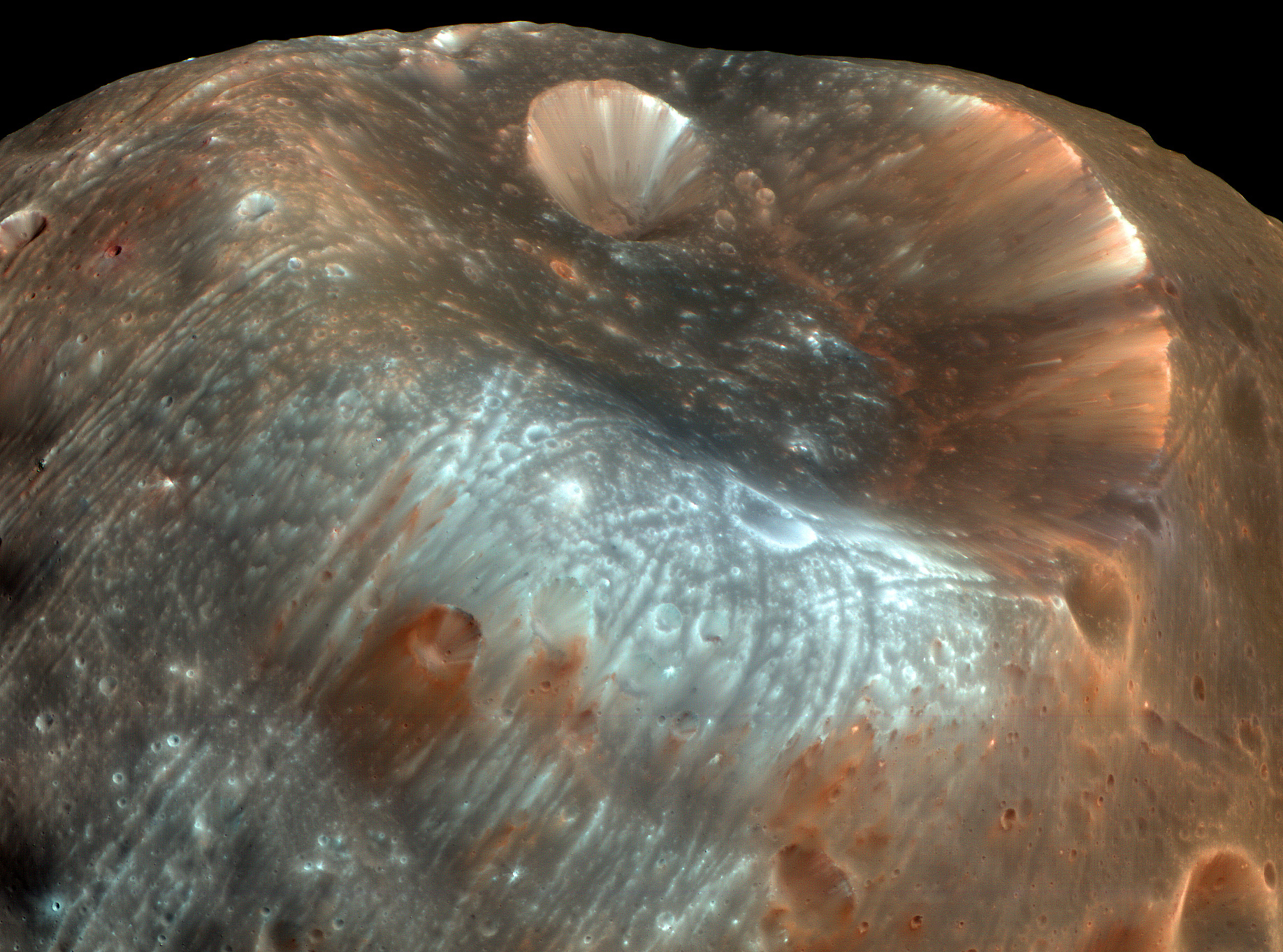
Stickney crater on Phobos. This large crater faces towards Mars. A base sited here would be protected from solar storms, and also from cosmic radiation. It's blocked by Mars overhead, Phobos below and the crater rim to all sides, and so gets only 10% of the cosmic radiation of an unprotected base.
Phobos also probably has a high percentage of material from Mars in its regolith, and larger meteorites surely as well. So you can study the geology of Mars by looking at fragments of rocks on the surface of Phobos. Possibly the biology of Mars also.
MATERIALS ON SETTLEMENT OF THE MARTIAN MOONS
Slide presentation: One Possible Small Step Toward Mars Landing: A Martian Moon - and more details: Page on caltech.edu
Spaceshow talk about the idea DrJosh Hopkins on David Livingston's Space Show
Concept map: Rationale for Human Exploration of Phobos and Deimos
The Scientific Rationale for Robotic Exploration of Phobos and Deimos : Scott L. Murchie
MINING PHOBOS AND DEIMOS
Deimos is also an asset for mining - it's not known for sure yet, but is similar in composition to meteorites that can have a large ice content. So it may have large deposits of water ice. If so that's of great value for fuel - and the delta v budget is such that it's actually one of the easier places to mine ice to return to LEO. As well as use in Mars orbit.
David Kuck in 1997 suggested starting up a Deimos Water Company to supply Earth orbit with water from Deimos. The Kuck mosquitoes are small unmanned craft that drill into Deimos and extract water from below the surface, use part of it as fuel to transport the rest back to Earth.
See also Mining Phobos and Deimos
This makes it a project that could be commercially viable, unlike Mars surface, through sale of ice to LEO.
LACK OF GRAVITY ON THE MARTIAN MOONS
There is one major issue of course - the gravity, almost none. Can humans stay healthy with such low levels of gravity? Or - can we create artificial gravity on the surface (spinning habs)?
But perhaps this can be done with either a carousel type approach or with centrifugal sleeping quarters for the crew. I think this all depends on what turns out to be the requirement for artificial gravity to keep a human body healthy, and on what our tolerances are for spinning motions in AG environments - which we don't know anything about as yet.
FREE FLYING HABITATS
Artificial gravity is probably an easy matter to arrange in a free flying settlement in orbit. You can use a tether system to generate gravity for the earlier settlements.
You can use materials from the Martian moons for shielding.
Long term, you could use materials from the Martian moons eventually to build Stanford Torus type settlements in Mars orbit. Deimos has a mass of 1.48 * 10^12 metric tons, which at 15 metric tons per square meter is enough to make Stanford Tori with about 100,000 square kilometers of living area.
So, if you were to mine the whole of Deimos - not suggesting we do - but if we do - that's cosmic radiation shielding for roughly the size of Iceland, larger than Scotland, or Norway, more than twice the size of Switzerland, which could be useful for Mars orbital colonies.
In terms of US states, that's about the size of Oregon or Colerado
That's just the outermost hull which you can build on top of - and larger habitats might well have multiple "shells" within it - so that's a lower bound on the total land are you could create from Deimos using it for cosmic radiation shielding.
Anyway that's obviously for some way down the road, if we ever do that.
PLANETARY PROTECTION ISSUES FOR DEIMOS AND PHOBOS
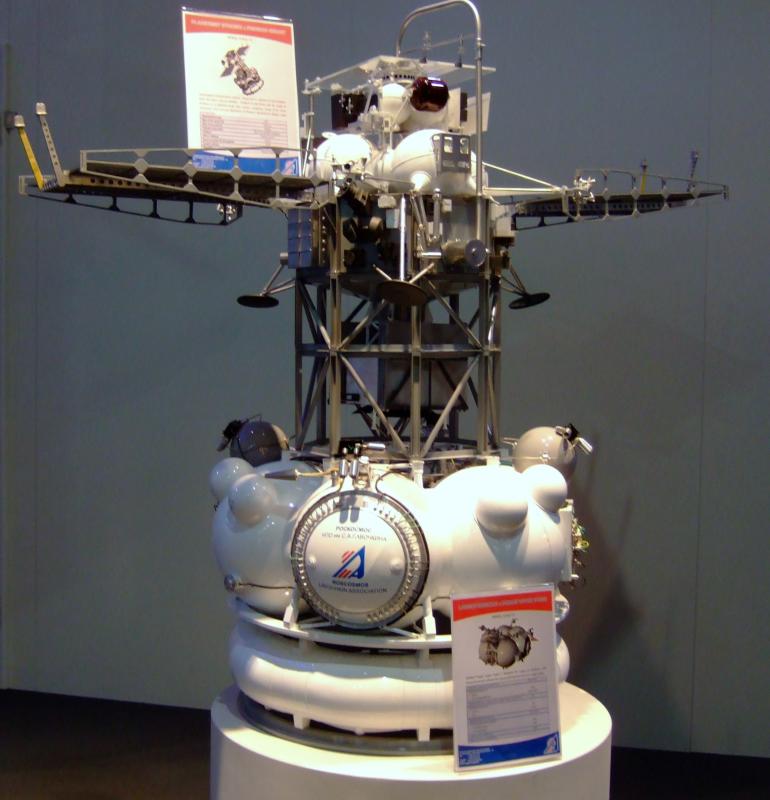
When Russia proposed a sample return from Phobos, then it was classified as a "unrestricted category V" mission, meaning that no special precautions are needed. Despite that, Russia did plan to take some precautions on return of the sample, though not required for planetary protection according to the classification their mission received.
The Russian Fobos-Grunt spacecraft, which was designed to return a sample from Phobos to Earth. The spacecraft never got there, it failed to separate and fell back to Earth and was burnt up. #this sample return got an "unrestricted category V" classification for planetary protection on the basis that Phobos couldn't be habitable for Earth life - but the Russians did plan to take some precautions even so.
There is no chance of present day life surviving on Phobos or Deimos to the best of our knowledge, no chance of habitability on the surface or below the surface. These moons are just too small to have any chance of liquid water even below the surface, so its thought.
But - there could be a very minute chance of dormant life, because Phobos receives material sent into orbit from Mars after meteorite impacts. Any life at least on the surface of Phobos would be sterilized over long time periods such as millions of years. But radioresistant life on Earth can resist the equivalent of 500,000 years of Mars surface cosmic radiation and so life on Mars, evolved in presence of cosmic radiation could conceivably resist at least that much and possibly more. And Stickney crater gets just a tenth of those levels of radiation, so dormant spores there there could survive ten times longer, and more so if somewhat buried.
So given that material is sent into orbit from Mars every one or two million years, with the last known impact large enough to send material as far as Earth a little over 700,000 years ago, there would seem to be a small chance of dormant life on Phobos - that is if life from Mars can be transferred on meteorites at all, which we don't know yet. But theoretically it would be possible.
I think myself that this suggests it would be worth while doing robotic in situ exploration of Phobos and Deimos first before we send humans there. And if signs of life are found there, dormant life, to re-evaluate the situation and take appropriate precautions depending on what is found.
In the forward direction also - then though to best of our knowledge, there is no chance of life from Earth surviving on Phobos or Deimos, there could be regions there of especial interest for the study of organics in the early solar system and dormant life. For instance what if there are ice deposits at the South pole of Deimos - including samples of organics from early Mars itself? Then we would need to keep humans well away from these until we have a chance to study them in situ and work out what effect a human base would have on them.
Could a human occupied base there be kept so clean that there is minimal impact on the study of ancient organics in the ice surrounding the base? If not, what can we do? By then we probably have experience already of bases on the Moon so may be able to use that to assess what impact a human base has on the area immediately surrounding it.
STEPPING STONES TO MARS
This is the title of the Lockheed Martin studies. They recommended a step by step approach. First, to send telerobotic expeditions to the far side of the Moon, operating rovers on the surface from a base station at the L2 position behind the Moon. This would have unique challenges and would also be of great scientific interest, as no rover or human surface mission has yet been sent to the far side of the Moon.
It's also a great place to work on telerobotics. The far side of the Moon is the most radio quiet place near to Earth because it is shielded from all radio transmissions from Earth by the thickness of the Moon itself. So one thing you could do there is to build radio telescopes.
This is an artist's impression of a telerobotic rover unrolling one leg of a radio antenna on the surface of Mars. (Joseph Lazio/JPL/Caltech)

Annother useful stepping stone would be to explore the craters of eternal night at the poles of the Moon by telepresence.
During these missions we'd find out about the Moon - including possibly finding meteorites from early Earth on the Moon - those could be of great interest for filling out the huge gap in our timeline between formation of the Moon and the earliest evidence we have of life on the planet.
The problem is that the continents didn't form right away on early Earth. There is nothing left at all from early Earth except a few zircons (like diamonds) trapped in later rocks. These trap the early Earth atmosphere but tell us little else about what was happening then. Any material from early Earth would be of huge interest to geologists and biologists. And if it had organics in it, or even preserved early life, of enormous interest. We might find these for instance preserved in the ice at the poles of the Moon, it's been suggested.
As well as developing telepresence experience while exploring the Moon in this way - and new science in its own right - we'd also develop the ability to mount long term missions distant from the Earth.
Could do that deliberately. Send a spacecraft to the L2, so Earth is permanently blocked from view by the Moon. Anyone living there for say a couple of years on end would feel as isolated as they would be on Mars pretty much. Yet - they can get back to Earth within a couple of days if necessary. And this could be a very inexpensive mission. Because it would also be testing the ability to survive a mission from Earth to Mars and back again. So has to take all their supplies with them. So just one launch to L2, of the crew + their supplies for, say, two years. Then they are on their own for the next two years studying the Moon from the L2 position via telepresence. If this works out, then we are perhaps ready to go to Mars. If any issues arise and they have to return to Earth or need emergency shipments from Earth to keep going, then no way are we ready yet to go to Mars.
Then later missions would be sent to Mars orbit and then to the Mars moons.
But before going to Phobos or Deimos, there are a couple of easier missions we can do first.
The HERRO mission suggested a near sun synchronous Molniya orbit, which is elongated, similar to a Mars capture orbit. This is the easiest to get to in terms of delta v, needing a similar amount of rocket fuel to a mission to the Moon for the same payload. This has the advantages that
- Less fuel to get there
- Approaches the sunny side of Mars twice a day,each time visiting the opposite hemisphere,so the entire surface of Mars is available for telepresence control every day
Robert Zubrin suggested a double flyby mission called Athena. The first flyby takes the spacecraft into an orbit resembling that of Mars itself. It then shadows Mars for half its orbit, so one Earth year. A second fly by takes it back to Earth 700 days after the launch. Advantages of this are
- Least delta v of all the proposals, so also the cheapest
- Astronauts are close enough to Mars for direct telerpresence control for several hours for each fly by, still remain close for days after the first flyby and before the second fly by, and close enough to be a major asset over Earth based control for the entire year.
Robert Zubrin's plan has several advantages over Denis Tito's Inspiration Mars, that you can do it more often, roughly every two years,, and it doesn't have the high speed return of Inspiration Mars so less issues with aerobraking into the Earth atmosphere on return, and you have far more time for near to Mars telerobotics. But is a longer mission by 200 days.
Both of these have the disadvantage that you have to take all your shielding for the entire mission with you.
With HERRO, later missions could mine Deimos for materials. If there is ice in Deimos; you could use this as rocket fuel to export this extra shielding to the habitat,
Also with of HERRO, and indeed for the other missions also, you could send supplies to Mars in advance in separate duplicate spaceships before the human mission gets there. Most of the cost of an innovative mission is in the design, so it often adds little to the costs, percentage wise, to make several duplicates of the spaceship.
So, you have a habitat there already, in orbit around Mars,and with all the systems functioning including life support. Preferably, have two such ships filled with extra supplies, before you send the first humans there.
They would be fully fueled lifeboat ships able to get the crew back to Earth, or for them to survive in if systems in the main ship fail. You can also ouse them as extra living space during the mission at Mars, and long term assets in Mars orbit. They could be filled with extra supplies, fuel and spare parts instead of crew and provisions for the journey out. These supplies could be used as extra shielding for the main ship for the stay at Mars. In the worst case you can also canabalize the other ships themselves, for repairs, or transfer the mission to another ship.
But - before Deimos, we could go to a Mars capture orbit.
That's as easy to get to as the surface of Mars in terms of delta v, but no need to land of course, and can get back to Earth safely.
Turns out, if you choose just the right orbit, it's ideal for studying Mars by telepresence. You use a slowly precessing sun synchronous Molniya type half sol orbit.
So, you have several hours of close up telepresence every 12 hours over opposite sides of Mars each time, also always on the sunny side of Mars. So the delta v is the same, to all intents and purposes as a Mars surface using aerobraking. But without the dangerous descent to Mars and without the expense of developing human rated landing equipment -I think pretty clear it would cost less than a surface mission.
This is a video I did which simulates the orbit they would use - in orbiter. I use a futuristic spacecraft as that was the easiest way to do it. Apart from that, it is the same as the orbit suggested for HERRO.
It would be a spectacular orbit and a tremendously humanly interesting and exciting mission to explore Mars this way.
I think myself also, it might help with "homesickness" as it were. From above, with its icecaps etc, Mars looks quite a bit like an Earth like planet. We know it isn't really, is freezing cold, vacuum, dark skies etc. But from above it looks quite Earth like. And continually changing views with these regular spectactular flybys, twice a day, passing close to the polar caps. And when exploring it by telepresence, we can arrange. through white balance, to have blue skies also when you look at it on the surface via VR - that would work better indeed because then you can see the colours of the rocks more clearly.
It's also better for science, the study for HERRO found that a single mission to explore Mars by telepresence from orbit would achieve more science return than three missions by the same number of crew to the surface - which of course would cost vastly more. Here is a powerpoint presentation from the HERRO team, with details of the comparison.
You could also do similar things with the earlier fly by missions. Especially if we can do Robert Zubrin's less well known "Double Athena" project. It's far better for telepresence than Inspiration Mars - that is - if we can crack the problem of how to have humans survive in space for as long as 700 days. It's a free return trajectory like Inspiration Mars, but works by first diverting into a sun centred orbit similar to Mars, "shadowing" Mars, then the second fly by of Mars an Earth year (half a Mars year) later diverts it back to the Earth.
I'm not sure that the Inspiration Mars 500 days is such an advantage over 700 days. I think if we can manage 500 days safely (surely not for a while yet) - then we can probably do 700 days also (as it is an extremely poor safety margin for Inspiration Mars if most astronauts are close to death at the end of 500 days). And the double Athena can be done every two years, doesn't need any special alignment with Venus, and it has a much slower return trajectory relative to Earth - can just do normal aerobraking much like the return from the Moon, which Inspiration Mars can't do because it has a far faster return velocity delta v relative to Earth.
Anyway its great advantage is that you are close enough to Mars for hours during each fly by - and in between you spend days really close, close enough to do things like drive rovers in real time and supervise experiments.
With all of these, we have to be really really careful that the human occupied ships can't impact on Mars, or any of our debris, human wastes etc.
Imagine yourself in orbit around Mars - in a Molniya orbit - comes round to the sunny side of Mars twice a Martian day - you go really close to the surface - and spend some time there controlling rovers on the surface - driving them around - with reality headsets like the Occulus Rift -
- the Mars astronauts in orbit could explore the surface with headsets like this - and haptic feedback gloves so you can feel what you are doing, and omni directional treadmills like the virtuix omni
and automatically enhanced vision
with everything you see on Mars streamed back to Earth so everyone back here can join in and see what you see exactly as you see it whenever you explore the surface of Mars.
Then after a few hours of that you see that Mars is now getting further away, becomes smaller, and then 12 hours later you come in again for another close approach and real time exploring - you can continue to explore all the time - but when you are really close you can control things on the surface in real time as if you were there.
And fly planes around on Mars, small planes, or entomopters - same design as a bumble bee.
Many other ideas like that - surely much more fun, to operate those from orbit around Mars, in a shirt sleeves environment than living a troglodite existence on the surface under meters thick layers of soil, going out only rarely to keep down your lifetime radiation dosage - and knowing all the time that just by being there you have contaminated Mars and made it far harder for scientists to find out interesting things about biology and alternative forms of biology and the early history of evolution.
Also great for collaboration - probably big international expedition to send the humans out to orbit around Mars - but then - you'd also have all the landers, for them to operate telerobotically. The more the better really, so something that all countries with interest in space could work on together, each contributing different things depending on their expertise.
And - if we were looking forwards towards such an expedition - all rovers to the surface of Mars could be fitted with binocular vision and hands with haptic feedback by default, so they could be controlled easily by telepresence whenever there are astronauts in close orbit around Mars.
But there is another thing we can do - and that's to do autonomous exploration from Earth, using "artificial real time" which lets you drive a rover around on Mars even with a huge time delay of minutes. At the moment the way we control our rovers on Mars is hugely time inefficient. We could as easily control rovers on Pluto, because they download the data for one day, and use that to direct the rover's operations for the next day.
There's no point in trying to speed that up though, because it is hard to get a data link from Mars to Earth. Once a day is about all we can manage easily, because our orbiters have their own work to do.
If we have a dedicated link though between Mars and Earth, satellites in orbit around Mars just to relay signals to Earth - our rovers could be hugely speeded up.
And - in a situation like that, we could also speed them up so much that using this idea of "artificial real time" from computer games, we could control them almost as easily as a rover on the Moon (say).
Standing Space found this interesting video about the idea: