Kim Stanley Robinson in his famous Trilogy Red, Green and Blue Mars describes a science fiction future with Mars changing colour to green and then to blue. However there are many other colours Mars could have as a result of human terraforming attempts or accidental or deliberate planet alterations. Snowball White is perhaps most likely after a failed terraforming attempt. With other scenarios, it could be black (or darker in colour) or purple or other colours.
I thought this would be a great way to explore some of the complexities of planetary transformation, to imagine the possible future colours of Mars. I'm doing this also as a contribution to ideas for a possible future art event in Finland, on "Imaginary Colonialism", by the artist Egle Oddo and composer, artist, translator and poet Timo Tuhkanen, inspired by my articles here.
Here are these six colours of Mars in a single slide, plus the last one which represents "none of the above" - it will make sense when we get to that part of this article.
Mars: White, Red, Purple, Green, Blue, Black, Or None Of The Above

These images are meant as visual coat pegs to attach the discussion to. I don't claim that they show scientifically accurate simulations of the visual appearances of possible future Mars.
WHITE SNOWBALL MARS

Partially Snowball Mars - it gets like this naturally when the axial tilt is very high. But if the amount of water and CO2 available on the surface increases it could be like this all the time, sometimes maybe completely covered in ice.
I don't know of any study of this, but a snowball or partially snowball Mars seems perhaps the most likely effect of a failed terraforming attempt, if the attempt involved importing water and carbon dioxide to Mars e.g. by diverting comets to impact on it, or some method that involves liberating water and dry ice from deep below the surface of Mars and returning it to the surface.
The excess water and CO2, as the planet cools down, would creates ice caps larger than those today.
Earth got out of its snowball Earth phases because of continental drift, which returns limestone to the atmosphere as carbon dioxide, a greenhouse gas. But Mars has no continental drift, and does have some volcanic activity, but not much, no currently active volcanoes (unlike Earth which has numerous active volcanoes every year). It is able to stay relatively warm mainly because it is so dry.
With more water than it has now, and more dry ice, it would not be able to escape from a snowball phase in the same way that Earth did.
PRISTINE RED MARS
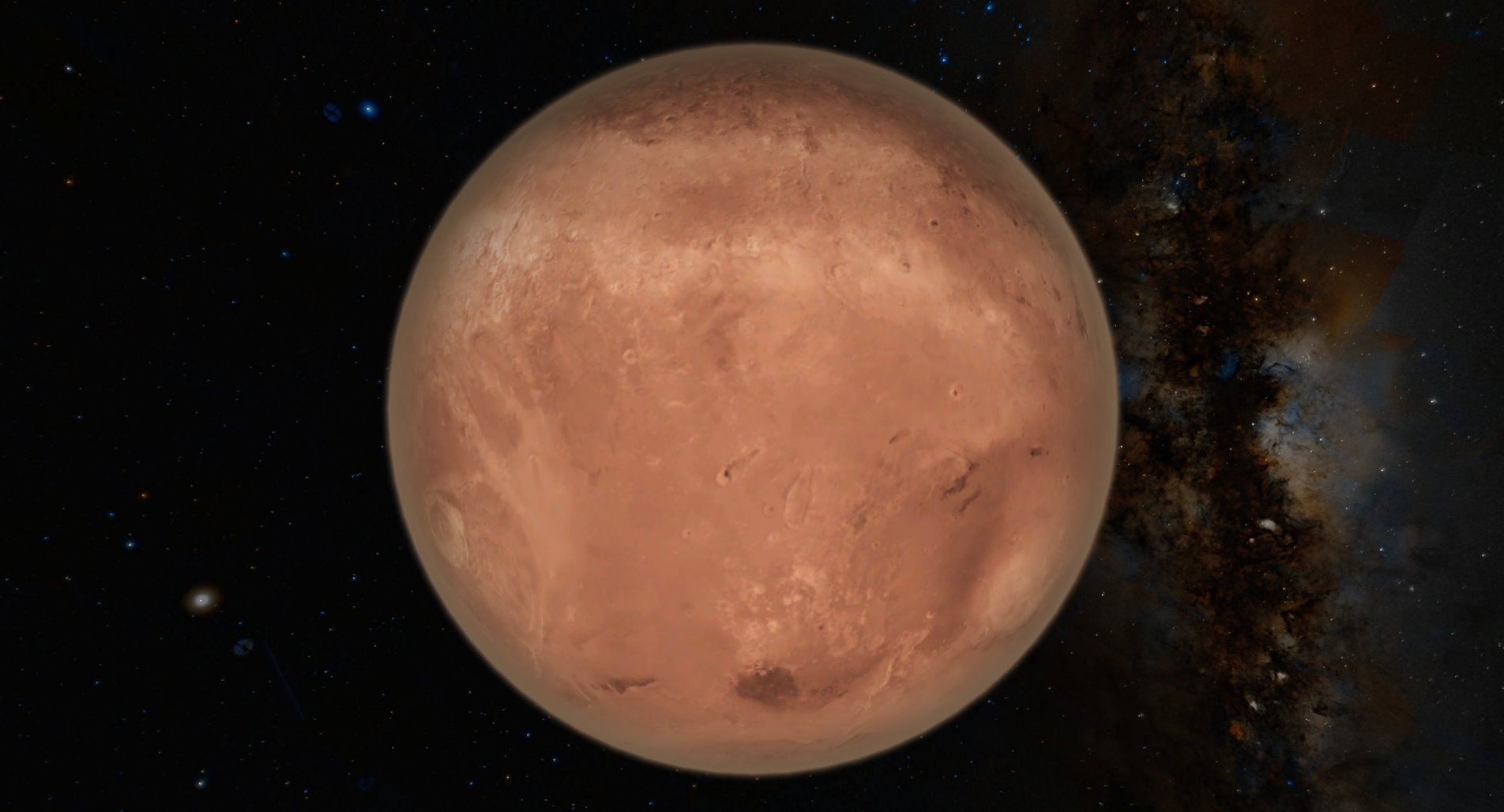
This image is actually not a photograph, but a rendering in Orbiter
This is the future if Mars is kept unchanged, just as it is. We decide not to colonize, not to land humans there, leave it exactly as it is.
If Mars turns out to be interestingly different for life, perhaps this is what we'll do. Or if it turns out that life can survive there, but we see many issues arising if we introduce life to the planet, again we might decide to leave it pristine.
There's no imperative to colonize Mars. If we want to set up colonies outside of Earth, then the most natural place to being is close to Earth, and you can make surprisingly large colonies from not much material.
A 300 meter near earth asteroid has enough material to provide cosmic radiation shielding for an entire Stanford Torus with 20,000 inhabitants. The cosmic radiation shielding, at 4.5 tons per square meter of surface area is the main part of the bulk of the materials needed.
Video fly through of a Stanford Torus type habitat by Uzi Bento
You could make a habitat like this using materials mined from a small NEO such as 4660 Nereus
4660 Nereus, 300 meters diameter, NEO, easier to get to than the Moon, has more than enough material for the cosmic radiation shielding (main part of the mass) for an entire Stanford Torus with 10,000 inhabitants.
If we used all the materials in the asteroid belt we could make enough habitats to provide ground area of 1000 times the surface area of the Earth - and that's just the ground floor of the colony. Typical colony worlds may well have many levels within that - which would not need additional shielding.
This method of construction also makes it much easier to build large spacious habitats - imagine trying to build a Stanford torus on the Moon! The gravity would make it really hard to construct, and as for spinning it to generate extra gravity, that would be a major engineering challenge.
For more about all this see my Asteroid Resources Could Create Space Habs For Trillions; Land Area Of A Thousand Earths
So in a future solar system with space settlements, there won't be any pressure on Mars as a place to live, there will be plenty of living space for everyone in free space.
This is a calculation that goes back to the 1970s and was the original reason why O'Neil and the team at Stanford and other researchers imagined their colonies in space rather than on the Moon or planetary surfaces. The situation is still the same today. Free space may well be the easiest place to build future settlements and certainly it gives more space to expand.
PURPLE MARS

I did this by adjusting the colours of stage 2 of MarsTransitionV by Daeen Ballard.
Chris McKay has the idea that if there is interestingly different life on Mars then we might "Mars form" it - transform Mars to make it more habitable for the life already there. For instance if it needs more warmth or water, then adjust Mars to make things easier for it. Also you would take care not to introduce any Earth life to the planet apart from whatever microbes might already be shared between the planets - and he envisions us sending rovers to Mars to remove all the spacecraft already there or sterilize them, as well as sterilize any microbes that may have got into the soil in their vicinity (e.g. for the crashed spacecraft).
In this image, I imagined, what if the indigenous Mars photosynthetic life is purple? There's no particularly strong reason for Mars photosynthetic life to be green. Its atmosphere lets through most colours - though it does block a fair bit of blue light through scattering of fine dust in the upper atmosphere, which is what colours the Martian sky. Purple pigments absorb yellow and green light and reflect red and blue light.
It's not so surprising an idea. After all, we already have red photosynthetic pigments here on Earth for the halobacteria, which make the Red Sea red. When concentrated, you get a purple colour like this
A salty pond in the Arabian desert, colored red due to the presence of Halobacterium salinarum.

So, what if the dominant photosynthetic life form on early Mars, both on land and in the sea, was purple like this, and still survives there to this day? After making conditions hospitable for it to flourish again, it might turn the entire planet purple.
Of course it might turn it other colours as well. This image is just a place holder for the idea.
GREEN MARS
This seems possible if the terraforming scenarios worke - but Kimley Stanley Robinson's time-scale is accelerated compared with the ideas of the most optimistic terraformers.
Here is how they envision it in the Mars Society

Images from the Big Idea (National Geographic Magazine)
See also, How we will terraform Mars - by Jason Shankel and Terrafprming Mars by Nicole Willet

But there's much to go wrong. If you moved Earth out to the Mars orbit, all its oceans would freeze of course, leading to White Mars. So that has to be prevented.
(Image from Sunlight on Mars - teacher's resource which examines possibility of agriculture on the Mars surface)

This landscape would need to be kept warm with some warming method such as artificially or naturally created extra greenhouse gases or giant mirrors or both.
Then it could be other colours also, why should the vegetation that evolves on Mars be green as it is on Earth? Whatever you seed it with, evolution will cause new species to arise and spread over the planet. With the planet so different, it's likely to develop its own novel lifeforms, even starting with Earth life as the basis.
Still - green Mars is a possibility, so this image is a placeholder for a future Mars that gets terraformed with plants that are reasonably congenial to human habitation, whatever colour they turn out to be.
BLUE MARS
This is the one the terraformers would like to see:

Mars society estimate a thousand years to reach this point, followed by several millennia to get to the stage where there is enough oxygen in the atmosphere to breath.
Others estimate it would take a hundred thousand years to get the oxygen.
But maybe all that can be solved with unlimited sustainable and controlled fusion power - or solar power beamed from space - and nano technology or mega-engineering.
There are also issues with stability. How exactly do you keep the climate warm enough to stop the water freezing, given that Earth, moved out to Mars orbit, would go straight into a greenhouse phase? Do you rely on mirrors in space to achieve this?
The Mars society suggestion has giant mirrors in orbit to keep the planet warm.
Here is an artist's impression of a similar idea - this time to warm up a single spot on Mars.


To terraform Mars you'd need greenhouse gases, or many giant mirrors in space like that - or both
But you'd also need to keep the planet warm once terraformed, or it would revert to a snowball phase. So a future terraformed Mars would probably be surrounded by giant mirrors in space and rely on continually functioning mega technology to keep warm.
There are many questions to answer here. Would the Earth cycles work in a third of normal gravity - which also needs three times as much CO2 and O2 to get the same pressure?
What do we do long term about the CO2 that gets trapped into limestone - a biological or engineering solution to return it to the atmosphere?
Would it stay terraformed long term without megatechnology? Or does the terraformed Mars depend on continuing high technology civilization through into the future for hundreds of millions of years, and would it unterraform with extinction of its inhabitants if they lost the technology? If so - surely we have some moral responsibility to those future inhabitants, whose world we helped to create?
Can humans survive on Mars anyway with a third of normal gravity? Would they perhaps need spinning modules to live in to function normally and be healthy, or else be biologically adapated to Mars?
Maybe we can solve all those problems in the future, I don't think we have the technology or knowledge to do it right now.
But if it does turn out possible, this image shows the result.
BLACK MARS
This is an imagined result of a contaminated Mars, a life form spreading rapidly over the surface after a human landing, turning the planet darker in colour.
The idea behind this possibility goes back to Carl Sagan. He pointed out that the iron oxides would provide protection from ultraviolet light to microbes imbedded in a grain of dust. In this way, some forms of life might spread over the entire surface of Mars. He calculated that a microbe reproducing as slowly as once a month, if not limited by conditions there, could create a microbial population equal to that of Earth soil over the entire surface of Mars within a decade. Of course this doesn't mean that Mars would get a population like Earth because of the harsh conditions there - but if niches suitable for life were widespread, and if life could also get transferred to them easily in the wind, then there wouldn't be much to prevent life from colonising the entire surface within a few years.
The main reason we are so careful about sterilizing rovers to Mars is because of concern that something like this might happen, either a dramatic change like this - or a more subtle, but pervasive change of the entire planet.

This is just an old Viking photograph of the whole of Mars, adjusted to make it a bit darker, but it serves to illustrate the idea, that Mars could turn darker.
If humans land on Mars then they will introduce many new life forms to Mars, as a typical human is host to a hundred trillion microbes in ten thousand different species, and you also have them in our food, plants and air.
Most will surely die soon. but some may survive and spread. The DLR experiments showed that lichens, and cyanobacteria may well be able to survive on Mars even without moisture, in partial shade, using the hundred percent night time humidity. You get morning frosts even in equatorial regions of Mars so there is water vapour there - it just gets evaporated each day to leave the surface totally dry, and freezes at night so is unavailable to life then either. But some life can take water vapour directly from the atmopshere, and may be able to survive on Mars using the 100% night time humidity.
Lichens can come in many colours including black.You can imagine black would be selected for, because black lichens would warm up more quickly and be better able to take advantage of whatever warmth there is. Now, lichens grow very slowly and spread slowly. But cyanobacteria also come in different colours including red and black. A micro-organism only needs to reproduce once a month to cover the entire surface of Mars well within a decade.
Here, I've imagined that Mars gets colonized by a dark cyanobacteria. This is the fastest of the possible colour changes, this could be what Mars looks like within ten years of first human habitat to land on Mars, if one of the microbes finds Mars conditions to its liking and spreads out of control. We might be able to actually watch the life spread over Mars year by year. Would be fascinating to watch and see what it does - but a disaster for planetary science, especially exobiology.
It might be a visible change like this - or perhaps more likely, a subtle change you can only see easily on the ground, dark patches and smudges on the rocks and sand here and there spreading out over the landscape.
Though not strictly speaking black, the press would probably call it "Black Mars" if this happened.
It's not as if we can roll back and try again - or travel to another solar system to find a pristine Mars equivalent if we mess up this one.
Just one of many possibilities of course. Could be green cyanobacteria, or lichens for instance. Then, by analogy with the Atacama desert or McMurdo dry valleys, might well be cryptic life also, layers of microbes you see if you dig into the sand or crack open a rock. Might also spread far more slowly than this - but once started would be inevitable.
However it happens, this outcome could potentially lead to extinction of extant species on Mars before they have been "discovered".
It would certainly make it much harder to study Mars as any experiments to search for biosignatures would find the amino acids and DNA of the black cyanobacteria - or whatever the contaminating life form is.
And the life form might be one that is a nuisance to humans or one that gets in the way of future attempts to terraform. Could produce toxic biproducts - after all green algae produce a toxic chemical that causes Alzheimers on Earth - not through any adapatation to humans but just because the chemical happens to resemble a biochemical used by the human body. Or could be an allergen etc.
The main problem here is - on Earth if we detect that a species, say of cane toad, is causing problems, there is a possibility of eradicating it - though often as with Australia it's impossible to do that.
On Mars, then unless the contamination has only spread a very short way - say a few meters around a crashed spacecraft, then there is almost no chance of reversing it. Once hardy spores begin to spread in the dust, it's really hard to see how we could do anything about it, even with possible future technologies we don't have yet.
NONE OF THE ABOVE
There are many other things that could happen to Mars. If we "Mars form" it then native life could be orange, cyan, yellow, many different colours, and change the colour of the planet accordingly.
Then other things could go wrong during the terraforming process. For instance, an atmosphere of methane, or a species that gets out of control not as intended, so instead of going green it goes another colour, whatever is the colour of the out of control species. Which could be just about any of the colours you get of living microbes on Earth - and possibly more colours unique to Mars.
To get an idea of the range, check out the Microbial Art website - artworks created in a petri dish using microbes.
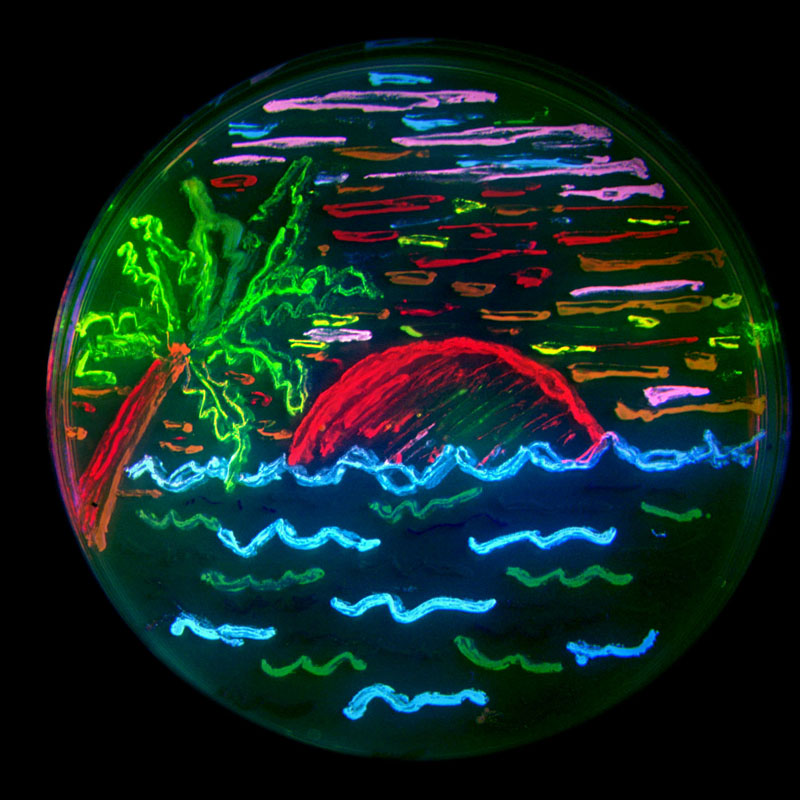
Microbial art by Roger Tsien - using various bio-engineered fluorescent proteins - attempts to terraform Mars might also use bio-engineered organisms, which might then go "wild" and spread over the planet and evolve in unexpected ways.

Check out Microbial Art for many more petri dish images - terraforming or Mars forming gone wrong could turn the entire surface of Mars into a giant petri dish with unpredictable results - and if it doesn't follow the exact course planned out for it by the terraformers, you could end up with species in almost any colours, dominating the planet.
WE SHOULDN'T MAKE MARS INTO A GIANT PETRI DISH FOR OUR EXPERIMENTS - OP ED
It might possibly create great art - but - expressing an opinion here - this is an opinion piece - we shouldn't use a planet as our canvas for accidental art like this. We can create giant habitats in space if we want to paint our experiments across a large canvas in space - using materials from the asteroid belt.
When it comes to planets, especially planets with atmospheres, I think we need to know what we are doing, and why we are doing it before we alter them biologically. That's because planets are large, the surface is interconnected through winds, introduction of life to a planet is irreversible, and there are so few planets in our solar system. We have only one other planet capable of hosting life on its surface - or possibly two if the Venusian clouds can also harbour life.
Whatever we might do to them biologically, it will have a strong element of unpredictability - unless we develop some really have some revolutionary new understanding of biology and planet cycles.
Certainly as we are now, when we have endless debates about whether or not 0.01% of CO2 is changing our climate, and what the effects are, we are far from the levels of understanding we need to predict what will happen to another planet.
Personally - I think that suggests that we recommend restraint and caution. We don't know which colour of Mars our descendants will want to have - or the detailed ecology they will want - will they want it Mars formed, Earth formed, or transformed in some way that is neither Earth or Mars inspired?
We have made many ecological and biological mistakes on Earth with accidental, and sometimes deliberate, transfer of species between continents. We don't want Mars to be one of our biggest biological and exobiological mistakes so far - and written in the sky for all future generations to deal with.
Even if we could somehow know what our descendants might want Mars to be like, a few centuries or millennia from now, then, on present day scientific understanding, we have no way of ensuring that it reaches one of these particular end goals rather than other ones.
It's great to explore ideas for terraforming Mars, and just by doing that, we may learn more about how planets work, and get insights into how the planetary cycles work on Earth. James Lovelock's Gaia hypothesis, for instance arose out of study of planetary atmospheres.
But - I think, personally, that we should think long and hard before commiting to any decision to treat Mars as a giant petri dish in the sky for an experiment, accidental or intentional, in transferring life to a new planet.
Anyway, Timo and Egle, hope this gives you a few interesting ideas for the exhibition.
As usual, if you have any comments, thoughts, ideas, corrections, anything you want to share do use the comments below.
This is an "opinion piece" or "op ed" expressing a strong personal point of view on these issues for discussion. Do feel equally free to present your own points of view in the comments section, and let's get a discussion going, or at least, an exchange of views.
For background material see my Science20 articles, such as Trouble with terraforming Mars.