This is something James Lovelock, author of the Gaia Hypothesis, predicted, way back in 1967. He said that Mars is lifeless, based on nothing more elaborate than the simple observation that it's atmosphere is in chemical equilibrium.. Nine years later, Viking I and II found a barren desert-like surface in 1976, which seemed to confirm his conclusions.
However, just the next year, 1977 we found the first of many exceptions to his argument. We now know that it is consistent with life on Mars in its past, deep underground, life that returns to the surface only every few million years, and sparse populations on the surface right now..
Then just last year we found out that the atmosphere of early Mars could go way out of chemical equilibrium in the absence of life. So in short his argument is no longer conclusive in either direction. A planet can be a long way out of equilibrium, without life. And a planet with life, even on the surface, can be in near chemical equilibrium.
I thought it might be a good way to go into this in some detail - why exobiologists are still interested in possibility of life on past or present day Mars after all this time, and why exactly it is that James Lovelock's argument no longer rules out life on Mars.
Of course,none of this detracts from it as an insightful and truly remarkable early landmark paper in his field..It eventually lead him to develop his Gaia hypothesis.
ORIGINAL ARGUMENT
Lovelock took as his starting point a simple observation - that the planet's atmosphere is in a state of chemical equilibrium - and - he argued - any life on the planet would throw it out of equilibrium. For his original paper see Life detection by atmospheric analysis (1967).
At this point we had no observations from the Mars surface - the only close up information he had was from the Mariner 4 flyby.
Our best image of Mars when James Lovelock's paper was published - this was taken by Mariner 4 in 1964.

But he didn't need any observations from close up. Its atmospheric composition is something we can measure from Earth, by clever disentangling of doppler shirts - a technique pioneered in the Leck Observatory observatory in the 1920s.
This was a convincing argument at the time - especially as it seemed to be confirmed by the Viking results. Most of the experiments, indeed, didn't detect any life on Mars.
One experiment gave ambiguous results - for more about this, see Rhythms From Martian Sands - What Did Our Viking Landers Find in 1976? Astonishingly, We Don't Know
However, at the time, persuaded by his argument, and the results of the other experiments - most scientists concluded that, indeed, Mars is completely lifeless.
There is no doubt that his paper was an important contribution to the field - and it went on to become the foundation of his influential and important "Gaia" theory.
However almost immediately, scientists began to find exceptions to his conclusions.
FIRST EXCEPTIONS - LIFE WITH NO COMMUNICATION WITH THE SURFACE
First of all, just a few years later, scientists discovered the hydrothermal vent communities around the black and white "smokers" on the sea beds. They form at great depths, where the Earth's plates are pulled apart along the mid ocean ridges.
This was in 1977, just a year after the Viking lander on Mars, and ten years after Lovelock's paper, with the first paper on the subject published in September 1977.
These were able to survive with almost no communication with the surface. The higher lifeforms there did use oxygen disolved in the water. Some of the microbes however didn't rely on anything except chemical energy and did not need oxygen.
Hydrothermal vent

Tubeworms deep under the ocean living on the hydrothermal vent
Complex flow of chemicals for a hydrothermal vent. See Deep sea vents (Microbe wiki)

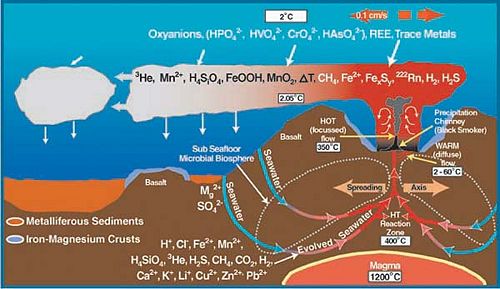
The interesting thing here is - that a planet could have communities like this at the depth of oceans - and they would have no effect at all on the atmosphere. Even the chemical biproducts just get disolved in the ocean and do not return to the atmosphere.
This is just the first of many such discoveries. Now we also have cold seeps, where microbes use methane and hydrogen sulfide as an energy source
See Cold Seep Communities

Also underground caves that have almost no communication with the surface. Such as microbes in the Lechugulla cave, isolated from the surface for millions of years.
The caves were carved out by sulfuric acid - which recently was drained exposing the giant crystals.

Also life kilometers underground within the rocks themselves.
the "Worm from Hell" from 1.3 kms deep, about half a mm long, lives on microbes, need minimal oxygen.

None of these would have a significant effect on the atmosphere of Mars.
So - then some began to put forward the view that Mars could have life - but only in caves or deep underground, in some way not connected to the surface.
It might also have life in its hydrosphere. Unlike Earth, Mars has a cryosphere over its entire surface - a deep layer which remains at temperatures below freezing point of water. But deep down, temperature rizes, and a few kilometers below the surface - it gets warm enough - and also pressures high enough - so tht there may well be a layer of liquid water. Possibly a hundred meters thick, possibly deeper. This could be an ideal habitat for microbial life - almost completely disconnected from the surface.

Pole to pole cross section of Mars showing the cryosphere - permanently cold enough for ice - and below it, the saline groundwater. This may well be the most habitable region of Mars - on Earth similar habitats deep below the surface have abundant life - but may not be much exchange with the surface.
Mars probably also has hot spots - as it has been geologically active in the recent geological past (though no confirmation yet of any present day hot spots and geological activity). If so - if the hot spot is beneath a "trapping layer" much like an oil field - it could provide another habitat with liquid water and almost no communication with the surface.
SNOWBALL OR SLUSHBALL EARTH
Then a bit later we discovered - first that Earth has gone through phases in the past when it was covered in ice, or almost completely so. This is the Snowball - or Slushball Earth
Slushball Earth

It might have had some open ocean in the tropical regions as in that image, or could have been completely covered in ice
Possible Snowball Earth models

Last one was just before the Cambrian explosion of multi-cellular life - and might have helped to trigger it.
So - rather than a continuous thing - that when you have life on a planet - it stays in an equilibrium rich with life - it became clear that planets vary in their habitability and can go through long stretches when there is almost no life there at all.
For millions of years - the entire surface of Earth -except possibly a small region of pack ice near the equator - was completely covered in ice. Was as barren as Antarctica - but without the penguins of course.
There was life there - but so little - that if you had landed a Viking probe on a random spot on Earth, chances are you would not have spotted a thing.
That could potentially have been the end of the story for evolution on Earth. Because - once a planet is covered in ice -then it is highly reflective, so it doesn't absorb as much heat from the sun - so it just stays cold from then on.
Now the way that Earth got out of it, is that, because it has continental drift, then eventually limestone that deposited in the oceans during its warm phase gets subducted beneath the continents, and then returns to the atmosphere in volcanoes. With no life to turn that back into organics, and no oceans for the CO2 to disolve into - then the atmosphere got richer and richer in CO2
Finally the ice over the oceans began to melt, and life started to flourish again.
http://www.aslo.org/lo/toc/vol_51/issue_4/1801.pdf
SNOWBALL MARS
This then raises the interesting idea - what if the same thing happened on Mars?
We now have pretty conclusive evidence that Mars had a shallow ocean covering much of its northern hemisphere in the first few hundred million years of the solar system (and briefly again a billion years later).
At the very beginning, it's thought that Mars, Earth and Venus were almost identical with dense CO2 rich atmospheres of tens of atmospheres of pressure - which raised the boiling point of water permitting all three planets to have global oceans of water well above boiling point - much like planetary pressure cookers.
These atmospheres were also nitrogen rich - and the seas were rich in nitrates formed during asteroid impacts in the "Late heavy bombardment" - and probably also organics delivered by comets.
Mars is further out from the sun of course, and had no Moon impact. So life may have begun there earlier than on Earth. It cooled down more quickly however - and entered the snowball phase far sooner than Earth.
And - Mars has no continental drift. So unlike Earth which went through many snowball phases and survived - Mars just got colder and colder. There were temporary respites - floods perhaps due to giant impacts - also its axial tilt and orbit changes far more than the Earth's so that also led it's oceans to melt from time to time.
But before long it went into a permanent snowball phase. And then eventually - the ice disappeared as well - either lost to space - or underground - we don't know. At any rate it is currently as cold or colder than Snowball Earth ever was - but without any ice so dry as well.
So - let's suppose for purposes of discussion that Mars did have life in the early solar system? What would happen to it as a result of this snowball phase?
Well - to start with for sure, would be like Earth. There is life there - but it's hard to detect and mainly underground.
What little there was left on the surface - would have no detectable effect at all on the atmosphere.
If we were to spot an exoplanet like that around another star - then again - we would have no way of knowing that there is life there. And if you landed Curiosity on it - you would not expect to find anything.
Eventually - you might think - with the surface completely frozen, and no liquid water - it would be totally underground - so - this seems, on the face of it - to feed into the idea that Mars must be totally lifeless on the surface - and only have life deep underground.
How could it have any life on the surface if there is no liquid water there?
Well various discoveries in Antarctica and in the permafrost layer can give some clues here
MICROBES THAT ARE ALMOST DORMANT - BUT NOT QUITE
Some deep sea microbes have such a slow metabolic rate that they take 1000 years to divide, They have a metabolic rate of a millionth, or a ten millionth of a grams of carbon per hour for every gram of carbon in the cell (typical rates are between a tenth and a thousandth of a gram of carbon per hour).
This obviously would have minimal effect on the atmosphere.
And some metabolize even more slowly.
Mars polar regions - one of the places where slowly metabolizing microbes may be able to survive, similar to P. cryohalolentis, an ordinary microbe but able to repair 10 DNA base pairs a year.

P. cryohalolentis a microbe which is not radioresistant enough to repair 600,000 year's worth of damage on the Earth was found still alive in 600,000 year old deposits in permafrost and Antarctic sea ice, still viable. The researchers believe it did this by metabolizing extremely slowly throughout the time period, using its ability to slowly repair DNA damage at about 10 base pairs of DNA a year.
This makes it a good candidate for a Mars microbe also. It might also have reproduced, but it might have survived simply by using a slow metabolism + DNA repair. See Even Ordinary Microbes May Survive Radiation on Mars
LIFE THAT CAN SURVIVE IN TINY MICROHABITATS.
OXYGEN PRODUCTION ON MARS - WOULD WE DETECT ANY SIGNS OF SURFACE LIFE IN ITS ATMOSPHERE?
We can get some idea of this from measurements of microbal mats in ice covered lakes in the dry McMurdo valleys.
These measurements were taken in Lake Hoare
Lake Hoare (Antarctic explorers)


See Photosynthetic performance of benthic microbial mats in Lake Hoare, Antarctica
The researchers estimated oxygen production of the microbial mats at around 0.089 micrograms per square centimeter of surface per hour. That's 0.0089 grams per square kilometer per hour, or about 89 grams per square kilometer per year of oxygen production.
For the next step we need to know how long the oxygen remains in the atmosphere.
I can't find figures for Mars - anyone know (for methane it is 430 years)?
However, for Earth, atmospheric oxygen has a residence time of 4500 years. So, if oxygen lasts as long in the Mars atmosphere as it does on Earth, that takes it up to 4500 * 0.089 or around 0.4 tons per square kilometer in the atmosphere, if the entire surface was as habitable as ice covered lakes in Antarctica.
Using the average atmospheric pressure of 7 millibars, gravity 38% of Earth's, so 10 tons per square meter requires 26 tons per square meter on Mars, so 7 millibars requires about 0.182 tons per square meter, or about 182,000 tons per square kilometer.
So our 0.4 tons per square kilometer would contribute about 0.0002% by weight of oxygentothe Mars atmosphere.
Curiosity measured 0.145% of oxygen in the Mars atmosphere (mole fraction). We don't really need to convert that to percentage by weight - is clear that it would not spot oxygen at 0.0002%. And diurnal cycles are going to be about 0.4 parts per billion.
That is what would happen if the entire surface of Mars was as productive as the Antarctic ice covered lakes - and all that oxygen ends up in the atmosphere.
OXYGEN PRODUCTION IF LIFE IS EXCEEDINGLY RARE ON MARS
Life on Mars is likely to be far rarer than this though, it's hardly likely that the surface has on average as much photosynthetic life as an ice covered lake in Antarctica.
Suppose that it only occurs in the warm seasonal flows?
These are exceedingly rare. Each asterisk on this map shows one of the sites

Sixteen sites in total marked, over entire surface of Mars. See Water seems to flow freely on Mars
So there aren't many of them. And the habitats themselves consist of just thin streaks on the slopes like this

Suppose, for example, that we had a total of ten square kilometers surface area of these dark streaks on Mars - I mean just the streaks themselves. I expect that's an over estimate - but - this is just to give a very rough idea of what's involved here.
Suppose that they really are liquid water, as they seem to be - and suppose they are all inhabited by biofilm of life to a depth of a few mms as in Antarctica. And suppose these are all photosynthetic lifeforms.
Then that would be less than 1 kg of oxygen production over entire Mars surface, per year, and assuming a residence time of 4500 years, then a total of 4 tons of oxygen in the atmosphere.
If we look at Nilton Renno's more recent idea, the potential habitats are widespread over the surface of Mars - but they are tiny drops of liquid that form for a few hours a day, a few days a year.
""Based on the results of our experiment, we expect this soft ice that can liquify perhaps a few days per year, perhaps a few hours a day, almost anywhere on Mars. So going from mid lattitudes all the way to the polar regions. This is a small amount of liquid water. But for a bacteria, that would be a huge swimming pool - a little droplet of water is a huge amount of water for a bacteria. So, a small amount of water is enough for you to be able to create conditions for Mars to be habitable today'. And we believe this is possible in the shallow subsurface, and even the surface of the Mars polar region for a few hours per day during the spring." (transcript from 2 minutes into the video onwards)"
That's Nilton Renno, who lead the team of researchers. See also Martian salts must touch ice to make liquid water, study shows
LIFE THAT CAN SURVIVE WITHOUT WATER AT ALL - ALMOST BUT NOT COMPLETELY LIFELESS DESERT HABITATS
This leads to another discovery. Remarkably, there are several completely dry habitats on the Earth - cold and dry - with no liquid water - that still have life in them.
They have life that is able to eek a slow existence some of them. Some of these are amongst the longest lived microbes, with individual lifetimes of millennia.
And - they don't just go into a dormant state - they actually metabolize - extremely slowly - for thousands of years.
They live beneath the surfaces of rocks, in the Atacama desert - and the McMurdo dry valleys - and other microbes live in deposits of pure salt, sometimes meters below the surface of the Atacama desert.
One way they can take in water is through using deliquescing salts. Even at temperatures well below zero, then salt can take in water vapour from the atmosphere to form a very salty films of brine - just damp patches.
Some microbes also can take in moisture directly from the humidity of the air. Though the air is very dry in these places - the absolute humidity is tiny - still - it is also very cold. And air as it gets colder loses its carrying power for moisture - so the night time relative humidity can get quite high.
On Mars you get 100% relative humidity at night.
So - some microbes are able to access this humidity in the air. Some have microscopic structures on their surfaces that help them to extract the humidity from the air even at well below 100% - and others - they depend on the salt deposits they live in to extract the humidity.
Then, we also found microhabitats on Mars, where water can form briefly. The droplets on Phoenix's legs in 2008. The warm seasonal flows. And more recently, Nitton
SAME THING ON MARS
So - this process could also happen on Mars - and remarkably - it turns out that it has all the ingredients in place to make it possible.
It is indeed extremely dry - more so than the Earth - over most of the surface of Mars it is so dry - that water boils at a few degrees centigrade - and in many places - it boils instantly as soon as it forms. This means that any water that forms will dry out very quickly.
However - at night it still has 100% humidity because of the extreme changes of temperature between day and night - and the salts can take in night time humidity through deliquescence. And microbes like those in the Atacama desert or the Arctic and high alpine lichens studied by DLR - they could take up the Mars night time humidity directly from the atmosphere.
That's not just speculation - DLR did a series of experiments in a simulated Mars environment to show that this does actually happen. That's with Earth lifeforms - so not particularly adapted to Mars environments. Remarkably - they are also able to heal themselves from damage caused by UV light - and by cosmic radiation.
Some Earth microbes can heal themselves from the damage caused by 32 years of cosmic radiation on Mars in just three hours of metabolizing. This is - real time healing of the DNA - which is held in a special donut shaped receptacle inside the organism which helps to keep the fragments close to each other after they are sliced apart by the cosmic radiation - and as soon as they get the chance to metabolize again - just for a few hours - an automatic mechanism gets underway that joins all the fragments back together again to remake the original DNA - without errors.
It's quite remarkable. And even more remarkable is - that it is not an adaptation to cosmic radiation - as in their natural environment they do not encounter cosmic radiation at all - not in levels similar to the Mars environment. Instead - the best guess seems to be that it is a biproduct of adaptations that give them resistance to desiccation.
They can also heal from far longer periods of cosmic radiation, given enough time to metabolize and complete the healing process. One of these extremophile radioresistant microbes waking up even after several millennia of dormancy could heal itself completely.
So - goodness knows what a Mars microbe adapted through billions of years of cosmic radiation might be able to achieve in this direction.
One major problem for life on Mars is the lack of nitrogen in the Mars atmosphere. Nitrogen is essential to life as we know it. However - Mars does have a bit of nitrogen in its atmosphere. And meteorite impacts continually deliver nitrates to Mars. Indeed it's surprising how little is found there - and a major question - what happens to all the nitrates delivered on meteorites to Mars? Nitrates can also form through lightning.
Also in the very early Mars - then it's thought that large amounts of nitrogen were formed through meteorite impacts (also through lightning etc) back when Mars had a nitrogen rich atmosphere.
So - Mars might have some deposits of nitrates still left and small amounts delivered to it. This was just a hypothesis until last year -when Curiosity discovered the first conclusive evidence of nitrates on Mars.
So - it does have nitrates - patchy surely, low levels - but are present. And remember Curiosity can't drill even cms below the surface.
The McMurdo dry valleys and the Atacama deserts are similarly challenging in this way also - not much at all by way of nitrates - unless a micro-organism is nitrogen fixing.
LIFE CONTINUING THROUGH SNOWBALL MARS TO THE PRESENT
This then suggests at least a possiblity - that life could still survive on Mars to this day - right from the early solar system.
First of course, underground. But also on the surface.
There are several possible habitats that could have life - the deliquescing salts - and just on the surface, already mentioned - also - the solid state greenhouse effect - warming effect of a surface layer of dry ice or water ice.
Isotope measurements by Phoenix show that it has liquid water on the surface - either all the time - or episodically in recent geological past. We know that because of isotope evidence of chemical exchange of oxygen atoms with the CO2 in the atmosphere.
That's far from actually proving that there is present day life there - or that there are habitats there - but it leaves the possibility open at least.
Then - a recent discovery again - Mars has enigmatic "Warm seasonal flows" - thin dark seasonal streaks. They form only on sun facing slopes - and are not correlated with dust storms or wind - is far too warm for dry ice where they form - and only form at temperatures above 0C.
So far no-one has come up with any hypothesis to explain them - except - some form of seepage of liquid - probably salty water - brine. They start off short in spring - and gradually grow through the summer - and then gradually fade (possibly dry out) in the autumn.
So - are these habitats for life? Are the other potential habitats suggested by researchers also suitable for life?
It's hard to study them. If anything like the Atacama desert or McMurdo dry valley communities - then Curiosity could gather a sample and search for organics - and it would find nothing.
ExoMars - due to launch in 2018, might be sensitive enough to find life in these samples.
The Viking labelled release experiment back in 1970s was probably sensitive enough also if it was lucky enough to find a cultivable micro-organism (only required a single viable life form to work). But it's results were - though suggestive - hard to interpret because of unexpected chemical reactions on Mars. Some researchers still think it found life, especially with the recent re-analysis that found what seems to be a diurnal variation in the signal.
However - if there is life on Mars, present day Mars, the regions visited by Viking and Curiosity are amongst the least likely to be inhabited. If we are astonishingly lucky - ExoMars could discover present day life right away when it lands on Mars.
But most likely - it will only find past life. And that also hard to find even a rich organic deposit - originally of thousands of tons of amino acids on the surface of Mars - if expoosed to the full levels of cosmic radiation there - would be almost completely disintegrated to water and gases such as CO2 over billions of years - leaving perhaps just a single milligram for every thousand tons originally present.
So - past life is also likely to be hard to find -and requrie lucky combinations of circmstances, much liek looking for past life as macro fossils and micro-fossils on Earth.
And present day life also hard ot find.
It might not be there at all. Might be Mars never had life. MIght be it had life but is now extinct on the surface. Might be extinct underground also.
Or might be that it had life in the past - and still has today.
There is no way to decide this at present. But hopefully our missions to Mars, - curiosity - then ExoMars and whatever missions come after them - will gradually filli n more of the gaps. And maybe some day we will make the astonishing discovery of either past or present life on Mars - or both.
ATMOSPHERE OUT OF EQUILIBRIUM WITHOUT LIFE
Also - just to complete the circle as it were - you can have atmosphere that are, for instance, rich in oxygen - and way out of equilibrium - without life.
This may well have happened on early Mars. It could answer the question "Why is Mars red?".
One possiblity is that in the early solar system it had an oxygen rich atmosphere. This would be because of its low gravity field - so making it possible for its ocean to evaporate - and then the hydrogen and oxygen dissociate - because of lack of magentic field so almost no protection from solar radiation - and then the hydrogen escapes leaving an oxygen rich atmosphere.
A rather similar process is thought to be going on right now in the case of Europa - Jupiter's intense radiation dissociating hydrogen in its icy surface, leaving it oxygen rich - which eventually finds it way to the under ice ocean keeping it oxygen rich.
So - if we spot an exoplanet with an oxygen atmosphere - we certainly won't be able to say for sure that it has life on it. And if we spot an exoplanet with its atmosphere in equilibrium, then we won't be able to deduce that there is no life there.
This doesn't leave much of Jame's Lovelock's argument in its original form - but - that's common in science. It doesn't detract from his achievement - of advancing the subject with a remarkable deduction from minimal evidence - which was - if not actually confirmed - was "almost confirmed".
From the Mars atmosphere in close to equilibrium - then what you can probably still say - to this day - is that it is unlikely that it has a rich and flourishing surface biosphere like Earth. And indeed it doesn't. But it might still have present day life - very much "life on the edge" as in the Atacama desert or snowball phases of early Earth.