A while back I wrote my article "Can Giant Airships Slowly Accelerate to Orbit Over Several Days" . It lead to a lot of discussion and as usual whenever you discuss John Powell's ideas, there were physicists and aeroengineers saying it is impossible, and others saying it can be done. So anyway as part of this I had an especially interesting online discussion over many days with James Fincannon on the Space Show blog and much of this article comes out of that discussion. Unlike many of the discussions on the topic, he actually did many calculations and shared them and we discussed them and I did calculations too. He thinks the idea is impossible as JP states it. I'm not so sure. So we had a lively debate there, and in the process unearthed some interesting new points about JP's ideas which I want to share here. This is a post for those of you who like figures and calculations :).
Incidentally JP himself liked my previous article, writing in his blog:
"There’s a article about JPA at Science 2.0. It’s a good article.A few minor errors (Dark Sky Station will be at 140,000 feet not 180,000 feet and we never charge for PongSats). However overall it really captures what we’re up to."
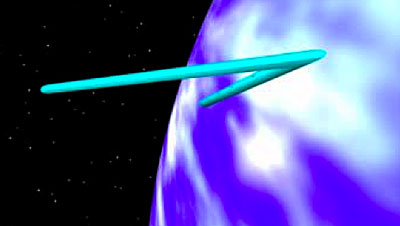
This shows the idea, one of his airships in the vacuum of space.
As Jeff Foust, editor and publisher of The Space Review wrote back in 2004, when JP Aerospace were still working as part of the USAF,
"It would be easy to dismiss ATO as simply an interesting idea—or worse—but for the fact that some elements of the system are already being built. Under an Air Force contract JP Aerospace has been developing the NSMV, developing several subscale vehicles as well as a full-sized one, over 50 meters long. The full-scale NSMV is currently in a hangar in Texas, with flight tests slated to begin later this month. The Air Force is not necessarily interested in the ATO concept—they see the NSMV as a potential high-altitude reconnaissance platform—but their support has paved the way for continued development of the system."
So to start with, there's one basic point we need to be clear about. His airships don't literally "float into space" all the way as the title of his book, "Floating to Space", might suggest. They do float up to a very high altitude of 200,000 feet. But not all the way.
From their highest neutral buoyancy altitude, according to his ideas, they slowly accelerate a bit higher, and at this stage the lift continues to counteract some of the weight of the airship. At this point the airship is operating like the Airlander 10, a hybrid airship / lifting body which is actually slightly heavier than air but is able to fly with a combination of lift and buoyancy. Though at a far higher altitude of course.
When they reach the speed of sound, they are still flying at a level where they have some assistance from buoyancy. By the time the air ships reach Mach 5, however, he says that they are way above the buoyancy level.
The buoyancy is very useful. It saves lots of fuel in the early stages and he couldn't get to those high altitudes and speeds without going through these earlier stages first. But once he is going at hypersonic speeds, it's no longer worth trying to use buoyancy to keep the airship flying. The amount of drag would be so huge as to make that impossible, if he flew at an atltitude low enough to keep it in the air just through buoyancy.
At least that's how I understand his plans. For nearly all the flight to orbit, it would use lift just like a conventional airplane - though with a radically different shape.
When you think about it like this you may then think that the design surely can't work as it doesn't look aerodynamic. How can something as bulky looking as this produce significant lift, enough to lift its own weight?
But aerodynamics can be a bit deceptive at times. So anyway that's what he claims it can do, and that's what we will look at.
I found a number of rather simple mathematical calculations that I think help with clarity of thinking in this topic.
There is almost nothing published on this in the literature. There is JPs book and his blog posts, but they don't go into a lot of engineering detail. Nobody else seems to be working on detailed calculations for kilometer scale orbital airships traveling at hypersonic speeds in the upper atmosphere where the pressure is only a tiny fraction of a millibar. At least I couldn't find anything in a literature search. So anyway here are a few ideas I'd like to share.
LIFT TO DRAG RATIO CALCULATION
This is a simple argument I found recently which rather simplifies thought about orbital airships. It’s based on this idea of how the airship accelerates to orbit
- To start with it just uses buoyancy
- As it gets faster it uses lift combined with buoyancy
- Finally it just uses lift like an airplane
The buoyancy is well worth it because it saves so much fuel in the early stages when it is moving through the thicker lower atmosphere. But this lasts for only a small fraction of the total flight duration. The question of whether it can get to orbit depends on the final stage when it's flying as an airplane.
When flying as an airplane then it’s the lift to drag ratio that matters most. So, though JP Aerospace don't seem to have published estimates of the lift to drag ratio of their airships to orbit, I found a way of estimating the lift to drag ratio from the time taken to orbit. The calculation is rather simple and gives an easy "in" to the whole question of whether you can accelerate to orbit slowly.
It doesn't matter what you are using for propulsion for your spacecraft or airship - or what configuration it is, rocket, scramjet, skylon, airship, it doesn't matter what. The only assumption in this calculation is that it's accelerating to orbit using lift all the way until it reaches orbital velocity.
Our assumptions are that
- It uses lift like a conventional airplane rather than using thrust to offset its weight (like a rocket) or buoyancy.
- It uses a fixed percentage, say 50%, of its thrust to offset the drag.
- It has a fixed lift to drag ratio throughout the flight (in practice of course this varies)
So let's start with an example to show how it works, one that doesn't have the controversey of an orbital airship, Skylon. Suppose, for instance, it has
- A fixed lift to drag ratio of 4
- It uses half of its thrust to offset the drag
Skylon when traveling at Mach 3.508 can achieve a lift to drag ratio of 3.583, so not quite as good as this, (see page 13 of this article), but this is just a simple calculation to show the idea.
Then that means that the amount of drag is the same as a quarter of its weight (by definition of lift to drag ratio), so it has to use thrust of a quarter of a g just to offset the drag.
Then, since it uses half the thrust to offset the drag, it accelerates the spaceship by the same amount, a quarter of a g.
That's enough information to calculate the time to get to orbit as we have the acceleration, and the required delta v to reach orbital velocity.
Let's take its final orbital speed as 7900 meters per second (the details would depend on its altitude when it reaches orbital velocity).
Then using v = at, we can deduce the time it will take to reach orbital velocity as v/a = 7,900 / (9.80655/4) = 3222 seconds or about 53 minutes.
So, Skylon, it seems, would take about an hour to reach orbital velocity if it were to use 50% of its thrust to offset drag and use lift all the way. It would need half a g of thrust, half of that used to offset drag. This is a simplication in the case of Skylon as it actually only flies like a plane for the first part of its flight, and then it accelerates like a rocket using thrust to offset its weight. But it gives the basic idea.
If Skylon used only 25% of its thrust to offset drag, then it would need to use a full 1 g of thrust and accelerate at 3/4 g, and would get to orbit in around 18 minutes.
That's our general formula too. We'll assume 50% thrust to offset drag in these calculations and target orbital velocity of 7.9 km / sec. Then if the lift to drag ratio is L, then the time to get to orbit will be
7,900 * L / 9.80655 secs.
I'll use links to google calculator for the calclations so you can check them easily.
So now, suppose that our orbital airship can somehow manage a lift to drag ratio of 70 like the best glider, the ETA glider, and again uses 50% of its thrust to offset drag. Then it would need 1/35 g of thrust, and it would get to orbit in 7,900 *70 / 9.80655= 56390 seconds, or about 15 hours 40 minutes. (You can use this online tool to help convert seconds to hours and minutes quickly).

ETA glider photographed by Britta Pulz. This is a glider with a remarkable lift to drag ratio of 70 : 1.
If a spacecraft could achieve a lift to drag ratio as high as this, with hypersonic flight, and could keep up a continuous thrust of 1/35 g, it could reach orbit in 15 hours 40 minutes using half of its thrust to offset drag.
So, then you can also work backwards too, and from the time it takes to get to orbit, work out its (average) lift to drag ratio.
John Powell estimates that it would take three days for his airship to get to orbit. So, if he uses at most half of the rocket power to counteract drag, we have
7,900 * L/ 9.80655 = 3*24*60*60
So L = 3*24*60*60*9.80655 / 7,900 = 322.
So to achieve such a slow acceleration to orbit, his airships need a rather fabulous lift to drag ratio of 322. Not saying that's impossible but that seems to be what he would need to aim for.
Of course, it could be that he has a lower lift to drag ratio and is using more thrust to offset drag. But if you find yourself using more than 50% of your thrust to offset drag, would it not make more sense to use a more powerful engine, even if it meant increasing the amount of mass? Double the number of engines?
I find that a lift to drag ratio as high as that, more than four times higher than our best gliders, a bit hard to believe. However his airship is flying as a hypersonic waverider. Also, the density of the airship is so low, it's probably not that far off the density of the shockwave itself, and the airship, he says, is designed to ride on top of the shockwave. So, perhaps it might be a bit hard to apply the hard got knowledge of conventional hypersonic flight and even subsonic flight to this regime.
He says on page 111 about lift to drag ratios:
"Sailplanes have a ratio of over 60 to 1. The Space Shuttle has a L/D ratio of just over one to one. THe L/D ratio for hypersonic aircraft is thought to be around five. The orbital airship will need a L/D ratio much higher than that. It is important to note that the L/D barrier was calculated for conical, or cone shaped vvehicles. We simply don't have the data to correcty model other shapes of hypersonic vehicles. Early tests suggest that lift to drag ratios much higher than those needed for ATO [Airship To Orbit] are possible. "
He doesn't give any figures though.When he says the early tests suggest L/D ratios much higher than those needed for ATO are possible - what L/D ratio does he think ATO needs, and what's his reasoning for them? Does he mean over 300:1 or does he think ATO is possible for a L/D ratio much smaller than that, and if so, how and why? That would be my main question for him here.
AIRSHIP OPTIMAL ALTITUDE
In this section I hope to show that if he can achieve a lift to drag ratio significantly greater than 1, then he should be able to fly at whatever altitude in the atmosphere achieves that ratio, using lift alone.
To see how it works, suppose for instance he only achieves a 4 to 1 lift to drag ratio like Skylon..To make the calculations simpler, suppose he has an airship with a weight measured in force units as 10,000 newtons (about 100 tons). Then it would fly at whatever altitude gives a drag of 2,500 newtons.
If he flies lower than that, at an altitude with a drag of 2,025 newtons, say, and uses enough thrust to overcome the drag and fly forwards, then by a lift to drag ratio of 4 to 1, then he has a lift of 10,100 newtons. Of that, only 10,000 newtons is needed to support the weight of the airship, so he would have an upwards force of 100 newtons. This would accelerate it upwards at a hundredth of a g.
So, as he flies, as the airship accelerates to higher and higher speeds, although the drag would increase at whatever altitude it is flying at, it will automatically rise in response until the lift to drag ratio equation balances again. For this to happen the pilot has to keep it angled at whatever angle optimizes the lift to drag ratio.
So for instance, during Skylon's stage in its flight when it is using lift to stay aloft, then we can deduce from this that its drag will be at most a quarter of its weight as measured in force units. We don't need to know anything about the altitude it flies at, to say this. Of course in practice the lift to drag ratio is going to vary at least a bit depending on altitude, so this is a first approximation. But if the ratio is reasonably constant then it will give a good idea of how much drag to expect.
Similarly if he can achieve a 10 to 1 lift to drag ratio, it will automatically rise until the drag is reduced to 1,000 newtons. If he can get to a 100 to 1 lift to drag ratio, he can fly at whatever altitude achieves a drag of only 100 newtons.
If you think about it this way, you don't need to take account of the air density or work out what altitude it is flying at. All you need is the lift to drag ratio.
This is why I was able to work out the average lift to drag ratio from the time taken to get to orbit, and vice versa, without knowing anything about the particulars of the airship, or even the altitude it flies at.
Though he doesn't say much about altitude, his idea for his transatmospheric airship is that it would achieve Mach 5 at 350,000 feet. I think it's reasonable to assume his orbital airship would achieve hypersonic speeds at a similar height and orbital velocity at a higher altitude than that.
The atmosphere thins out very quickly. At 200,000 feet it's 0.177603 millibars. At 280,000 feet it's 0.0034 millibars. The standard 1976 atmosphere model doesn't go up to 350,000 feet. However, from the diagram here, it looks like you get down to around 0.0001 millibars. So the atmospheric pressure is 1,776 times less at 350,000 feet than it is at 200,000 feet. Since the drag is normally proportional to the density of the air then that means you get less than a thousandth of the drag at 200,000 feet at its altitude for hypersonic flight.
Note, though hypersonic flight by convention starts at around Mach 5, it doesn't necessarily follow that the airships experience the other effects of hypersonic flight such as high heat loads, or that you have molecular dissociation or ionization of the air because they would be flying in a hard vacuum with hardly any air.
LIFT CALCULATION
James Fincannon worked out the lift for his orbital airship based on its dimensions, and it turned out to be far too small for an airship of the dimensions that JP described for the masses he gives.
The calculation was rather simple. For the 6,000 foot airship, which he says in his book can take a payload of 20 US tons to orbit, or 18.14 metric tons, then James worked out the lift from the published dimensions and from JP's statement that it would be neutrally buoyant at 200,000 feet, and his results just don't fit with this. He gets a mass of 2.6 metric tons as the maximum lift.
We can double check that, by using a simple over estimate. Let's estimate its volume as a tube of diameter 300 feet and length 12,000 feet. Let's treat the hydrogen as massless.
Then the volume is 12,000 * PI *150^2 cubic feet which works out at less than 850,000,000 cubic feet or just over 24,000,000 cubic metres. This will of course be a huge over estimate but that's the idea for in this calculation. We know the density of air at 200,000 feet, at 0.000254864 kg / cubic metre, so that means it can't possibly have more thant 6.11 tons of lift, so no way it can lift 18.14 tons to orbit.
James works out the volume more exactly,using the figures from his diagram, and he also of course doesn't treat the hydrogen as massless, so he subtracts the mass of the hydrogen when working out the lift, and he gets a mass of 2.6 tons in part 5 of his calculations.
So how can this have happened? There is some mistake somewhere. Of course it could be in our calculations but they are so simple, that it's hard to see how that's possible.
Well, you do get the right answer if you read JP's feet as metres in his orbital airship diagrams. If you take our calculations and multiply James' figure by the number of cubic feet in a cubic metre, or 35.31467, that would change his 2.6 tons into 91.8 tons which then becomes much more plausible as a way of lifting 20 tons into orbit, taking account of the mass of the skin, life support, lifting gas, solar cell deposited layer etc.
It is something that could happen - if the Mars Climate Orbiter can crash on Mars because of a mix up of imperial and metric units, then it's no shame for the same to happen here. Maybe some kind of a communications glitch?
Whatever the reason, it seems to me that whenever JP has feet in his dimensions of the orbital airship, we should read that as meters. If we do that then the lift is enough. That would increase the size of his already large 6,000 foot orbital airship to six kilometers in length.
It's the same for his transatmospheric airship. He says here
""The TransAtmospheric Ascender will be our first airship to reach space. The vehicle is 2100 feet long and will have a crew of three. It will have a peak altitude of 350,000 feet and a maximum velocity of Mach 5. Technically it is a hypersonic waverider.""
If those really are feet, then you have to take James' figure for the 6,000 foot long airship of 2.6 tons and scale it down by (2100/6000)^3 to get a mass of 111 kilograms as the most he could carry if it is buoyant at 200,000 feet. It wouldn't be enough lift to carry the mass of two average adults, never mind the rest of it. But if the value is in meters, you get a more realistic 3.94 tons of payload.
You may throw your hands up in dismay at this point. But remember, it's very light for its size, at only 100 tons. After all weather balloons can be pretty huge and weigh little. I don't think we should dismiss the idea just because the orbital airships would be huge
ACCELERATING TO ORBIT - FUEL EFFICIENCY AND SPECIFIC IMPULSE
This is by way of background. A rocket accelerates to orbit in minutes The airships would take days according to JP's plans. However in both cases whether they can get to orbit depends on how much thrust the rockets produce, and how fuel efficient they are. The fuel efficiency is measures using the "specific impulse". This is often abbreviated as Isp or just written as ISP. This in turn is defined as the ratio of the change in momentum to the mass of the fuel used to achieve that change.
If it's a conventional rocket and you measure the fuel used in units of mass such as the kilogram, and it's flying in a vacuum, then the ISP is just the exhaust velocity.When flying in an atmosphere, using the same units, it's the effective exhaust velocity.
However you may be puzzled at fist to find out that the ISP is most often given in seconds. You don't often think of seconds as a way of measuring velocity! Well the way they do that is to measure its weight in newtons or pound force, instead of its mass in pounds or kilograms.When you divide a momentum by a force in newtons, you get a number measured in seconds.
Anyway the main thing you need to know is that you get from the specific impulse in seconds to the exhaust velocity in meters per second by multiplying by the standard gravity of 9.80655 - if you use meters as your distance measure. That's because one kilogram exerts a force (weight) of 9.80655 newtons in standard gravity (the Earth's gravity varies slightly depending where you are, reduced in equatorial regions because of the Earth's spin, counteracting it, also less as you get higher and varying depending on whether or not you are above a gravity anomaly, so they use a standardized gravity).
The Saturn V had a specific impulse of 260 seconds. So multiplying by 9.80655, this means the exhaust velocity was about 2.57 km / sec.
If you could somehow arrange for the fuel to be expelled at a velocity of ten times that, then it would be as easy to get to orbit from Earth as it was to take off from the Moon. You would only need around half of the mass of your spaceship to be fuel. As an example, if we assume a rocket with ISP 2000, starting mass 2600 kg, then the final mass on reach orbit is 1609 kg for ideal rocket equation. with less than half its mass used to get it into orbit. You can try out other ideas with this online rocket equation calculation. .
Now ion thrusters can achieve much higher exhaust velocities. But they also need huge amounts of power. ESA is exploring a new type of ion thruster that in theory can achieve an ISP of 19,300 seconds - so an effective exhaust velocity of 190 km / sec, using xenon atoms. That's for "a single 20 cm diameter 4-grid ion thruster". See this paper. Also this page about their design. However it would need 250 kW power for 2.5 N of thrust. which is only enough thrust for 255 grams (2.5/9.80655) to hover against gravity.
You can get much more thrust and also high specific impulse using either anti matter or nuclear fission or fusion. The Orion pulse rocket design from the late 1950s which worked by exploding nuclear bombs one after another to get into orbit had a theoretical specific impulse of 10,000 to a million seconds, and would have been powerful enough to carry its own weight into orbit. Details here.
Another way is to use beamed power from the ground. This was the subject of Kevin Parkin's thesis in 2006. He calculated that you can achieve an an Isp of 700–900 seconds and a thrust to weight ratio of 50–150 by beaming microwave power to your spacecraft, which gives plenty of margin to get a payload into orbit. (You need a thrust to weight ratio of 1 to hover against gravity). See also Dmitriy Tseliakhovich in his thesis in 2010 and Jordin Kare's talks to the Space Show about power beaming.
JP Aerospace therefore have two main ways to overcome this problem of getting into orbit. They can beam power or collect vast amounts of solar power and somehow use ion thrusters, or they can build a rocket engine that somehow has a much higher ISP than a conventional rocket engine. It would need to have a higher thrust to weight ratio than a conventional ion thruster but it doesn't have to hover as that's done through buoyancy and then later on by lift. It needs a better thrust to weight ratio than an ion thruster, but it doesn't have to have a thrust to weight ratio greater than 1. So that's a rather unusual specification. Such an engine would be useless for a conventional rocket to take off from Earth. And for an ion thruster the main requirement is to be as efficient as possible, to have as high a specific impulse as possible, so it wouldn't be optimal for an ion thruster either. But it's what they need for this application.
He claims to have achieved such a rocket, with an ISP of 2000. It's called the symphony engine and it works by mixing the ions of an ion thruster with unionized gases. Also he saves a lot of power by using the combusion of the fuel itself to ionize it. Whenever you light a fire, the flames consist of plasma and so have ions within them which could be accelerated using an ion thruster. So that's his idea, and by accelerating those ions he also accelerates the burnt fuel as well.
So, I covered this in detail in the last article. Let's just take it for granted here, if he can achieve a 2000 ISP motor, then would that be enough to get his airship into orbit? Well that leads us to another fun and neat calculation we can do.
WET TO DRY MASS CALCULATION
So anyway it is easy to work out the wet to dry mass ratio for a 2000 ISP motor that's using half of the thrust to overcome drag. We need to use the rocket equation. But it's simple to adjust it to allow for the need to offset drag. If you use half the thrust to offset drat, it has the same effect as doubling the delta v with an assumption of no drag.
So I just input double the delta v to orbit, or 15,800 m/s into the ideal rocket equation, assuming an isp of 2000, mass of, say 100 tons. It turns out that the dry mass needed to get to orbit is 44.66 tons. Here is an ideal rocket equation calculator to check the calculations.
From this, it would seem that the fuel is not going to be a problem if he can achieve a 2000 ISP engine and he can achieve the other things necessary to get to orbit.
STRENGTH AND STABILITY OF THE AIRSHIP
First, often physicists in the online conversations assume that they are not launched from ground level. No, they are not. That would be impossible. Though their smaller airships are launched from ground level, The orbital airship would only ever fly above 140,000 feet, would be neutrally buoyant up to 200,000 feet and would be made of materials so light weight, like a weather balloon, that the structure would be torn apart at ground level.
The plan is to build the "Dark Sky Station" at 140,000 feet and to construct them there.
The outer envelope of the airship would be made of a very thin film. The JAXA balloon used a polyethylene film only 3.4 microns thick which they developed in 1998. That suggests a density less than 0.0003 grams per square centimeter, or about 3 tons per square kilometer of surface area. It's amazingly strong though, with a breaking strength of 400 kilograms per square centimeter, so might be overkill though for his airships. Also it's from 1998 so they may have better materials now.
So the outer skin doesn't need to be that heavy.
He has hydrogen in the lifting cells and nitrogen in the gaps between the cells and the skin. His airship is also made up of airbeams for structural strength.
He talks about his hydrogen cells unrolling from a roller as they expand, and has tested that already in his balloon flights. By the time it reaches its maximum neutral buoyancy altitude, then the hydrogen balloons would be fully extended.
Above that, iIf I understand right, then after that, he is just relying on the skins of the internal spherical balloons to hold them in against a near vacuum once in space, as for the echo balloons, Their internal pressure would be only 2 millibars if there is equal pressure inside and out at 200,000 feet so it's not such a huge challenge to hold that in against a vacuum. The region between them and the outer skin is filled with nitrogen gas which he then vents as it ascends.
He providing significant buoyancy at that point, indeed he could just bleed out the hydrogen altogether and use a pure nitrogen balloon once he is going so fast that only lift is needed to stay aloft. It would depend how much of the mass of the airship is hydrogen at that point. The hydrogen would help if he needed to abort though, he'd have enough hydrogen to stay buoyant as it slowed down, so I think for safety reasons also he wouldn't want to bleed out the hydrogen - unless he had lots of it to spare. But if he has it in compressed state, it's no great benefit to bleed it out anyway, he needed to have the same mass in compressed form to make it safe to bleed it out from the balloons.
He needs equalized pressure inside and out for the outer skin V shape, but the lifting cells inside could be spherical.
He has many design features to make his airship stable. The cells prevent the lifting gas from bunching up in the front, with 20 lift cells per arm (page 110).
He has a kevlar deck along the length of the wing at the top, and a keel along the bottom made of carbon composite truss type structures and inflated air beams. That's from page 114 of his book. He then has inflated ribs that run along the inside of the leading and trailing edges of the wings to maintain its airfoil shape. He also has a carbon fibre strip running from nose to tail all along the V shape leading edge of the outer V, and an aluminium cap to stiffen the nose which also acts as a mounting for the electrical drag reduction systems.
It is possible to maneuver it - it doesn't have to be agile and is controlled by gas shifting and vectored thrust. For docking with the dark sky station then it would use the smaller first stage airship as a tugboat. All this is on pages 114-5 of his book.
CAN HE ACHIEVE REASONABLE LIFT TO DRAG RATIOS AT ALL, EVEN 4 TO 1?
At first it would seem almost impossible. His airship looks so unaerodynamic compared to the planes and gliders we are used to, more like a balloon or an airship than a plane. If we read feet as meters, its 138 meters high! High as a skyscraper. How can that have a lift to drag ratio at all?
We don't think of airships as capable of using lift at all, but aerodynamics can be surprising sometimes.
The Airlander 10 is a lifting body, and look how tall and fat it is for its length?

Airlander 10 photographed by Airwolfhound - photos from its test flight on 11th May 2017 here.
Compared to it, then JP's orbital airship is positively slim!
It's heavier than air, though only marginally, but it does depend on lift to stay aloft, and that still lets them calculate a lift to drag ratio. This paper calculates the lift to drag ratio as 3.8:1 when flying at an angle of twelve degrees, see figure 12.
A lot of that apparently comes from its rather small fins.
It's a completely different situation of course, slow flight at atmospheric pressure compared to hypersonic flight in a vacuum, but there aren't any examples of hypersonic airships to use. So we tend to think in terms of airplanes rather than airships as they are the only things we have that go hypersonic at present.
So, this is just to show that you can have airships which are tall, yet have rather surprisingly useful lift to drag ratios. You might not necessarily expect the Airlander to have useful lift from our experiences of normal planes.
His airship would go much faster than this, but also in air that is far less dense than for a normal airplane. Small details in the design of the orbital airship, even tiny fins, could make a big difference to the amount of drag, and the lift to drag ratio.
He doesn't have a rigid skin. You might think again, from analogy with ordinary aircraft, that he has to have a rigid skin to go at hypersonic speeds. But he is going at hypersonic speeds in a near vacuum with an airship with a huge amount of drag at lower altitudes. That drag is actually an asset if he can achieve a reasonable lift to drag ratio, as it would lift his airship up to altitudes where the forces acting on it are much lower.
If he has a 4 to 1 lift to drag ratio for a 10,000 newton airship he has 2,500 newtons of force acting against it by way of drag. But that's spread over a vast surface area.
For a "back of the envelope" calculation, let's call the surface area over 360,500 square meters (reading feet as meters again) - there I just multiplied the 6000 meters by 2 and by the width of 300 meters, not an exact calculation, as an estimate for the area for only one side. It under estimates because the cross section is oval, not flat, and over estmiates because it over estimates the area of the plan (not taking account of where the two wings join). But it will do for this calculation.
That would make the force on the skin due to the drag at hypersonic flight less than 0.007 newtons per square meter. It's the same effect as resting less than 0.7 grams on a square meter of the material.. Remember the JAXA skin can withstand 400 kilograms per square centimeter. It would seem to be way overkill for this application, given equal pressure inside and out. There would be more force due to lift, and that would be of course the full 10,000 newtons, which then works out at 0.03 newtons per square meter or equivalent to resting 3 grams on a square meter of material.
Of course it wouldn't be spread out uniformly and there would be areas with much more force acting on them. However we do have plenty of leeway, and parts of the airship that have to withstand stronger forces like the nose and leading edges, he says would be reinforced with carbon fibre.
HYPERSONIC WAVE RIDER - CAN HE INCREASE THE HYPERSONIC LIFT TO DRAG RATIO ABOVE THE VALUE OF 4 FOR SKYLON
His airship is optimized not just to reduce drag, like a normal airship, but to maximize aerodynamic lift. It's actually optimized for maximum lift during hypersonic flight, he tells us, as a hypersonic wave rider (page 109 of his book).
"When the orbital airship reaches Mach three, it enters the low end of the hypersonic phase of the flight. This is where the vehicle has been tuned to fly. It's where it really shines. The airship is now a hypersonic waverider. A hypersonic waverider is a vehicle that takes advantage of the hypersonic wave. When traveling at hypersonic speeds, large shockwaves form around the airship. The shape of the wing is designed to ride on top of the shock wave. The orbital airship is the surfer of the upper atmosphere"
So what is a "hypersonic waverider". I was not familiar with the concept until reading it in his book and must confess to know knowing how it works in detail. But it's a well established idea. Here is one description:
"Simply put, a waverider is any vehicle that uses its own shock wave to improve its overall performance. The concept is probably most familiar from the world of water sports-motorboats ride the bow wave they create to reduce friction drag and surfers similarly ride the crests of waves. An aircraft traveling at Mach 1 or higher also produces a wave, a shock wave of air. If the aircraft is tailored correctly, it can be designed to ride this wave to produce greater lift, less drag, greater range, and overall improved performance. The reason waveriders are only practical at higher Mach numbers is due to the fact that the shock wave must remain close to the surface, a quality of hypersonic flow. A shock creates greater pressures in its wake, and the shock lying close the lower surface of the aircraft results in a large pressure force increasing the lift on the vehicle. This idea, which will be explored further in later sections, is known as compression lift and is the primary benefit of the waverider concept."
Here is the wikipedia page about it with lots of links. It depends on "compression lift" which is described here
As best I understand it so far, the basic idea seems to be that all that shockwave which would otherwise slow it down becomes a wave of thicker air which the airship rides on top of. This provides extra lift at any altitude so increases the lift to drag ratio, so letting it fly at a higher altitude. By increasing the lift to drag ratio, it reduces the drag. It can only do that at hypersonic speeds, fast enough so that the air that hits the skin flows next to the skin. He says that it can only do that above Mach 3.
So there, remember that his airship requires only 0.03 newtons per square meter to offset its weight (taking its weight in force units as 10,000 newtons), and is very low density, with the lifting bags inside perssurized to 2 millibars. Since the pressure from the shockwave would be acting upwards only, it doesn't need to be much to offset the weight of the airship. It doesn't have to be as much as the neutral buoyancy pressure of 2 millibars at 200,000 foot.
If the over pressure from the shock wave was dense enough, it could offset all of its weight as lift. So let's work that out. Atmospheric pressure is 10 tons per square meter, or around 100,000 newtons (using approximation of 10 for 9.80655). So his 0.03 newtons corresponds to an overpressure of 0.0003 millibars. Just a tiny overpressure in the shockwave would be enough to offset the entire weight of his airship.
Now, I don't know how that translates into a lift to drag ratio. But it does suggest I think that we are in a regime here that is very different from the normal situation of an airplane or even a normal airship. Conventional ways of thinking could easily lead us astray here.
DRAG REDUCTION
The nose of the airship is titled slightly up which he says "modifies the hypersonic wave and allows most of the vee wing to fly at a flatter angle, reducing drag".
http://eprints.gla.ac.uk/113788/7/113788.pdf
Figure 6 Electrohydrodynamic drag control.
https://arc.aiaa.org/doi/abs/10.2514/2.1769
Plasma Injection for Hypersonic Blunt-Body Drag Reduction
It seems to work by moving the position of the shock wave away from contact to the "nose" of the airplane. So I can imagine that might well make quite a difference to such a blunt nosed vehicle as an airship, if traveling at high speed.
This drag reduction technology is for the nose specifically, at least in the article and the image I shared - the nose presents a large cross section to the atmosphere, and the idea is to elevate the shock wave away from the nose to reduce drag. The whole thing is separated from the airship. He makes it clear that it's the same idea in is book by explaining that there's an aluminium cover to the nose, on which he'd mount the drag reduction machinery. He would have plenty of power from solar power, at least for as long as it is in sunlight.
So, he elevates the shock wave away from the nose, then it hugs the airship below the wings, and it is designed so that the shock wave goes below rather than above the airship as it flies, which adds to lift and reduces drag. At least that's his idea, and he describes it clearly in his book.
WIND TUNNEL
It's very hard to test hypersonic models in a wind tunnel because the speeds are so high. The USAF operates a facility Hypersonic wind tunnel 9 which can simulate hypeersonic flight up to Mach 14, and it can simulate flight altitudes of up to 173,000 feet and flight times of up to 15 seconds.
Most research is done with tiny models in shock tubes or shock tunnels or expansion tunnels. JP faces even more of a challenge if he wants to test the actual regime his airships would fly in, because he would have to simulate hypersonic speeds at 350,000 feet and higher.
He does have a tiny high speed "shock tube" type wind tunnel, mentioned here on the SpaceShow, capable of tests up to Mach 3.8 so far, was designed for Mach 3.8 but can't reach it.
I had one idea here, just sharing it in case it's of interest. His 2,000 ISP motor which he has in development would have an exhaust velocity of 19.6 km / sec. That's more than twice orbital velocity. Since he needs to simulate hypersonic speeds, but in vacuum conditions of only 0.0001 millibars, simulating 350,000 feet - could he do that simply by firing his rocket motor through a tube in a very hard vacuum chamber?
It's technically possible. Supposing he could have access to the Space Power Facility, a big ask of course, then it can get down to a little over 0.000001 millibars, so two orders of magnitudes harder than he needs. It's 100 feet in diameter and 122 feet high. There would be room there for rather large models, though of course, not anything approaching the size of his orbital airship.

Visitors inside NASA's Space Power Facility. This can achieve vacuums of a millionth of a torr (a bit over a millionth of a millibar). Could a large hard vacuum chamber be used for simulating hypersonic flight in near vacuum conditions by setting up a tunnel and just firing his 2000 ISP "dirty ion thruster" at very low thrust, if that's possible, to simulate the relative velocity of the air for his high velocity travel through a vacuum? Just my own idea here :).
CENTRIPETAL FORCE
By the time he reaches 6 km / sec he gets more than half the weight of his airship counterbalanced by centripetal force, so could move higher in the atmosphere with the same amount of aerodynamic lift. And by the time he reaches orbital velocity - then he may be spiraling out quite high in the atmosphere, but only for the last few hours towards the end of the journey I'd imagine because it is going up as the square of the velocity, over more or less fixed radius, a little over the radius of the Earth for the centripetal force calculation..
MAINTENANCE AFTER BREACHES IN THE HULL
Holes in the outer skin won't matter much as the pressure is equal inside and out, so as long it is non rip, maybe it just ends up having holes in it.
With the lifting cells inside, then it would matter, even though they are only at 2 millibars pressure. But you wouldn't need duplicates of all of them. How about a few backups stored in one place, with some method to move them automatically to the place where they are needed and to replace the leaking balloon in situ, and return it? It could even if ingenious perhaps compress the leaking balloon in such a way that the hydrogen is transferred to its replacement?
I did have one idea about maintenance of the outermost shell without having to deflate the airship completely, his Dark Sky station shaped like a starfish - there'd be room for a V shaped orbital airship under a pair of its arms - so then they might have access to it from above, from air beams running along the arms and then ropes down from them. It seems a bit precarious, but if you used telerobotics instead of humans to inspect and repair it might work.
ECONOMICS
This is not my strong point but just to say something about it.
I think it's hard to know if it would go the way of the airplane (huge financial success), or the airship (has some commercial value today) or the hot air balloon (of entertainment value but not of much else by way of commercial value). It might also depend on technology we don't have yet, to make it profitable, as with the early planes.
At the moment, they are like the Wright brothers before their first flight,. If they get as far as their transatmospheric airship, people will really start to pay attention. That would be a bit like the Wright brother's first hop - where they show they can actually get to hypersonic speeds. I don't know if that is possible.
The airship able to ascend to 140,000 feet from ground level seems almost within reach and they are getting to higher altitudes with each test. If I understand right, it seems to be a scaling issue that if they can build it large enough then they could reach that height. At that point, it will be like a new version of the airship they built for the USAF over a decade ago in 2004. Beyond that, nobody else is attempting anything like it, so it will be interesting to see how far they get.
The challenges seem formidable. But then they also seemed so with early flight and many other inventions, and we regularly get inventors achieving things that seem impossible on the face of it. For instance Skylon's SABRE rocket engines have now been demonstrated as able to cool the incoming air from 1000 °C to -150 °C in a hundredth of a second, and do so what's more without any problems of condensation and freezing chunks of ice.
I would hardly credit it, that it was possible, if it weren't already demonstrated and verified by independent observers - and the result leading to millions of pounds of funding from ESA and then from the UK government. The technology is secret, though we know it involved 3D printing to make components that can't be made in any other way.
So though it seems impossible, I don't know if it is seemingly impossible in the sense of the SABRE engine or really impossible. There is nothing to go on in the peer reviewed science journals - as they haven't published details like that, which again is a case similar to Skylon. There is no paper you can read that explains in detail how the SABRE rocket engine works.
So is the JP case like that, that it's possible but details not published for commercial reasons like Skylon, and also perhaps not fully worked out, or is it really impossible?
OTHER IDEAS
First the reason for my interest in this project isn't really that I think JP Aerospace are necessarily going to be the way that we succeed in reducing costs to orbit eventually. It's a long term project, and we will just see how far it goes and where it goes.
It's also intellectually interesting, and it's asking questions about a regime of flight that we simply have never explored in practice at all. So it will be interesting to see how practice lines up with theory and what new inventions are made while exploring this regime.
I think we should pursue all the possible avenues and after all JP is a private company, so they are free to follow whatever line they want to and are not depending on tax payer's money so they don't have to justify what they are doing to the rest of us. So, I'm cheering them on, to see how far they get and what they achieve. If I was in the US and within reach to do so, I can imagine wanting to volunteer to help them. It's such a fascinating project.just for what they have achieved already and should achieve in the near future.
Also, what they produce could be part of the mix at some point.
Meanwhile, Skylon I think can lead to low cost transport to orbit over a shorter timeframe, as soon as the mid 2020s.
There's also the idea of the orbital tether - which can be built with present day materials (unlike the space elevator) and also can get you into space much more quickly than a space elevator, and would pick up a Mach 12 or faster space planet and boost it direct to orbit in one go.
Skylon with its lower costs to orbit could help us build an orbital space tether by bringing its materialsr to orbit at low cost. That's the Hypersonic Airplane Space Tether Orbital Launch (HASTOL) System. It assumes a payload of 14 metric tons delivered to a speed of about Mach 12.
http://www.tethers.com/papers/HASTOLAIAAPaper.pdf
It's quite massive but not extraordinarily so, from 30 to 100 times the payload mass, so, up to 1,400 metric tons therefore, for their assumed payload of 14 tons, and made of conventional materials ,not needing new materials., they say there that
"The total mass of the space tether plus the Tether Central Station typically will be 30-200 times the payloads being handled. Most of that mass ratio requirement is driven by the fact that the tether system must mass considerably more than the payload it is handling, so that, upon pickup of the payload by the tether, the payload will not pull the space tether system down into the atmosphere. Thus, the advent in the future of better tether materials with higher strength at higher temperatures will not be used to lower the tether system mass significantly, but instead will be used to increase the tether safety margins, lifetime, and system performance, by allowing payload pickup at lower altitudes and lower speeds, thus decreasing the performance requirements on the hypersonic airplane portion of the system."
Skylon transitions to rocket propulsion at Mach 5.14, but it would need less rocket fuel to achieve Mach 12 from Mach 5 than to achieve Mach 22, all the way to orbital velocity, itself. Maybe it might even make sense for it or a similar space plane to continue air breathing through to Mach 12 and then get picked up by the orbital tether?
Some of this might apply to the airships too. If he can achieve his transatmospheric airship at Mach 5, th