Lisa Pratt, the new planetary protection officer for NASA takes up her job at a challenging time for astrobiology. We are approaching a major decision point for Mars. If Elon Musk succeeds in his ambitious plans, then some time in the next couple of decades we may introduce trillions of hardy microbial spores to the planet. Not deliberately, but just because we can't help but take them with us wherever we go. This is a major quandary for astrobiology. But not just for astrobiologists.
I think almost anyone would be saddened if we had this headline news story in the 2030s:
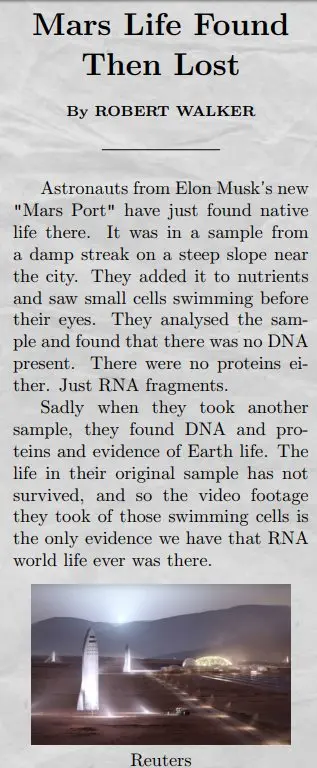
Fake Future News: Mars Life Found Then Lost: Robert Walker:
Astronauts from Elon Musk's new "Mars Port" have just found native life there. It was in a sample from a damp streak on a steep slope near the city. They added it to nutrients and saw small cells swimming before their eyes. They analysed the sample and found that there was no DNA present. There were no proteins either. Just RNA fragments.
Sadly when they took another sample, they found DNA and proteins and evidence of Earth life. The life in their original sample has not survived, and so the video footage they took of those swimming cells is the only evidence we have that RNA world life ever was there.Made with this spoof news story generator
The astrobiologists Alberto Fairén and Dirk Schulze-Makuch have argued, in the article "Searching for Life on Mars Before It Is Too Late" that after a human landing on the planet, it will already be irreversibly contaminated by Earth microbes, and that if we don't relax requirements now, we won't be able to search for native life on Mars at all before it is too late, saying:
"It is very likely that our children or grandchildren (the Mars generation) will see astronaut footprints on the red sands of Mars, and at that moment, it will be much too late to straightforwardly identify the nature of true indigenous martians."
So, for instance they wish to send Curiosity to investigate a possible wet streak close to where it is exploring, right now, before it is too late to study such streaks in their original state. They agree that it is not sterilized sufficiently for this, and might well introduce Earth life to the streak, if it does turn out to be habitable. However, they argue that this is going to happen anyway before astrobiologists can have the chance to explore these places robotically, if we wait until we can send sterile landers.
The issue here is that we have not sterilized any landers sufficiently to explore regions on Mars that could be contaminated since Viking, and the methods used back then (baking the entire spacecraft in an oven) can't be used with modern spacecraft with their more heat sensitive components. By the time we have figured out how to do it, they think our window of opportunity for studying the life will be over. So, they say, it's the only thing we can do. They discuss ways in which they think we'd be able to distinguish between habitats that are colonized by introduced Earth life from ones that still have only Mars life in them.
The previous planetary protection officer Cassie Conley and the one before her, Jim Rummel, have strongly criticized this approach, saying that the work of the Planetary Protection office as it is now is important and necessary to protect the science interest of Mars. They say that the proposed "dirty robots" would be as much of a problem as "dirty humans". They don't think the proposed methods to distinguish Earth from Mars life using genetic tests will be reliable.
They raise the point that we have had plans for humans to Mars as a near future mission for decades now, with nothing happening, and that the private spaceflight plans are "more hopeful than convincing", and that the future of both astrobiology and human missions depends on doing good science right now. They argue that there is still time to explore Mars properly before humans get there, and that it helps nobody to relax the requirements before we know what is there, saying:
A human mission to Mars is NASA's stated “horizon goal,” but this is not the same as a serious programmatic commitment—with an accepted rationale, budget, and schedule. To date, no government agency has produced such a commitment, and the details of private initiatives are still more hopeful than convincing. There is still time to explore Mars properly.
Their response is in their article "Four Fallacies and an Oversight: Searching for Mars Life,". The two papers are summarized in Debate Over Mars Exploration Strategy Heats Up in Astrobiology Journal, and both are open to read free online. I will discuss some of the other points made in these papers in more detail later on, so those short summaries just touch on some of the points they make.
Both are agreed on the central point however, that humans will introduce Earth microbes irreversibly to Mars, and that our best opportunity for studying any native life on Mars occurs before our Earth microbes are introduced to the planet. They differ in their views on how soon this may happen with the planetary protection officers suggesting it won't be for some time and that we have time to explore Mars properly.
Cassie Conley has just been succeeded by Lisa Pratt as NASA's new planetary protection officer. The few statements she has made in her interviews with the press are already being interpreted as suggesting she is open to relaxing the rules for planetary protection, perhaps along the lines of permitting "dirty robots". I think it is far too soon to say such a thing, when she has just started on her new job, and anyway, it's not for her to make such a decision. It has to be done at a higher level, in COSPAR.
Here is an example article I'm responding to, which will give you an idea of the sort of thing: NASA planetary protection officer suggests loosening limits on exploring Mars for life
I'm going to look behind these headlines at what she actually said and look also at some of the challenges of her new job. And I will also look at this debate between astrobiologists, and I will talk over why the story in the Fake Future News that I just shared is a realistic example of something that could happen in our future.
I will also look at the basic assumption nearly everyone makes - that as soon as we have the capability to land human "boots on Mars" that we will and should do it. What happens if we explore an alternative future where we decide to find out what is on Mars first before deciding whether or how to send humans there?
RELAXING PLANETARY PROTECTION RULES IS "ABOVE THE PAYGRADE" OF A PLANETARY PROTECTION OFFICER
Cassie Conley used to say in her interviews that decisions like that are above the paygrade of the planetary protection officer. And this is true for Lisa Pratt as well.
She couldn't make any promises about relaxing the rules anyway. Our planetary protection requirements under the Outer Space Treaty are decided by an international group of astrobiologists through the COSPAR meetings, which are held every two years. She can't set the COSPAR policy herself. The planetary protection officer is only responsible for implementing it. She would be there when the decisions are made and she might have some input into the conversations but she would not make that decision.
TESLA ROADSTER DIDN'T HAVE A PLANETARY PROTECTION PLAN
Indeed if you listened carefully she showed her concern about the need to make sure that private space are on board with planetary protection provisions. I was surprised to hear from her interview that there was no planetary protection plan for the Tesla roadster. As reported in SpaceNews:
Pratt said her office is also interested in working with potential commercial missions to Mars and other worlds subject to planetary protection protocols. Such discussions, she said, were limited prior to the Feb. 6 launch of a SpaceX Falcon Heavy rocket carrying a Tesla Roadster sports car into a heliocentric orbit that goes beyond the orbit of Mars.
Her office received many questions about NASA’s role in planetary protection for that mission, she said. “The answer was little or nothing,” she said. “We were supporting their launch, but we did not have a planetary protection plan in place.”
She called for more collaboration with commercial ventures on the issue, and suggested that such missions need not be subject to the same stringent requirements as government missions, calling for “reasonable protocols and processes” for commercial missions.
“What we do, and what ESA is doing, in some cases are requirements that would be virtually impossible for a commercial mission to meet,” she said. “We have to figure out how to work closely, how to move forward in a collaborative posture so we don’t have another red Roadster up there in orbit.”
That is astonishing as the planetary protection office say that it's a requirement to provide a protection plan. You need it even for a category II mission to the Moon. You don't currently need to take any precautions to prevent contamination of the Moon by your spacecraft or contents, but still, you are required to file a plan that says where it is going to land, where it travels, and document any crash, for information purposes. That's for later missions. For instance, if they find organics in such and such a crater they can look up the planetary protection plans and say "Ah that's from that SpaceX rocket, it landed in the crater over there ".
Let's quote from the Planetary Protection Office guidelines on the requirements for a category II mission e.g. to the Moon:
"Category II includes all types of missions to those target bodies where there is significant interest relative to the process of chemical evolution and the origin of life, but where there is only a remote chance that contamination carried by a spacecraft could jeopardize future exploration. The requirements are only for simple documentation. This documentation includes a short planetary protection plan is required for these missions, primarily to outline intended or potential impact targets; brief pre-launch and post-launch analyses detailing impact strategies; and a post-encounter and end-of-mission report providing the location of inadvertent impact, if such an event occurs."
She wants to get the private space companies more actively involved in planetary protection. But she doesn't want to be a sheriff bearing hard down on the private space industry. She wants to work with them, much as the planetary protection officer works with NASA. This is what gave people the idea that she would be open to relaxing the planetary protection provisions, especially with her remarks about the difficulty of applying the current requirements to private missions.
But the example she gave didn't suggest that at all. The only concrete example she gave was the Tesla Roadster and she said she doesn't want another red Roadster in space.
I dont think it actually is an issue in the case of the red Roadster, because the chance of it impacting Mars in that orbit in the next ten million years is negligible. Hanno Rein et al have done the analysis and got a chance of hitting Earth in the next 3 million years of 11% and of hitting Mars minute. Longer term it's got a high chance of hitting the Sun. Even longer term, if it survives that long, it could venture into the outer solar system or be ejected from our solar system altogether.
- Musk's car to drift for millions of years
- Paper here
- Elon Musk's Cherry Red Tesla Roadster Could Be Interstellar Traveler A Billion Years From Now - If It Doesn't Hit Sun Or Planet (my article on it)
Also it's not that different from the final stages of most spaceships sent to Mars. Nearly all, with the notable exception of MOM, the Indian spaceship, travel on much the same trajectory as the spaceship itself. They are trajectory biased to miss Mars for planetary protection reasons and are not sterilized. As with the Tesla Roadster, they may hit Mars eventually but the chance in the near term is low.
The current rules for orbiters and flyby missions to Mars is that there has to be a chance of less than 1% of hitting Mars within 20 years and less than 5% of hitting it in 50 years. Since the Tesla Roadster has only a minute, less than 1% risk of hitting Mars in a far longer time period of 10 million years, any planetary protection plan would certainly have passed it according to current rules.
Now - whether those rules need to be changed is another thing, but that's not the job of the office. It is to help with making sure missions comply by the rules as they are right now, whatever they are, and the Tesla Roadster would have passed the current rules with flying colours.
But it should have a planetary protection plan all the same. Even if the outcome of it is obvious, they should have filed a plan with the office so that everyone knows that they have considered this matter and knows how it is that they plan to avoid contaminating Mars with Earth microbes from the roadster. It only makes sense to do that.
Similarly if ROSCOSMOS (Russia) or ISRO (India) or JAXA (Japan) or ESA (Europe) or CNSA (China) were to launch cars into orbit, we'd all want to have enough of a planetary protection plan from them to understand what provisions they have taken to make sure it won't contaminate Mars. Or if it crashes, say on the Moon, we all need to know where the crash site is so that we can work around that and allow for it in investigations of that area of the Moon. It is astonishing to me that this wasn't done, that they weren't working closely with the planetary protection office to just run their plans past them and get their feedback and "okay", and indeed to have it on record for future scientists to refer to.
SO WHAT DOES LISA PRATT MEAN ABOUT NOT BEING A SHERRIF?
So what did she mean? She couldn't have been suggesting that the US ignores its obligations under the Outer Space Treaty or ignores the results of the deliberations of COSPAR. That is not her remit and indeed, it is not something that is within her power to decide. She can't change the US commitments under international law.
To do that would be like a quarantine officer deciding on the spot to change the quarantine laws to let someone's pet through because they took a liking to its owner or thought it was cute.
"Oh this cute puppy. The rule is that you can't bring a puppy into the US if it is younger than four months because you need to vaccinate it against rabies first and the first injection can't be given until it is three months old. But I'll make a special exception because I like it and like you - you don't seem like the type of person to have a puppy with rabies and I'm sure this cute puppy can't have rabies anyway, look, it's so adorable - just go ahead and take it in this one time".
What would you think of a quarantine officer who behaved like this? A planetary protection officer can't do that either. It doesn't matter how much she likes you. It is an unreasonable thing for anyone to expect of her.
Now, if you look at it more carefully, it's not quite like quarantine. Those laws are clearly spelt out for everyone. For planetary protection, then NASA has developed its own NASA Policy Directive (NPD) 8020.7G: Biological Contamination Control for Outbound and Inbound Planetary Spacecraft. As the Planetary Protection Office put it:
The NASA policy, and its associated guidelines and requirements, are well aligned with the COSPAR Planetary Protection Policy, and is consistent with Article IX of the ‘Outer Space Treaty’.
This treaty and Article IX are an obligation on the US as a whole, not NASA particularly. But when we come to deciding how to implement it then we have the COSPAR guidelines and the NASA policy directive (if I understand right).
So, she may be suggesting that we need something similar to replace the NASA policy directive? An intermediary between COSPAR and the private space companies? Not to ignore COSPAR, but to look in detail at how it is applied to private space, what the processes are and the obligations etc?
At any rate, I think that above all, it means, to bring private industry on board with the process so that they are involved, along with the scientists, also ethicists, politicians, and everyone else.
If we are all in this together, SpaceX would want to file planetary protection plans because they also would care about protecting Mars. They would care because they have had many conversations with the planetary protection department during which each comes to understand the other's perspectives. She would also presumably take their concerns and proposals to the COSPAR meetings so that the international deliberations of the astrobiologists are based on what matters to the private space industry, trying to answer the questions that are important to them.
So, I'm glad to hear she will be working towards closer integration with the private space industry. And as an astrobiologist I think one can be sure that her top priority will be to preserve the astrobiological interest of Mars, and to make sure we do not mess up our search for life there.
As we will see, Elon Musk also thinks we should not extinguish Mars life. He thinks that we should do what we can to prevent that. As you'd expect from someone with an interest in space and science generally. So he should be on board with this approach, you'd think.
BEFORE WE GO FURTHER, WE CANNOT USE MARS AS A "BACKUP PLANET"
Many of you may think we have to go into space urgently to become interplanetary, to avoid disasters on Earth. You may have been persuaded by Elon Musk's statements, and of course also by science fiction stories, which influenced him too. You may well think of the series of three books, Red, Green and Blue Mars by Kim Stanley Robinson that came out in the mid 1990s. In this he envisions Mars terraformed and developing a planet spanning civilization. The main focus is on social issues but he has a backdrop of terraforming with plausible sounding science, and this has influenced many people to think that terraforming Mars would be easy and accomplished on a short timescale, in as soon as a couple of centuries. See Mars trilogy - Wikipedia
The Martians cover - this is a sequence of short stories set within the fictional world of the Mars Trilogy.
Kim Stanley Robinson himself says that it would take far longer than his trilogy suggests, which is based on 1980s ideas. He says that we can’t use Mars as a ‘backup planet’. We have to fix our problems on Earth to have any hope of surviving on the timescales of the book. See the podcast here and summary on Io9 here
Mars is just extraordinarily harsh. Human lungs can't function there and there is no way to adapt. The air is so thin that the moisture lining your lungs boils at blood pressure. Even with an aqualung or a complete closed system rebreather, you can't take a single breath of oxygen nor can you exhale a single breath of carbon dioxide. You can't even use the air already in your lungs, indeed it can be dangerous to hold your breath - your best advice would be to exhale immediately as the air in your lungs is useless and potentially dangerous if it damages your lungs as it expands. You'd lose consciousness in seconds, as soon as the oxygen in your blood is used up, and you'd be dead in minutes. You need a full pressure EVA suit - and not the IVA suit shown by SpaceX which is only good for surviving a depressurization incident in a capsule. Your suit will cost as much as the average house in the US probably ($200,000 assuming a tenfold decrease in the current cost of around two million dollars) and needs a lot of maintenance and after many EVAs you need a new suit (current limit is about two dozen EVAs for the ISS). And it's not likely you can just put it on like a coat in the near future - that's science fiction (currently it takes hours for an astronaut to prepare for an EVA on the ISS, to do it safely).
Then it gets so cold at night that the carbon dioxide forms dry ice frosts on the landscape for many nights of the year and the dust storms occasionally block out the sun for weeks on end. The landscape looks like a desert in the US but it is far more like the Moon as a place to live. Indeed, in many ways, if you do a detailed comparison, the Moon turns out to be more habitable than Mars, marginally, I was surprised to find out, when I wrote Case For Moon First.
So there is no human urgency to get to Mars to survive. The Earth is where we make our stand. We can explore space but only with a secure planet that we protect as our base in our solar system. Earth is the backup for any prospective Mars colonists and it won't be the other way around any time soon.
LISA PRATT ON OPEN QUESTIONS
Her interview about her new job, posted on the Indiana University press release doesn't give answers. She talks about the question "Do we know enough about the possibility of present day life on Mars to safely take astronauts there?".
"It seems to me that the most important question we as humans could ever answer is, "Are we alone?" Do we know enough about the possibility of present day life on Mars to safely take astronauts there?
I have a burden, a burden of responsibility, to figure out how we collaborate with all the other nations and individuals who are capable of reaching Mars, to ensure that we understand what's there before we bring bits and pieces or intact spores of Earth organisms to Mars, and inadvertently inoculate a habitable planet.
During my time at IU (Indiana University) there are two things that I am most proud of. One is the recognition that there was a complex eco-system in these very, very deep, hot fluids in South Africa. But that then lead to the realization that Earth is unusually hot in the subsurface. And if we are interested in Mars. then Mars is a much colder planet. We then proposed similar work in deep mines in the Canadian Arctic. That was a real turning point for me, because that research was closely coupled to things that NASA wanted to know. That was the critical point when my career shifted to the exploration for life in places on Earth where people really hadn't done much looking.
The other thing I am most proud of is in the field campaign in Greenland right on the margin of the Greenland ice sheet.
I am so excited about the opportunity to be in the room when the decision-making conversations are taking place. To be actively participating in thinking about what are our rights and responsibilities at the moment in time when humans become space faring.
She raises the question of whether we know enough to safely take astronauts there. She didn't answer it, and all the COSPAR discussions so far on humans to Mars have concluded that we still have many knowledge gaps. So, at this stage anyway, she couldn't answer it.
IS THERE REALLY ONLY A BRIEF WINDOW OF TIME WHEN WE CAN STUDY EXTRA TERRESTRIAL LIFE ON MARS IN ISOLATION FROM TERRESTRIAL LIFE?
This comes from other quotes from her on the Indiana University press release about her appointment:
"The importance of planning for the protection of Earth's biosphere, and for responsible exploration of Mars and other locations in our solar system, cannot be overemphasized,"
"With only a few decades left until there are boot prints on Mars, it is imperative for the international scientific community to plan for the unknown consequences of contact between two life forms and their biospheres. It's possible that 'first contact' has already occurred due to the unavoidable presence of spores and cell fragments on spacecraft launched from Earth and landed or crashed on Mars.
"If life does exist on Mars, which is a big 'if,' then we have a brief window of time remaining in which extraterrestrial life can be studied in near-isolation from terrestrial life,"
For me that is so sad, to hear her say that.
It is not a great surprise actually, as it's in other NASA announcements by the planetary protection officers in the past. It seems to be how they are thinking about the plans of either the government or the private space industry or both - that one way or another we will send humans to Mars in the near future. It's like a given, a fixed point in future history that they feel they have to work around.
Knowing what they now know about Mars, that Earth extremophiles can survive there, definitely as spores for thousands of years, and possibly also revive and colonize habitats there, spread in the occasional global dust storms - they conclude that it is inevitable that eventually we will irreversibly introduce Earth microbes to the planet. From that, it follows that we have only a brief moment of time to study Mars in its current uncontaminated state before humans get there.
Why this urgency? Why "only a brief window of time"? This is the question nobody seems to ask in this debate.
THIS IS OUR DECISION AS THE HUMAN RACE - ANY BIOSPHERE COLLISON IS OUR OWN RESPONSIBILITY AND NOBODY ELSE'S
If we lose the opportunity to learn about Mars life, it is of our own doing. Nobody else and nothing else is imposing this on us. There are so many other places we can send humans in the solar system. Starting with the Moon, the moons of Mars, Venus clouds, Mercury, Jupiter's Callisto and beyond.
What is the urgency to land human boots on Mars as fast as possible? Can't we do both, send humans into space, learn about sustainable living on the Moon - and eventually send humans further afield. But on Mars, to study it from orbit, by telepresence, so that the astronauts there are part of the adventure of searching for life too.
12th April 2011: International Space Station astronaut Cady Coleman takes pictures of the Earth from inside the cupola viewing window.- I've "photoshopped" in Hubble's photograph of Mars from 2003 to give an impression of the view of an astronaut exploring Mars from orbit.

They can speed up the robotic searches hugely by guiding them from orbit, secure in the knowledge that what they are doing does not in any way risk endangering the search for life there. And meanwhile we are finding out about Mars and placing various assets on the surface, all of which would be useful in the future if we do send humans right down to the surface.
Also, if there is life there, we learn about its capabilities and its vulnerabilities before embarking on this hard to predict collision between the Earth and Mars biospheres. If there isn't life, we learn about the conditions on Mars and can begin to try to work out how Earth microbes would interact with them and what they would do to Mars (if anything).
If we do it this way, learn about Mars first, we can have a far better idea of what is there and maybe avoid future issues such as accidentally turning the water supplies on Mars to cement (more on this later). And if we find some vulnerable but incredibly interesting life there, then I think almost everyone will be on board with the need to protect it and study it carefully. And then we can develop proper planetary protection plans for this life, based on knowing what is there and what its capabilities and vulnerabilities are.
Is this "boots on Mars" and rapid colonization attempt what our children and grand children would want - if this is indeed the implication that we would lose the opportunity to find some wonderful discovery on Mars? Is it even what Elon Musk himself would want if that's the end result?
I write this article as a way to help get more public awareness of the perspective of astrobiologists and the planetary protection officers. Also to get us all thinking about it and talking about it.
The geologists and the colonization enthusiasts have their unique perspectives too, but there is so much more to space exploration than geology and colonization attempts. We need to get a complete picture on this if we are to avoid making maybe tragic mistakes as we explore the solar system. I think the more of us get involved in this debate, with all our various perspectives that we bring to it, the more likely that we can end up making wise decisions in the future.
WE SIMPLY DON'T KNOW ENOUGH
So - now we get to the nitty gritty of the central problem that has dogged several COSPAR workshops on what provisions are needed for human missions to Mars. It's the issue the planetary protection officers constantly grapple with. We simply don't know enough.
Their reports come out with long lists of knowledge gaps. And actually, I don't see myself how they can be filled in a short timescale such as the next decade, say. Mars is such a large planet and the few missions so far have only just scratched the surface, and we have not yet sent a single modern astrobiology instrument to Mars or sent anything to search for life in the places we think present day life just may be possible. Indeed we haven't even looked for it properly where our current rovers are.
Curiosity could be driving over sand with dormant spores in it every day, and we simply wouldn't have a clue yet. Because it is not equipped with any instrument that could detect life. We do have several that could be sent, and a couple (UREY and the Life Marker Chip) got close, UREY very close to getting onto a mission to Mars, until NASA pulled out of the joint mission with ESA - but astrobiologists have never yet managed to get any of their many instruments onto a mission to Mars. Not since the two Viking landers in the 1970s.
For more on this see
EXAMPLE OF EARLY PRE-DNA LIFE ON MARS - ALREADY EXTINGUISHED ON EARTH
One example which for me shows strikingly that we just don't know what our microbes could do to Mars is the possibility of some early form of life there that's not yet evolved as far as DNA. We must have had such life on Earth, indeed quite possibly many different such life forms, independently evolved, but if so, it is now all gone (the idea of a shadow biosphere popular a decade ago doesn't seem to have panned out). But it could still be there on Mars. Either as a shadow biosphere of some early form of life that still survives there, though not on Earth, or it could be that this early life is the only form of life there.
In either case it is potentially vulnerable to whatever made early life like that extinct on Earth. Because Earth must have had a simpler biology than our modern DNA based life. Everyone agrees on that, because modern life with its numerous intricate interconnections is just far too complex to arise in one go. These early life forms are no longer here only because modern Earth life made them extinct. Again there is no other possible explanation, since modern Earth life survived and early life didn't. Since modern life evolved from it, at some point there must have been both types present here, and then the earlier life was made extinct by modern life.
This proves that it is possible for modern microbial life from Earth to make some other forms of life extinct. And not just a few species. It can make the entire biosphere extinct so that there is not a trace of it left, only Earth life. Because that has already happened here on Earth. The one thing we don't know is how long it takes.
WHY MARS LIFE COULD BE EARLY LIFE
You may remember Bill Clinton's announcement of a discovery of life in the Martian meteorite ALH84001 - which was later retracted as not yet proven. Well even though we still don't know if it is life or not, it lead to a lot of interesting discussion and a workshop to try to figure out if such structures could be life.
Here are is one of their images from the original press release:

The structures in these photos are between 20 and 100 nm across, well below the resolution of a diffraction limited optical microscope of 200 nm.
These were tiny cell-like structures that some thought might be an early form of life because they were too small to contain all the biological "machinery" needed for modern DNA based life to reproduce. Although there is now an alternative geochemical explanation, it's an alternative, it's not a disproof that those structures are remains or fossils of life. Future discoveries on Mars could end up giving us the extra evidence needed to prove that they are life, if indeed they are.
The workshop convened on limits of size for cells showed in great detail that such small cells could indeed be life. Early pre-DNA life could be as small as tens of nm in diameter, like these cells.
So, they still could be life. They just weren't able to decide conclusively either way and the question remains open with opinions on both sides of the debate.
Now, of course they might not be life. The geophysical hypothesis may be correct. But whether they are or not, it does show the possibility that in the future we could find such structures in Mars meteorites, or on Mars itself, and this time be able to prove that they are indeed life.
This is normally given as a suggestion for past life on Mars, 4 billion years ago, the date for the Mars meteorite ALH84001. However, if we can find fossils like that, and if Mars is still habitable as some think, then it's at least a possibility that we can find present day life that is still like that on Mars.
That is, unless modern Earth life got to Mars long ago, and already made it extinct long before we came on the scene. Is this possible?
POSSIBILITY THAT NO MODERN EARTH LIFE GOT TO MARS
It's a major challenge for microbes to travel in the direction from Earth to Mars because of Earth's gravity and atmosphere. The rocks have to leave the atmosphere at the escape velocity of 11.2 km / sec. That's only possible for the debris of a large impactor, probably the likes of the Chicxulub impactor that hit Earth at the end of the dinosaur era, 66 million years ago. Also the rock has to leave Earth's surface at an even higher velocity, so has to be a blazing fireball all the way through the atmosphere. The shock levels as the rock is suddenly ejected from Earth by the impact are likely to be huge also.
Any life that did survive all this would have to be well within the rock where it was not burnt off by the fireball ablating its outer layers. In particular photosynthetic life is very unlikely to make it to Mars as it tends to live on the surface of rocks, or in cracks that would be reached by plasma from the fireball. And life that does get there is likely to just stay trapped inside its rock, landing on a dry cold dusty Mars with almost no atmosphere - unless this happened billions of years ago when Mars was more habitable. After surviving all that, then it also has to be sufficiently pre-adapted to the conditions there to thrive.
It's not impossible for a hardy microbe but it's no sure thing either.
OR EARTH LIFE GOT THERE BUT MARS LIFE SURVIVES AS A SHADOW BIOSPHERE
It's also possible that though there was some exchange of life, especially after the huge impacts over three billion years ago - and that whatever life got there plays nicely with whatever is on Mars, leaving the earlier life, whatever it is, as a shadow biosphere.
When astrobiologists design instruments to search for life on Mars they design them to be as general as possible. They reason that if they design them to look only for Earth life, they may miss out on the most exciting discovery possible, of life that is not like our form of life in some interesting way.
So, at least on the basis of what we know so far, there could be early life on Mars, either co-existing with DNA life as a shadow biosphere, or it may even have never encountered DNA.
Either way it would be vulnerable to whatever made it extinct here. So, based on what we know so far, it has to be possible that introduced Earth microbes make Mars life extinct.
EARTH EXPERIENCE NOT ENOUGH TO PREDICT EFFECTS OF A COLLISION OF BIOSPHERES
Our experience studying microbes on Earth is not sufficient to test these ideas thoroughly. We do get invasive diatoms here as well, and they can prove a nuisance, for instance a diatom that is taking over fresh water lakes in New Zealand seems to have been introduced recently in the last decade or so on wet diving gear from the northern hemisphere. For more on this, with cites, see Invasive diatoms in Earth inland seas, lakes and rivers in my Touch Mars? book.
But this would be something over and above anything that is even possible on Earth. We simply don't have any examples of any life on Earth that would be as vulnerable to our microbes as some of the possibilities for what we could find on Mars. Nor can we make such forms of life in the laboratory.
The only life we can make is based on DNA, or small modifications such as adding two extra bases to the DNA base code (one of the most major accomplishments in recent years in this topic area - They added various features to their microbe including a "spell check" that let it hold onto the new bases for 60 generations which they think means it can hold onto them indefinitely).
There are plans eventually to replace DNA itself by the same code but using a different backbone, PNA perhaps. If so it would still be basically DNA based life doing all the same things, same cell processes, the same amino acids, RNA sequences and "language", but with PNA making up the genes instead of DNA. It would be nothing like as radical as a separately evolved or precursor lifeform. What we find on Mars could be wildly different, not even using the same basic building blocks. see Alien life could use an endless array of building blocks. We can imagine various possibilities, but as to actually building a test "RNA world cell", say, to see if it works, it is way beyond us.
It's not like putting lego pieces together to make a model - because the components are active, chemicals, doing things, reacting together, as soon as you put even two of them into the same place. It's more like trying to "herd cats" than to build something out of lego or Meccano.
EPS award winning "Cat Herders" commercial . Making a living cell from its chemical components, even if you know how it works, would be like herding cats. And we don't even know how an RNA world cell would work in detail.
Once we have a living cell we can make more just by letting it replicate, and we can modify it. But to make even the simplest cell from chemicals - no - that's way beyond us.
So, we can't use Earth bound analogies as a way to prove that it is safe to introduce Earth microbes to Mars. Because we have no proper Mars surrogate on Earth to test the ideas on.
COULD ANY MARS LIFE MAKE DNA BASED LIFE EXTINCT?
This section is inevitably speculative. But we can't avoid that in this topic area. We may be about to go into a future that so far has only been the subject of science fiction stories.
So, there is another implication here too. If it's agreed that Earth microbes can make earlier forms of Earth life extinct, and so, potentially, Mars life too - what is to stop some even more advanced form of life making Earth life extinct? Not a super intelligence, I just mean a more evolved type of biology in every cell.
Although you can make a good case for Mars life being less evolved than Earth life, you can also make a case in the other direction too. Mars has had many periods of variation in habitability. Some think that the "slush ball" or "snowball" Earth was what lead to the diversification of multi-cellular life in the pre-Cambrian explosion. Well in that case Mars has had numerous potential "pre-Cambrian explosions" in its brief periods of habitability. According to some ideas, for instance, early Mars was totally frozen over for hundreds of thousands of years, becoming briefly habitable when closest to the sun (i.e. every two years) at times when its orbit was particularly eccentric.
Might all those "snowball Mars" phases have accelerated evolution?
Also might there be variations anyway in the rate of evolution? Could Mars life have some feature that is as advanced over Earth life as the cell nucleus of eukaryotes is over prokaryotes? Or might it just have life with vastly more non redundant genes in their DNA (i.e. ignoring "junk DNA" and duplicated genes)? There has been a steady increase in the complexity of the genome of Earth creatures over billions of years, as measured in this way, and there is no particular reason to suppose this has stopped.
So what happens when Earth life encounters another form of life with vastly more complex genomes than anything that has yet evolved on Earth? Equivalent to whatever will evolve on Earth a billion years from now perhaps?
Or it could be that Mars life is more capable in some respects, and Earth life out-performs it in other respects?
For a concrete example, suppose Mars has a new form of life more capable at photosynthesis than any Earth algae in the sea or our land plants either? With the low light conditions, frequent dust storms blotting out the sun, and the thin atmosphere, this might put efficient photosynthesis at a premium. For instance, perhaps it is black and uses the full spectrum of all the light that falls on it? (Earth photosynthetic life reflects away green light, the brightest part of the solar spectrum, for some reason.)
We know that our plants have reached nowhere near the theoretical limit of efficiency for photosynthesis. Artificial enzyme paths have been designed using chemicals from many different lifeforms on Earth, mixed together in ways that they never could in nature, to make a form of photosynthesis that is 20% more efficient than Earth plants
"The end result was a synthetic CO2-fixing cycle, something which, as far as Erb is aware, "nobody has ever achieved before." A total of 17 different enzymes, including three "designer enzymes", are used from nine distinct organisms including human beings. The bottom line is that the CETCH cycle, where the Marburg-based researchers emulate photosynthesis's dark reaction, fixes CO2 at 20% greater efficiency than the Calvin cycle in plants."
That could be enough of an advantage to edge out Earth life. But if it uses some radically different principles, it might be far more effective than that. Earth photosynthetic life is only one percent efficient at converting sunlight to biomass. The Bionic leaf version 2.0 is able to convert 10% of the sunlight to biomass, using a catalyst made of cobalt and phosphorus with the help of a bacteria Ralstonia eutropha.
Also there is no reason for photosynthetic life to produce oxygen. Some consume hydrogen sulfide converting it to sulfur (CO2 + 2H2S = CH2O + H2O + 2S, the traditional photosynthetic equation with the O that enters into the reaction replaced by S).
More radically,the salt loving haloarchaea convert light directly into energy (through a proton gradient) much as the cells in our retina do, not producing any chemical byproducts at all. So, what if some Mars microbe is more efficient at converting light into biomass than our plants or algae but does not produce oxygen, and is inedible or poisonous to Earth life? It doesn't have to infect humans to be harmful.
Though it is also possible that unrelated Mars life is a pathogen of humans. It doesn't have to be adapted to us to do that. Take the example of Legionnaires disease, a disease of microbes and biofilms that uses essentially the same methods to live in human lungs. This shows that it is also possible that microbes evolved to infect biofilms on Mars could live in and on humans too, and if so, it's not impossible that it is harmful to us, accidentally. Often microbes evolve to become less harmful to their hosts rather than more so, as it is not in their interests to kill their hosts, and eventually, they may co-exist as symbionts.`
There are many other ways in which Mars life could be harmful to our astronauts or to Earth. For instance by producing toxins. Chrys Chyba gives the example of green algae in the Great Lakes in the US that produce toxins that kill dairy cows. They are of course not natural predators on cows; it's just an accidental poisoning. Well the same could happen with Mars microbes and humans. The life need not use the same biochemistry to be hazardous in this way. It might even be a more likely issue for unrelated independently evolved life.
For many more examples see Many microbes harmful to humans are not "keyed to their hosts" in Touch Mars?
So, this could go either way. Or indeed, both ways, that some Earth microbes make some Mars lifeforms extinct, while other Mars lifeforms make some Earth life extinct, and other lifeforms, while not making each other extinct, severely degrade the microbiome for the other form of life, or even the entire biosphere of a planet, making life harder.
Astrobiologists, when asked if Mars life could impact on our astronauts, or the biosphere of Earth, generally tend to say they think the risk is likely to be low. But not zero. However I think it's important to realize that we have never had a clash of independently evolved biospheres, so we have nothing to compare it to.
In a way they are being asked the impossible, if you try to poll astrobiologists about this. To assess it properly they would need to have experience of many different biospheres. Or, of course, to have the opportunity to study Mars life first, before they answer the question.
NO WE CAN'T EXPECT TO DISTINGUISH MARS MICROBES BY SEQUENCING THEM
If all Mars life is derived from Earth life, or the other way around, so that we are distant "cousins, and if our last common ancestor is late enough in evolution so that it all uses the same internal machinery as Earth life does, again there are many issues involved in introducing new Earth microbes to Mars.
You often hear this argument, which I think derives from Robert Zubrin, that it is no problem. The idea is that we will be able to tell if a species comes from Mars or Earth by gene sequencing.
Well to start with, gene sequencing is hardly trivial. We'd like to be able to test to see if there is life there just by putting some dust into a nutrient solution and seeing if it metabolizes. For instance, if it only eats food in one symmetry and doesn't eat the mirror symmetry food (as is the case for all Earth life), that would be a good sign that we had found Mars life already, or some extraordinarily elaborate chemistry not present on Earth. Or we look for amino acids all with the same symmetry. Or more dramatically, we might look at it with a microscope and see if it swims about. There are many tests we can do, and some of them, or a combination of several, could establish beyond question, that there is native life on Mars, if not contaminated with Earth microbes.
But if Earth microbes have got there first, almost none of those tests will do. Even if we spot a microbe purposefully swimming around with our microscope, flagella waving and undoubtedly alive, it will prove nothing. We have only one way to search for Mars life and that is, to look for DNA and sequence it, and test to see it is from Earth or not. Or we try to find some other chemical that may be produced by Mars life and not Earth originated. We are no longer looking for biosignatures, but for "mars life signatures".
They make it sound easy. But even a DNA sequence is hardly a sure fire test. Of an estimated one trillion microbial species on Earth, only 100,000 have classified sequences. That makes it only 0.00001% of all microbial species on Earth that have been sequenced to date. Then, of that 0.00001%,, 90% can't be cultivated in the lab, and are the result of sequencing a single isolated cell using new techniques which reached maturity around 2013. See Largest ever analysis of microbial data (May 2016).
From this you can see that if we find a microbe on Mars that is not in our list of sequenced Earth microbes it will tell us nothing about whether it is from Earth or Mars. There are entire branches of the tree of life, deeply branched, that are only known by a few fragments of DNA, with no cultivable species yet.
To complicate it further, then microbes can swap DNA sequences via Gene Transfer Agents (GTAs) very readily, many of them overnight in sea water. This is a natural process of lateral gene transfer that is so ancient that not only can a fungus transfer capabilities to an aphid, even the most distantly related microbes can do so too.
If Martian life is based on DNA it can almost certainly transfer capabilities to Earth microbes and vice versa in the same way. Before we have a chance to study what is there, we will have Earth microbes that have acquired Martian capabilities and vice versa. There will be no disentangling this mess to find out what happened, given that we don't even know which of the microbes there originated from Earth or Mars in the first place.
Alberto Fairén et al in their "Searching for Life on Mars Before It Is Too Late" suggest that though we couldn't necessarily distinguish individual Martian and Earth microbes, at least, not if they are distant cousins, that we could distinguish a population of Earth microbes from a population of Mars microbes. They suggest that the generation times of Earth microbes on Mars are likely to be very slow, by analogy with their behaviour in Antarctic conditions, and so would take 50 years to cover a small patch of Mars of one square kilometer with a density of 5000 cells per gram. In detail:
"A more realistic example would be the generation time of 2.5 years for bacteria exposed to temporal freeze–thaw cycles in the permanent ice covers of Antarctic lakes. Assuming such an optimal environmental situation for Mars, a contamination of 100 metabolically active cells would require 50 years to produce a cell density of about 5000 cells/g in a square kilometer"
"Furthermore, we have an excellent control with which to monitor the potential contamination of Mars: sequencing the microbes found in the clean spacecraft assembly rooms. Any sequence identical or highly similar to those found on a martian sample would indicate very likely contamination and should be discarded as being indigenous to Mars.
"All the facts described above strongly suggest that if we ever find microorganisms on Mars, we will be knowledgeable enough to distinguish martian (exobiota) from terrestrial (contamination) life. That of course applies only for a short time span in the future, while the terrestrial biological contamination of Mars (if any) remains contained (close to our spacecraft) and known (present in our clean rooms) and therefore manageable. Human missions will change the name of that game forever."
Their idea is that we examine the habitats on Mars, sequence the genomes, and if the resulting population closely resembles the microbe assemblies from clean rooms on Earth, we discard it as contamination, and look again. In that way, they hope to be able to find the remaining genuine Martian populations that have not yet been contaminated by Earth microbes. They want to do this as quickly as possible before human missions make these studies impossible.
I find their reasoning a bit hard to follow here. First, they suggest Curiosity approaches a potential habitat. But Curiosity is not equipped to detect life and certainly has no DNA sequencer on board, so there would be no way that it, for one, could distinguish between Martian life and Earth contamination. For that matter, it wouldn't be able to detect the Earth microbes either if they remained in small concentrations similar to those in other extreme conditions. All it could do is to detect organics and it would not be able to tell if they came from Martian or Earth life or were just organics brought there from meteorites or comets. It's just not equipped for the job, being designed as a geology rather than an astrobiology explorer. There are many instruments we could send that are up to the task but none of them are on Curiosity.
Then, if we did send a more sophisticated rover with single cell gene sequencers - this is possible using SETG which is already space hardened and the experimenters say could be made ready to fly quickly - how do we tell if it is Earth life or our Martian cousins? They suggest testing to see if there is a deep branching from Earth life. But we often discover new forms of microbes on Earth that were separated from the other branches long ago. Perhaps some of those got to Mars in the past in which case it may belong to families we have on Earth already. But the Earth microbes that get to Mars on our rovers are also, many of them, going to be unstudied unsequenced microbes.
To complicate it all further, any Earth microbes that flourish in the Mars conditions are extremophiles and unusual. The conditions there are so unlike anywhere on Earth, with perchlorate, sulfate and hydrogen peroxide rich brine, battered with ionizing radiation, irradiated with strong UV (if there is any surface exposure), and with daily temperatures cycling through tens of degrees below zero and back to more habitable conditions. The salinity also goes through similar cycles every day. Though we have present day Mars habitability analogue environments that duplicate many of those conditions separately, - we don't really have anything quite like that in all respects on Earth. In particular we don't have the thin atmosphere (which is what leads to many of the other effects indirectly).
Also, there are few places on Earth that are so super-oxygenated as the Mars surface with its hydrogen peroxides and perchlorates - which nevertheless also have significant chemical gradients if you just dig a little below the surface.
Any Earth life that can handle such strange conditions might seem quite alien if we haven't come across it yet in our studies here on Earth. Just the process of selecting the few Earth microbes able to survive in the habitat is likely to produce a community unlike any we have seen before, and could encourage many species of microbes to flourish that occur here in such low numbers they were never noticed before.
Our microbes on Earth could also take up capabilities from any Martian life by lateral transfer and it could also evolve new capabilities, or unlock genes through gene expression that are rarely needed on Earth. The result could easily seem "Martian" and yet just be introduced Earth life. We might discover this, embarrassingly, months after announcing discovery of Martian life. Perhaps even years after the groundbreaking "discovery", someone spots this "Martian" DNA sequence on Earth in some new microbial survey and we discover that what we thought were new insights about Martian life were just insights into the behaviours of microbe stowaways adapting to the Martian conditions.
If you do somehow find a way to characterize the native Mars life - then so long as it is reasonably similar and DNA based, even as you study them, you are introducing Earth microbes, and these are sharing genes with the life you are studying via lateral transfer. Whatever information you collect during your mission will be the only information available to future scientists for all future generations about these habitats, as they were before you introduced Earth life to them. It is a philosophy of despair it seems to me.
SAD ARTHUR C CLARKE STORY ABOUT FORWARD CONTAMINATION
As I write about these various ways that Mars life could be made extinct by our Earth microbes, I am reminded of a sad science fiction story that I use to help motivate my Touch Mars? book.
Few science fiction authors have tackled the theme of forward contamination of other parts of our solar system by Earth microbes, but there's one poignant sad story, by Arthur C. Clarke, "Before Eden". This story was published in the same year as his more famous classic short story "A Fall of Moondust", in Amazing Stories, June 1961. Back then, though they knew Venus was hot, scientists thought it was still possible that Venus could have water on its surface, perhaps at the top of its mountains.

One of the covers for Arthur C. Clarke's "Before Eden" -a poignant sad story about forward contamination of Venus, published in 1961 at a time when surface life there was still a remote scientific possibility. You can hear the complete story read as an audio book here.
These adventurers are exploring a completely dry Venus, or so they think. Up to then (in the story), everyone thought Venus had no water, and was sterile of life. That was a natural thought, because the temperatures they encountered were always above the boiling point of water. But the heroes of the story are stranded near the not quite so hot South pole, and find mountainous cliffs there. On those mountains they find a dried up waterfall - and then - a lake!
“Yet for all this, it was a miracle—the first free water that men had ever found on Venus. Hutchins was already on his knees, almost in an attitude of prayer. But he was only collecting drops of the precious liquid to examine through his pocket microscope.... He sealed a test tube and placed it in his collecting bag, as tenderly as any prospector who had just found a nugget laced with gold. It might be – it probably was – nothing more than plain water. But it might also be a universe of unknown, living creatures on the first stage of their billion-year journey to intelligence....”
“...What they were watching was a dark tide, a crawling carpet, sweeping slowly but inexorably toward them over the top of the ridge. The moment of sheer, unreasoning panic lasted, mercifully, no more than a few seconds. Garfield’s first terror began to fade as soon as he recognised its cause....”
“… But whatever this tide might be, it was moving too slowly to be a real danger, unless it cut off their line of retreat. Hutchins was staring at it intently through their only pair of binoculars; he was the biologist, and he was holding his ground. No point in making a fool of myself, thought Jerry, by running like a scalded cat, if it isn’t necessary. ‘For heaven’s sake,’ he said at last, when the moving carpet was only a hundred yards away and Hutchins had not uttered a word or stirred a muscle. ‘What is it?’ Hutchins slowly unfroze, like a statue coming to life. ‘Sorry,’ he said. ‘I’d forgotten all about you. It’s a plant, of course. At least, I suppose we’d better call it that.’ ‘But it’s moving! ’ ‘Why should that surprise you? So do terrestrial plants. Ever seen speeded-up movies of ivy in action?’ ‘That still stays in one place – it doesn’t crawl all over the landscape.’ ”
“‘Then what about the plankton plants of the sea? They can swim when they have to.’ Jerry gave up; in any case, the approaching wonder had robbed him of words... ”
“... ‘Let’s see how it reacts to light,’ said Hutchins. He switched on his chest lamp, and the green auroral glow was instantly banished by the flood of pure white radiance. Until Man had come to this planet, no white light had ever shone upon the surface of Venus, even by day. As in the seas of Earth, there was only a green twilight, deepening slowly to utter darkness. The transformation was so stunning that neither man could check a cry of astonishment. Gone in a flash was the deep, sombre black of the thickpiled velvet carpet at their feet. Instead, as far as their lights carried, lay a blazing pattern of glorious, vivid reds, laced with streaks of gold. No Persian prince could ever have commanded so opulent a tapestry from his weavers, yet this was the accidental product of biological forces. Indeed, until they had switched on their floods, these superb colours had not even existed, and they would vanish once more when the alien light of Earth ceased to conjure them into being...”
“...For the first time, as they relaxed inside their tiny plastic hemisphere, the true wonder and importance of the discovery forced itself upon their minds. This world around them was no longer the same; Venus was no longer dead – it had joined Earth and Mars. For life called to life, across the gulfs of space. Everything that grew or moved upon the face of any planet was a portent, a promise that Man was not alone in this universe of blazing suns and swirling nebulae. If as yet he had found no companions with whom he could speak, that was only to be expected, for the lightyears and the ages still stretched before him, waiting to be explored. Meanwhile, he must guard and cherish the life he found, whether it be upon Earth or Mars or Venus. So Graham Hutchins, the happiest biologist in the solar system, told himself as he helped Garfield collect their refuse and seal it into a plastic disposal bag. When they deflated the tent and started on the homeward journey, there was no sign of the creature they had been examining. That was just as well; they might have been tempted to linger for more experiments, and already it was getting uncomfortably close to their deadline. No matter; in a few months they would be back with a team of assistants, far more adequately equipped and with the eyes of the world upon them. Evolution had laboured for a billion years to make this meeting possible; it could wait a little longer.”
“...For a while nothing moved in the greenly glimmering, fog-bound landscape; it was deserted by man and crimson carpet alike. Then, flowing over the wind-carved hills, the creature reappeared. Or perhaps it was another of the same strange species; no one would ever know. It flowed past the little cairn of stones where Hutchins and Garfield had buried their wastes. And then it stopped. It was not puzzled, for it had no mind. But the chemical urges that drove it relentlessly over the polar plateau were crying: Here, here! Somewhere close at hand was the most precious of all the foods it needed – phosphorous, the element without which the spark of life could never ignite...”
" ... And then it feasted, on food more concentrated than any it had ever known. It absorbed the carbohydrates and the proteins and the phosphates, the nicotine from the cigarette ends, the cellulose from the paper cups and spoons. All these it broke down and assimilated into its strange body, without difficulty and without harm. Likewise it absorbed a whole microcosm of living creatures—the bacteria and viruses which, on an older planet, had evolved into a thousand deadly strains. Though only a very few could survive in this heat and this atmosphere, they were sufficient. As the carpet crawled back to the lake, it carried contagion to all its world. Even as the Morning Star set its course for her distant home, Venus was dying. The films and photographs and specimens that Hutchins was carrying in triumph were more precious even than he knew. They were the only record that would ever exist of life’s third attempt to gain a foothold in the solar system. Beneath the clouds of Venus, the story of Creation was ended.”
How sad it would be if future explorers on Mars get glimpses of early forms of life there, and then they go extinct soon after they are discovered. Or indeed, even before, maybe they are extinct before anyone finds them.
These astrobiologists, feeling that humans on Mars are inevitable and that there is nothing to do about it, are suggesting that we do what the science fiction explorers did in Arthur C. Clarke's book. However, they propose to do it, not by accident, but as a matter of policy. They envision Martian life inevitably getting taken over by Earth microbes or mixed with it inextricably, and propose exploring it in a way they know is not ideal for astrobiology, because it is the only way to get some good astrobiology done before it is too late.
This is tragic, in my view. And if there was more public awareness of the perspectives of astrobiologists, and the various insights from the planetary protection officers, and of the need for protection of Mars from Earth microbes, I don't think this would be necessary.
PUBLIC OPINION IS CHANGING
I do think the situation is slowly changing, Even in the last few years. Just a couple of years ago I'd say things like this and many people would respond, especially colonization enthusiasts: "Are you joking!" They thought it inconceivable that we'd send humans all the way to Mars orbit, orbit it and not land, just to protect native life on the planet.
But there is increasing awareness of these issues, and I hope that I and others who are blogging about it are helping to get this into public view, and to get this debated and aired widely before it is too late.
I find in discussions with the public, that there is a great deal of support for planetary protection and for valuing native ET microbes on Mars. They just have to have it explained to them carefully.
It helps a lot that the message can be a positive one for human spaceflight, emphasizing the value of humans on the Moon and many other places in the solar system, including humans exploring Mars via telepresence - just not on the surface of Mars, or at least not quite yet.
HIGH VALUE OF AN UNINHABITED HABITABLE WORLD FOR SCIENCE
Even if there are habitats there with no life at all, and no Earth life ever got to Mars, that also is amazingly interesting. What happens to a terrestrial planet with no life on it, but organics and habitability, after a billion years?
Mars may be our only chance to study such a situation for many light years distance in any direction. If we blow this chance, we won't have the opportunity to study it again for generations into the future, not in this detail. Not even if we manage interstellar flybys of other planetary systems at some time in the future. The earliest we could expect to get data back even from a flyby of another star, never mind a robotic lander on one of its planets, is probably the end of this century. To study such a planet close up, even to the detail we can do with our current robotic missions to Mars from Earth, is probably not something we can do for many centuries.
What happens on a habitable world with no life for billions of years? Do you get self replicating chemicals but no life? Structures that look like cells and maybe even have some kind of metabolism but don't replicate exactly? Giant organic crystals through Ostwald ripening? Nothing even slightly resembling life? This may be our only chance to find out. It could tell us a lot about what happened in the early pre-biotic stages before there was any life, but with millions of years worth of chemical reactions continuing beyond the conditions we can reproduce in laboratory experiments.
At least, it's our only chance until we can travel to other stars.
If there are habitats for Earth microbes at all on Mars, then that means there are habitats that our microbes will change. There will be things we could learn that will be lost by introducing Earth life there before we have an opportunity to study them. And until we know what is there, we simply have no way of knowing what we could lose.
Should we not find out what is there right now, before we decide whether it is okay to lose it?
IF WE CAN'T SEND STERILE ROVERS TO EXPLORE MARS "SPECIAL REGIONS" RIGHT AWAY - OUR FIRST PRIORITY IS TO DESIGN AND MAKE THEM
If we make this decision to continue to protect Mars from forward contamination by Earth microbes and we find that we can't sterilize our spacecraft adequately - or that the only way to do it is too expensive right now - well, we can wait until we do have the technology. Not just wait idly, but actively develop it. The Russians, drilling into the ice above Lake Vostok in Antarctica, stopped just a few meters short of the lake. They decided that it has probably been cut off from the surface for millions of years, so they just left it like that, while they decided what to do about the last few meters, and how they could do it without contaminating the lake with their drilling fluids and with microbes in the fluids.
Well it's similar with Mars. Do as the Russians did with lake Vostok. Not throw up our hands and say
"We don't have the technology, so, tough, we'll just rush in anyway and if we mess things up, so be it, at least we tried".
It would be so sad to do that, and then find that the native Mars life was made extinct by rushing, when a few more years of patience would have meant we could have learnt all about it.
MARS LIFE FOUND THEN LOST - "FAKE FUTURE NEWS" STORY
Imagine how tragic it would be to have found direct evidence that there was life there up to just before we sent our rover? Or even, to detect it with a rover experiment but to observe the Earth microbes taking over the habitat before your eyes as you study it? This was the thought that lead to that "Fake Future News" story that opens this article.
Your first test finds some alien biology, e.g. DNA with an extra base, or a chemical in abundance, not usual in meteorites and not found in Earth life. Or with the example of an RNA world, even more striking, perhaps it only discovers RNA. cell walls and ribozymes (like ribosomes but much smaller, and made up of fragments of RNA). You find living cells, maybe you can even see them in an optical microscope swimming in the solution (there are proposals to send microscopes to help with the search for life even on robotic missions). You test and there is no DNA there at all, only RNA. Great excitement, you have discovered RNA world cells.
But as you repeat the experiments you begin to find DNA. Then more and more if it. The RNA world signal is getting weaker and weaker until all you can find is evidence of Earth based life in your sample. And the first sample with the exciting results - perhaps that's got contaminated too. Or just that you didn't provide quite the right conditions, they didn't like something in the nutrients you provided, and the life has all died. Most microbes even of Earth life can't be cultured in the laboratory, so it is even likely that it will be impossible to culture RNA world life when first discovered.
You would know for sure that there had been some form of Martian microbe there, you would know that it only had RNA and no DNA, but all you'd know about it is what little data you gathered before it went extinct in that habitat (and probably eventually Mars-wide, as the Earth life is transported in the dust storms). Then, much as for Arthur C. Clarke's scientists on his fictional Venus, the small amount of data you collected in your experiment would be the only evidence of extant RNA world life ever found.
As with Arthur C. Clarke's Venus explorers, those few photos, or maybe video of the microbes swimming would be far more precious than the scientists ever anticipated. They would be pored over by scientists for generations to come to try to glean more evidence and understanding of how the RNA world microbes worked. Those observations made by the first mission to find them might be all we ever learn about them as extant life rather than fossil remains on Mars.
And perhaps there are other square kilometers on Mars where the RNA world will survive for a while. Or maybe this is one of its last few refuges, as in the Venus story, and we don't find the other refuges until it is too late to study the lifeforms before they are extinct. Some of the potential habitats on Mars are very localized
How awful that would be.
ARE 100% STERILE ROVERS A COUNCIL OF PERFECTION - NO!
So, is such technology possible, to achieve 100% sterile rovers?
Well actually, it is possible, it's just more expensive. And not as a far future possibility with many engineering challenges to overcome. It is already possible to make 100% sterile landers in principle. We already have all the pieces in place; it's like a jigsaw puzzle ready to be assembled. There's a proposal for a 100% sterile cryobot that we can send to Europa for instance. That is by Brian Wilcox who is working on a 100% sterile probe to descend into the Europan ocean. It would have vacuum insulation like a thermos flask, a blade that cuts ice chips that the body then melts and analysed. It would be heated to over 900 °F (500 °C) during its cruise to Europa which would not only kills microbes but also decomposes organics that would confuse the results.

Vacuum insulated probe for Europa (screenshot from this YouTube video) - it doesn't heat the ice directly. Instead a blade at the tip cuts the ice into chips which the probe then melts and analyses. The probe would be heated to over 900 °F (500 °C) throughout the cruise out to Europa. It uses plutonium 238 for the melting - and so, presumably for its power source too, so there is no problem with batteries vulnerable to heating.
He describes it in a paper here (abstract, the paper itself is behind a paywall).
It's just the probe that's sterile here, not the lander. But combine that with ideas for a Venus lander and we may be getting close to a 100% sterile complete system.
As a result of research into high temperature components for use on Earth and for Venus too, we have all the components needed to build such a machine that is able to survive months of the voyage out to Europa at 500 C, so that the entire apparatus can be heated as a unit. No Earth life could survive that.
We could even remove the organics with CO2 snow. And a lot of progress has been made towards a rover that can drive over the Venus surface, again, in conditions that would sterilize Earth life. If we made it top priority I think our brilliant engineers could figure out a way to send 100% sterile rovers to Mars within a decade probably, if we already have one on the drawing board for Europa.
See also these sections in my online Touch Mars? book.
- Design change suggestions that could make a lander close to 100% sterile
- Can we achieve 100% sterile electronics for an Europa, Enceladus, Ceres, or Mars lander?
The first such rover is bound to be expensive to design, and test, and prove it works. But it would then give us the tools and experience we need to make any number of such rovers at far less cost. And then send them to any of the habitats on Mars, also with appropriate modifications, to explore Europa, Enceladus etc. What a huge difference it would make to have 100% sterile landers so that we don't need to be concerned about contaminating the places we visit with Earth microbes!
This was not possible in the 1970s when current planetary protection guidelines were drawn up. It was a case of either accept a percentage chance of contamination Mars, even if it was only 0.1% over the lifetime of the expected exploration period - or not to send our rovers there at all.
But now we do have a choice.
WHAT IF WE HAVE ALREADY CONTAMINATED MARS?
It seems possible that we haven't contaminated Mars yet, even likely that we haven't .For sure there are dormant microbes on our spacecraft but they are probably just that, most of them stuck in a crack, hidden from the UV and doing nothing.
However the aim for planetary protection measures for Mars so far has always been to reduce the probability of contaminating Mars. Certainty seemed unattainable and that wasn't the aim. So we should face the possibility, hopefully a very remote one, that, through blind chance, we have contaminated Mars already with Earth life.
If we have contaminated Mars already - suppose, heaven forbid, that the methane plumes were formed by microbes introduced to the Mars subsurface by one of the spacecraft that crashed on Mars or a microbe that somehow got into them? Well - hopefully not. But if they were - still, it's not a case of saying
"Okay we've had it, no point in protecting Mars"
That would be like saying "Okay we've introduced rabbits to Australia so it doesn't matter what else we introduce, wolves, foxes, plants, do what you like as it is already contaminated by rabbits".
That's not how it works. If we have introduced some microbe to Mars accidentally - well the native Mars life may still be there as a shadow biosphere. It may be possible to disentangle what happened and to still learn a lot. If that happened I think exobiologists would be very shocked. And everyone would want to know what happened, what we can do about it, and how to limit the damage.
CHECKING HOW EFFECTIVE OUR PLANETARY PROTECTION MEASURES WERE
One thing that would be great would be to get some in situ data on how effective our measures have been so far. We have been doing planetary protection for our missions to Mars for decades now, but it is all based on hypothesis and ideas, and tests in Earth conditions. We don't yet have a single point of hard data to validate those ideas.
If we are really serious about protecting Mars, I think as a priority we should send a mission to study one of the previous spacecraft we sent there, with astrobiology instrumentes to search for life.
This will serve several purposes
- It lets us send astrobiology instruments to Mars, knowing that they will find at least something there, the Earth microbial spores on the lander
- Gives us our first data on how well our planetary protection measures have worked
- Also can be combined with an astrobiology mission to study the region around the spacecraft.
I would suggest sending it to study the Phoenix spacecraft. After all, it had what seemed to be drops of liquid on its legs, possibly Nilton Renno's droplets forming on salt / ice interfaces. These fell off the spacecraft onto the ground (or at least suddenly vanished from the leg).
The spacecraft also got covered by a thick layer of dry ice as winter progressed. This was expected and it snapped its panels off.
All of this is about as much of a battering any spacecraft there has had except for the crashed ones. We also know where it is exactly, we know we can land there, and we have its own observations of its landing site, which may be useful for comparison studies.
So, has it contaminated the ground around it? We will only have a few months to find out unless our rover can survive the dry ice sheets (which would be fascinating to study in situ) - that might be possible if it is RTG powered. It is now thought to be an astrobiologically interesting region too, so we can search for Mars life first at some distance from the lander, then approach it, and examine it for contamination with Earth microbe.
The astrobiologists seem to think that there is a pretty decent chance we haven't contaminated Mars with Earth life, mainly because conditions are so hostile. Even if it is something as vulnerable as RNA world cells, still, there is a good chance that it is still there and has not yet been extinguished by Earth microbes. And even in that case of something as vulnerable as an RNA world, well on the basis of what we know so far, we may be able to reverse what we have done, in the future, sterilize the rovers already there, or even remove them from the surface. We would need to develop those 100% sterile landers first of course, or we are just going to make things worse by trying to clear it up. But after that.
We couldn't eliminate every single dormant spore from the dust. But most Earth microbes wouldn't be able to survive there anyway, others would be sterilized by the UV, cold, heat, perchlorates or any of the other potentially biocidal factors on the Mars surface. It's not impossible, still, that we are able to reverse the effects of what we have done so far.
SCIENTIFIC VALUE OF NULL RESULTS FOR ASTROBIOLOGY
I think it's important to realize that a null result is important too. Indeed as we search for life on Mars we may get many null result, looking in one place after another as we narrow down the search for life there.
If Curiosity had life detection capabilities, it could answer the question right away, whether Viking found life or not in the 1970s. Suppose it comes up with the answer no? Then we have our answer to this question that has lead to so much debate over how to interpreted the limited information available from Viking.
That is how you do science. If you are scared of null results, your progress is going to be very slow. Short of spotting an obvious fossil, or a large lichen or some such, we aren't going to find life on Mars until we send astrobiological instruments there to look for it. And then keep looking, until we have tried all the main proposed habitats, and several times over too. As astrobiology isn't neat like geology. The life can be cryptic, hidden inside rocks and beneath a layer of dust or salt. In the Atacama desert some gypsum pillars have life and some don't, as a result of just a small change of humidity. Similarly if there are cyanobacteria colonizing beneath the surface of rocks, some will have them, and drill just a centimeter to the right and you may miss it.
Mars 2020 is not expected by most astrobiologists to find life. They warned in a forthright paper to the decadal survey that they expect it to return samples as ambiguous for their subject as the Mars meteorites we have already. It is likely to find organics, but if it returns those to Earth, there will be the same question we have with the Mars meteorites we already have. Carbonaceous meteorites typically have organics in them anyway. Mars can create its own organics as well, through various processes. And organics are constantly falling on Mars in the form of comets and meteorites. It's actually more of a mystery why there aren't more organics there and the organics found by Curiosity already are thought to be from meteorites.
REMOVE THE BIGGEST BOTTLENECK FIRST - WE NEED GOOD BANDWIDTH FOR HUMANS - LET'S DO IT RIGHT NOW
As for the idea that it would be much faster to explore with humans - maybe - but at vastly greater expense and what good is it to be fast if you make what you are looking for extinct in the process? As a possibility that you can't rule out, and even likely for one of the most interesting possibilities for what you can find there?
And our rovers are so slow mainly because of lack of bandwidth at present - that's the bottleneck, not the roundtrip time, as you get communications only once a day typically. In the mid 2020s we'll have 800 gigabytes a day, a huge increase, just by sending an extra satellite to Mars, if ti goes ahead. We simply have no experience of exploring Mars with such a high bandwidth, nor even the Moon. On the Moon the Russian Lunakhod with 1970s technology traveled as far in months as Opportunity did in years. But we have not tried exploring it with more modern technology or high bandwidth 800 Gb a day either.
So when bandwidth is our bottleneck, the first thing to do is to remove that bottleneck. We certainly wouldn't send humans to Mars with the bandwidth we have at present. I think we will be amazed how fast the Moon can be explored robotically once the technology is fully mature. And then we should see the same also for Mars.
As an example, to show how it could potentially make a huge difference - for instance with multi-gigabyte images you'd be able to look closely at any rocks around the rover with the equivalent of a geologist's hand lens just by moving around in the virtual 3d scene and looking closely at them based on the images streamed back from the rover for that day.
The rovers can easily be given vastly more powerful engines and more power for the experiments. Humans on Mars would not be driving around at 100 meters a day. There are many ways we could arrange for our rovers to be able to explore at tens of kilometers a day travel time like the lunar rovers. The main reason we don't do that at present is that there is no incentive with the low bandwidth. If it takes days to do a photographic survey of just one small spot and send the images back to Earth - you get into a situation of diminishing returns by making the robot able to cover more ground.
We need good bandwidth before it's worth making sure our rovers can drive tens of kilometers a day and give them more autonomy like a self driving off road vehicle on Earth. For power sources - we can use fuel made from hydrogen feed stock on Mars as for the ideas for human driven rovers there, or we can use large areas of thin film solar panels spread on the surface to charge up batteries. Even the equivalent of the lunar rover batteries would give us plenty of mobility.
Eventually we can have humans in orbit around Mars which will speed it up hugely.
And there is absolutely no urgent need to send humans to Mars. The only thing they have given as a compelling reason is that we need to be multi-planetary" to safeguard our species. But if we want to make sure our species survives ,we have to look after Earth. If we can't there is no way we can look after the much more harsh Mars. And it makes sense to have a backup in space, but as part of a situation where our priority is to protect and preserve Earth. If you think like that the natural place to do it is the Moon not Mars. And there are many other places we can send humans to in our solar system that don't have planetary protection issues.
I think we shouldn't change the rules to permit colonization enthusiasts to go to Mars as quickly as possible, to the one place in the inner solar system most vulnerable to Earth life.
If Elon Musk proposed to melt a hole into Lake Vostok, the subsurface lake in Antarctica, and drop a sub into it with humans on board and cruise around looking for hydrothermal vents, there would be outrage amongst scientists. They would dearly love to do that but they think it is very important to avoid contamination of the lake with surface microbes. And even more so if he proposed to build a city of a million on the floor of lake Vostok (I think you can argue that would be more feasible in the near term than a city of a million on Mars myself).
If it matters even for lake Vostok cut off for only a few million years, of course it matters for Mars and we should make that clear.
OUR MICROBES COULD TURN MARS AQUIFERS INTO CEMENT IN THE ANOXIC, POSSIBLY METHANE RICH CONDITIONS THERE
We also have no idea what Earth life would do to Mars, in the unusual conditions there unlike any that we have on Earth - but possibly still habitable to Earth microbes. The previous planetary protection officer, the biologist Cassie Conley gave a simple example to show how we could get an unpleasant surprise if we introduce microbes inadvertently without knowing all the interactions and what they could do there.
Some Earth microbes, in the anoxic conditions on Mars and in the presence of methane (which may well be present there), could form calcite in underground aquifers - so turning them to cement.
"Conley also warns that water contaminated with Earth microbes could pose serious problems if astronauts ever establish a base on Mars. Most current plans call for expeditions that rely on indigenous resources to sustain astronauts and reduce the supplies they would need to haul from Earth."
"What if, for example, an advance mission carried certain types of bacteria known to create calcite when exposed to water? If such bacteria could survive on Mars, Conley says, future explorers prospecting for liquid water instead might find that underground aquifers have been turned into cement."
Going to Mars Could Mess Up the Hunt for Alien Life
In more detail what she is talking about there is the anaerobic oxidation of methane that leads to formation of calcium carbonate in anoxic conditions . It's done by a consortium of methane oxidising and sulfate reducing bacteria. See summary here in wikipedia: Calcite - formation process - which links to this technical paper which goes into more detail.
Calcite - calcium carbonate. In the anoxic conditions on Mars, in presence of methane, a combination of methane oxidizing and sulfate reducing microbes can cause calcite to form and so, basically, could turn underground aquifers on Mars into cement. Cassie Conley’s example of one way that accidentally introduced microbes could have unpredictable effects on Mars.
When it comes to microbes introduced to an unfamiliar planet that behaves differently from Earth, with many differences in the chemistry, atmosphere, environment - any number of unexpected interactions could happen.
Another thing that can happen is that the microbes from Earth mutate on Mars in the unusual conditions, not like anything ever encountered on Earth. They can also take up capabilities from Mars microorganisms via lateral gene transfer, if it is related, or is unrelated but still uses DNA / RNA. The resulting new pathogens combining traits from Earth and Mars organisms, or mutated in the Mars conditions, could endanger the astronauts too. Quoting from Conley and Rummel's paper
"Given the assumption that there really will be a serious effort to go to Mars with humans and have them do things on the surface, we can posit that human missions will inevitably bring a large population of Earth microbes along with them. We should anticipate, too, that not all of those microbes will always be harmless. If humans are going to contaminate Mars, we also need to be concerned about the possibility that the microbes they carry could endanger the astronauts, both in their native state and if they mutate in the space environment. If Earth life and martian life are related, or if martian life is unrelated but still uses DNA/RNA, then lateral gene transfer is another route for acquiring new (and potentially hazardous) traits. While COSPAR planetary protection policies are principally science-enabling, they have other benefits as well."
It's not as if Mars is the only place we can send humans to. We have the Moon, the moons of Mars, Venus, Mercury, and if Elon Musk is right about his BFR then within a decade or two we should have access also to Callisto in the Jupiter system (not Europa) and Titan in the Jupiter system to send humans to as well. In the future we could have humans fill the solar system right out to Pluto and beyond, and still keep Mars free from Earth microbes if we felt what is there is valuable enough and also vulnerable to Earth microbes.
Why the big rush to send them to Mars, which of all the places we could send them, is the most vulnerable to contamination by Earth microbes in the inner solar system? If we feel it urgent to ensure we have a "backup" in space, so urgent we have to do it right now, not wait even two decades, we can do it on the Moon.
And for human exploration the Moon is close by, easy to get to (comparatively) but still a huge challenge that will stretch us to the limit. The Apollo astronauts made it seem easy, but it's not. They were test pilots that often made decisions in seconds that avoided disasters that would have killed everyone if they weren't experienced test pilots used to flying new designs of planes that could crash any moment, and often did.
IMPOSSIBILITY OF PLANETARY PROTECTION AFTER A HUMAN CRASH ON MARS
However careful you are with the humans on the surface, however much you can slow down contamination (and everyone agrees it can only be slowed down - after a human landing then our contamination of Mars by Earth microbes is irreversible) - what can you do in the event of a crash landing? The chance must be rather high. It's an exceptionally dangerous and risky mission for humans to attempt. After a Columbia style re-entry crash debris would be spread over hundreds, or thousands of square kilometers of the Mars surface.

The debris field for Space Shuttle Columbia, with a debris track around 350 miles long, and about fifty to a hundred miles wide (depending on whether you measure to the most distant debris). An accident, especially if it happened early during the supersonic retropropulsion entry to the Mars atmosphere, could scatter debris over a large area of Mars.
If you send humans there, there is a chance that you are able to control the contamination to some extent and slow it down. But there could be as much as a 50/50 chance that the first mission crashes there, so ending any possibility of even slowing down the inevitable irreversible contamination of Mars with Earth microbes.
If the human mission was to the vicinity of a region of interest for life, then the chance of contaminating that even right away must be high.
So what can we do?
SENDING HUMANS TO MARS RIGHT NOW LIKE PADDLING FROM PARIS TO AUSTRALIA IN CANOES - CHRIS HADFIELD'S EXAMPLE
The retired Canadian astronaut Chris Hadfield, former commander of the ISS, interviewed by New Scientist, put it like this in their article "We should live on the moon before a trip to Mars"
"I think ultimately we’ll be living on the moon for a generation before we get to Mars. If the world and the moon were threatened and the only way to preserve our species was to launch from Earth, we could go to Mars with yesterday’s technology, but we would probably kill just about everybody on the way."
"It’s as if you and I were in Paris, paddling around in the Seine in little canoes saying, 'We’ve got boats, we’ve got paddles, let’s go to Australia!' Australia? We can barely cross the English Channel. We’re sort of in that boat in space exploration right now. A journey to Mars is conceivable but it’s still a lot further away than most people think."
Elon Musk has big plans for his BFR. Perhaps that might change things, but on the other hand - we are at only the early stages of life support systems. The ISS has had numerous life support issues which were only fixed due to resupply from Earth. See this list of some of them. None were immediately dangerous, and some were relatively minor but some of them would have been fatal on a timescale of months.
The logistic figures support the idea that t what we have now may be reliable enough for a Mars mission. It's hard to be sure though, with a sample size of 1. In a recent evaluation the conclusion is:
"With several readily apparent exceptions, WRS [water recovery system] and OGS [oxygen generation system] equipment has been shown to be capable of achieving operational lifetimes on the order of those needed to support such missions. It is important to note, however, that the sample size represented by the fleet of WRS and OGS ORUs (Orbital Replacement Units) that have been used in operational service remains very small (sample size of 1 in most cases) and that statistical reliability predictions cannot be supported by this data alone. Furthermore, other challenges likely to be faced in developing Mars transit and surface vehicles, such as mass and volume constraints, water and oxygen loop closure needed to support mission scenarios, dormancy management, equipment reparability, etc., also will need to be considered as part of an integrated Mars exploration mission and vehicle design. But in terms of highlighting first-order trends and focus areas needing improvements, the daily operation of the ISS WRS and OGS is providing an invaluable first step towards human Mars exploration. "
Even SpaceX do come up with a supremely reliable Mars capable spacecraft with the BFR, I think you would need to start with a "shake down" cruise in LEO testing the actual systems you would use for the mission for a similar duration mission in LEO with no resupply from Earth.
So for practical reasons also Mars may be a step too far for humans. And when we go there eventually, we can have humans in orbit or on its moons, an exciting mission, to explore it via telepresence. All of that is compatible with planetary protection. Indeed the BFR could make for an extremely spacious orbiting station for exploring Mars. As for gravity - the BFR could spin via a tether spin arrangement with a second BFR to generate artificial gravity throughout the journey to Mars and while in orbit around it. Tether technology is mature enough so that this is feasible no matter how slow the spin needs to be. The relative velocity of the two spinning craft would only be meters per second, not kilometers per second, so it is easy for them to dock with each other again in the case of a tether break, though you'd need to make sure the orbit was designed so that a tether break would not lead one of them to go careening into Mars. If it had rather fewer people, 20 per BFR instead of 100, then it could be spacious and indeed that would be few enough so that they could grow sufficient crops to sustain the crew indefinitely, for years on end if necessary, providing nearly all their food and oxygen. Just inside the BFR. I talk about this a bit more in my Value Of Titan As Base For Humans In Saturn System - Surprisingly - Once There - Easier For Settlement Than Mars Or The Moon
I think the answer to Elon Musk's plans to send colonists to Mars is not to restrict ambitions but to be even more ambitious. Look further afield to Venus, Mercury, Jupiter, Saturn, eventually Triton, Pluto and beyond. But to keep Mars protected for now as part of an open future. It is a way to keep all our options open until we know more. Not to close down our possible futures based on just not knowing what the effects of our actions could be. Again it's a case of being more ambitious. Of saying
"Yes, we can do this, we can explore Mars and we don't need to introduce Earth microbes, we are in control of our own destiny and can decide what to do for ourselves, we are thinking beings and we can use foresight and insight to plan our futures".
There is so much we can do on the Moon. For that matter in many ways it is a far easier place to go, to do our first experiments in human settlement in the solar system than Mars. No dust storms, hard vacuum simplifies many things (e.g. can make solar panels by vacuum deposition in situ), sunlight 24/7 at the poles, large lunar caves that may be so big in the lunar gravity that you can fit a city inside, sheltered from solar storms, cosmic radiation and even fairly large meteorites too. And it is huge too, continent sized, much to explore.
It is of interest to astrobiology because, just as we have Mars meteorites on Earth, they must be on the Moon too but not weathered, still in their original state. Not only that, in the cold traps at the lunar poles, then the meteorites will preserve organics not just from recent impacts on Mars but right back to meteorites that got here after huge impacts into the primordial Martian oceans. The same should be true of Venus if it ever had a thin enough atmosphere. Some think it's present thick atmosphere is only a few hundred million years old and formed after a global upwelling of a vast magma superplume. If so, it may have had life like Earth, oceans, etc and meteorites from early Venus may preserve traces of that life on the Moon. And it will definitely have meteorites from Earth preserved there complete with the organics and DNA etc preserved at temperatures of liquid nitrogen and below for billions of years from impacts on Earth.
As humans we are not just the biosphere's way of getting into space. We are also our biosphere's "noosphere" (a term from Theillard de Chardin), it's way of thinking about the future and anticipating consequences and avoiding things that could be disastrous or unfortunate.
It is within our capability to ensure that we have more than a brief window of time, and that if necessary we can take as long as is required to find out what is on Mars and how Earth microbes will interact with it and how it will interact with Earth life and our astronauts, before sending anyone there.
ELON MUSK ON WHAT TO DO IF WE FIND LIFE ON MARS
Here he answers a question on this topic, in the 2015 AGU conference in San Francisco, 30 minutes into this video:
Q. "I am Jim Crawl from Arizona State University. I was listening to doctor Chris McKay, another advocate of humans to Mars, and he was talking about when we do go to Mars and if we find life either currently there or extinct, we should consider removing human presence so that we can allow that other life to thrive. I was wondering what your thoughts on that were. "
His answer:
A. "Well it really doesn't seem like there is any life on Mars, on the surface at least, we are not seeing any sign of that. If we do find some sign of it, then for sure we need to understand what it is and try to ensure that we don't extinguish it, that's important. But I think the reality is that there isn't any life on the surface of Mars. There may be microbial life deep underground, where it is shielded from radiation and the cold. So that's a possibility but in that case I think anything we do on the surface is really not going to have a big impact on the subterranean life."
If astrobiologists and others were to make it crystal clear to him that there is a diversity of views on this topic and that there remains a definite possibility that Earth microbes could make Mars life extinct and that we can't rule this out,yet, I think he'd be concerned himself also. He does have an interest in science.
There are many suggestions now for habitats not just at the base of the regolith, but on the surface or in the top cm or so of the soil as well. There is an almost bewildering variety of possible habitats for surface, near surface and subsurface life. None confirmed but many to be investigated. Here are some of them - the links take you to the section of my online Touch Mars? book.
- Nilton Renno's droplets that form where salt touches ice - why did he call a droplet of salty water on Mars "a swimming pool for a bacteria"?
- Recurring Slope Lineae
- Lichens and cyanobacteria able to take in water vapour directly from the 100% night time humidity of the Mars atmosphere
- Liquid brines beneath the surface of sand dunes at night - beneath the sand that Curiosity drives over - that one was reported as uninhabitable but Nilton Renno was not so sure, biofilms might make it habitable
- Transgressing sand dunes bioreactor
- Desert varnish
- Sun warmed dust grains embedded in ice
- Southern hemisphere flow-like features - these may involve fresh water!
- Methane plumes on Mars and the possibility of water deep below the surface in its hydrosphere
- Porous basalt
- Two ways Curiosity's methane spikes could be generated in the shallow subsurface (centimeters deep at most)
- Ice covered lakes habitable for thousands of years after large impacts
- Ice covered lakes from volcanic activity
- Possibility of geological hot spots in present day Mars
- Life in ice towers hiding volcanic vents
Also see Modern Mars Habitability in Wikipedia (one of my contributions to the encyclopedia)
There are plenty who do say it is possible that there's life there close to the surface of Mars in their papers.
I summarize their views in the section "Views on the possibility of present day life on or near the surface" in the article Modern Mars Habitability
The main views I summarize there as (removed the footnotes):
- Unlikely - these authors cite the inability of microbes to survive dormancy on the surface between periods when the atmosphere is thicker, due to ionizing radiation, the ephemeral nature of surface habitats, low temperatures, or low relative humidity, and the difficulty of colonization in surface conditions of high UV
- Possible, recolonized from below, these point out the ability of micro-organisms to repair damage by ionizing radiation and capability to remain dormant for up to several million years in the deep subsurface, suggesting that these short lived surface habitats, such as the Recurring Slope Lineae, could be recolonized from the subsurface.
- Possible, open question if it proliferates on the surface these are investigating the possibility with experiments in simulated Mars conditions, theoretical models and study of the observations from Mars, and treat it as an open question for now, whether the present day surface and near sub surface is habitable. .
- Likely Some researchers, particularly the researchers at DLR consider that their experiments have already shown a high likelihood that the surface of Mars is habitable, for some lichens and cyanobacteria, taking advantage of the night time humidity, and even in equatorial regions such as Gale crater.[.
- Already detected on the surface A small minority of authors believe that their reanalysis of the Viking Labeled Release experiments already indicates presence of life on present day Mars
There is greater agreement on deep subsurface habitats since conditions there may be similar to Earth conditions. They would be protected from UV, cosmic radiation, and the low pressure of the atmosphere, and water activity would be likely to be similar to Earth. For instance the deep hydrosphere (if it exists), or temporary lakes that form after impacts or volcanic eruptions, seem likely to be habitable, by analogy with similar habitats on Earth.
Note - microbes in the deep hydrosphere or in geothermal hot spots and caves could still be vulnerable to spores scattered in the dust after a crash of a human occupied spacecraft on Mars. For instance the methane plumes that Curiosity detected, if they are confirmed, may well be signs of some communication between the deep subsurface and the surface. If so, then that could mean there is possibility for transfer both ways, especially if some geothermal hot spot reaches to close to the surface and makes surface brines liquid (one hypothesis for the RSL's).
WHY ABSENCE OF EVIDENCE IS NOT EVIDENCE OF ABSENCE IN THIS PARTICULAR CASE
Part of it maybe is that scientists are more comfortable working with things they know are there rather than possibilities that can't be proved yet? I wonder if that's why with my philosophical background I see this so much more acutely? Absence of evidence of life on Mars is not in this case evidence of absence because we haven't looked, and we don't yet have any missions yet even on the drawing board to look at the locations where present day life may be on Mars and they can't be seen from orbit because the habitats are cryptic because of the near vacuum Mars atmosphere - most are below a layer of dust or rock or salt or ice.
Others may be well below the surface but with enough connection to bring methane to the surface maybe through local hot spots and near surface habitats - and so also possibly provide communication both ways. Life in such cold conditions may also be in sparse populations slowly metabolizing with individual microbe lifetimes maybe measured in millennia and have negligible effects on the atmosphere. Probably much or even all of it is not detectable even by the Trace Gas Orbiter, sensitive as it is.
The Curiosity 2020 sample return if it does go ahead again will not answer this question. It's not even designed to address it.
BENEFITS OF NEW BIOLOGY IN SPACE - EXTENDS FAR BEYOND THE SEARCH FOR ORIGINS OF LIFE IN OUR UNIVERSE
And for those who are not especially interested in astrobiology I think it's worth saying that there are many possible discoveries and advances can come from discovery of new biology in space. Understanding our origins better yes. Understanding how our own biology works better also by seeing how biology works with cells that work differently with different coding systems, ways of replicating, different enzymes, maybe life without any proteins such as RNA cells. Yes all of that. But it may be only the "tip of the iceberg".
I found this in an article by Charles Cockell:
"In uncovering the secrets of life's survival on the Earth, astrobiology has some found remarkably prosaic applications. The powder that works in your washing machine at high temperature functions because it contains proteins extracted from microbes that grow in volcanic hot springs."
" They were first found by scientists (who would today call themselves astrobiologists) seeking to know how life adapts to such primitive, searing surroundings."
Intriguing isn't it?
These enzymes are now used
- in the food industry, including bread making, fruit juices, for lactose free foods, for making syrups
- in the $1 billion industry of enzymes for detergents - which work at cold temperatures so removing the need for heating and saving energy.
- for wood pulp and paper processing
- in the textile, cement, cosmetic industries.
- in various research techniques for experts studying DNA and RNA
They are used to reduce costs, make the processes more ecofriendly, reduce CO2 emissions, more efficient faster processing, etc etc.
They come in two main categories, enzymes from cold adapted, and from heat adapted extremophiles.
The cold adapted enzymes are more active, and active at lower temperatures. This means you need less of them to get a result, and you don't have to heat them up and they can work at low temperatures. As an example, this lets you reduce washing temperatures and to help people with limited access to warm water. The global market for detergent enzymes is valued at over $1 billion.
The heat adapted enzymes are active and efficient at high temperatures, extreme pH values, high concentrations of the substrate, and high pressures. They are also highly resistant to organic solvents, and other things that stop enzymes working (denaturing agents). They are easier to separate during purification steps (because they don't break up) and they catalyze faster reactions.
I cover this in these sections of my book Touch Mars? Europa? Enceladus? Or a tale of Missteps? :
They summarize details from this long technical paper: Cold and Hot Extremozymes: Industrial Relevance and Current Trends (paper from 2015)
If what we find on Mars is related to Earth life, but evolved on a planet with night time temperatures cold enough for dry ice, extreme desiccation, high levels of UV, and of ionizing radiation, pervasive perchlorates and hydrogen peroxide etc - we may well find extremophiles there that push the limits far beyond what Earth extremophiles can do.
Who knows what the applications would result from a new biology from Mars in the most interesting and I'd say "best case"? The case where there is a significant potential issue of contamination, yes, but also major discoveries to be made.
This could go far beyond discovery of some new enzymes. It could have applications in medicine, agriculture, nanotechnology, new materials for industry, there is simply no ay of knowing what the results could be of such a revolutionary discovery as life based on different principles from Earth life, even if it is just microbes.
If we make Mars life extinct, then we are robbing not just ourselves but our children, grandchildren and all future generations from the countless benefits that may follow from the discoveries they could make by studying it.
Cassie Conley before Elon Musk's BFR announcement said:
“The excitement over this pending announcement overshadows a worrisome dilemma: The special regions where Earth life could take hold are also the areas where we would most likely find indigenous Martian life. That means—unless we are very, very careful—we could ruin our chances of discovering extraterrestrial organisms just by going to look for them."
“It’s like looking for stars when the sun's out. If you want to find Mars life, you have to get rid of the signals of Earth life so that you can see it."
NEED FOR MORE PUBLIC AWARENESS OF PLANETARY PROTECTION ISSUES
One of the things that makes a planetary protection officer's job hard is that there is so little awareness amongst the general public and even other scientists, even today, of the need for her job, and why we care about whether Earth microbes might make Mars life extinct, or confuse our studies of it.
In this debate, there are many groups of people with different emphases and priorities working together.
- Hopeful Mars colonists who are vocal, organized under the umbrella of the Mars Society. They are an advocacy group and very year, they lobby Congress to support their views
- Geologists who would love to have humans on the surface of Mars to study the rocks there. They currently dominate decision making about space missions and their main focus is to continue to do what they know how to do, to find out more and more about the chemistry and geology of Mars. As a result it is hard for astrobiologists to get their life detection instruments sent to Mars.
- Impatient astrobiologists who want to study Mars before it is too late to learn anything.
- The more cautious astrobiologists, who rarely hit the limelight but who have spent much of their life considering in detail the challenges involved and the things that could go wrong while exploring a potentially habitable planet, possibly badly wrong. They write papers in the academic journals about their views. But they don't have a vocal lobbying group, and for historical reasons are not much involved in decision making for space missions.
So far the planetary protection officers have been the main representatives of those more cautious astrobiologists. But in their quiet way I think they are just presenting common sense myself. We should all listen to them, because they are the ones who have the most in depth and detailed understanding of what the issues are and how things could go wrong, badly wrong.
It's been their job to protect Mars and they have devoted their working life to this. They are backed up by many other astrobiologists who have similar views that they have published in papers and who have also looked in detail at planetary protection issues.
MORE ABOUT OPEN ENDED HUMAN EXPLORATION IN SPACE WITH PLANETARY PROTECTION AT ITS HEART
I'm not an astrobiologist, I approach this as someone trained as a mathematician who specialized in the philosophical studies of mathematical logic for several years of postgraduate study. But that helps I think, coming as someone who is not immersed in the field, so having a bit of a distance from it. I have no personal involvement, and no research I'm doing myself depends on planetary protection decisions. Neither am I in a hurry to get some experiment done, nor am I personally involved if we extinguish Mars life. Also I have a strong background in maths, logic, philosophy and ethics, I think this helps me to take a broader view on it all.
I have written three books on this topic of humans in space and ways to do both - to explore in space with humans in an exciting and ambitious way - and at the same time to do it responsibly, to protect both Earth and other planets and to leave the future open so that scientists can continue study of exobiology on Mars and in other places for as long as is needed, for the foreseeable future if it comes down to that.
The books also look at the history of planetary protection and some of the many possible locations for life in our solar system, and indeed elsewhere, and how we can search for it. Further into the future it raises the wider question of whether we need "Galaxy Protection" once we develop the capability to visit other stars. I also cover nitty gritty questions such as trash on the Moon, how you would grow plants in space, possible science surprises from our explorations and many other topics. I look at the practicality of human settlement and look at questions that might arise as we try to send humans further and further afield into our solar system.
I hope it's a fun read. The sections are self contained as far as possible so that you can use it as a book to dip into, rather than one you read from cover to cover.
You can read my Touch Mars? book free online here:
Touch Mars? Europa? Enceladus? Or a tale of Missteps? (equivalent to 1938 printed pages in a single web page, takes a while to load) also available on Amazon kindle. It is designed for reading on a computer with embedded videos and links, and I have no plans to attempt a printed version.
As far as I know it's the first book devoted to planetary protection since "When Biospheres Collide".
My other books, which cover human exploration as well as planetary protection, and explore the case for going to the Moon first (for humans), are:
- Case For Moon First: Gateway to Entire Solar System - Open Ended Exploration, Planetary Protection at its Heart - and on kindle - which as the name suggests explores the Case for going to the Moon first in detail, as its main focus.
- MOON FIRST Why Humans on Mars Right Now Are Bad for Science - and on kindle.
This includes my An astronaut gardener on the Moon and continues some of the themes of the Case for Moon First with a special focus on lunar gardening.
NOTIFICATIONS OF FUTURE POSTS AND COMMENTS
You can get notifications of new posts on my Science 2.0 blog by following the announcements on twitter. You can also 'like' my Facebook page: Science20 Blog Alerts
Any thoughts or comments - do say below.