There is only one way to stay at a healthy weight; burn more calories than you ingest. High-fructose corn syrup does not matter, organic food does not matter, gluten-free doesn't matter. Even quinoa doesn't matter. In biology, only calories matter.
Which may be why you need to exercise until you are tired rather than using your "smart" device if you are going to crash a wedding and want to look better.
A recent experiment tested the Garmin Forerunner 955, the Fitbit Sense 2, the Apple Watch Series 8, and Samsung Galaxy Watch against calibrated laboratory equipment, the COSMED K5 metabolic analyzer, to measure true energy use. The participants were 58 adults on a recumbent bike engaged in a controlled workout alternating between moderate and vigorous intensity. The results showed the devices were overcounting by up to 25 percent. Garmin and Samsung was the most inaccurate while Apple was only around 15 percent wrong.
Video and photos by Taimy Alvarez, Florida International University
When I was young guy in the Army, you weren't adjusting the sights on an M-16 in the middle of things, you used what Fort Campbell instructors called "Kentucky Windage"; when you were shooting low and left, aim high and right. And that may apply to your smartwatch. Don't stop at 500 calories, go to 625. And diet, don't eat more because you are hungry because you are now exercising more. People underestimate the calories they consume also.
While Apple was least bad and both Garmin and Samsung stunningly bad, the Fitbit was so flaky you shouldn't buy it until they fix them. Sometimes they were impossibly low, a calorie for a workout, and sometimes it had no reading at all. When you have to manually look at impossible readings and eliminate those, it is generally better to just throw out the whole set.
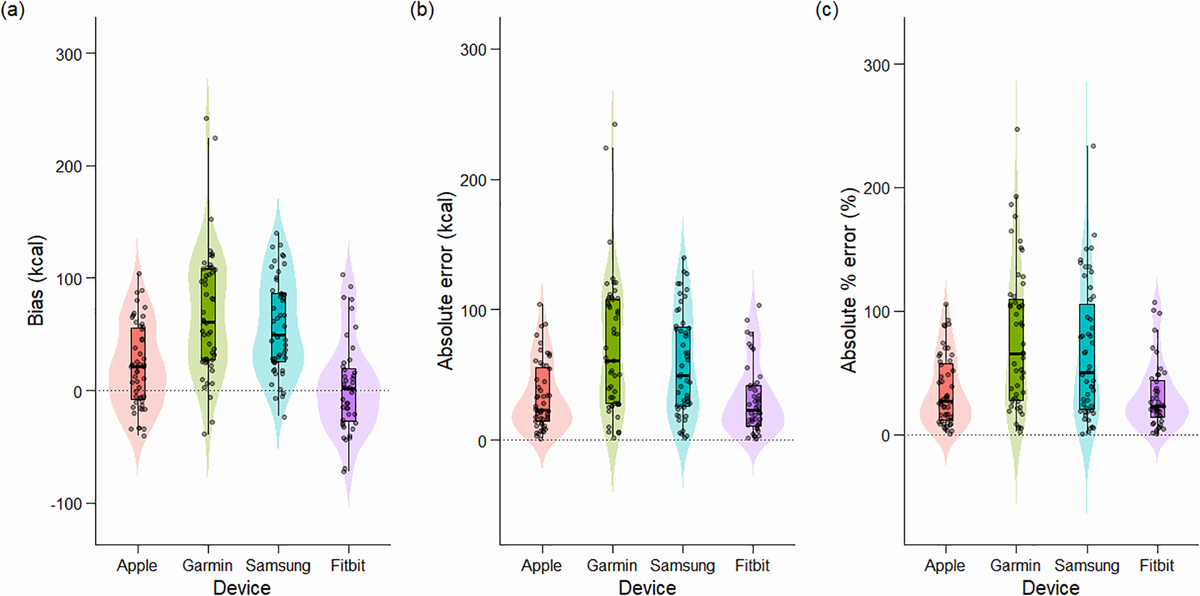
Distribution of error metrics in physical activity energy expenditure (PAEE) estimates across four consumer wearable devices; Apple, Garmin, Samsung, Fitbit.
The problem is their software. Different body types, like a higher fat percentage, require different estimates. And the companies are not commissioning independent test data to create the estimates, they are using, wait for it, their own customers. Fitbit won't be accurate as long as their algorithm only uses their own incorrect data.
It's not to say they can't be useful. That's why I made the Kentucky Windage joke. If you recognize that accuracy drops as body fat goes up, add calories to what they are telling you. If buying the watch motivated you to exercise, that's more important than their accuracy.
Citation: Kostrna J, Oparina E, Palacios C, Rodriguez AJ, Pei J, Ajmal A, et al. (2026) Body fat, skin tone, and the accuracy of smartwatch caloric expenditure estimates. PLoS One 21(7): e0353261. 10.1371/journal.pone.0353261