Beyond IQ

Garth Sundem

Garth Sundem

Garth Sundem is a Science, Math and general Geek Culture writer, TED speaker, and author of books including Brain Trust: 93 Top Scientists Dish the Lab-Tested Secrets of Surfing, Dating, Dieting, Gambling, Growing Man-Eating Plants and More (Three Ri…
RSS Feed
Really, Should You Go To The Bar? Game Theory's El Farol Problem

Really, Should You Go To The Bar? Game Theory's El Farol Problem

Everyone loves the El Farol Bar in Santa Fe, New Mexico (especially W. Brian Arthur, who wrote this puzzle in 1994).That is, everyone loves the El Farol as long as it's not too crowded.If it's less than 60% full, it's more fun to be at the bar; if it's more than 60% full, it's more fun to stay home. This puzzle has one more catch: everyone has to decide whether or not to go at exactly the same time, without communication.So what should you do—stay home or go to the bar?You can probably see the Catch 22 here.

Game Theory Solves The Date-Night Dilemma: Battle Of The Sexes Puzzle (Solution)

Game Theory Solves The Date-Night Dilemma: Battle Of The Sexes Puzzle (Solution)

Yesterday I posted how Game Theory solves the date-night dilemma: opera or the football game. Actually, I posted the problem but not the solution. For all of you who scratched your heads on Saturday night, here's the answer:Mathematically, the cleanest solution is for them to use a commonly observed randomizing device: they flip a coin. Heads it's football and tails it's opera. And once the coin lands, there's no incentive for one player to switch, as it would only result in the loving husband and wife going separate ways for the evening and the loss of all preference points.

Game Theory Solves The Date-Night Dilemma: Battle Of The Sexes Puzzle

Game Theory Solves The Date-Night Dilemma: Battle Of The Sexes Puzzle

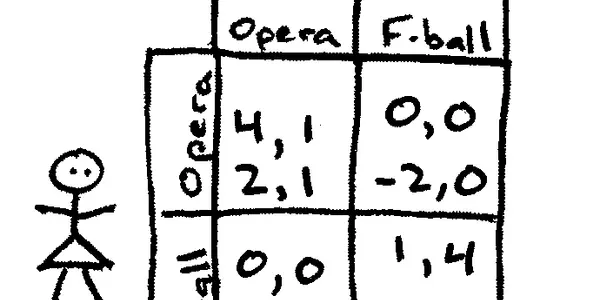
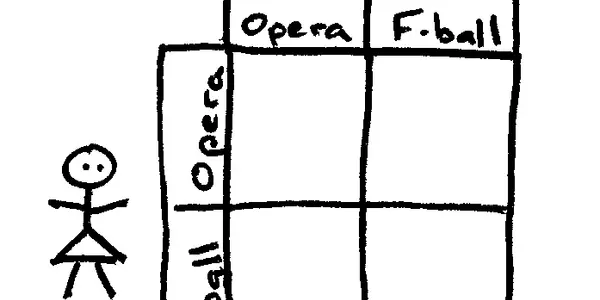
Can't decide between the opera and a football game? (If needed, replace these bland stereotypes with specifics from your own relationship). Game Theory's got your back. Imagine the possible outcomes: football together, football alone, opera together, and opera alone. We can show this with the following grid (imagine the guy choosing a column and the lady choosing a row—they accept the outcome that gets two marks):

Hot Or Not: The Science Of Attractiveness

Hot Or Not: The Science Of Attractiveness

Have you heard about HOTorNOT.com? It's perhaps the most superficial of all superficial dating site, allowing members to vote on other members' attractiveness and promoting dating decisions based almost solely on attractiveness scores. (You carry your own attractiveness score with you and how hot you are becomes part of your profile.)Researchers in the science of beauty and human attraction call this a data paradise. Here are some of the things researchers have been able to discover using HOTorNOT.com's magical numbers:• Men are 240% more likely to accept a date offer than women.

How To Punk Memory: The Brainworks Of Misremembrance, False Memories, And Alternate Realities (Part Trois)

How To Punk Memory: The Brainworks Of Misremembrance, False Memories, And Alternate Realities (Part Trois)

Okay, in the past two days we've seen that our memories are malleable. We can easily be made to misremember, and easily be made to adopt memories of things that never happened. But what actually goes on in our brains as we code bad information? Can we see misinformation taking hold?Researchers Yoko Okado and Craig Stark can.They showed subjects slides (correct information), and then showed them another set of slides with details changed (incorrect information).

How To Punk Memory: The Brainworks Of Misremembrance, False Memories, And Alternate Realities (Part Deux)

How To Punk Memory: The Brainworks Of Misremembrance, False Memories, And Alternate Realities (Part Deux)

Yesterday I posted about how Elizabeth Loftus is able to Jedi mind trick our interpretations of memories, but what about creating entirely new memories? Oh yeah, baby. Actually, making a false memory is pretty easy. Loftus describes a father convincing his daughter she’d gotten lost in a mall when she was five years old. At first, the daughter denied any memory of the event, but as the father provided more fake details—“Don’t you remember that I told you we would meet at the Tug Boat”—the daughter began to “remember” and even provide details of her own. Eventually when her father said “I was so scared,” she responded “Not as scared as I was!”

How To Punk Memory: The Brainworks Of Misremembrance, False Memories, And Alternate Realities

How To Punk Memory: The Brainworks Of Misremembrance, False Memories, And Alternate Realities

In the next three days, I'll out the work mostly of Elizabeth Loftus, who describes how and when our memories misfire—in cool and interesting ways—ways, you can use to create the realities you want in unsuspecting friends and family. Part I:When we store events in our memories, we tag them with keywords. Was the rollercoaster ride exciting, or scary? Was the dip in the pool cold, or invigorating? Then when we encounter a similar situation, we run a quick keyword search of our memory to help us interpret the new event. Whether you go on the rollercoaster or jump in the pool depends on how you tagged these experiences last time.

Personality Of Science 2.0 Users: Results

Personality Of Science 2.0 Users: Results

Did you find yesterday's personalized horoscope spookily accurate? Isn't it amazing how precisely the websites you visit allow description of who you are?In fact (as many of you guessed), it's a trick.

Personality Of Science 2.0 Users Analyzed

Personality Of Science 2.0 Users Analyzed

The following is a horoscope based on the specific personality type common to users of Science20.com. After reading, please comment your evaluation of its accuracy. Then come back tomorrow for post discussing the methodology of accurately modeling group personality based on website preference. You have a need for other people to like and admire you, and yet you tend to be critical of yourself. While you have some personality weaknesses you are generally able to compensate for them.

Strip-Search Prank Call

Strip-Search Prank Call

Do you remember Stanley Milgram's famous authority experiments that found participants were willing to shock the living hell out of people if ordered to do so? If you’re not familiar with this, just google “Milgram experiment” and get ready for some scary reading. If you ARE familiar with this, check out this link to a Washington Post article which describes a recent French reality show that found contestants willing to kill for cash.  Here is a BBC excerpt on Milgram's work.

Kuhn Poker Solved: Win Money With Game Theory

Kuhn Poker Solved: Win Money With Game Theory

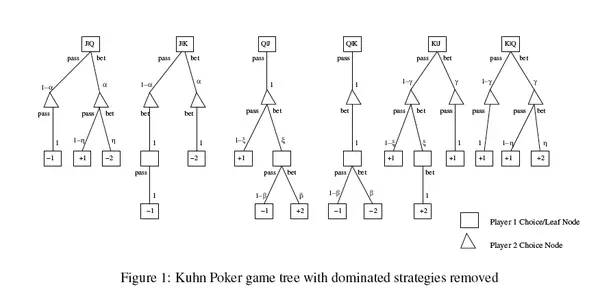
Yesterday I posted the rules of the very cool Kuhn poker. Here's optimal play:Playing first:Interestingly, you can either check or bet a King or a Jack—this is poker, after all and in this case bluffing/slow-playing is as good as playing your cards straight. But holding a Queen is tricky: If you bet, your opponent folds with a Jack or raises with a King. Half the time, you win your opponent's one-chip ante, and half the time you lose your ante plus your bet. This is not good. In fact, it's bad. You're losing twice as many chips as you're winning. So you check.

Win Money With Game Theory: Kuhn Poker

Win Money With Game Theory: Kuhn Poker

Two players share a deck composed of three cards: Jack, Queen, and King. The highest card wins. You each ante one. You each get a card. The third card remains unseen. There's one standard round of betting, with a max bet of one chip each, giving the following choices: the first player can check or bet one. Player two can call, fold, check or raise one (as appropriate). If needed, player one can then call or fold (no re-raising).