News Releases

News Releases

The latest from the scientific community across the world. These are unedited and unfiltered so caveat emptor, even though this is all free.
RSS Feed
More compelling evidence on why earlier HIV treatment lengthens survival

More compelling evidence on why earlier HIV treatment lengthens survival

Seattle – A study showing improved survival of starting antiretroviral treatment earlier than current U.S. recommendations is being reported in the April 30 issue of the New England Journal of Medicine. The study found that not starting HIV patients at a CD4 count greater than 500 cells per cubic millimeter increased risk of death by 94 percent.
"The question of when to start antiretroviral therapy has been one of the key controversies in HIV care for over a decade" said University of Washington's Dr. Mari Kitahata, the lead researcher on the study. "Our study adds a lot of weight to the growing body of evidence that starting treatment earlier in HIV disease prolongs survival."

MIT: Novel needle could cut medical complications

MIT: Novel needle could cut medical complications

CAMBRIDGE, Mass.--Each year, hundreds of thousands of people suffer medical complications from hypodermic needles that penetrate too far under their skin. A new device developed by MIT engineers and colleagues aims to prevent this from happening by keeping needles on target.
The device, which is purely mechanical, is based on concepts borrowed from the oil industry. It involves a hollow S-shaped needle containing a filament that acts as a guide wire. When a physician pushes the device against a tissue, she is actually applying force only to the filament, not the needle itself, thanks to a special clutch.

Neuroscientists demonstrate link between brainwave acticity and visual perception

Neuroscientists demonstrate link between brainwave acticity and visual perception

NEW YORK, April 2, 2009 – Can we always see what is in front of us? According to Dr. Tony Ro, a Professor of Psychology and Cognitive Neuroscience at The City College of New York (CCNY), the answer is "no." New research published in "The Journal of Neuroscience" by Professor Ro and colleagues from the University of Illinois demonstrates that the brain cannot detect images when brainwave activity is in a trough.
"We may have our eyes open, but we sometimes miss seeing things," Professor Ro said. "When the brain is in a state of readiness, you see; when it is not, you don't see."

Passover's matzoh ball soup may be good for your health

Passover's matzoh ball soup may be good for your health

WASHINGTON, April 2, 2009 — With the Jewish holiday of Passover beginning at sundown next Wednesday, April 8, a staple of the traditional dinner –– chicken soup with matzoh balls –– may take on medicinal importance based on findings published in the American Chemical Society's Journal of Agricultural and Food Chemistry.

The popular home remedy for the common cold sometimes known as "Grandma's Penicillin" may have a new role alongside medication and other medical measures in fighting high blood pressure, scientists in Japan are reporting.

Astronauts may need more intense workouts to maintain muscle fitness in space

Astronauts may need more intense workouts to maintain muscle fitness in space

MUNCIE, Ind. — A new study in the The Journal of Applied Physiology, suggests that astronauts need to modify their workouts to avoid extensive muscle loss during missions onboard the International Space Station (ISS).
The latest NASA-sponsored research from Ball State University's Human Performance Laboratory (HPL) suggests that changes are needed to optimize the inflight exercise regimen for astronauts to improve their muscle performance while in space for extended stays.

Artificial pump effectively backs up failing hearts

Artificial pump effectively backs up failing hearts

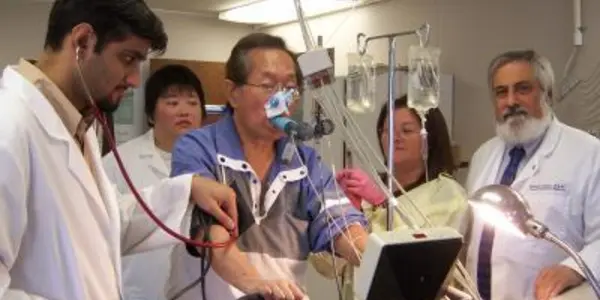
Patients with severe heart failure can be bridged to eventual transplant by a new, smaller and lighter implantable heart pump, according to a just-completed study of the device. Results of this third-generation heart assist device were reported at the 58th annual meeting of the American College of Cardiology on March 30.
The device, called a left ventricular assist device (LVAD), is the latest generation of heart assist devices. The LVAD was tested at five main sites: Washington University School of Medicine in St. Louis, the University of Minnesota, Mt. Sinai School of Medicine, Inova Fairfax Hospital and the University of Pittsburgh.

Beverage consumption a bigger factor in weight

Beverage consumption a bigger factor in weight

When it comes to weight loss, what you drink may be more important than what you eat, according to researchers at the Johns Hopkins Bloomberg School of Public Health. Researchers examined the relationship between beverage consumption among adults and weight change and found that weight loss was positively associated with a reduction in liquid calorie consumption and liquid calorie intake had a stronger impact on weight than solid calorie intake. The results are published in the April 1, 2009, issue of the American Journal of Clinical Nutrition.

Naturally fluorescent molecules may serve as cancer biomarker

Naturally fluorescent molecules may serve as cancer biomarker

Excess amounts of a naturally fluorescent molecule found in all living cells could serve as a natural biomarker for cancer, according to bioengineers.

NADH, or nicotinamide adenine dinucleotide, is a key coenzyme -- a non-protein molecule necessary for the functioning of an enzyme -- found mostly in the inner membrane of a cell's power plant, or mitochondria. It fuels a series of biochemical reactions that involve various enzymes to produce ATP, the major energy source in cells. In the event of disease or a metabolic disorder, these enzymes and their related reactions can become disabled, causing a buildup of unused NADH.

Supervised exercise therapy can lead to improvements in COPD symptoms

Supervised exercise therapy can lead to improvements in COPD symptoms

LOS ANGELES (April 2, 2009) – Those suffering from chronic obstructive pulmonary disease (COPD) often complain that exercise is too exhausting and leaves them breathless. An article in the current issue of the New England Journal of Medicine reports that supervised exercise through pulmonary rehabilitation can actually reduce their feelings of breathlessness, increase their tolerance for exercise and improve their quality of life.

High-resolution image of the brightest Orion Trapezium star

High-resolution image of the brightest Orion Trapezium star

Astronomy & Astrophysics is publishing the first high-resolution image of the young binary system Theta1 Orionis C, located in the Orion Trapezium cluster. This image was obtained by a team of astronomers led by Stefan Kraus and Gerd Weigelt (MPIfR, Bonn, Germany), using the AMBER instrument installed at the ESO/Very Large Telescope Interferometer (VLTI). AMBER is an interferometer beam combiner for the VLT, sensitive in the near-infrared wavelength range (from 1 to 2.5 microns).

Effects of disease severity on autobiographical memory in semantic dementia revealed in new study

Effects of disease severity on autobiographical memory in semantic dementia revealed in new study

Milan, Italy, 2 April 2009 - In a study conducted by the Laboratory of Neuropsychology of the Université de Caen Basse-Normandie and published by Elsevier in the April 2009 issue of Cortex (http://www.elsevier.com/locate/cortex), researchers studied for the first time autobiographical memory in a group of semantic dementia (SD) patients according to disease progression. They highlighted that at early stages of the disease those patients could recall recent memories, but also lasting memories from their youth which tend to disappear as dementia evolves. Mechanisms at the root of this autobiographical memory impairment result from storage deficits combined with faulty retrieval strategies.

Diabetes drug class linked to vision-threatening complication

Diabetes drug class linked to vision-threatening complication

Philadelphia, PA, 2 April 2009 – Treatment with the glitazone class of diabetes drugs leads to a "modest" increase in the risk of diabetic macular edema (DME)—a common complication that can lead to vision loss, reports a study in the April issue of the American Journal of Ophthalmology (http://www.elsevier.com/locate/ajo), published by Elsevier.
Using a database of about 170,000 patients with diabetes, Drs. Donald S. Fong and Richard Contreras of Southern California Permanente Medical Group analyzed the link between glitazones and the development of DME. Diabetic macular edema is a common diabetes complication, with swelling and fluid build-up in the retina leading to progressive visual loss.