Hey, heads up Public: game-changing new science means we can probably make insects stop spreading malaria, dengue fever, and Lyme disease. Or reverse pesticide resistance in agricultural pests. Or even eliminate invasive (or otherwise undesired) species. But this has major public policy implications, and scientists want to make sure everybody knows what we’re getting into and we set up safeguards before any of this actually happens.
I have given up on categories. I did a BA in physics, a PhD in molecular biology, and now a postdoc in a bioengineering department. So call that what you will, I'm interested in using a quantitative approach to understand biology and solve problems…
Hot off of revolutionizing ground-based transportation with the electric car company Tesla and proposing to revolutionize slightly-above-the-ground-based transportation with the Jetsons-esque Hyperloop, eccentric billionaire genius Elon Musk (of PayPal fame) appears to believe he has risen above the law. Or rather, he believes his Space Exploration Technologies Corporation (SpaceX) Grasshopper rocket has risen above the law.
Hot off of revolutionizing ground-based transportation with the electric car company Tesla and revolutionizing slightly-above-the-ground-based transportation with the Hyperloop, eccentric billionaire genius Elon Musk appears to believe he has risen above the law. Or rather, he believes his SpaceX Grasshopper rocket has risen above the law.
The US Supreme Court recently sided with patient advocacy groups that a company cannot patent your genes. Sounds like a pretty clear case, but the decision also creates some exceedingly odd loopholes, and even loopholes within loopholes, to say nothing of the fact that Justice Scalia dissented with the uncontroversial, basic science introduction to the case.
The U.S. Supreme Court just released a groundbreaking decision about the ability to patent genes – the assembly instruction for life. Amid much discussion about potential implications for the biotech industry, a separate, extremely troubling aspect of this decision has largely slid under the radar: one of the SCOTUS Justices dissented with basic science saying he is "unable to affirm... knowledge or even my own belief" in high school biology
Deciding who gets a lung transplant - and thereby who doesn’t - is not easy. Lungs can only be transplanted from people who are organ donors, who are brain dead, and who died in such a way that their organs remain intact. Problem is, there are not enough people marking the “organ donor” box on their driver’s license to give everyone on the transplant list a chance to live.
The music-recording industry has been under pressure lately, as it struggles to adapt to the age of the internet. This is the second major structural revolution to challenge the recording industry in the past few decades, the first being when video killed the radio star. Music videos surged in popularity (and budget) in the '90s, but during the '00s (pronounced "uh-ohs") music video budgets seemed to have plateaued and begun to decline. In fact, just 3 of the 20 most expensive (inflation-adjusted) music videos of all time were produced after 2000. The most expensive of all time remains Michael and Janet Jackson's "Scream" at $10 million.
In October 1908, after several false starts, one of the world's most effective predators finally found a niche where its population could begin to boom. A century later, this ruthless hunter has spread throughout the world and is known to prey upon everything from insects to grizzly bears, although it does occasionally lose when attacking the latter. Among its prime targets are birds, of which it is estimated to kill nearly 100 million every year in the United States alone1. I refer, of course, to the automobile.
In the past few centuries, our understanding of bacteria has progressed from mysterious medieval vapours, to the microscopic "animalcules" of van Leeuwenhoek, to the germ theory of disease à la Pasteur, to the realizations that bacteria outnumber us within our own bodies and that good "probiotic" bacteria actually make us healthier. Now, a new study seems to have discovered a Batman bacterium. Well, technically, the bacterium was already well-known; the discovery was to show that this prokaryotic Bruce Wayne is, in fact, Batman.
Perhaps the most persistent prediction in the futurist documentary series Futurama is that humans will outlive our bodies by adopting the brain-in-a-jar form factor. In the show, the main purpose is to enable satire targeting familiar celebrities, despite the 30th century setting. However, it raises an important question: Would it be possible to decouple our brains from our bodies? Or are neurons (brain cells) limited to the same intrinsic life span as the biological machinery that hosts them?A new study
In some Chinese cities, breathing has recently become demonstrably hazardous to your health. According to the US embassy's monitoring station, air pollution has skipped over unhealthy, exceeded hazardous, and gone straight to " crazy bad". No, literally. A "crazy bad" category was programmed into the system's automated twitter feed, presumably assuming it would never be triggered. "Crazy bad" has now been rebranded as the more reassuring "beyond index". Whatever you call it, the extreme smog is not only crazy bad for Chinese, it's hurting those across the Pacific as well.
The Earth just got a few shots across our bow, what with a giant asteroid hurtling between us and the moon, and another (fortunately much smaller) space rock exploding over Russia, causing a surprising amount of destruction. So what can we do about the solar system trying to bomb us? Fortunately, the Space Generation Advisory Council is on the case with its Move an Asteroid contest.
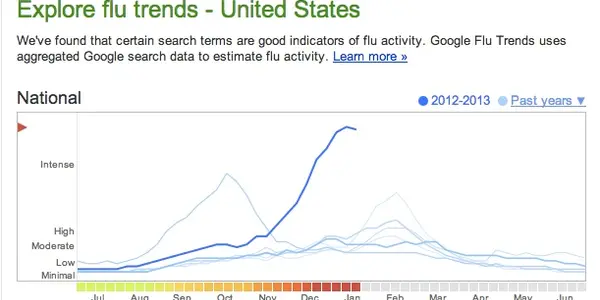
The influenza virus, ever-wiley, has decided to hit America early and hard this year. The flu season is always full of uncertainty. How bad will it be? How well will the annual vaccine work? What folk remedy will the internets come up with this time? For many people, all this uncertainty can make a flu shot not seem worth the effort. That wouldn't be so bad if flu shots were just about our own personal cost-benefit analysis. But the truth, which gets far too little attention outside epidemiology circles, is that getting your flu shot is about more than just you.