I’ve written in the past about the tendency of some researchers to compensate for weak study design or small sample size by over-hyping their research findings, particularly with the news media.
Dr. Gregory Bond obtained a Ph.D. in Epidemiology after receiving a Bachelor of Science degree in Microbiology and a Masters in Public Health, all from the University of Michigan. Dr. Bond has published more than sixty peer-reviewed journal articles …
Although I’m a trained and credentialed epidemiologist, and an
ardent supporter of the professional discipline as a foundational science that
underlies legitimate public health efforts, several of my past blogs (Bond
2016 and Bond
2017) have remarked on the many limitations of observational
epidemiology1 research for establishing disease causation.
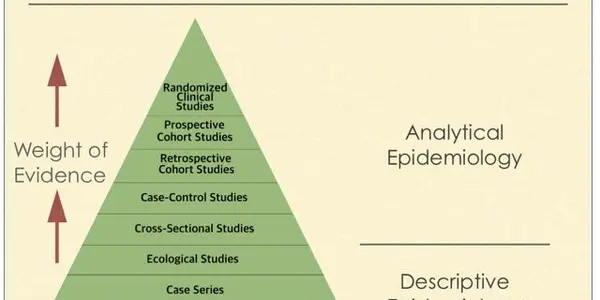
Although I’m a trained and credentialed epidemiologist, and an ardent supporter of the professional discipline as a foundational science that underlies legitimate public health efforts, several of my past blogs (Bond 2016 and Bond 2017) have remarked on the many limitations of observational epidemiology1 research for establishing disease causation. Of course, I’m not the only such critic writing about it. Of late, observational studies have been getting a particularly bad rap in the popular press as too unreliable.
Although I’m a trained and credentialed epidemiologist, and an ardent supporter of the professional discipline as a foundational science that underlies legitimate public health efforts, several of my past blogs (Bond 2016 and Bond 2017) have remarked on the many limitations of observational epidemiology1 research for establishing disease causation. Of course, I’m not the only such critic writing about it. Of late, observational studies have been getting a particularly bad rap in the popular press as too unreliable.
Although I’m a trained and credentialed epidemiologist, and an ardent supporter of the professional discipline as a foundational science that underlies legitimate public health efforts, several of my past blogs (Bond 2016 and Bond 2017) have remarked on the many limitations of observational epidemiology1 research for establishing disease causation. Of course, I’m not the only such critic writing about it. Of late, observational studies have been getting a particularly bad rap in the popular press as too unreliable.
Several contemporary events scheduled for the European Union are bringing increased focus to the topic of communicating risks about Endocrine Disrupting Chemicals (EDCs). The first took place on May 16 at the annual meeting of the European Chapter of the Society of Environmental Toxicology and Chemistry (SETAC) which was held in Rome.
My wife and I annually host Thanksgiving dinner for extended family and friends. It’s a big affair and since we live in a fairly remote, albeit stunningly beautiful, part of northern Michigan, and our guests have to travel hundreds of miles to get here, the event stretches over multiple days. One of my responsibilities is to ensure we have sufficient quantity and diversity of alcoholic and non-alcoholic beverages to appeal to all of our guests who span four generations and have varied tastes.
In 2017 the National Academies of Sciences, Engineering, and Medicine (NAS) published a report that it developed for the U.S. Environmental Protection Agency (EPA) to evaluate the evidence that chemicals are capable of causing health effects at low-doses.
On November 29, an op-ed article, co-signed by 94 scientists, and entitled “Let’s Stop the Manipulation of Science” was published in Le Monde. It makes numerous allegations, most prominent among them that industry is “manufacturing doubt” about the science on endocrine disrupting chemicals (EDCs). But as anyone who has followed the issue of endocrine disruptors knows, it is highly controversial and polarized with serious questions
In 1991, Theo Colborn convened a group of international scientists to discuss concerns about the trans-generational effects of persistent chemicals on predator species in the Great Lakes. Their report, and a subsequent book authored by Colborn and her colleagues entitled Our Stolen Future, Are We Threatening Our Fertility, Intelligence and Survival?, proposed that many chemicals which display an ability to interact or interfere with the human endocrine system have the ability to elicit adverse health effects at doses far lower than the toxicities caused through other modes of action and required special regulation.