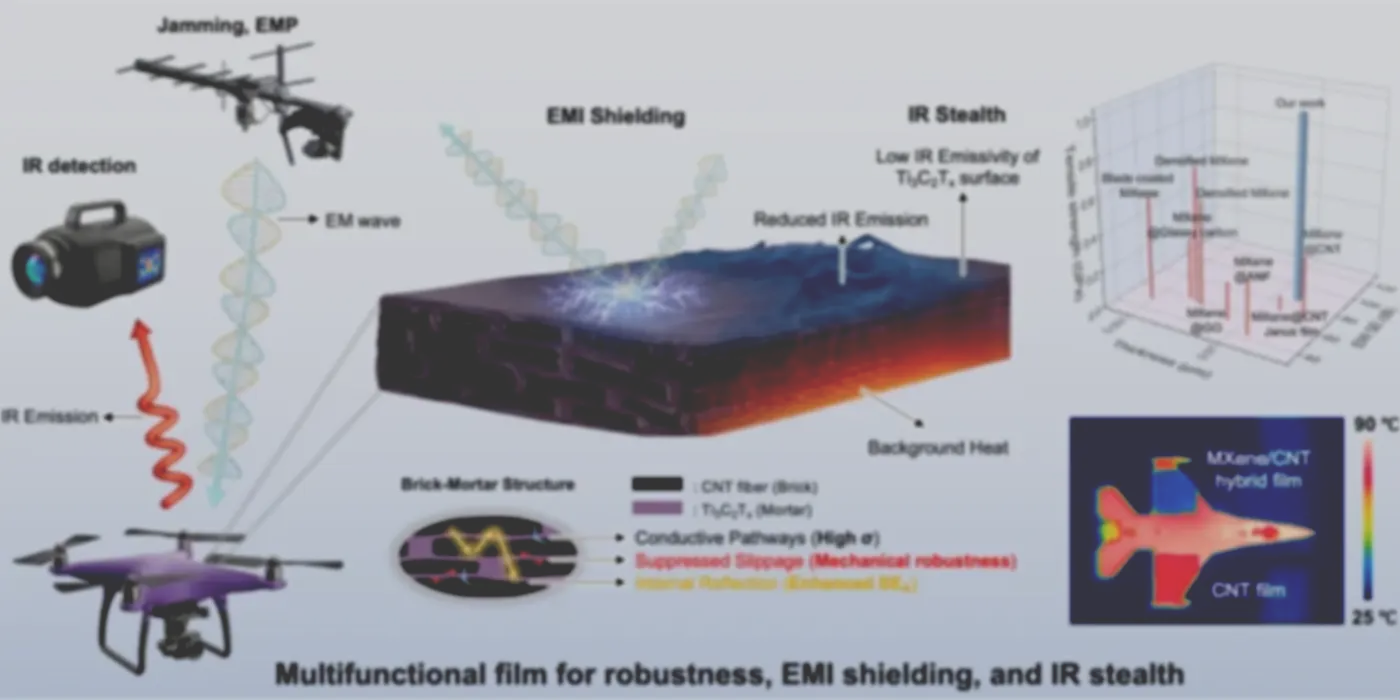
Carbon Nanotube Has EMI And Hides Heat
Researchers have developed a composite film that combines electromagnetic interference shielding, infrared stealth, and high mechanical strength using carbon nanotube fibers and MXene.
Researchers have developed a composite film that combines electromagnetic interference shielding, infrared stealth, and high mechanical strength using carbon nanotube fibers and MXene.


A chemically-modified version of a mitochondrial toxin long used to control species of invasive fish in lakes has been found to selectively inhibit two "survival proteins” in cancer cells. The research is a first step toward developing a molecularly-targeted drug that could eliminate cellular-level resistance to multiple types of chemotherapy and radiation therapy found in many types of cancers.
In a paper published today in the July 2007 issue of Molecular Cancer Therapeutics, scientists at Fred Hutchinson Cancer Research Center report that a modified version of antimycin called 2-Methoxy antimycin is selective in killing cells that have high levels of Bcl-2 and Bcl-xL proteins.
Researchers from the University of Pittsburgh School of Medicine report a significant new advance in the search for an effective treatment for human liver cancer in the July issue of Molecular Cancer Therapeutics.
Using a newly available monoclonal antibody, they demonstrated significant reductions in tumor cell proliferation and survival in human and mouse hepatocellular cancer (HCC) cell lines. According to the researchers, this finding has significant implications not only for the treatment of liver cancer but for a number of different types of cancer.
Most cases of HCC are secondary to either a viral hepatitis infection or cirrhosis of the liver.
Argonaute 2 (Ago2) is unique among its family: It is the only one of the four mammalian Argonaute proteins that exhibits endonuclease “slicer” activity (facilitation of miRNA-guided cleavage of target mRNA).
However, as Drs. Donal O’Carroll and Alexander Tarakhovsky (The Rockefeller Institute) report, Ago2’s defining characteristic is surprisingly non-essential for its role in hematopoiesis and miRNA biogenesis.
Drs. O’Carroll, Tarakhovsky and colleagues generated transgenic mice harboring mutated versions of Ago2 in their bone marrow. The researchers found that Ago2 is, indeed, quite necessary for normal blood cell development. Its endonulcease activity, however, is not.
Using natural ‘gravitational lenses’, an international team of astronomers claim to have found a hint of a population of the most distant galaxies yet seen - the light we see from them today left more than 13 thousand million years ago, when the Universe was just 500 million years old.
Team leader Professor Richard Ellis, Steele Professor of Astronomy at Caltech, will present images of these faint and distant objects in his talk on Wednesday 11 July at the ‘From IRAS to Herschel and Planck’ conference at the Geological Society in London.
A University of Alabama astronomer has co-developed a new way to characterize galaxy features that is giving scientists additional insight into how galaxies formed and changed over time, according to a paper published in the June 2007 issue of The Astronomical Journal.
Dr. Ronald J. Buta, professor of astronomy at UA, and Dr. Xiaolei Zhang, of the Naval Research Laboratory, Washington, D.C., co-authored the paper detailing the new method of characterizing density wave features in galaxies. Density waves are mass enhancements in galaxies that appear in the forms of spiral arms, linear bar features, and ring-shaped patterns. Orbiting stars and gas clouds stream in and out of these features much like vehicles in heavy traffic.
Researchers have identified a new gene mutation linked to frontotemporal dementia, according to a study published in the July 10, 2007, issue of Neurology®, the medical journal of the American Academy of Neurology.
Frontotemporal dementia, one form of which is known as Pick’s disease, involves progressive shrinking of the areas of the brain that control behavior and language. Symptoms include language problems and personality changes, often with inappropriate social behavior. Unlike Alzheimer’s disease dementia, the disease does not affect memory in the early stages. The genetic form of the disease is rare; most cases occur randomly.
Computer graphics researchers at Carnegie Mellon University have developed systems for editing or altering photographs using segments of the millions of images available on the Web.
Whether adding people or objects to a photo, or filling holes in an edited photo, the systems automatically find images that match the context of the original photo so they blend realistically. Unlike traditional photo editing, these results can be achieved rapidly by users with minimal skills.
“We are able to leverage the huge amounts of visual information available on the Internet to find images that make the best fit,” said Alexei A. Efros, assistant professor of computer science and robotics.
A new study of sweetened beverages shows that cane sugar and high fructose corn syrup have similar effects on hunger, fullness, and food consumption at lunch.
According to the study, which appears in the July issue of the American Journal of Clinical Nutrition, this may be because sucrose (table sugar) in beverages splits into glucose and fructose molecules, such as are present in high-fructose corn syrup. The results suggest that while appetite and food intake are influenced by the number of calories consumed earlier, the types of sugars consumed in those calories seem to make little or no difference.
A new study finds that the more “western” the diet -- marked by red meat, starches and sweets -- the greater the risk for breast cancer among postmenopausal Chinese women. According to researchers who conducted the analysis at Fox Chase Cancer Center in Philadelphia, Harvard University, Shanghai Cancer Institute, and Vanderbilt University, the findings mark the first time a specific association between a western diet and breast cancer has been identified in Asian women.
The study is the latest set of findings derived from the Shanghai Breast Cancer Study, conducted in the 1990s by Wei Zheng, M.D., Ph.D., M.P.H, and colleagues at Vanderbilt University.
Since being found in Florida just a little more than a year and a half ago, citrus greening disease, which originated in China a century ago, has spread from 8 to 23 counties. The disease, called Huanglongbing (yellow shoot) in Asia, is spread by the bacterium Candidatus Liberibacter asiaticus (CLas) via insects. Once citrus trees are infected, the fruit yield, rate, and quality are greatly reduced. The trees also become susceptible to other diseases and health problems. In some areas of Brazil, citrus greening has affected as much as 70 percent of the fruit rate and yield. Since Florida has nearly $10 billion in citrus products, it is important to avoid spread. However, right now citrus greening disease can only be managed, not completely controlled.
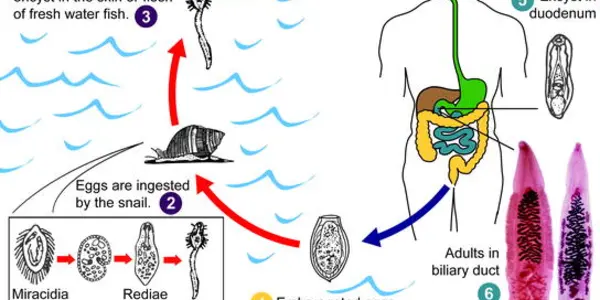
An age old preference for eating uncooked fish dishes like “koi-pla” puts people in SE Asia at risk of ingesting trematodes that can cause a type of liver cancer called cholangiocarcinoma (cancer of the bile ducts), say researchers.
Banchob Sripa (Khon Kaen University) and colleagues discuss the mechanisms by which the food-borne trematode Opisthorchis viverrini (the SE Asian liver fluke) causes cholangiocarcinoma. The fluke is endemic to Thailand, Lao People’s Democratic Republic, Vietnam, and Cambodia. In Thailand alone, 6 million people are thought to be infected with the fluke.
Embryonated eggs are discharged in the biliary ducts and in the stool (1).
A pooled analysis of data from previous studies suggests that cigarette smoking appears to be associated with a reduced risk for developing Parkinson’s disease, with long-term and current smokers at the lowest risk, according to a report in the July issue of Archives of Neurology.
Several studies have suggested that patients with Parkinson’s disease are less likely to be smokers, according to background information in the article.
“Recent studies also suggested that Parkinson’s disease risk is particularly low in active smokers with a long history of intense smoking; some even suggested dose-related risk reductions with increasing pack-years of smoking,” the authors write.