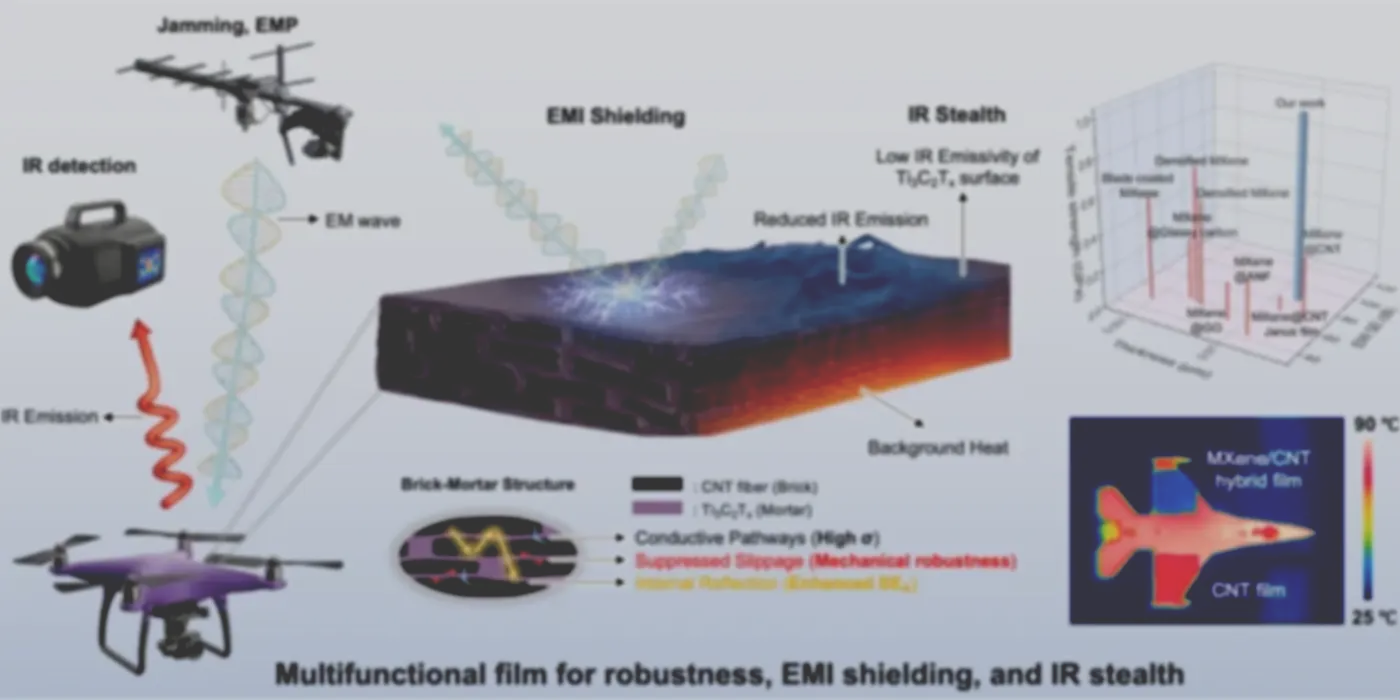
Carbon Nanotube Has EMI And Hides Heat
Researchers have developed a composite film that combines electromagnetic interference shielding, infrared stealth, and high mechanical strength using carbon nanotube fibers and MXene.
Researchers have developed a composite film that combines electromagnetic interference shielding, infrared stealth, and high mechanical strength using carbon nanotube fibers and MXene.


A Cornell study of genome sequences in African-Americans, European-Americans and Chinese suggests that natural selection has caused as much as 10 percent of the human genome to change in some populations in the last 15,000 to 100,000 years, when people began migrating from Africa.
The study looked for areas where most members of a population showed the same genetic changes. For example, the researchers found evidence of recent selection on skin pigmentation genes, providing the genetic data to support theories proposed by anthropologists for decades that as anatomically modern humans migrated out of Africa and experienced different climates and sunlight levels, their skin colors adapted to the new environments.
Using plastics to harvest the energy of the sun just got a significant boost in efficiency thanks to a discovery made at the Center for Polymers and Organic Solids at the University of California, Santa Barbara.
Nobel laureate Alan Heeger, professor of physics at UC Santa Barbara, worked with Kwanghee Lee of Korea and a team of other scientists to create a new “tandem” organic solar cell with increased efficiency. The discovery marks a step forward in materials science.
A team of researchers at Umeå University in Sweden have discovered a unique mechanism by which the same signal molecule determines the formation of the both the lens of the eye and the olfactory cells of the nose.
Smell and sight are two sensory systems that are crucial to our ability to perceive the world around us. The ability to sense smells is established by the development of the olfactory mucous membrane. The ability to see is similarly dependent on the formation of the lens in the eyes.
Estrogen, which binds estrogen receptor alpha (ER-alpha), is a risk factor for breast cancer development. However, one-third of new breast cancers lack detectable ER-alpha. These ER-alpha–negative cancers are more aggressive and have a worse prognosis than do ER-alpha–positive breast cancers, and have been thought to be estrogen independent.
In a new study, Joyce Slingerland and colleagues from the University of Miami shed further light on the mechanisms regulating ER-alpha expression levels during breast cancer.
That title alone should get this article on the front page of technology papers everywhere, but the comparisons are valid.
Though people feel they have rich visual experiences, researchers have found that the average person is only aware of about four things at a time. This short term capability varies from person to person but an individual’s capacity for short-term memory is a strong predictor of IQ and scholastic achievement. People with high IQs can think about more things at once.
For example, a four-gigabyte iPhone, the popular new Apple cell phone, might be able to hold about 1,000 four-minute songs, but far fewer if the songs were all 20 minutes in length, explained University of Oregon psychology professors Edward Awh and Edward Vogel.
Scientists studying one of nature’s simplest organisms have helped to unravel the structure of a key molecule that controls pain in humans.
Chronic pain, unlike the acute pain associated with trauma, has no apparent physiological benefit, often being referred to as the ‘disease of pain’. Complete and lasting relief of chronic pain is rare and often the clinical goal is pain management through one or more medications.
But now researchers at The University of Manchester have examined microscopic amoeboid organisms commonly called slime moulds in a bid to gain greater insight into these pain molecules, known as ‘P2X receptors’.

Dr. Giovanna Tinetti ( read her interview with Scientific Blogging's Douglas Blane here ) of the European Space Agency and UCL’s Department of Physics & Astronomy has discovered that a planet passing in front of its ‘sun’ absorbs starlight in a way that can only be explained by the presence of water vapour in its atmosphere. This is the first time that astronomers have been able to confirm that water is present on an extra-solar planet.
‘Extra-solar’ planets are those outside our Solar System and more than 200 have been discovered orbiting stars close to our own Sun.

Indonesia’s Mount Gamkonora volcano is spewing hot ash and smoke into the air, as seen in this image taken by the MERIS instrument aboard ESA’s satellite Envisat, causing more than 8000 people to be evacuated amid fears of an imminent eruption, according to officials.
Officials raised the alert to the highest level on Tuesday after the volcano, located in the eastern province of North Maluku, started spitting out flaming material, indicating magma was approaching the crater’s surface making an eruption more likely, Saut Simatupang of Indonesia's Vulcanological Survey told Reuters news agency.
The 1635m volcano, located about 2400 km northeast of Jakarta, began releasing smoke and ash on Saturday and spewed it as high as 4000m on Monday.
A startling discovery on the development of human embryonic stem cells by scientists at McMaster University will change how future research in the area is done.
A study this week reports on a new understanding of the growth of human stem cells. It had been thought previously that stem cells are directly influenced by cells in the local environment or ‘niche’, but the situation may be more complex. Human embryonic stem cells are perpetual machines that generate fuel for life.

One year after the beginning of its scientific operations, the high-capability infrared satellite AKARI continues to produce stunning views of the infrared Universe.
Launched in February 2006, AKARI is making a comprehensive, multi-wavelength study of the sky in infrared light, helping to gain a deeper understanding of the formation and evolution of galaxies, stars and planetary systems. The mission is a Japan Aerospace Exploration Agency (JAXA) project with ESA and international participation.
In the course of last year, AKARI performed all-sky observations in six wavelength bands. More than 90 percent of the entire sky has so far been imaged.
Neutrophils are biological killers. These white blood cells patrol the body and guard against infection by bacteria and fungi, identifying and destroying any invaders that cross their path. But new evidence, which may lead to better drugs to fight deadly pathogens, indicates that neutrophils might actually distinguish among their targets.
A scientist has discovered that neutrophils recognize and respond to a specific form of sugar called beta-1,6-glucan on the surface of fungi. This sugar comprises just a small fraction of the fungal cell wall, much less than another sugar with a slightly different chemical conformation called beta-1,3-glucan.
Organic farming can yield up to three times as much food as conventional farming on the same amount of land---according to new findings which refute the long-standing assumption that organic farming methods cannot produce enough food to feed the global population.
Researchers from the University of Michigan found that in developed countries, yields were almost equal on organic and conventional farms. In developing countries, food production could double or triple using organic methods, said Ivette Perfecto, professor at U-M's School of Natural Resources and Environment, and one the study's principal investigators.