Carbon Nanotube Has EMI And Hides Heat
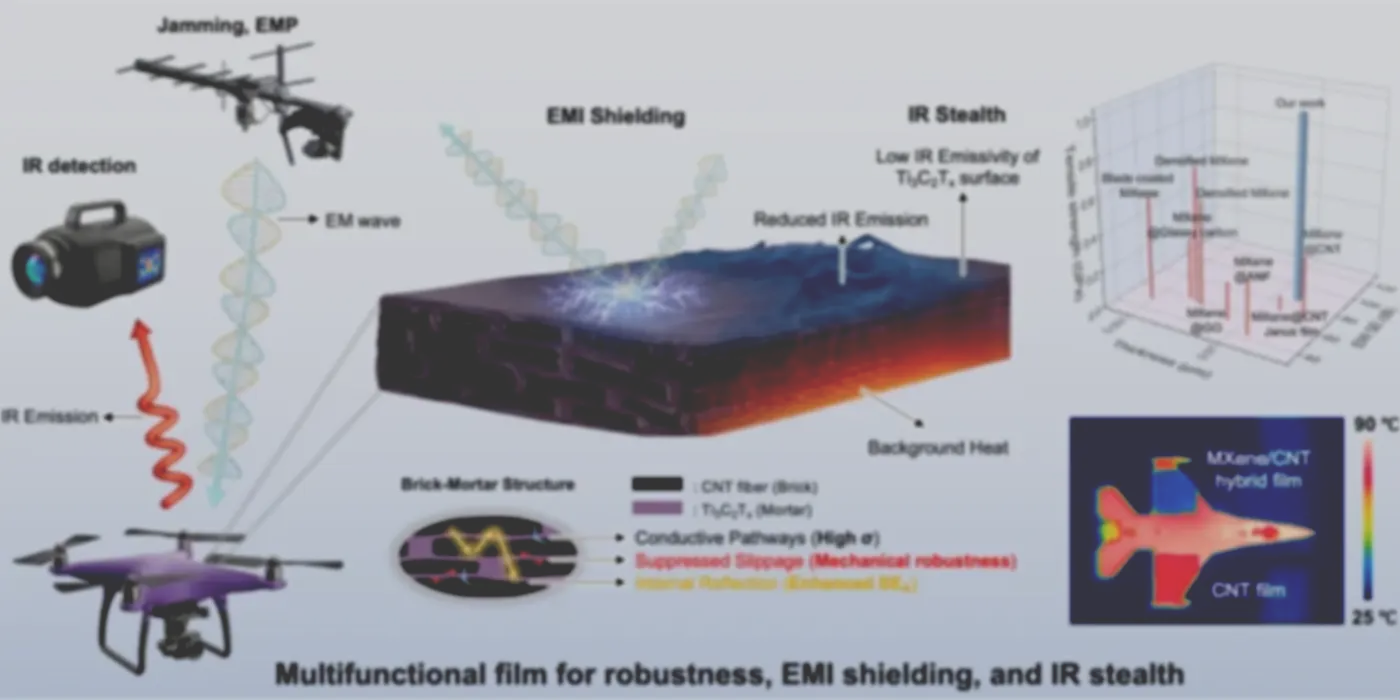
Researchers have developed a composite film that combines electromagnetic interference shielding, infrared stealth, and high mechanical strength using carbon nanotube fibers and MXene.
Researchers have developed a composite film that combines electromagnetic interference shielding, infrared stealth, and high mechanical strength using carbon nanotube fibers and MXene.


It's fun to imagine life on other planets being advanced alien civilizations and exotic creatures conversing in foreign languages but it's not possible to determine any of those things now.
Instead, by studying various biosignatures found in the light spectrum leaking out to Earth, researchers can speculate on what kind of photosynthesis might occur on such planets and what the extrasolar plants might look like.
Paint it black
It could be the plants are black, says Robert Blankenship, Ph.D., Lucille P. Markey Distinguished Professor in Arts & Sciences at Washington University in St. Louis. But it all depends on what size and light intensity of star – or sun – the planet feeds off, and the extrasolar planet’s atmospheric chemistry.

The obesity epidemic has become a major public health problem in both industrialized countries and the developing world. Recent studies suggest that the major development of persistent adiposity is established already at pre-adolescence.
The fact that obesity is mainly determined before puberty implies that preschool detection of children at risk is essential along with individual prevention programs.
A Swedish study reports a protocol that detects with high precision which pre-adolescent children will be obese later using only weight and height data.
Protocol assessment according to the STARD procedure.
The report says investment capital flowing into renewable energy climbed from $80 billion in 2005 to a record $100 billion in 2006. As well, the renewable energy sector's growth "although still volatile ... is showing no sign of abating."
The report offers a host of reasons behind and insights into the world's newest gold rush, which saw investors pour $71 billion into companies and new sector opportunities in 2006, a 43% jump from 2005 (and up 158% over the last two years. The trend continues in 2007 with experts predicting investments of $85 billion this year).
In addition to the $71 billion, about $30 billion entered the sector in 2006 via mergers and acquisitions, leveraged buyouts and asset refinancing.
The significance of pleiotrophin (PTN) expression in breast cancer has not been clearly established but researchers at Scripps sau they have done it in a new study.
A sheet of molten rock roughly 10 miles thick spreads underneath much of the American Southwest, some 250 miles below Tucson, Ariz. From the surface, you can't see it, smell it or feel it.
But Arizona geophysicists Daniel Toffelmier and James Tyburczy detected the molten layer with a comparatively new and overlooked technique for exploring the deep Earth that uses magnetic eruptions on the sun.
Toffelmier, a hydrogeologist with Hargis + Associates, Inc., in Mesa, Ariz., graduated from ASU’s School of Earth and Space Exploration in 2006 with a master’s degree in geological sciences. Tyburczy, a professor of geoscience in the school, was Toffelmier's thesis advisor.
Researchers have discovered a sophisticated neural computer, buried deep in the cerebellum, that performs inertial navigation calculations to figure out a person’s movement through space.
These calculations are no mean feat, emphasized the researchers. The vestibular system in the inner ear provides the primary source of input to the brain about the body’s movement and orientation in space. However, the vestibular sensors in the inner ear yield information about head position only.
A particular resonance pattern in the brain’s auditory processing region appears to be key to its ability to discriminate speech, researchers have found. They found that the inherent rhythm of neural activity called “theta band” specifically reacts to spoken sentences by changing its phase.
The researchers also noted that the natural oscillation of this frequency provides further evidence that the brain samples speech segments about the length of a syllable.
The findings represent the first time that such a broad neural response has been identified as central to perceiving the highly complex dynamics of human speech, said the researchers.
The team of Denis Réale, Professor in the Department of Biological Sciences at Université du Québec à Montréal, recently published some remarkable research findings. Reconstructing the genetic history of a population of mouflons descended from a single pair, the researchers demonstrated that the animals’ genetic diversity increased over time, contrary to what the usual models predict.
These results contradict the belief that a population descended from a small number of individuals will exhibit numerous deficiencies and reduced genetic diversity.
The mouflon population of the Kerguelen archipelago
The Kerguelen Islands in the Indian Ocean are one of four districts in the French Austral and Antarctic Territories.
In a survey of more than one thousand infertility patients with frozen embryos, 60 percent of patients report that they are likely to donate their embryos to stem cell research, a level of donation that could result in roughly 2000 to 3000 new embryonic stem cell lines.
In August of 2001, less than two dozen embryonic stem cell lines were made eligible for federal research funding. Most scientists now agree that the eligible lines have proven inadequate in number and unsafe for transnational research.
Until recently, the best estimate of human embryos currently in storage that might be available for additional stem cell research was three percent. The 2003 study showed that donations would yield, at best, less than 300 new lines.
A new type of stainless steel alloy developed at Oak Ridge National Laboratory could allow for significantly increased operating temperatures and corresponding increases in efficiency in future energy production systems.
The new alloys offer superior oxidation resistance compared to conventional stainless steels, without significant increased cost or decreased creep resistance (sagging at high temperature). What sets this proprietary material apart from other stainless steels is its ability to form protective aluminum oxide scales instead of chromium oxide scales.
The combination of creep and oxidation resistance offered by these alloys previously was available only with nickel-base alloys, which are about five times more costly than the new stainless steels.
New study finds the key to understanding the global spread of AIDS is the size of the infected prostitute community around the world.
In new academic research published today in the online, open-access, peer-reviewed scientific journal PLoS ONE, male circumcision is found to be much less important as a deterrent to the global AIDS pandemic than previously thought. The author, John R. Talbott, has conducted statistical empirical research across 77 countries of the world and has uncovered some surprising results.
The new study finds that the number of infected prostitutes in a country is the key to explaining the degree to which AIDS has infected the general population.
A major question in evolutionary studies today is how early did humans begin to think and behave in ways we would see as fundamentally modern?
One index of ‘behavioral modernity’ is in the appearance of objects used purely as decoration or ornaments. Such items are widely regarded as having symbolic rather than practical value. By displaying them on the body as necklaces, pendants or bracelets or attached to clothing this also greatly increased their visual impact. The appearance of ornaments may be linked to a growing sense of self-awareness and identity amongst humans and any symbolic meanings would have been shared by members of the same group.