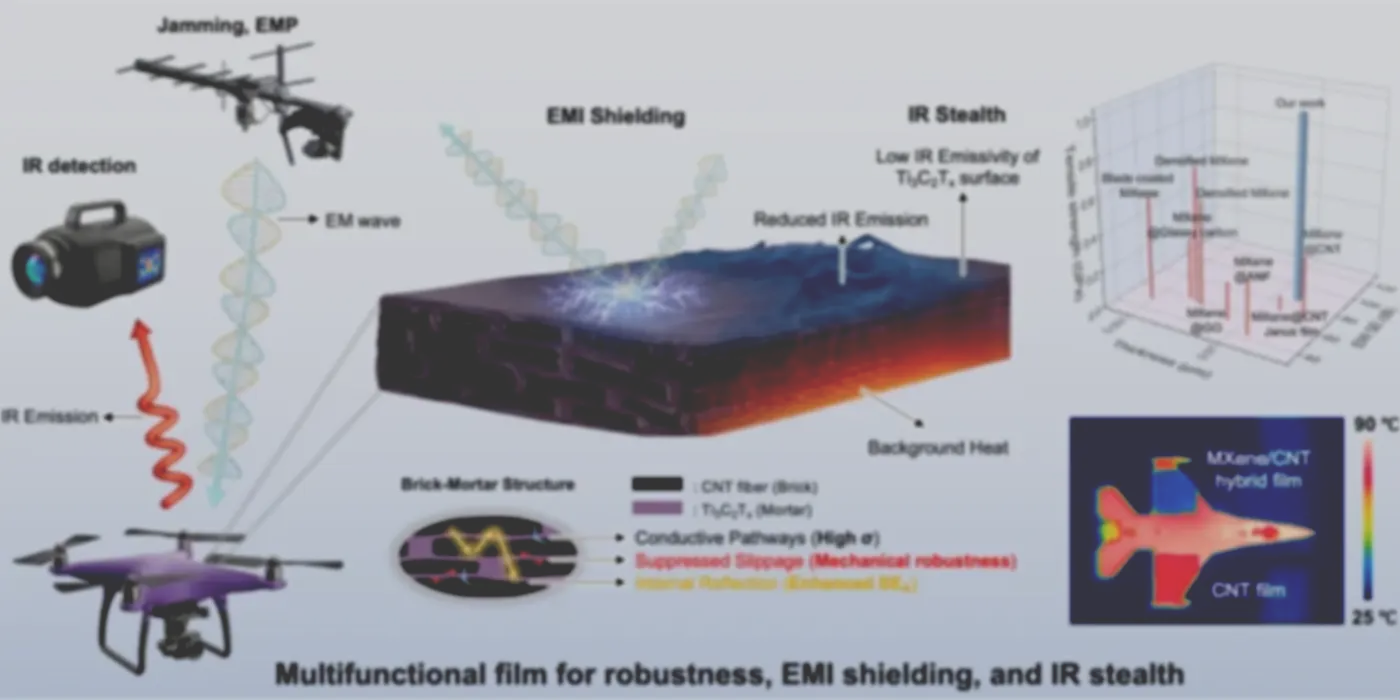
Carbon Nanotube Has EMI And Hides Heat
Researchers have developed a composite film that combines electromagnetic interference shielding, infrared stealth, and high mechanical strength using carbon nanotube fibers and MXene.
Researchers have developed a composite film that combines electromagnetic interference shielding, infrared stealth, and high mechanical strength using carbon nanotube fibers and MXene.


Cells constantly swap cargo bound in vesicles, miniscule membrane-enclosed packages of proteins and other chemicals. Before the swap can take place, the vesicle membrane must fuse with another membrane, creating channels packages can pass through.
This process, known as membrane fusion, is fundamental to health and disease. It occurs at fertilization and is particularly critical to keep hormones circulating and brain cells firing. Membrane fusion is also how HIV and other viruses infect cells.
Researchers from the University of Washington, Rosalind Franklin University of Medicine and Science, Merck Laboratories, and Mount Sinai School of Medicine have released a study suggesting that specific laboratory and clinical tests can predict outcome of antibiotic therapy for infections in persons with diabetes.
Chemicals in cruciferous vegetables, such as broccoli, watercress, cabbage and cauliflower, appear to not only stop human prostate cancer cells from growing in mice but also may cut off the formation of blood vessels that "feed" tumors, says a University of Pittsburgh Cancer Institute study.
A type of omega-3 fatty acid may slow the growth of two brain lesions that are hallmarks of Alzheimer’s disease, UC Irvine scientists have discovered. The finding suggests that diets rich in docosahexaenoic acid (DHA) can help prevent the development of Alzheimer’s disease later in life.
This study with genetically modified mice is the first to show that DHA, an omega-3 fatty acid, can slow the accumulation of tau, a protein that leads to the development of neurofibrillary tangles. Such tangles are one of two signature brain lesions of Alzheimer’s disease. DHA also was found to reduce levels of the protein beta amyloid, which can clump in the brain and form plaques, the other Alzheimer’s lesion.
Using Chinese herbs either alone or in conjunction with chemotherapy may help protect a breast cancer patient's bone marrow and immune system, as well as improving the woman's overall quality of life.
Sixty per cent of women undergoing chemotherapy for breast cancer experience a range of significant short term side effects. These include nausea, vomiting and fatigue, as well as inflammation of the gut lining, decreased numbers of red and white blood cells and decreased numbers of blood platelets.
A Cochrane Systematic Review of the use of electronic mosquito repellents (EMRs) failed to find any evidence that they work. The researchers therefore say that there is no reason for recommending their use, and that there is no reason for even trying to do more research with the devices.
Women who have unprotected sexual intercourse or experience contraceptive failure can seek emergency contraception to reduce their chance of unintended pregnancy. Emergency contraception is a safe medication, and to be effective, must be taken within five days of unprotected intercourse. Several barriers can discourage use of emergency contraception, including an inability to obtain the medication fast enough. One proposed solution is to let women have a set of the tablets that they can keep for immediate use should it be needed.
Trials lasting 4 to 8 weeks indicate that including wholegrain oats in your diet may lower total and low-density lipoprotein cholesterol.
Coronary heart disease (CHD) is a major cause of death and ill health. One of the risk factors for CHD is elevated blood levels of total cholesterol and of low density lipoprotein cholesterol. Existing observational studies indicate that wholegrain cereals may reduce the risk of CHD, possibly by reducing cholesterol levels.
Temporal sequence represents the main principle underlying episodic memory. The storage of temporal sequence information is thought to involve hippocampus-dependent memory systems, preserving temporal structure possibly via chaining of sequence elements in heteroassociative networks.
Converging evidence indicates that sleep enhances the consolidation of recently acquired representations in the hippocampus-dependent declarative memory system. Yet, it is unknown if this consolidation process comprises strengthening of the temporal sequence structure of the representation as well, or is restricted to sequence elements independent of their temporal order.
Put a human and a chimpanzee side by side, and it seems obvious which lineage has changed the most since the two diverged from a common ancestor millions of years ago. Such apparent physical differences, along with human speech, language and brainpower, have led many people to believe that natural selection has acted in a positive manner on more genes in humans than in chimps.
But new research at the University of Michigan challenges that human-centered view.
Researchers from the Woods Hole Oceanographic Institution (WHOI) are venturing this month to the North Pole to deploy instruments that will make year-round observations of the water beneath the Arctic ice cap. Scientists will investigate how the waters in the upper layers of the Arctic Ocean—which insulate surface ice from warmer, deeper waters—are changing from season to season and year to year as global climate fluctuates.
The Arctic expedition is part of a multi-year, multi-institutional program to establish a real-time, autonomous Arctic Observing Network.
Climate change could trigger "boom and bust" population cycles that make animal species more vulnerable to extinction, according to Christopher C. Wilmers, an assistant professor of environmental studies at the University of California, Santa Cruz.