Carbon Nanotube Has EMI And Hides Heat
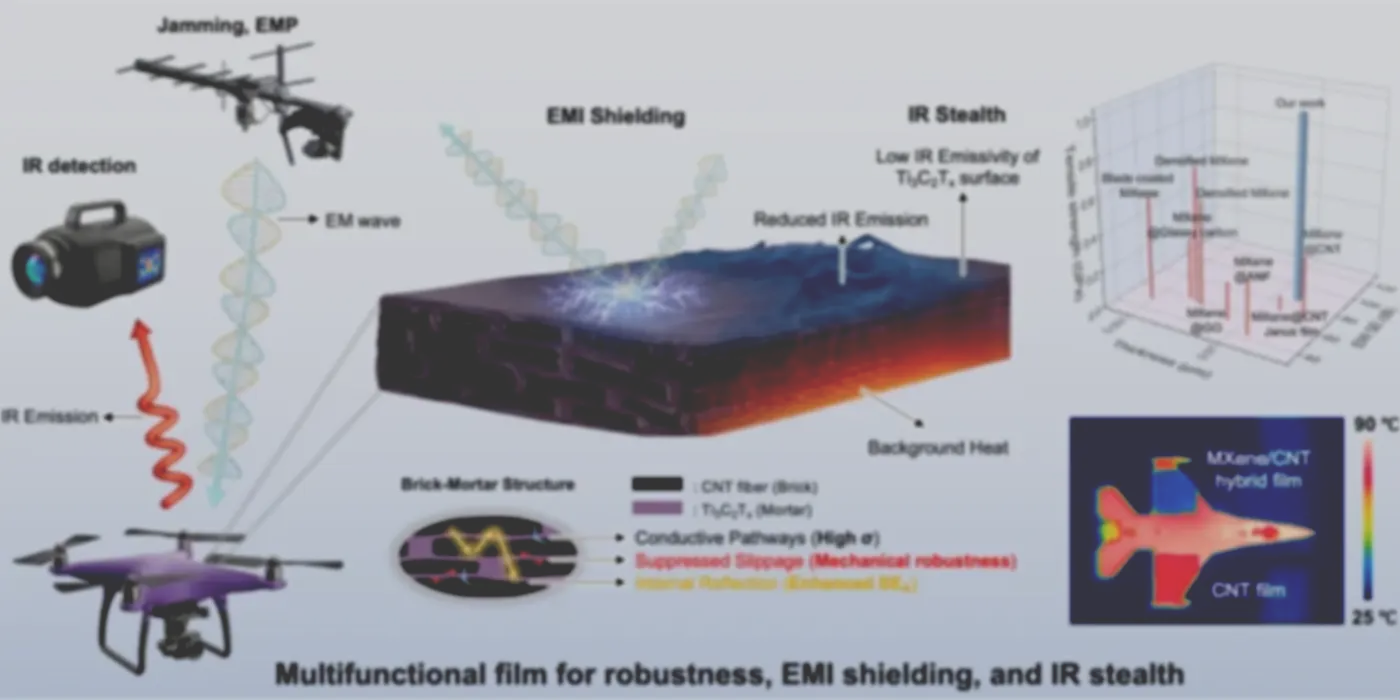
Researchers have developed a composite film that combines electromagnetic interference shielding, infrared stealth, and high mechanical strength using carbon nanotube fibers and MXene.
Researchers have developed a composite film that combines electromagnetic interference shielding, infrared stealth, and high mechanical strength using carbon nanotube fibers and MXene.


This device, called HeartLander, can be inserted using minimally invasive keyhole surgery. Once in place, it will attach itself to the heart and begin inching its way across the outside of the organ, injecting drugs or attaching medical devices. In tests on live pigs, the HeartLander has fitted pacemaker leads and injected dye into the heart.
An international research team has found evidence of the Earth's earliest forest trees, dating back 385 million years.
Upright stumps of fossilised trees were uncovered after a flash flood in Gilboa, upstate New York, more than a century ago. However, until now, no-one has known what the entire trees looked like.

New evidence of the brutish and short lives of Stone Age Britons has been revealed by researchers from Cardiff University and the University of Central Lancashire.
Carbon dating of 14 human remains discovered at a prehistoric burial site suggests that most could have died together in a massacre, possibly in a scramble for land or a cattle raid.
The prehistoric chambered long barrow where the remains of 14 people were discovered. Credit: Cardiff University
Ethanol is widely touted as an eco-friendly, clean-burning fuel. But if every vehicle in the United States ran on fuel made primarily from ethanol instead of pure gasoline, the number of respiratory-related deaths and hospitalizations would likely increase, according to a new study by Stanford University atmospheric scientist Mark Z. Jacobson.
Climate model simulations for the 21st century indicate a robust increase in wind shear in the tropical Atlantic due to global warming, which may inhibit hurricane development and intensification. Historically, increased wind shear has been associated with reduced hurricane activity and intensity. This new finding is reported in a study by scientists at the Rosenstiel School of Marine and Atmospheric Science at the University of Miami and NOAA’s Geophysical Fluid Dynamics Laboratory (GFDL) in Princeton, N.J.
Warmer oceans feed storms, yet increased wind shear is able to also impair their intensity. Credit: NOAA GFDL
There will be 10 million workers in nanotechnology related jobs by 2014, according to Andrew Maynard and Robert Aitken. Measuring the health of these workers, and their exposure to airborne engineered nanomaterials, is vital.
Maynard is chief science advisor at the Wilson Center's Project on Emerging Nanotechnologies and Aitken is director of strategic consulting at the Institute of Occupational Medicine in Edinburgh.
According to a new review of studies, women who received an advance supply of birth control pills for emergency contraception had the same chance of becoming pregnant as women who did not have early access to the pills.
Contrary to the fears of critics, the study says, the presence of Plan B does not provoke riskier sexual behavior but advance access to emergency contraception is also no antidote for the national problem of unintended pregnancy.
Surgery is about to change with the introduction of a new surgical robotic system at the University of Calgary/Calgary Health Region. NeuroArm aims to revolutionize neurosurgery and other branches of operative medicine by liberating them from the constraints of the human hand.
The world's first MRI-compatible surgical robot, unveiled today, is the creation of neurosurgeon Dr. Garnette Sutherland and his team. Dr. Sutherland has spent the last six years leading a team of Canadian scientists, in cooperation with MacDonald, Dettwiler and Associates Ltd. (MDA), to design a machine "that represents a milestone in medical technology."
Daniel O’Connor, M.D., Professor of Medicine and Pharmacology at the University of California, San Diego (UCSD) School of Medicine has studied about 265 twin pairs over the past few years, which has led him to some surprising discoveries.
"By studying many traits and genes, we have started to put together unexpected stories," he said.
Whiskers provide a mouse with essential information to negotiate a burrow or detect movement that could signal a predator's presence. These stiff hairs relay sensory input to the brain, which shapes neuronal activity. In a first, studies of this system by Carnegie Mellon scientists show just how well a mouse brain can compensate when limited to sensing the world through one whisker. Published April 4 in the Journal of Neuroscience, the results should help shape future studies of sensory deprivation that results from stroke or traumatic brain injury, say the authors.
A new "black smoker" -- an undersea mineral chimney emitting hot, iron-darkened water that attracts unusual marine life -- has been discovered at about 8,500 feet underwater by an expedition currently exploring a section of volcanic ridge along the Pacific Ocean floor off Costa Rica.
Expedition leaders have named their discovery the Medusa hydrothermal vent field. The researchers are working aboard WHOI's research vessel Atlantis, and the expedition is funded by the National Science Foundation.
One of the challenges of managing forests is deciding among management practices, particularly when the landscape effects these practices will have are not fully known.
Since 1995, Pacific Northwest (PNW) Research Station scientists and their colleagues from Oregon State University and the Oregon Department of Forestry have been conducting research that provides managers with a better idea of the effects—both intended and unintended—that forest management practices can have on landscapes.