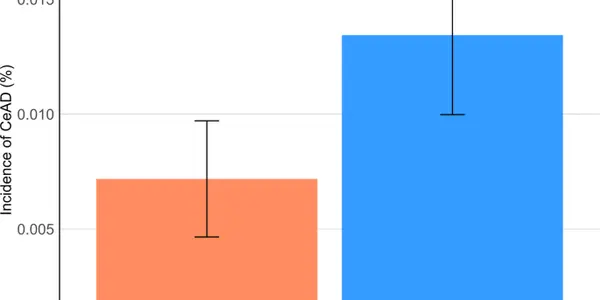
Chiropractors Are Dangerous But Artery Tear Risk May Be No Greater
There are no valid reasons to use a chiropractor but many seem to do it anyway. They can rest a little easier about wasting their money(1) on spinal manipulation.
Datasets are changing the way we approach the world around us. 10 years ago, you could get by doing terrible numerical models and make rookie statistical errors in understanding data and only 400 people would read it, while even fewer would understand it. Not any more, everyone can now parse data on the Internet so your clever analysis of fMRI images or convenient massaging of results to match your end-oriented beliefs are going to get tripped up pretty quickly.
What do the motion of spinning of a top, computer architecture, and the sugar in your coffee all have in common?They highlight the beauty of mathematics.Yann Pineill and Nicolas Lefaucheux created a video where they put equations on the left, the technical diagram in the middle, and then real-life footage of the phenomenon is on the right.Result: Math makes some incredibly complicated stuff look easy.H/T Gizmodo
Halloween is just around the corner, but if you live in California, like me, they aren't doing anything fun. They can't even call it Halloween.So though when you were a kid you might have learned things that excited you about science, like how to make 'slime' using cornstarch and water or, for a little more cost, fog using dry ice and water, that isn't going to happen in 2013.
93 scientists have declared GMO safety a misinformation campaign and deplore the lack of empirical and scientific evidence on which the false claims of “consensus” on safety are being made.Bring your tinfoil hat.They say that there is no consensus at all, there are no studies on the health effects of genetically modified food, the ones that exist are terrible, that government and scientific bodies don't really mean it when they endorse the safety of GM foods, that Europe is also lying to the world, and a bunch of other stuff with dozens of footnotes.
'Priming' studies, which suggest that decisions can be influenced by apparently irrelevant actions or events that took place just before the cusp of choice, have been a boom area in psychology over the past decade, though what isn't? fMRI, surveys of college students, claims about epigenetics and just about everything have been used by psychologists fame-whoring mass media for publicity.Sure, but that is psychology, easily marginalized as soft and wayward, right? Not so. Irreproducibility is much more widespread, finds The Economist. It happens in all science and the usual ability of science to self-correct is losing ground.
Fake volcanoes, giant space mirrors, oceans of iron filings - one of these ideas might save our planet from the worst effects of global warming – or destroy it. Memphis Barker reports on the rise of geoengineering – and the rift it has opened in the scientific community.
Few people love evolutionary biology outreach as much as the University of Chicago's Professor Jerry Coyne. His book, "Why Evolution Is True", is one of three that gets a personal endorsement on my profile page and he posted a terrific article here, A Letter To Darwin - Here's What Has Happened In The Last 150 Years, for our 30 Days of Evolution Blogging event during the 150th anniversary of 'Origin of Species'. His Why Evolution Is True site has become a go-to venue for smart writing about science and society.
Do you rush to buy a particular brand of chicken because it is anti-biotic free? Are you more likely to buy beef that uses "ethical, sustainable" practices like no added steroids or hormones.I don't blame you, that stuff sounds scary, I don't want antibiotics in my sandwich. There's just one problem: chicken has to be antibiotic-free by law. One brand is trying to look like they are somehow superior to another company even though the chicken is the same.And 'added' hormones make someone less ethical? Well, that qualifier is necessary because, as you know, we have lots of natural hormones - so do cows and the plants they eat.
Florida, second only to the entire country of Brazil in global orange juice production and which accounts for over 90 percent of orange juice consumed in the United States, has lost billions of dollars in revenues from a disease that is killing orange trees faster than they can be replaced.Citrus greening has cost Florida's economy an estimated $4.5 billion in lost revenues since 2006, according to the University of Florida's Institute of Food and Agriculture Sciences. In an already terrible economy, having a state industry that employs 76,000 full- and part-time workers at further risk is a very bad thing.
UK environment secretary Owen Paterson believes that Golden Rice could prevent blindness and death among children in poor countries.Anti-science progressives insist most science is dangerous and that biologists are just immoral tinkerers who don't think about safety.