If you had a way to save the world and the NIH refused to fund it, could it ever happen? What if both Science and Nature, which claim to be the most prominent journals in the world, refused to publish your study? A study you were giving them free and they could then copyright and sell?
You might give up. Yet both of those events did occur, to the inventor of the mRNA technology that created the COVID-19 vaccine, and we are fortunate the researcher denied NIH funding and rejected by corporate science media persevered.
It highlights why the public should ignore partisan spin in media about how American science is being crippled by 'funding cuts'.
For the last 18 months we've been told funding 'cuts' are crippling American science. America will be held back for a generation or more, it's lamented. If that is true, then government-funded scientists only recovered from the Clinton administration cuts to science before President Obama cut them again. Yet science was not crippled, despite Clinton and Obama cutting science funding, so this looks to be the same old politics; Republicans are bad and even worse if they do the exact same thing Democrats do.
You need not lose hope, American science will be just fine. Just like it was fine after 2012.
The reality is that government is often not funding bold, moonshot science. It is overwhelmingly funding programs by experienced researchers based on proposals written by people who excel in grant proposals and for projects often 'Evolutionary, Not Revolutionary.' Which is to safe they are 'safe.' A researcher who gets an R01 grant and has the experiment fail is likely finished. So most scientists know to propose things they are sure will work. Falsifying the hypothesis is for Ph.D. students, not the Principal Investigator.
The reason so many Nobel laureates are rewarded for work when they were young is because they achieved their success before they were trapped in the mercenary government grant cycle. Not because of it. CRISPR-Cas9 is a great example of something that was a career risk but the scholars behind it didn't care; they had no careers to lose.
What the Trump administration is really doing is funding fewer investigators. And though it cut funding that was often not funding for important science. In reality "science" is not impacted much because the government has never funded the bulk of science research, it doesn't even fund the majority of basic research.
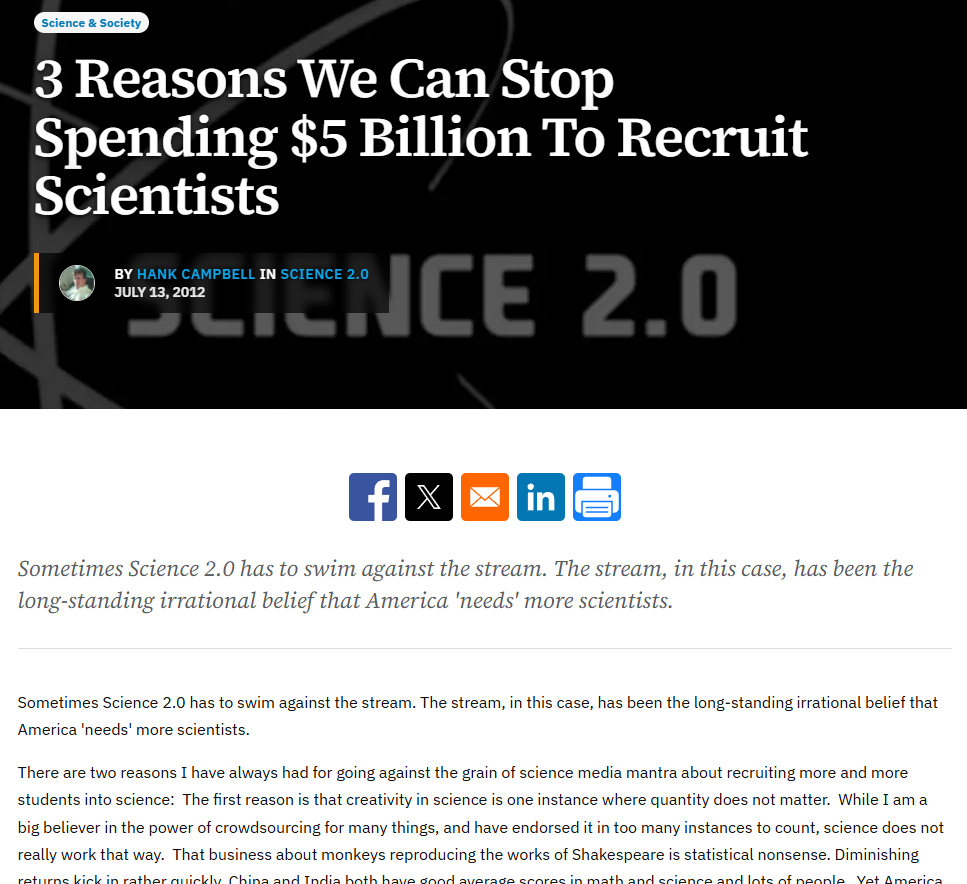
In 2012, I defended the Obama administration wanting to reduce science funding - as long as it was waste. And there was a lot of waste.(1) My reasons were sound then and remain so now.
1. Creativity does not happen due to volume. Maybe in an infinite universe some monkey randomly hacking on a typewriter would recreate Macbeth but not in this one. If funding mattered the way government and academia claims it does, we'd have 100 cures for cancer and solar power wouldn't need to be propped up by natural gas customers forced to pay higher costs.(1) We do have a way to prevent cancer, but you really have to stretch credibility to claim the HPV vaccine was due to academia. The same way the NIH and University of Pennsylvania got laughed at for claiming they were involved in the mRNA technology used to create the COVID-19 vaccine after it got a Nobel prize. Despite NIH never funding it and Penn demoting Dr. Katalin Karikó and telling her she should leave academia - because the NIH wouldn't fund her.(3)
2. The number of truly inventive people remains finite. Funding the second tier of researchers gives a false sense of achievement, which is not the business taxpayers should be in - especially not when they were chosen to fulfill a cultural agenda. Because the pool of the truly smart is finite, undergraduate students who might want to be doctors or engineers were instead being told to be scientists. That is not a win for society any more than politicians of the 1980s telling people who might otherwise be plumbers and electricians they should go to college - and then changed student loans to be unlimited so college graduates who had crippling debt.
My big reason was the most quantifiable. Government and academia had spent a whopping $5 billion convincing smart people in graduate school they should stay in academia. Only academic science was real science, the suggestions went, you don't want to work for those evil corporations and be told what to work on. For a demographic that was guided to be partisan from the moment they entered academia, anti-business framing was obviously also anti-Republican.
Not everyone will like that fewer researchers are being funded but when I first started writing about science funding waste, it was because the government was giving grants to academics who "study" why people use Match.com and why politicians lie.
What government did actually change
Government is funding fewer researchers but university lobbyists who were already reeling that their candidate didn't win the 2024 election and waive student loan debt(4) got another whack on the nose with a government document; government declared science funding used for 'overhead' and 'infrastructure' costs had to be capped as a percentage. If you think $400 government toilets are ridiculous, you should read the complaining by scientists who spend thousands per month on costs that are manufactured by their host institutions.
There is a reason Johns Hopkins heavily recruits people who already know how to get grants. It is a giant profit center for them. That is why they went to court. Universities wanted to be able to continue to exploit scientists with government grants in perpetuity. Something scientists had complained about for 25 years.
The other change that partisans use to claim funding has plummeted is that government is now avoiding science grants being a political football by paying the grant upfront rather than doling it out annually. If the spending is going to be the same, but each grant will be paid in full, that means fewer researchers.
That allows scientists to focus on the science, not worry if there will be a budget shutdown and they have to fire people. And more competition for grants must be a good thing. Because if it was not a good thing, universities would not have been spending billions to recruit graduate students to stay in college rather than join the private sector. Instead, they were producing 600% more Ph.D.s than there are any jobs in academia, even lowly-paid post-doctoral researcher positions, all while telling young people that only academic life would be fulfilling.
NOTES:
(1) The most humorous one was years after I created Science 2.0. It was a registered trademark. The National Science Foundation had an account here. Regardless, the NSF gave hundreds of thousands of dollars to two West Virginia University academics to create "Science 2.0."
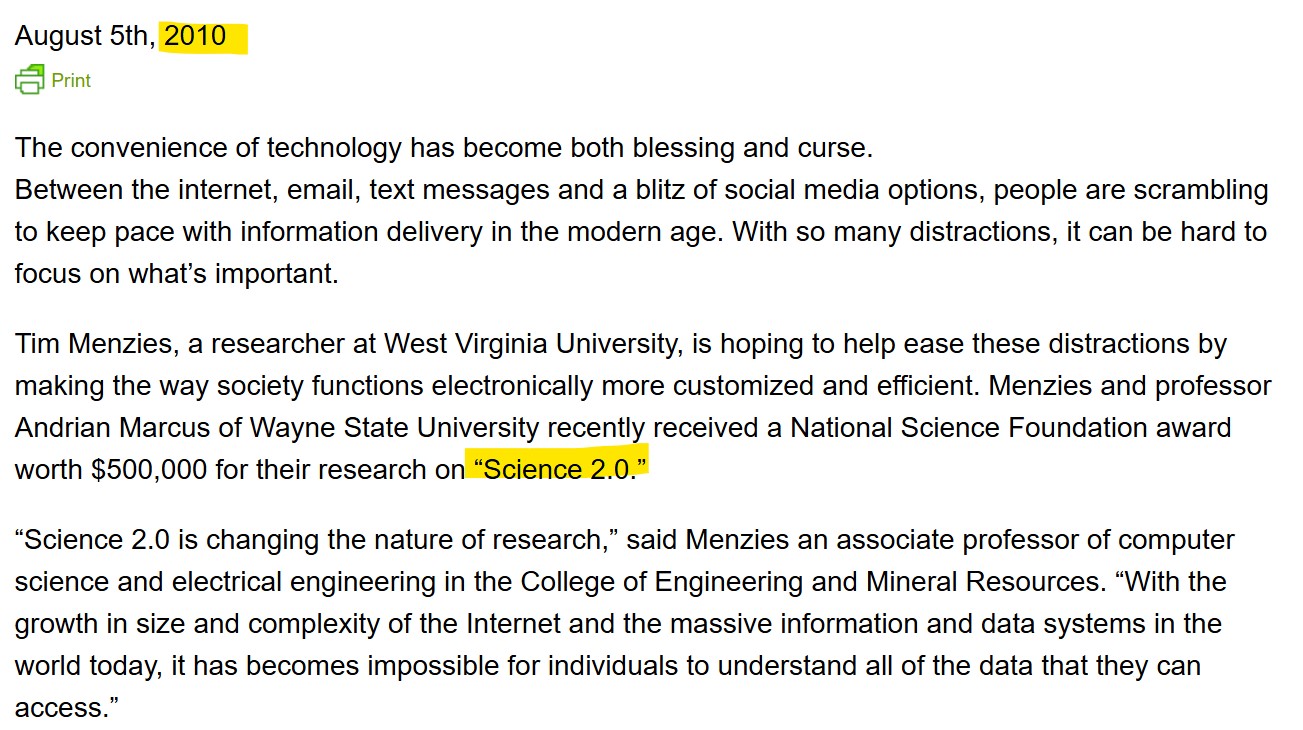
When I wrote the grant recipients to ask what that meant, one replied and said he didn't really know anything about the details(!) and the other refused to reply.
Nothing ever came of it.
(2) Solar power has not been embraced without government subsidies and has instead only increased costs for those without the wealth to install solar panels despite $9 trillion. When the Obama administration mandated it, I noted that companies were laughing that 50 years of their scientists doing work on it was going to be beaten to the punch because funding went up 30X. Now it is $9 trillion and the physics remain unchanged. The share of conventional energy has changed - it has gone down by only 0.2%.
(3) She did leave academia but those two groups claim credit for mRNA based on a technicality. Penn demoted Dr. Katalin Karikó to try and force her to quit and she had to suffer their indignity because she was undergoing treatment for cancer and couldn't risk losing her health insurance. Dr. Drew Weissman believed in her work and gave her a spot in his lab. She was paid less than bench techs because he didn't have much budget. Because he was funded by NIH and at Penn, they claim they were vital to saving the planet from the pandemic even though after Science and Nature refused to publish their paper she left academia for the private sector.
More government funding would not have helped her. The NIH committee drawn from government-funded researchers said she was just stupid.
(4) Instead, they are cutting programs that were clearly only funded by student loan debt to make the books balance again - because they can't fire tenured academics who exist to smear Republicans and Jewish people. Great musicians rarely get Ph.D.s in music, artists rarely get Ph.D.s in art, actors don't get Ph.D.s in acting, but universities basically lied to young people and told them a Ph.D. in Folklore and other humanities fields would lead to higher lifetime earnings. When I first wrote about this, there were 5,000 Ph.D.s working as janitors and 2,000,000 people were doing jobs they could've done with no student loan debt at all.