Die Naturwissenschaften began publication in 1913. It was a German general science magazine like England had with Nature or the U.S. with Science. Now it is owned by a corporate conglomerate and goes by The Science of Nature but they like to think their legacy is intact. It was, sort of, until they bizarrely retracted work down in the 1940s by legendary physicist and Nobel laureate Max Planck.
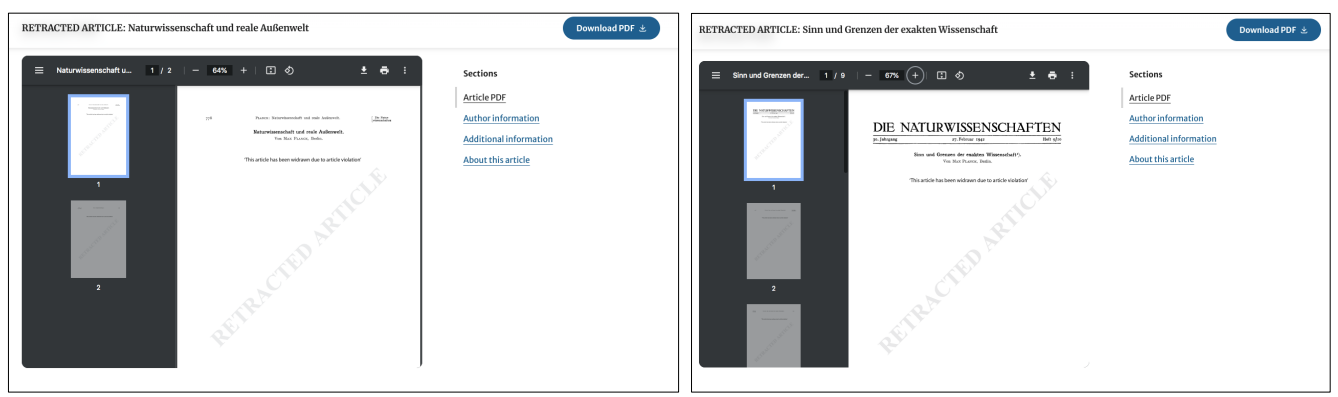
Their reasons, they said, were that one paper was submitted to other journals. Corporate media hate when they can't copyright and exclusively monetize content they didn't pay for, but journals were not a big deal in the 1940s. A peer-reviewed journal was just one way to get read and if an editor said they were sending a paper for peer review it was often insulting.(1) If you wanted to be read you didn't limit yourself to one German journal, you put it in books and anywhere people would read it. (2)
The other violation was that he wrote a paper about another physicist's quantum mechanics paper but used the same title.
It was not fraud or anything unethical. It was really due to money and copyright. Corporate media belief is if they can't get it for free, have it reviewed for free, and then charge for it they do not want to promote it. Speculation was that it was done automatically by bots but the corporate public relations team says it was done by a human. Which actually makes them look worse.
It is unclear why they un-retracted the retraction, since nothing changed, but the publicity from this paper likely caused it. Though maybe it was a top-down directive from the Holtzbrinck family that owns Springer-Nature, to atone for their national socialist past and the execution of Planck's son in 1945. That is just speculation. Planck remains a titan in physics, no matter what bizarre behavior one obscure journal engages in.
NOTE:
(1) The most famous example is Albert Einstein, who submitted "Do Gravitational Waves Exist?" to Physical Review. When he found out the editor sent it out and the reviewer (later identified as cosmologist H.P. Robertson) sent back notes, he refused to let them publish it. And never sent them a paper again for the rest of his life.
However, Robertson's critique of his 'singularity' was correct and eventually Einstein recognized it.
(2) In the 1980s, President Ronald Reagan, in the running with Jefferson as America's most pro-science leader, wanted to boost government science funding. A lot. But he wanted a way to see that the money was being spent usefully. Academics came up with peer-reviewed journal publication as the solution, which is why it is a multi-billion dollar industry today - pretending it is about science.