Marek’s disease, a deadly illness that infects chickens, is caused by the herpes virus but was never given gain of function funding to try and see how it would infect mammals the way H5N1 and coronavirus were and does not make people sick.
Yet it can wreck a chicken flock fast, causing tumors, paralysis, and then death in 100 percent of cases in organic chicken farms that refuse to accept vaccines.
Fortunately for the rest of the industry, it does have a vaccine, but as influenza has taught since the 1940s, and as three coronaviruses so far in the 21st century have demonstrated to the entire world in more alarming fashion. viruses evolve. Europe and Asia are not as rigorous about vaccines as the U.S. and they have reported a newer “hypervirulent” strain that can break through the third generation vaccine.
Scientists are on the hunt to try and mitigate that, because it will reach American shores eventually, and a new study focused on 10 loci in the genome of this chicken herpes they believe leads to increased virulence.
Their effort involved 65 Marek's disease virus (Mardivirus gallidalpha2) strains stored by the U.S. Department of Agriculture since the 1960s.(1) They parsed the viruses into four pathotypes based on health outcomes and ability to overcome first and second generation vaccines. Among the genome sequences they found single-nucleotide polymorphisms and insertions/deletions, 784 of the former and 17 of the latter, that stood out, around 100 percent greater prevalence.
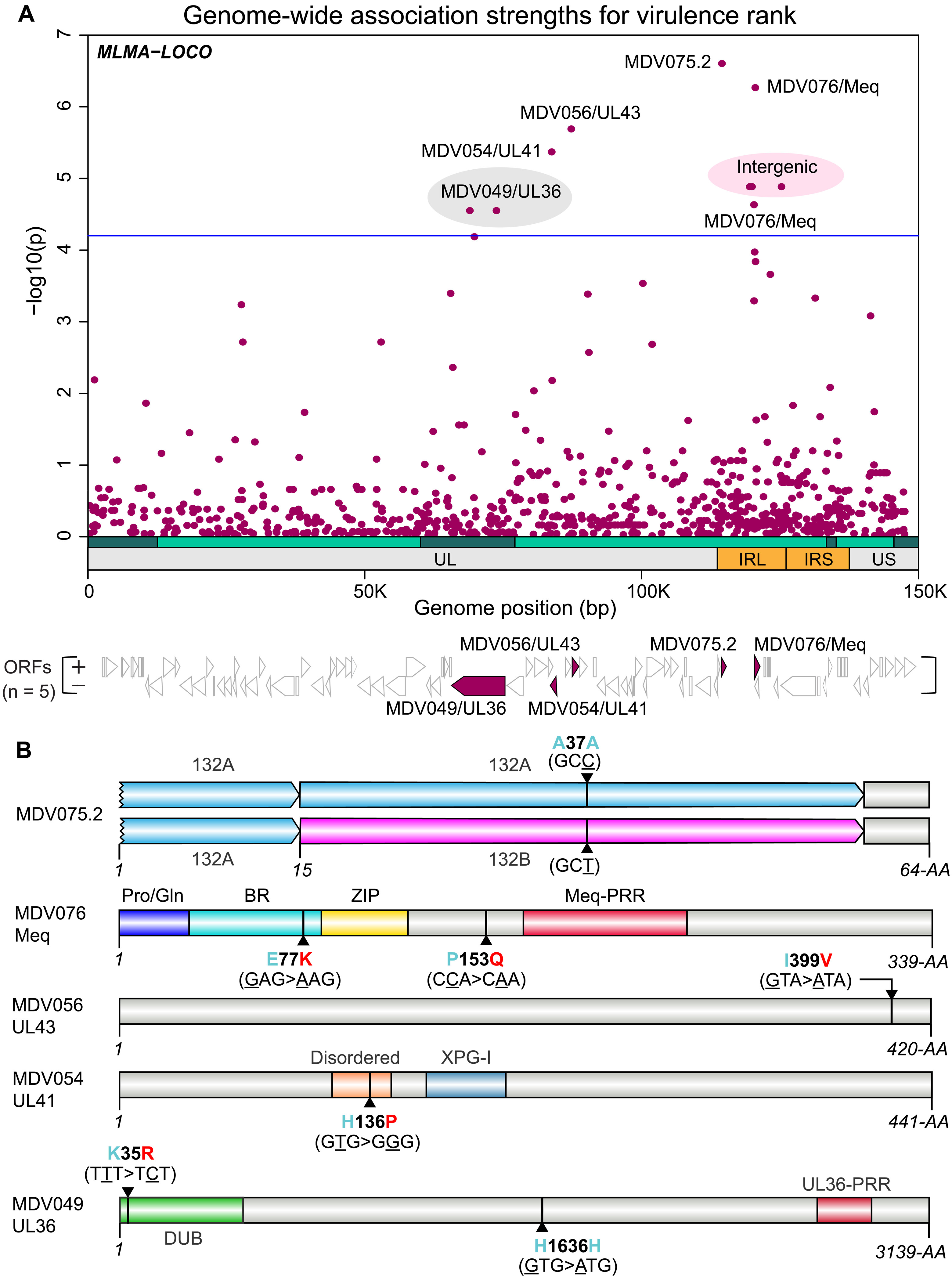
A Manhattan plot was generated based on the MLMA-LOCO analysis, with virulence rank used as the phenotypic component. The position in the MDV genome (x axis, UL = Unique Long, IRL = Internal Repeat Long, IRS = Internal Repeat Short, US = Unique Short) and the observed -log10(P value) of all tested genomic variants (y axis) are shown. Shaded green rectangles above the x axis indicate chromosome-like regions assigned as chromosomes in the MLMA-LOCO analysis (1–7, from left to right), with different shades of green used to distinguish adjacent regions. Solid blue line indicates the P value threshold for genome-wide significance (P < 6.25 × 10⁻⁵). ORFs associated with each significant locus are labeled, with shaded ovals used to indicate multiple variants of the same label. A map of all ORFs in the MDV genome is shown below the x axis, with ORFs associated with genome-wide significant variants shown in color. (B) Protein domain diagrams for each ORF associated with variants at genome-wide significance, sorted by strength of significance (top to bottom, descending). Functionally relevant domains are colored and labeled. For each variant, the residue number and resulting amino-acid change (synonymous = blue/blue, non-synonymous = blue/red) is shown. Nucleotide triplets for each variant codon are shown below in parenthesis, with the variant nucleotide underlined (DUB = Deubiquitinase, XPG = Xeroderma Pigmentosum, BR = Basic Region, ZIP = Leucine Zipper, PRR = Proline-Rich Repeat region). Source: DOI:10.1126/sciadv.aee9024
They assembled a virus 'family tree' hey then built a family tree of the virus strains, including the versions where one letter in the DNA alphabet differed or where segments of DNA were inserted or deleted, and saw the tree had a common root, and it was linked to breaking through the vaccines. The genome-wide association study that resulted found the 10 genomic variants associated with virulence. The authors are particularly interested in a DNA variant where a segment of DNA gets duplicated - a tandem repeat - and intend to focus on that next.
Citation: Alejandro Ortigas-Vasquez, Utsav Pandey, Andrew S. Bell, Daniel W. Renner, Matthew J. Jones, Hans H. Cheng, John R. Dunn, Andrew F. Read, Maciej F. Boni, David A. Kennedy, and Moriah L. Szpara, Genome-wide analyses of an avian herpesvirus identify 10 loci associated with tumorigenicity and vaccine escape.Sci. Adv.12,eaee9024(2026).DOI:10.1126/sciadv.aee9024
NOTE:
(1) Don't be concerned about that, this is not China, BSL ratings are real in America, the 2024 chicken crisis in the US was not due to this, it was instead due to organic farms that don't believe in giving animals medicine and raw milk dairies that think foodborne illness boosts your immune system.