If you are not currently smoking marijuana, do not start. It is a carcinogen, no different than cigarettes and alcohol. Most people recognize its effects on the brain are so broad it is about as safe as lead in drinking water.
But if you already have cancer, that relative risk equation may change.
For doctors, though, it does not. A new survey highlights that. Like all surveys, these results are only EXPLORATORY. Surveys are not behavior so do not make decision based on the popularity of a small population.(1) Since it is now legal in 47 states, 58 percent of marijuana users were already using it before they got cancer so it is not like they made a neutal decision.
Doctors will still talk about the risks of marijuana more, nearly 300 percent more than users do, and while doctors generally believe 'whatever works' for pain and nausea, even things that might be placebos like hypnosis or homeopathy, when it comes to recreational use they are more often against it. Marijuana users are over with the supplement/naturopathy/organic food camp and say they distrust healthcare. Vague disbelief about science and health may be why marijuana users are also more likely to smoke cigarettes and report anxiety and depression - which they believe marjuana helps mitigate.
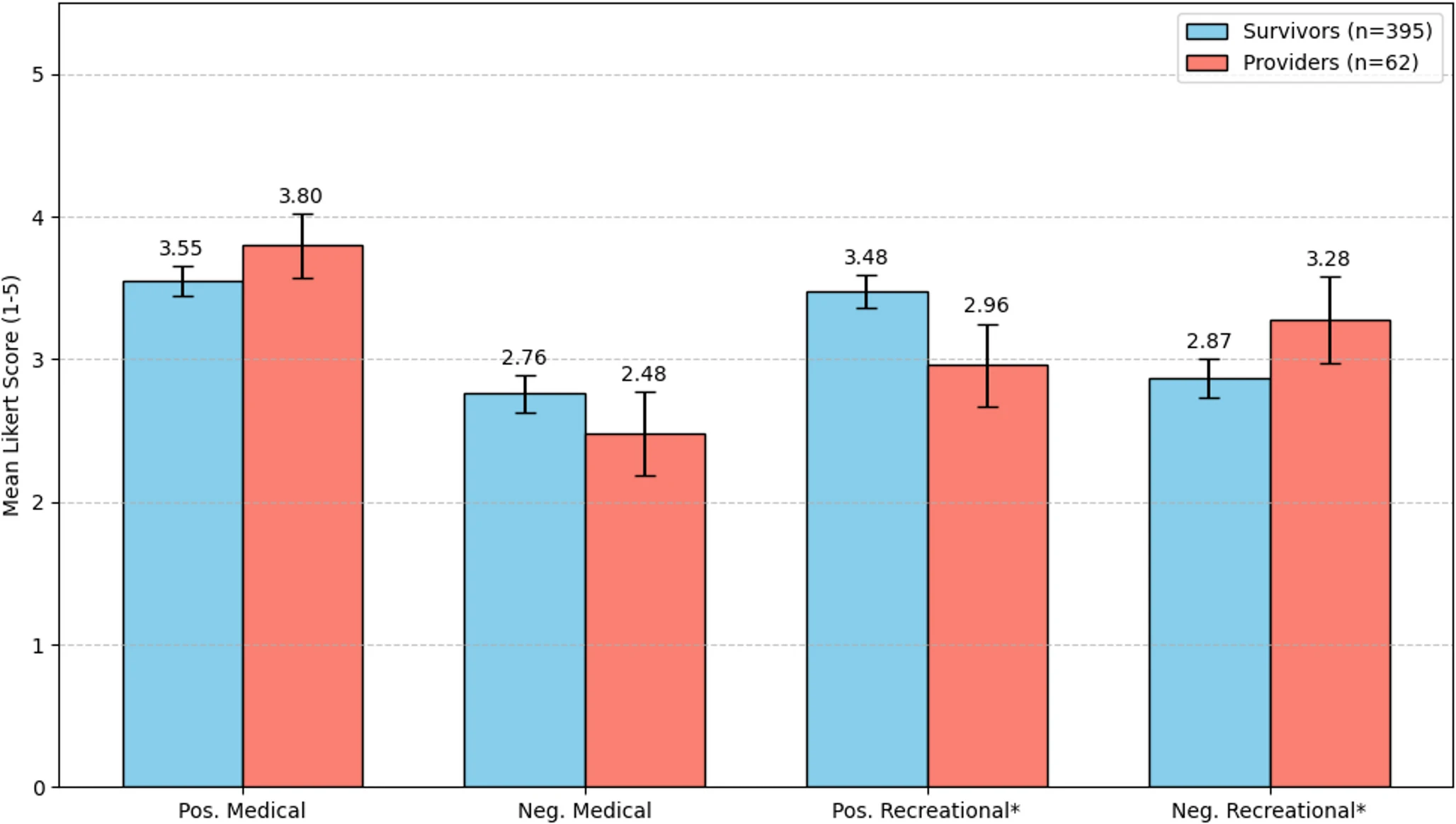
Comparison of Marijuana Attitudes: Cancer Survivors vs. Cancer Care Providers with 95% Confidence Intervals. Attitudes were measured on a 5-point Likert scale, with higher values indicating more positive (or negative) attitudes toward cannabis use. * indicates a significant difference between groups at the 0.05 level
It's the people who were marijuana naive before getting cancer that warrant a closer look, the same way people addicted to painkillers before they develop cancer are not providing the same information those who get addicted after.
Inhaling smoke is bad but if you and your doctor determine the benefits of gummies now outweigh future risks, that's fine, it is surveys that hold back real progress in policy. Currently, marijuana's poorly-established health benefits were waved away by government because it meant more tax revenue. Taxes never go away so what will be needed are clinical guidelines. That means long-term studies with biomarkers rather than what people claim on surveys.
Citation: Sunny Jung Kim, Farnese M. Motto, Hannah Ming, Viktor Clark, Susan Hong, Aron H. Lichtman & Vanessa B. Sheppard, 'Perspectives on Cannabis Use among Cancer Survivors and Cancer Care Providers: Parallel Surveys'. J Canc Educ (2026). DOI: 10.1007/s13187-026-02934-w
NOTE:
(1) Or a large population. The U.S. wouldn't have had rampant vaccine denials among Democrats from 1998 to 2021 and Republicans since then if surveys were valid. Vaccine deniers have rarely admitted to denying them as much as saying they just 'need more testing.'