Today is Chaos Never Dies Day, an informal holiday (sorry, government employees, you still have to work on this one) that celebrates the randomness of the universe. Or, as the holiday page notes, "Disorder is more fun if you think of it as a holiday."
It's also a pretty good barometer of how people thought about the universe long before Newton. Chaos is a term in physics now, as is Disorder, but many scientists in the past were classically trained, not a mile deep but only a yard wide in knowledge like Werner Heisenberg, who could come up with the uncertainty principle but didn't know how a battery worked. The term Chaos was chosen by them for a learned reason.
Chaos is from Hesiod's Theogeny, written 2,700 years ago. In his poem, he tackled the creation of the universe. Chaos, the origin of everything, was a woman (take that, patriarchy!) who gave birth to Erabus (darkness) and Nyx (night) and then they gave birth to everything else.
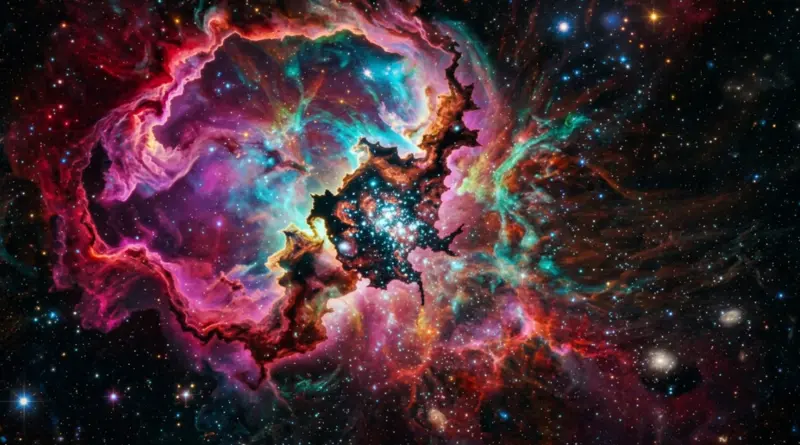
2006 public domain image of Messier 42 by NASA, modified by the GIMP tool to look more chaos-y.
To most people, darkness and night are so synonymous they don't need to be separate words and therefore it may seem odd that Chaos would start the universe with two kinds of dark but the Greeks understood the distinction between spatial darkness, like the physical gloom of a cave, and temporal darkness; the cycle of night itself where we rest and dream. They understood that space-time were intertwined, as when he described Nyx gathering the mists of Erabus and spreading them across the universe, and then her daughter Hemera (Daylight to the Night that was Nyx) would put them back hours later. This cosmic balance was paralleled by Aether who was the physical stuff of light.
The ancient Greeks understood that fixed space and changing time not only could interact, but they absolutely must. That the universe only looks empty and but is actually static fields, for example electromagnetic ones, and are changed by energy, like Nyx and Erabus and Herema and Aether, is the foundational premise of modern Quantum Field Theory. Light breaks out from darkness and all matter erupts from what seemed to be an empty void. Chaos created deities as tools to build the structure of the cosmos.(1) There was no Order without Chaos first. Without Thermodynamics there is no Entropy.
This chaos and order cycle is repeated in Theogeny; Uranus (Sky) and Gaia (Earth) have 18 kids and Cronus overthrows his father and then Zeus overthrows Cronus. Creation and destruction in cycles, like day and night. 'Balance of nature' was a myth created in the early 20th century and dismissed by anyone who understood the universe immediately.
The Greeks believed that the universe created its opposites, so Erabus would require Aether, and that holds up. "Red in tooth and claw" wrote Alfred, Lord Tennyson, for In Memoriam A.H.H., and today we take a flu shot every year because nature is out to kill us - and maybe create something better. We instead hope nature failing makes us stronger.
So relax this Chaos Never Dies Day. It was here before you, it will be here after you. Take a nap.
NOTE:
(1) Gaia, Tartarus, and Eros, who came after Chaos, are only marginalized to keep the physics analogy cleaner. Don't smite me from the heavens.