Gonorrhea is a sexually transmitted disease (STD) that causes urethritis and pelvic inflammatory disease. Before AIDS, this was what you got for having promiscuous, unprotected sex with many anonymous partners in a consequence-free environment (a period known as "The 1970s" yet often assumed to be the '60s) and when you contracted it you took some antibiotics and then it was back to Studio 54.
Not today. Neisseria gonorrhea is evolving into multiresistant bacteria - resistant to most antibiotics, which means most treatments are now ineffective. Japan reported the first example of multiresistant gonorrhea earlier this year, in a female prostitute who had come in for treatment in 2009. Targeting high-risk groups (known as "young people") can mitigate some of the risk but young people are going to do dumb things, like having risky sex and buying organic food because they believe it is nutritionally superior. The ideal scenario, since we can't control behavior - that is why they are called high-risk groups - is a vaccine but N. gonorrhea mutates quickly and is too complex to develop a vaccine. It can also promote antibiotic resistance in other microbes through gene transfer.
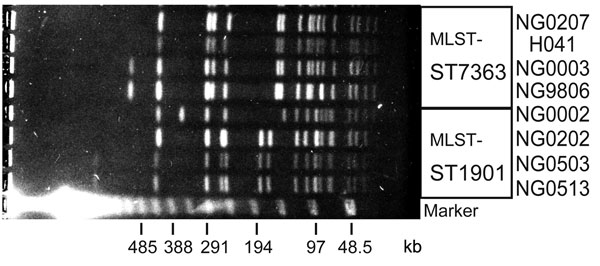
Pulsed-field gel electrophoresis patterns of ceftriaxone-resistant Neisseria gonorrhoeae strain H041 and other multilocus sequence typing (MLST) ST7363 and ST1901 strains. SpeI-digested genomic DNA from ceftriaxone-resistant N. gonorrhoeae H041, 3 of the MLST ST7363 strains and 4 of the MLST ST1901 strains were analyzed by pulsed-field gel electrophoresis. A lambda ladder standard (Bio-Rad, Hercules, CA, USA) was used as a molecular size marker. Source: Makoto Ohnishi , Takeshi Saika, Shinji Hoshina, Kazuhiro Iwasaku, Shu-ichi Nakayama, Haruo Watanabe, and Jo Kitawaki, 'Ceftriaxone-Resistant Neisseria gonorrhoeae, Japan', Emerging Infectious Diseases Volume 17, Number 1—January 2011
"The spectre of widespread multiresistant gonorrhea demands an urgent public health, community and individual response," conclude the authors of a new study of the sexcapade landscape in Canadian Medical Association Journal. "Without action, we are heading back to the pre-antibiotic era, with an escalation in the number of deaths from other multiresistant organisms as well as rampant gonococcal infections — with treatment options for urethritis limited to painkillers, baths and catheterization for strictures."
Citation: Noni E. MacDonald MD MSc, Matthew B. Stanbrook MD PhD, Ken Flegel MDCM MSc, Paul C. Hébert MD MHSc, Daniel Rosenfield MD, 'Gonorrhea: what goes around comes around', CMAJ September 19, 2011 doi: 10.1503/cmaj.111393