Square Root of Not

Steve Schuler

Steve Schuler

Twitter: @SteveSchuler20. You may try my hacks AT YOUR OWN RISK. Kids use adult supervision. There are infinitely many ways to injure persons and damage property—I can’t think of them all. I am not responsible for any damage or injuries obtained whil…
RSS Feed
Add Light, Sound, And Motion To Your Crafts And Projects With LittleBits

Add Light, Sound, And Motion To Your Crafts And Projects With LittleBits

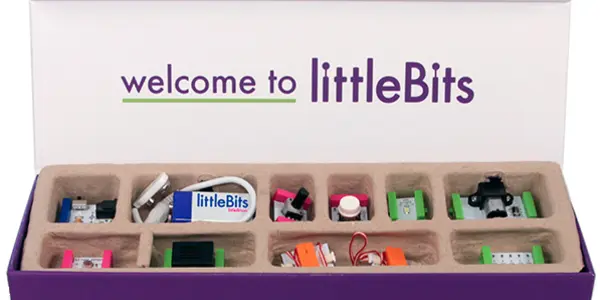
littleBits are color coded electronic modules that connect together magnetically to create simple electronic circuits. They are designed for ages 8 and up so hobbyists, designers, makers, and artists, and can add light, sound, and motion to their crafts and projects. Since they connect up magnetically (no need for circuit boards, breadboards, or solder), you can’t accidentally connect them the wrong way. With littleBits you can quickly build electronic circuits in a matter of minutes.

The color coded modules are divided into four categories. Blue, for power, currently includes three modules—the power module to which you connect the 9 volt battery, a coin battery module, and a USB power module.

Science Play And Research Kit: Borax Bead And Flame Tests

Science Play And Research Kit: Borax Bead And Flame Tests

You can perform simple qualitative analysis to detect certain metals in various substances using borax bead, and flame tests. The inoculating loop for these tests is very easy to make. You can use 20 gauge to 26 gauge Nichrome or platinum wire depending on what is easiest for you to find. To make the loop use a 20cm length of wire and something cylindrical to wrap the wire around such as a small brad or finishing nail. I used an ink cartridge from a disposable ball point pen.

Note: the wire in this photo is oversized to make it easier to see in the photograph.

Wrap the wire around the cylinder to form a loop:

Science Play And Research Kit: Lego Robotic Claw

Science Play And Research Kit: Lego Robotic Claw

In a previous article I demonstrated how to build a conductivity tester out of Snap Circuits for your Science Play and Research kit. You can use the same circuit with a small modification to build a simple magnetic stirrer. You can also further modify the circuit to make a reversible motor driver. Reversible motor drivers are often used in robotics to drive the robot forward or reverse, turn it right or left, to raise or lower a robotic arm, to open and close a robotic gripper, and so on.

Science Play And Research Kit: Foil The NSA With Chemistry

Science Play And Research Kit: Foil The NSA With Chemistry

Edward Snowden: patriot or traitor? Whatever your opinion of Mr. Snowden, he did give us pause to reflect on our Fourth Amendment rights “of the people to be secure in their persons, houses, papers, and effects, against unreasonable searches and seizures, shall not be violated, and no Warrants shall issue, but upon probable cause, supported by Oath or affirmation, and particularly describing the place to be searched, and the persons or things to be seized.” When contemplating the problem, one must first answer why the Fourth Amendment was considered so important that it needed to be added to the Bill of Rights.

Science Play And Research Kit: Conductivity Tester

Science Play And Research Kit: Conductivity Tester

Some older chemistry sets included a conductivity tester to demonstrate the conductivity of materials and liquids. If you wish to include Snap Circuits in your Science Play and Research Kit you can use a simple circuit designed with the 555 timer IC incorporated into the circuit to test conductivity. For an introduction to the 555 timer IC and snap circuits, please review this article.

Parts Needed:

1 555 Timer IC

2 Clothespins

1 250 ml beaker

Snap Circuits Parts:

Science Play And Research Kit: Fluorescence

Science Play And Research Kit: Fluorescence

You may wish to include a UV LED in your Science Play and Research Kit. Nowadays you can find inexpensive key chain lights that include a visible light LED flashlight, but also include a red laser LED and UV LED. The red laser can be used to demonstrate the Tyndall effect, and the UV LED can be used to demonstrate  a lot of stuff that becomes visible under UV light. I found this black light (UV) LED strobe light on clearance after Halloween for around $2.00 USD:

Science Play And Research Kit: Fluorescence

Science Play And Research Kit: Fluorescence

You may wish to include a UV LED in your Science Play and Research Kit. Nowadays you can find inexpensive key chain lights that include a visible light LED flashlight, but also include a red laser LED and UV LED. The red laser can be used to demonstrate the Tyndall effect, and the UV LED can be used to demonstrate  a lot of stuff that becomes visible under UV light. I found this black light (UV) LED strobe light on clearance after Halloween for around $2.00 USD:

Here’s a better picture:

Science Play And Research Kit: Tyndall Effect…With Frickin’ Laser Beams

Science Play And Research Kit: Tyndall Effect…With Frickin’ Laser Beams

You can use a laser to demonstrate the Tyndall effect. A simple cat toy (laser pointer) will do but for this demonstration I’ll be using the laser from my DIY Laser Interferometer. “The Tyndall effect, also known as Tyndall scattering,” according to Wikipedia, “is light scattering by particles in a colloid or particles in a fine suspension.” You can use the laser to test three different mixtures: solutions, colloids, and suspensions.Parts needed:250 ml beakerTeaspoonEyedropperTable salt (NaCl)MilkDirt from your gardenTap waterSolutions

Science Play And Research Kit: DIY Titration Lab Ware

Science Play And Research Kit: DIY Titration Lab Ware

You often see demonstrations of titration using an expensive glass burette, but you can build titration lab ware using a disposable serological pipette, a solder sucker bulb, and a ring stand or support stand. For this build I’m using my erector set support stand (I sometimes call it my Bunsen burner stand). Titration is the process of determining the unknown concentration of a solution by adding a known amount of a solution with a known concentration. For example, in an acid-base titration, you can determine the unknown concentration of an acid in a solution by adding a base solution of known concentration.

Science Play And Research Kit: Business Models, Packaging, And Marketing Part 2

Science Play And Research Kit: Business Models, Packaging, And Marketing Part 2

In Part 2 of Science Play and Research Kit: Business Models, Packaging, and Marketing, we’ll discuss the Gillette Razor model. I’m sure you’ve heard of it: give the razor away and sell the blades. It would seem that this model is more myth than reality. There isn’t much in a science kit that you can actually patent and if you’ve bought in to open design from SPARK Part 1 patents would be an anathema to open design and science outreach.

Science Play And Research Kit: Business Models, Packaging, And Marketing Part 1

Science Play And Research Kit: Business Models, Packaging, And Marketing Part 1

Click here and sign up to be a participant on ABC’s Shark Tank. You’re probably thinking “what does appearing on a TV show have to do with The Science Play and Research Kit?” Let’s put things into perspective: you’ve designed the perfect science kit, you’ve won the $50,000 prize…then what? If you’re not thinking right now about how to build a sustainable business around your kit, then you’ve probably failed before you began. We’ll take a look at a few business models you may wish to consider. Part 1 of “Science Play and Research Kit: Business Models, Packaging, and Marketing” discusses Open Design.

Open Source Hardware

Science Play And Research Kit: K’nex Test Tube Rack

Science Play And Research Kit: K’nex Test Tube Rack

In my previous article, I posted the press release for the Science Play and Research kit. There are 76 days left in the competition. I can only produce one article per week due to my work schedule thus I’d only be able to come up with a chemistry set with 11 experiments. It wouldn't be much of a chemistry set would it? So, I’ve decided not to actually enter the competition but instead to post ideas for the set so whoever wants to use them can incorporate them into their design for SPARK. According to the FAQ page:

Does the entry need to be based on the science of chemistry?