The Daytime Astronomer

antunes

antunes

Read more about the strange modern world of a day laborer in astronomy, plus extra space science-y goodness.
RSS Feed
Crowdsourcing Science

Crowdsourcing Science

Anyone can help discover new stuff in Galaxy Zoo- but why do people bother in the first place? In the podcast "Why Go to the Zoo?", Jordan Raddick responds with some unexpected insight into why people donate their time for open science.Anyone can contribute to science these days-- and you don't even need to know any science!  You can run the SETI@home screensaver, to help try to tease out potential alien signals in radio data.  You can do protein folding, hunt for comets, search for solar flares, all from the comfort of your home.

Winning Science Fair Secrets From A SciFair Judge

Winning Science Fair Secrets From A SciFair Judge

After judging my fifth science fair (for this year), I've decided to share my secrets of a science-fair-judging scientist.  Appropriately, I made this as a Science Fair 3-fold poster.  At the risk of alienating Hank, the much put upon ScientificBlogging editor, I'm going to see if my poster breaks this article software.But then again, I did say these were secrets.  So making them hard to blog about sort of fits!.... oh, but I do put a pure-text version at the end.   Enjoy!Alex

10 Discoveries In 10 Minutes

10 Discoveries In 10 Minutes

Here are the top ten science headlines ripped, raw and bleeding, from this month's huge AAAS uber-science meeting. The National Association of Science Writers sponsored 10 undergraduate science journalists. Here is their coverage, arranged using my own arbitrary ranking from harder science down through the squishier marshes of policy and ending at the meta-topic of science education.  (Or follow this this link for the full stories.)Comp SciSimulations make earthquake hazards less shaky ELIZABETH STOREY

Why Do Astronomy?

Why Do Astronomy?

Did you ever wonder why some people become astronomers?  I asked random astronomers at last month's AAS meeting, and in my latest 365DOA podcast, you can find out what each said-- and how each explained their research in 30 seconds or less.  For the big picture, the stories of why ordinary, sane people become astronomers, it turns out we get bit by the astronomy bug early.Either in elementary school, we've already decided, or in high school, we get inspired.  By the time people hit college, the ones who want to be career astronomers have already decided that's their path.

Da Vinci Resume Advice

Da Vinci Resume Advice

Marc Cenedella has excavated an old resume of da Vinci, the very definition of 'renaissance man' and  'genius'.  At the time, da Vinci was applying to work for the Duke of Milan.Wired UK looks at his resume (Was Da Vinci the right man for the job?) and (being Wired) come to exactly the wrong conclusions.

Blowing Things Up: Is It Science?

Blowing Things Up: Is It Science?

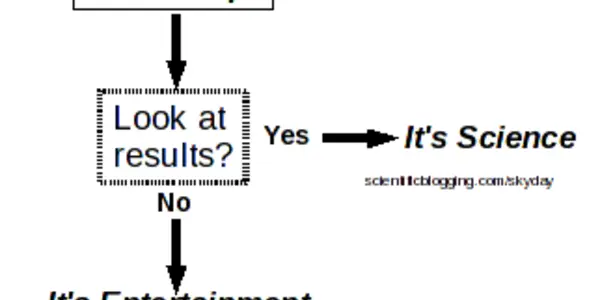
We scientists have a desperate need to make our science interesting to everyone-- including ourselves. Our terminology reflects this. In astronomy, we have the Big Bang. In comp sci, computers Crash. In engienering, "Test to Destruction".But at some point, usually when I'm in a classroom, my science audience wants me to do something extreme. Mix chemicals until they explode. Shatter a rose in liquid nitrogen. Fire off a rocket. Something 'kinetic', in the sense of lots of fragments of something once whole being rent a'sunder.As usual, parody best covers the dilemma, as with this week's "The Onion" science headline: Science Channel Refuses To Dumb Down Science Any Further.

Peeing In Space

Peeing In Space

Take 2 minutes with Canadian astronaut Chris Hadfield and you too will know how to pee in space.  And the origins of shooting stars.   He starts with "when you go to the bathroom on Earth, you are relying on gravity, pretty heavily... imagine if you were halfway done and someone shut off the gravity, it would be a mess..." and it just gets better from there.  You'll never look at the sky the same way again.

Giant Invisible Space Ribbon

Giant Invisible Space Ribbon

Where are we?  Cosmically, I mean.  We have barely made steps to get to the edge of our solar system, via Voyager 1 and 2.  It's ironic that we can see back 13 billion years using telescopes, but we have little idea of what 'stuff' is out there-- matter, dark matter, energy.  Or even what is just outside our local solar system.

Astronomy Employment: Past And Future

Astronomy Employment: Past And Future

I just posted a tweet storm from this week's 215th AAS Conference.  The specific session was a workshop on "Astronomy Employment: Past and Future".  The panelists were Beryl Benderly (Science Careers journalist), Rachel Ivie (AIP), Jim Ulvestad (NRAO), and Steve Beckwith (Univ. of CA), and their opinions were both frank and highly welcome at dispelling illusions about the ivory tower of academia.This is the cold, hard reality of professional astronomy, presented from the inside.  Here are the quotes and tweets from the workshop."More people are beign qualified as scientists than can be employed" (B. Benderly) #aas215

Best New Astronomy Books?

Best New Astronomy Books?

What are the best new astronomy books?  I just got asked this question, and thought I'd hit up all you Bloggies for your opinions.  I'll also make sure to check with publishers at the ongoing 215th AAS Meeting to get their recommendations, and post updates as they arrive.My recommendations so far would be:1) Laika, by Nick Abadzis (2007)

My Worst Columns of 2009

My Worst Columns of 2009

To wrap up the year, I'm listing my 4 worst columns.  Or, at least, the four columns that got outstandingly terrible readership.  I searched for a pattern or justification for why people stayed away in droves, but darned if I can spot one.  If you've got any ideas on why some columns sink while others swim, feel free to speak up.

Launch Early, Launch Often

Launch Early, Launch Often

Here's a pleasant Christmas thought-- why are rocket launches like holidays-- infrequent, big productions that tend to always be the same?  A New York Times op-ed, Faster, NASA, Faster, puts forth an idea that, really, resurfaces at least once every few years.  It's a good idea.  It says, hey, let's do more launches with higher risk.