The hammock physicist

Johannes Koelman

Johannes Koelman

I am a Dutchman, currently living in India. Following a PhD in theoretical physics (spin-polarized quantum systems*) I entered a Global Fortune 500 company where I am currently Chief Scientist. In my blogs here you won't read about my professional w…
RSS Feed
Survival Of The Stupidest

Survival Of The Stupidest

Is stupidity rising? Are we witnessing an alarming proliferation of irrationality and an exuberance of ignorance? 

The Gravity Of Free Will

The Gravity Of Free Will

Some subjects I try to avoid in this blog. But this one seems to become increasingly difficult to escape. Since my interview at Philosophy-To-Go, I regularly get questions about the physics of free will. These questions range from"Does free will exist given that the laws of physics are deterministic?"to the more suggestive"Is our free will based on quantum indeterminism?"and the more confrontational

Who Is Today's Einstein? An Exercise In Ranking Scientists

Who Is Today's Einstein? An Exercise In Ranking Scientists

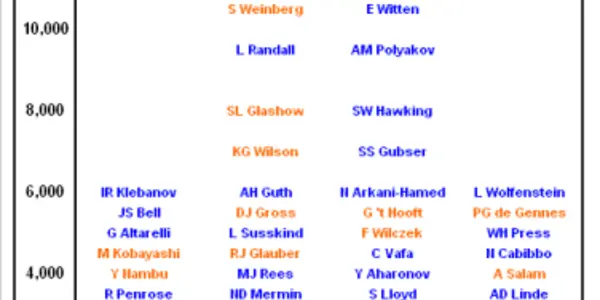
Who cites who? Science funding, tenure track appointments, all that is important to young scientists gets more and more dominated by citation analysis. This is certainly true in physics. Physics is very much a cumulative endeavor. Each physicist builds on earlier work, and therefore each new physics publication will cite the papers it builds upon. It is therefore not unreasonable to link the impact of a paper to the number of citations it attracts. 

Holomata

Holomata

"Call it entropy [..] nobody knows what entropy really is, so in a debate you will always have the advantage.” -- Von Neumann to Shannon.

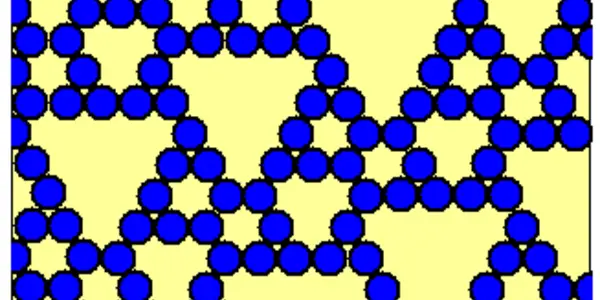
Have a look at below picture. You see a binary pattern. This pattern is formed by a hexagonal pattern of empty (yellow) spots and blue disks. The pattern repeats. If you carefully inspection the figure, you will discover that the repeating unit consists of 31 spots (with 15 of these empty, and 16 occupied). Let's consider a simple question:

How many bits do you need to fully specify the image displayed?

What's Wrong With 'Relativity'?

What's Wrong With 'Relativity'?

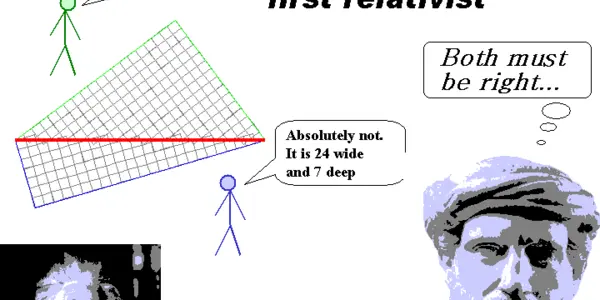
In his book "Everything's Relative - And Other Fables From Science And Technology" Tony Rothman writes: "[The term] 'special relativity' is probably the greatest misnomer in the history of science"I wholeheartedly agree. Amongst all scientific terms, the single word 'relativity' stands out as absolute record holder for triggering an astonishing amount of utter nonsense. 

Who Is King? Michael Jackson Vs Sir Isaac Newton

Who Is King? Michael Jackson Vs Sir Isaac Newton

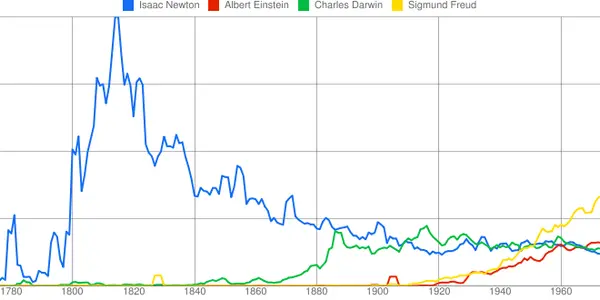
What's on people's mind? Who or what is impacting us most? That is easy to decide: go to Google, put in the search field the n-gram (the sequence of n words) that describes the item you want to check,* and watch the number of hits. So the bigram "John Lennon" (25 million hits) is apparently more talked about than "Elvis Presley" (20 million hits). But both get beaten by "Paris Hilton" (32 million hits), who in turn is dwarfed by "Michael Jackson" (98 million). And of course, "Lady Gaga" (140 mln) is the biggest.That's pretty clear, right?

Limits To Science: God, Godel, Gravity

Limits To Science: God, Godel, Gravity

Stupid physicists, they are doomed. Spending their whole lives searching for a theory of everything, not knowing that some eighty years ago this was proven to be logically impossible. The internet is full with sentiments like the above. Many such posts refer to Stephen Hawking's 2002 Dirac lecture Gödel and the End of Physics.

Quantum Hexodynamics

Quantum Hexodynamics

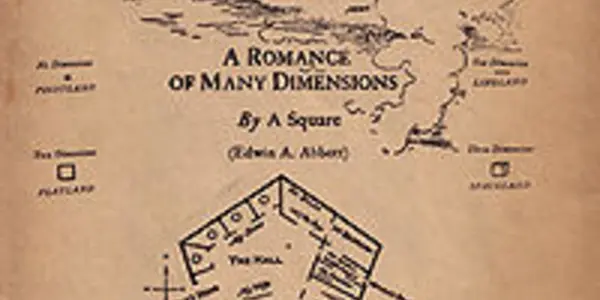
Special Guest Post From A Far Boundary Of Our Universe By Richard P. Flatman"I call our world Flatland, not because we call it so, but to make its nature clearer to you, my happy readers, who are privileged to live in Space."This is how my great-grandfather, Albert Square, started his memoirs. Memoirs he wrote in solitary confinement. Years later he died, still imprisoned and alone, and unaware that his ideas slowly but steadily started to change the views and imagination, not only of his fellow Flatlanders, but also of you Spacelanders.*  

Physical Reality: Less Is More

Physical Reality: Less Is More

Physical reality is composed of properties like distance, duration, velocity, area, volume, mass, energy, and temperature. To quantify these properties you need to measure them. And the act of measuring boils down to comparing against an agreed yardstick, a unit of measurement such as a foot, a gram, etc. Do you need a dedicated yardstick for each quantifiable property?Would the answer to this question be 'yes', then physics as we know it, would not be possible. We would not be able to relate the various properties to each other, physics laws would not exist. Fortunately, the answer to the question is a clear 'no'. We need far fewer units than one might expect based on the number of physical properties. 
Square Root Of The Universe

Square Root Of The Universe

Is energy conserved? "Of course it is!" anyone with just a rudimentary knowledge of physics will answer. A more pertinent answer would be: "if you can't show me a working perpetual motion machine, shut up and stop wasting my time!" The conservation of energy is an insight that stood the test of time. It was Julius von Mayer who first worded it in its clearest form: "Energy can be neither created nor destroyed". That was nearly 170 years ago. So why question energy conservation?The interesting thing about physics is that the deeper you dig, the more you are forced to doubt existing principles. Dig deep into the universe, allow gravity to become a dominant feature, and the conservation of energy becomes much less obvious. 

Why Physicists Are Smug

Why Physicists Are Smug

Over at Cosmic Variance Sean Carroll is fighting an interesting battle. In a series of recent blogs that started under the title "The Laws Underlying The Physics of Everyday Life Are Completely Understood" he is making the claim that physicists have fully figured out whatever we may encounter in our day-to-day lives. Everything. No exception. Sean wonders why this several decades old achievement never got the attention it deserves.

The Nobel In Physics 2010: Place Your Bets!

The Nobel In Physics 2010: Place Your Bets!

A week from now, Tuesday October 5th, the winner(s) of the 2010 Nobel Prize for physics will be announced. Predicting the Nobel laureates in physics is notoriously difficult. As part of their overall Nobel prize predictions, each year Thomson Reuters attempts to predict the winners in physics, but despite their habit of listing multiple candidates, so far they never managed to hit any of the annual winner(s).This year Thomson Reuters might, for the first time, be lucky.