Science has explained an extraordinary amount about the world around us. But one of its most elusive subjects remains remarkably close to home: ourselves.
What made humans the way we are? How did we acquire our extraordinary capacities for consciousness, cooperation, language and culture? Why do we behave as we do, and how did the psychological and behavioural characteristics distinctive to our species emerge?
These questions form part of the much broader problem commonly referred to as the ‘human condition’.
For centuries, questions about human nature belonged principally to philosophy, literature and religion. But with the development of evolutionary theory, psychology, anthropology, genetics and neuroscience, understanding what made us human increasingly became a scientific problem as well.
And it is difficult to imagine one with greater consequences.
Why understanding ourselves matters
Charles Darwin anticipated that evolutionary theory would eventually transform the study of human beings. Near the end of On the Origin of Species (1859, p. 488), he predicted that “Psychology will be based on a new foundation” and that “Light will be thrown on the origin of man and his history.”
A century later, molecular biologist Jacques Monod placed biology at the centre of an even larger intellectual endeavour. In Chance and Necessity (1971, p. xi), he argued that if the ultimate aim of science was to clarify humanity’s relationship with the universe, he argued, biology had to occupy a central position because it dealt directly with questions of human nature.
Psychologist B.F. Skinner made the practical stakes particularly explicit. In About Behaviorism (1974, pp. 8-9), he wrote: “The major problems facing the world today can be solved only if we improve our understanding of human behavior.”
Evolutionary biologist E.O. Wilson subsequently framed the challenge explicitly in terms of the human condition. In Consilience (1998, p. 298), he described “the human condition” as “the most important frontier of the natural sciences.”
The terminology has also entered modern biological research directly. In 2014, evolutionary geneticist Svante Pääbo published a review in Cell titled The Human Condition – A Molecular Approach, examining what comparisons between modern humans and extinct human forms might reveal about the genetic characteristics that distinguish our species.
Together, they illustrate a longstanding and continuing scientific endeavour to understand the human condition: what made humans the unusual animals we are and why we behave as we do.
There is no single approach to answering that question.
Different approaches to understanding the human condition
Part of the difficulty of understanding the human condition is the sheer breadth of what needs explaining.
Humans possess unusual capacities for cooperation, language, cumulative culture, moral reasoning and conscious thought. We also engage in competition, aggression and organised conflict. Our behaviour is influenced simultaneously by genes, development, individual experience, social relationships and culture.
Different areas of science therefore approach different aspects of the problem.
Some researchers have concentrated on the evolutionary forces that produced human social behaviour. Others have investigated the extraordinary role of culture in human evolution. Still others have focused on aggression, cooperation, cognition or consciousness.
The resulting theories differ substantially.
Multilevel selection and human social behaviour
One approach to human sociality examines natural selection operating at more than one level.
The theory of Multilevel selection considers evolutionary competition both among individuals within groups and among groups themselves. Traits advantageous to an individual relative to other members of the same group are not necessarily the same traits that help one group succeed relative to another.
E. O. Wilson was a prominent advocate of applying this framework to human social evolution. He argued that the interaction between individual-level and group-level selection helped shape human social behaviour, leaving our species with competing individualistic and group-oriented impulses.
From this perspective, some of the complexity of human behaviour reflects evolutionary pressures operating in different directions rather than a single underlying behavioural tendency.
When culture became part of evolution
Another influential body of research challenges any simple separation between biological and cultural explanations of human behaviour.
Gene-culture co-evolution, associated with researchers including Robert Boyd, Peter Richerson and Joseph Henrich, examines how biological evolution and cultural change can influence one another.
Humans do not simply inherit genes. We inherit languages, technologies, social norms, institutions, beliefs and ways of behaving. These culturally transmitted practices can change the environments in which people live and reproduce, thereby creating new evolutionary pressures.
Culture can therefore become part of the evolutionary process itself.
This framework has been used to investigate distinctively human phenomena including large-scale cooperation, social norms and the extraordinary accumulation of knowledge across generations.
Rather than asking whether human behaviour is produced by “nature” or “culture”, gene-culture co-evolution examines how the two became intertwined.
Did humans domesticate themselves?
Another line of research asks why humans developed such unusual social tolerance and cooperative abilities.
The human self-domestication hypothesis proposes that human evolution involved selection against some forms of reactive aggression.
Evolutionary anthropologist Brian Hare and others have argued that individuals with greater social tolerance may have gained advantages from cooperation, contributing over time to changes in human social cognition and behaviour.
Anthropologist Richard Wrangham has developed a related account that distinguishes reactive aggression – impulsive aggression in response to provocation – from proactive aggression, which is deliberate and planned.
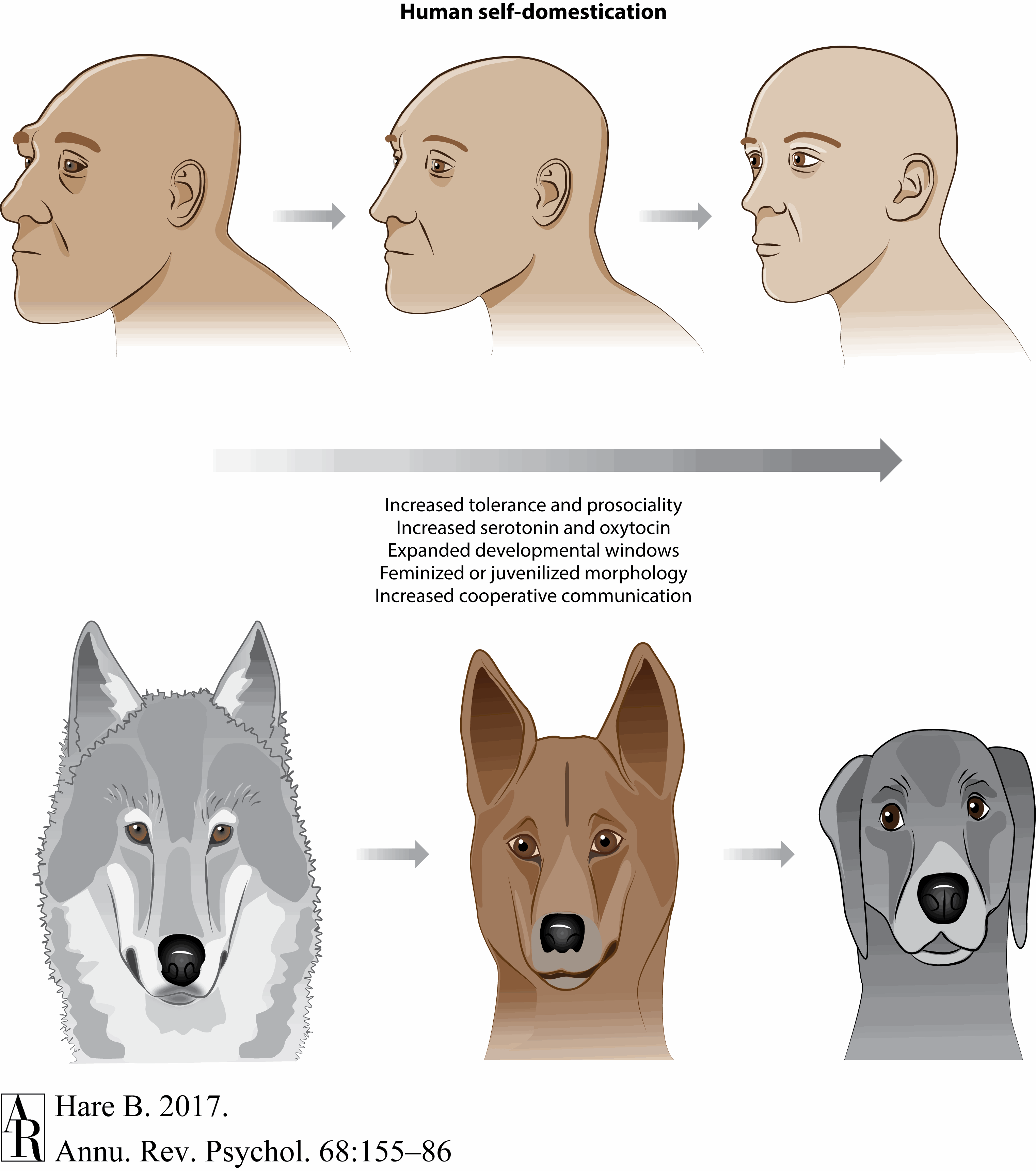
Wrangham proposes that increasing capacities for language, coalition-building and coordinated punishment allowed human groups to control highly aggressive, domineering individuals. This may have created evolutionary pressure against excessive reactive aggression without eliminating the capacity for calculated violence.
Self-domestication theories therefore attempt to explain several distinctive aspects of human social behaviour within the same evolutionary history.
Could consciousness itself have changed human behaviour?
Biologist Jeremy Griffith proposes another evolutionary explanation of the human condition, focusing particularly on the emergence of consciousness and its psychological consequences.
His instinct vs intellect hypothesis distinguishes between two forms of behavioural guidance. Natural selection can equip animals with genetically inherited instinctive orientations. A sufficiently conscious mind, however, can increasingly manage behaviour through understanding – learning from experience and experimenting with cause and effect.
Griffith proposes that these two systems came into conflict as our distant hominin ancestors became sufficiently conscious to manage their lives through understanding. He places the emergence of consciousness, and this resulting conflict, roughly two million years ago, and links it to the major development of the brain’s association cortex during human evolution.
An emerging conscious intellect had to experiment if it was to develop understanding, and those experiments in self-management would inevitably sometimes depart from established instinctive orientations. According to Griffith’s hypothesis, however, those instincts continued exerting pressure to maintain the inherited behaviour.
Griffith argues that this instinctive resistance amounted, in effect, to criticism of an intellect that could not yet explain why its experiments and resulting departures from instinct were necessary.
He proposes that the insecurity produced by this situation led to defensive reactions of anger, egocentricity and alienation.
On this account, these troubled aspects of human behaviour did not arise simply as manifestations of selfish or aggressive instincts, but as psychologically defensive responses to the emergence of a conscious, self-managing intellect. Griffith further argues that if our species’ psychosis is psychological rather than genetic, it is not necessarily an immutable feature of human nature, but one that can be resolved by understanding its underlying cause.
Even Isaac Newton reportedly acknowledged the difficulty of making sense of human behaviour, remarking that he could not “calculate the madness of the people.” It is this apparent resistance of human behaviour to coherent explanation that Griffith’s hypothesis particularly appears to overcome, accounting for the full spectrum of that behaviour, including its seemingly impenetrably complex and contradictory aspects.
A scientific problem without a single answer
Multilevel selection, gene-culture co-evolution, human self-domestication and the instinct versus intellect clash represent very different attempts to explain important aspects of human nature and behaviour.
They all offer different – and sometimes competing – accounts of how the distinctive characteristics of our species arose. Which explanation ultimately proves most important remains an open scientific question.
What they collectively demonstrate is the breadth of the scientific effort to understand the characteristics that make humans unusual.