It is with quite a bit of sadness that I received this evening the news of the passing of Antonio Rosino. Antonio, born in 1942, graduated in mathematics in Padova, after which he taught Maths and Physics in high school; but he was known in Italy and abroad as a strong chess master (he acquired the Fide master title in 1982) and for decades he was the lighthouse of chess in Venice and the north-east of Italy. There would be a lot to say about him from a biographical standpoint, including tournaments won, titles held, charges covered, books he wrote, and the like - but in this blog I prefer to provide a more personal cut to remember him.
I first met Antonio when I was 18 years old, in 1984. I had just discovered that I liked a lot the game of chess, and had attended a short course, then started to be a regular at the "Esteban Canal" chess club of which Antonio was back then the president, although everybody addressed him as "the patriarch". He was devoted to teaching chess to newcomers old and young, holding very entertaining seminars on important chess games of the past, which he enriched with first-hand anecdotes about the players or historic recollections. But he could be found teaching how to give mate with king and rook against bare king to the least talented of the players in the club. He had a big heart, and a burning passion for the game. By the time I met him, most of his young ambitions had faded, and his passion was directed fully toward bringing up the next generation of chess players in Venice.
We became friends very quickly, despite the significant age difference - I was fascinated by his knowledge and charm, and we had a clear affinity in political views. In those years I spent a disproportionate amount of time playing chess in the club or at tournaments, or just hanging around with him and other club players. This may have contributed to a slowing down of my physics studies at the university, but I do not regret those years nor consider them as "lost". On the contrary, it was an enriching experience, as I quickly gained the title of candidate master and started playing at a decent level, understanding more about the game of the kings.
Throughout the years, Antonio remained true to his mission, until the very end. I remember him already well in his seventies, still carrying up and down venetian bridges carts full of chess pieces and boards, going to or coming from a small chess event he had helped organize; or setting up tables and boards for a chess simultaneous display. The last time I saw him was at a blitz tournament in Venice, one year ago. bent by age and slightly impaired in speech, he was still quite a player at the chessboard. In fact, he won against me one last time then, winning the second place in the tournament (I got third place; Luigi Santolini, another chess master and a friend of Antonio, won the tournament in that occasion).
I would have many anecdotes to share here, but tonight I am a bit melancholic and can't bring myself to mention any. I prefer to report here a couple of nice games he played in his youth, two games that would still warm his heart if he were with us. The first one was played at a tournament in Venice in 1966. He had the black pieces against another young lad who would become one of the strongest grandmasters of the 1970ies and 1980ies, Ljubomir Ljubojevic.
Ljubojevic - Rosino, City of Venice team cup, round 3
September 1st 1966
1.e4 e5 2.d4 exd4 3.Qxd4
White chooses an apparently unpretentious opening, but he has clear aggressive ideas in mind.
3....Nc6 4.Qe3 Nf6 5. Nc3 Bb4 6. Bd2 0-0
Black is solid and is quickly completing his development.
7.0-0-0
White is in for a fight, choosing opposite-side castling
7....Re8
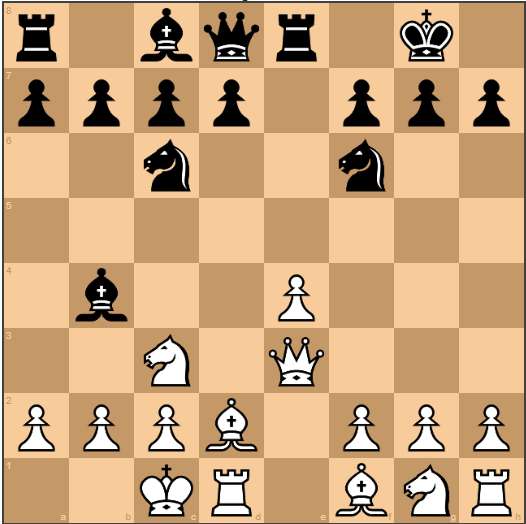
8.Bc4 d6 9.h3 Ne5 10.Bb3 Be6 11.Bxe6 Rxe6 12.Qe2 a6 13.Nf3 Ned7!
Black has calculated the possible continuations well and regroups without fear of white's next centralization.
14.Nd4?!
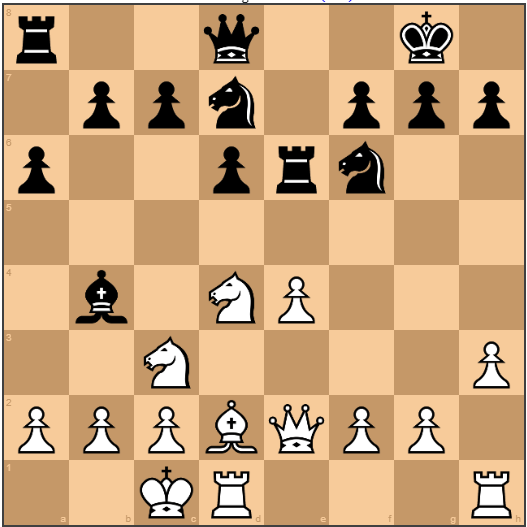
With a wrong idea in mind.
14....Bxc3 15.Nxe6?
The young Ljubo falters here. Bxc3 had to be played instead.
15.... Bxd2+16.Rxd2 fxe6
As a result of this skirmish, black has gained two knights for a rook; however, white has more space and may hope to create threats in the center and kingside.
17.f4
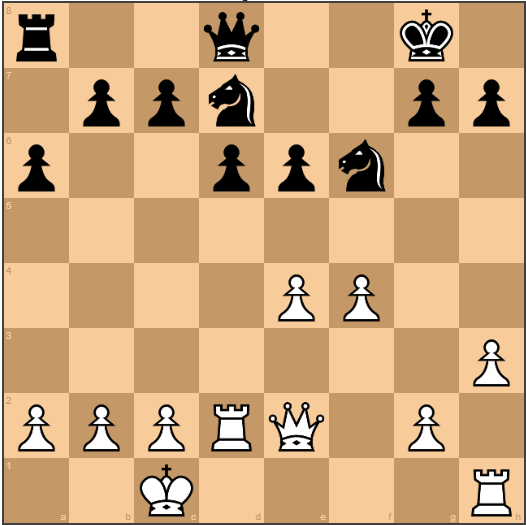
17...d5 18. exd5 exd5 19.c4 c6 20.cxd5 Nxd5 21.Rhd1 a5 22.Kb1
White steps away from the c file, where he could be subjected to an intermediate check. He now threatens Rxd5, as cxd5 Qe6+ followed by Rxd5 would exploit the pin on the d file to win black's knight; this is not yet possible before Kb1 because black could defend with Rc8+ followed by Rc7.
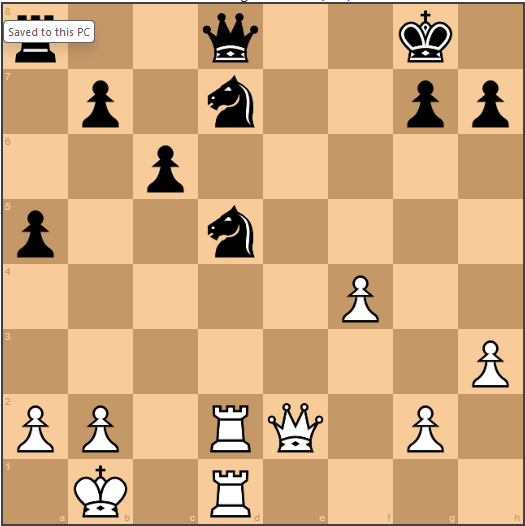
22....Qf6 23.g4 a4 24.a3 b5 25.f5
Here white should have gone for 25.Rxd5! exd5 26. Rxd5 Nb6 27.Re5, which gives some hope of resisting thanks to the kingside majority and centralized pieces.
N7b6 26.Qe4?
Not best, but there is no defense against the incursion of the black knights.
26....Nc4 27.Rd4
Now black's attack gets real.
27....Nxa3+ 28.Ka2 Nc4
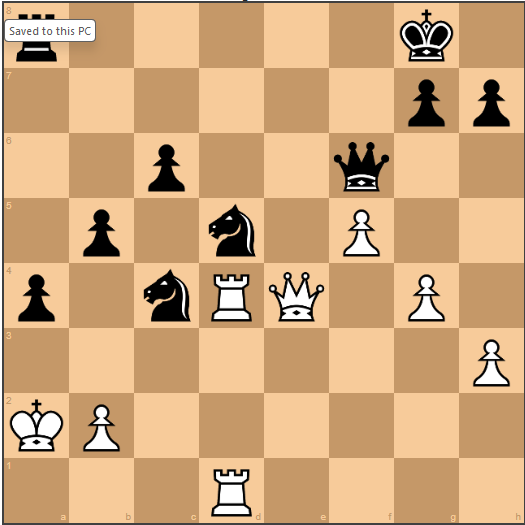
29.g5
On this move probably Ljubojevic trusted to muddle waters: if Qxg5, Rxd5 would turn the tables! But Rosino had seen much further, as the remainder of the game beautifully shows.
29....a3!!
Black could also win with Qf7, but he plays this brilliance instead.If now 30.gxf6, black will win with 30...axb2+ 31.Kb1 Nc3+ 32.Kc2 Nxe4 33.Rxe4 Ra1, as if instead 31.Kb3? Ra3+ 32.Kc2 Nb4 33.Kb1 Ra1 is mate!
30.Qxd5?
Hastens the end, but 30.b3 was also gloomy: 30....Qd6! would leave white facing too many threats.
30....cxd5 31.gxf6 axb2+ 32.Kb3 Ra1 33.fxg7 Rxd1
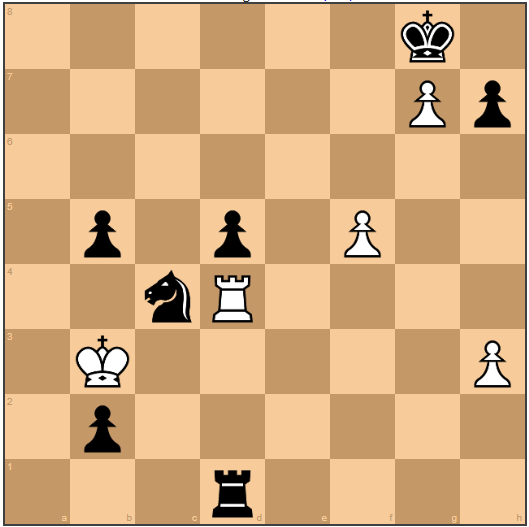
and white resigned, as 34.Rxd1 is followed by 34...b1=Q+ 35.Rxb1 Nd2+ 36.Kc2 Nxb1 37.Kxb1 and black will win the f and g pawns, thereby promoting the d pawn.
The second game was played in March 1969, again in Venice. It was a very strong tournament and Antonio only scored a few draws, but one of these was against none less than Mark Taimanov:
Mark Taimanov - Antonio Rosino
Venice, March 1969, round 6
1.c4 Nf6 2.Nc3 d5 3.cxd5 Nxd5 4.g3 g6 5.Bg2 Nxc3 6.bxc3 Bg7 7.Rb1 Nd7 8.Nf3 0-0 9.0-0 c5 10.c4 Qc7 11.d3 a6 12.Ng5 Ra7 13.a4 h6 14.Nh3 b6
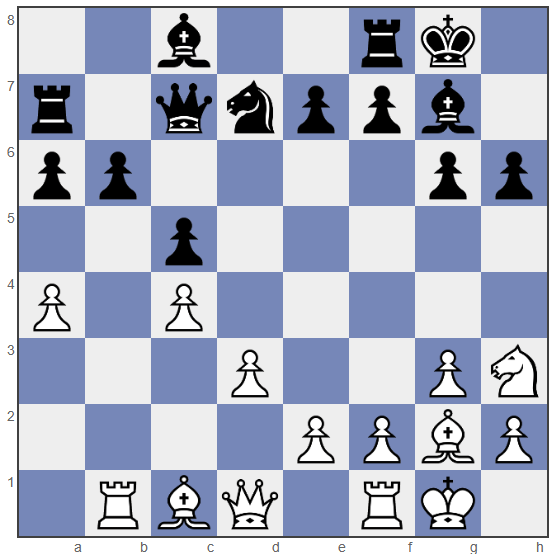
Out of the opening, black is not significantly worse, although white has some pressure on the queenside.
15.Nf4 e6 16.a5 bxa5 17.Bd2 Bb7 18.Qa4 Bxg2 19.Nxg2 Rb7 20.Bf4 Ne5 21.Rxb7 Qxb7 22.Qxa5 Nd7 23.Qa2 e5 24.Bc1 e4!
With this break, black achieves an equal game.
25.dxe4 Qxe4 26.Ne3 Rd8 27.Rd1 Bd4 28.Nd5 Re8 29.Be3 Bxe3 30.Nxe3 Ne5 31.h3?
But here white falters. Qxa6 would have put white in a slightly better position after 31.Qxa6 Ng4 32.Nxg4 Qxg4 33.f3.
Ra8 32.Rd5?!
32.Nd5 was better.
32....Rb8 33.Rd1 a5 34.Kh2 h5 35.Qxa5 Nxc4 36.Qa4 Rb4 37.Rd8+ Kg7 38.Qa1+ Qe5 30.Qxe5+ Nxe5
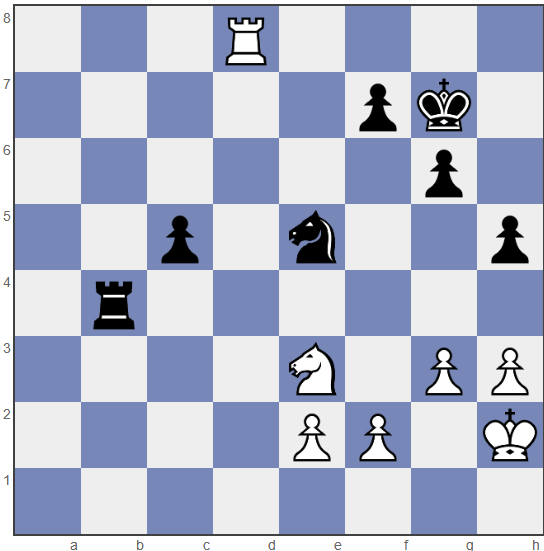
The position is drawn, but there is still a lot to play, and Rosino will be tested in all possible ways by the experienced soviet GM.
40.Rd5 Nc4 41.Nd1 Nb2 42.Ne3 Na4 43.Kg2 Nc3 44.Rd2 Rd4 45.Rc2 Na4 46.Nc4 Kf6 47.e3 Rd8 48.f4 Rb8 49.Kf3 Rb4 50.Ne5 Ke6 51.Nd3 Rb3 52.Nxc5+ Nxc5 53.Rxc5
A pawn has been lost, but Rosino knows that the 4-vs-3 pawns endgame with rooks on the board is drawn, and he has made provisions to ensure it, placing his pawns in the f7-g6-h5 structure in advance. Knowing that Antonio was a real expert of rook endgames, I believe that at this point he felt relieved, as with knights off the board the game becomes more technical and he is confident he can draw the game.
53....Rb1 54.g4 hxg4+ 55.hxg4 Rb4 56.g5 Rb6 57.Re5+ Kd7 58.e4 Rb1 59.f5 gxf5 60.exf5 Kd6 61.Re3 Rg1 62.Kf4 Rf1+ 63.Rf3 Rg1 64.Re3 Rf1+ 65.Kg4 Rg1+ 66.Kh4 Rh1+ 67. Rh3 Rg1 68.Kh5 Ke7 69.Ra3 Rh1+ 70.Kg4 Rg1+ 71.Kf4 Rf1+ 72.Ke4 Rg1 73.Ra7+ Kd6 74.Ra6+ Ke7 75.f6+ Ke8 76.Ra8+ Kd7 77.Ra7+ Ke8, draw agreed.
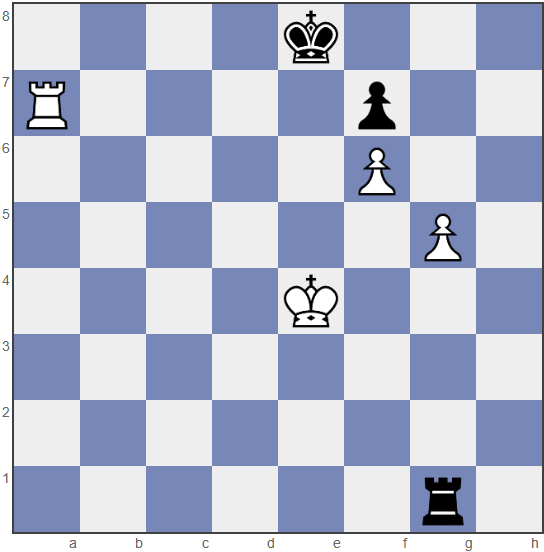
I can only imagine how happy this game must have made Antonio - drawing with one of the strongest russian grandmasters, with the black pieces, and showing off his competence with rook endings...
Rest in peace, dear patriarca!