This is the second post reporting a few tests of the Radiacode 110 spectrometer, an extra-cool pocket dosimeter/radiation counter/spectrograph sold by RadiaCode.
I have had the chance today to test the Radiacode 110 and the Radiacode 103 at an x-ray facility in Lulea University of Technology, where soft x-rays are used for material science applications. I placed the two units inside the x-ray chamber and we took a one-minute spectrum of the detected radiation. Since these x-ray machines are producing a continuous spectrum of photons, the test does not reveal much in terms of spectrography precision of the instruments, as the data is rather featureless. However, it is interesting to compare the response of the two instruments in a situation of moderate-high fluence (in the tens of microSieverts/h range) which does not saturate either of the two counters.
[ It is useful for me to point out that the R110, being equipped with a three-times-larger scintillation crystal than the R103, has a correspondingly smaller saturation threshold - according to specifications by the manufacturer, the R103 goes off scale beyond 1 milliSieverts/h, while the R110 tops at 0.4 milliSieverts/h. As 0.4 mSv/h is still a radiation level you practically never encounter in real life scenarios (except if you walk by the wreck of the Chernobyl reactor, e.g.) this limitation is quite acceptable for the R110, that with its large crystal is focusing on fast detection of weak-moderate sources. I will have something more to show about that below. ]
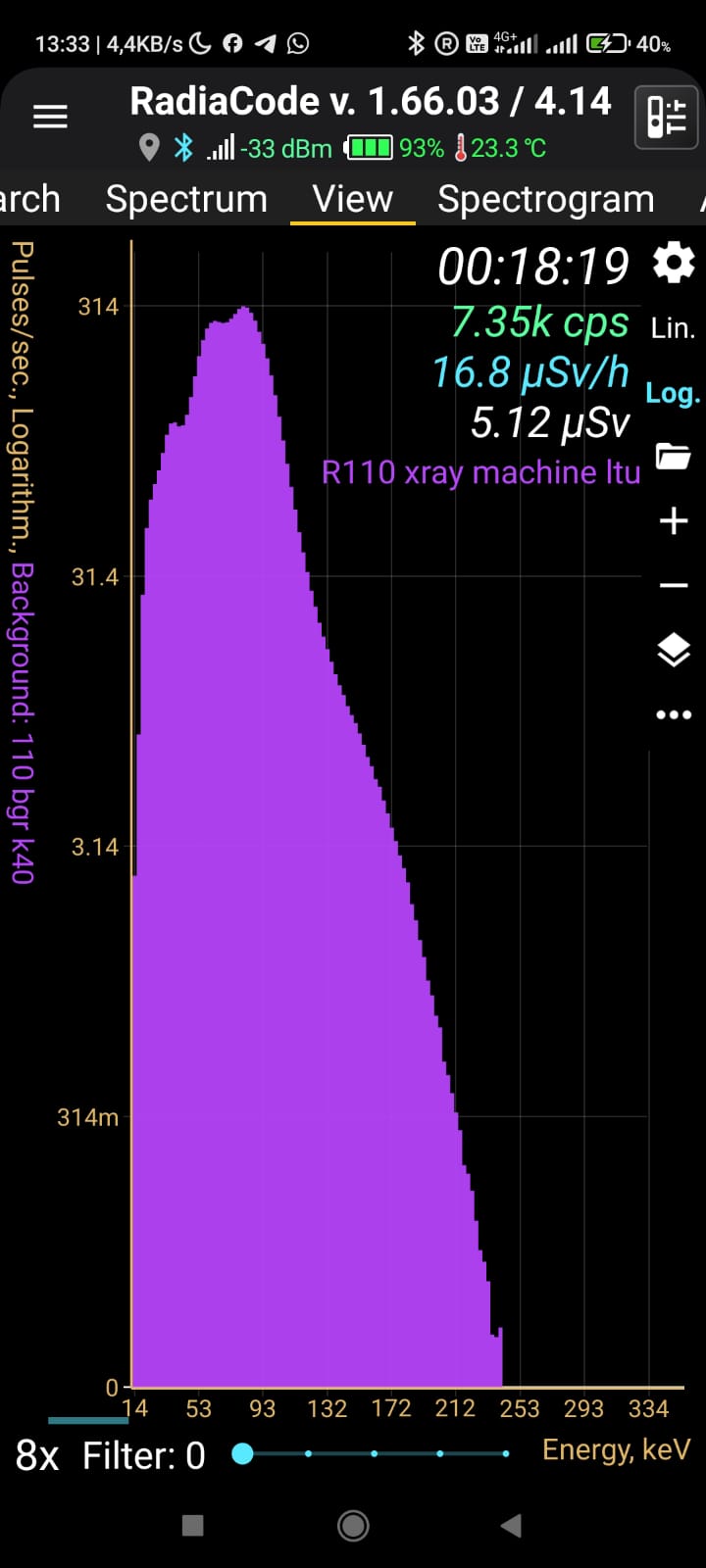
In the figure below you can see the spectrum I collected from a x-ray exposure in the R110. Although it shows some wiggles near the top, there are no evident "lines", as expected. At these energies (100 keV or so) a mono-energetic emission would appear as a narrow peak of 8 keV width. The R103 recorded a similar spectrum, with less statistics (about a factor of 2 less).
Perhaps more interesting is to look at the raw count rates and dose rates during the exposure. The x-ray machine necessitates a pre-conditioning, during which some x-rays are generated although not at full power. With the fast data collection of the R110, it is possible to observe the fine structure of the ramping up of the radiation intensity; the R103 does a similar job, but as you can see the count rate is about twice smaller (ignore the numbers on the right, which are relative to the instantaneous conditions at the time when I took a snapshot - what matters are the reading on the y axis).
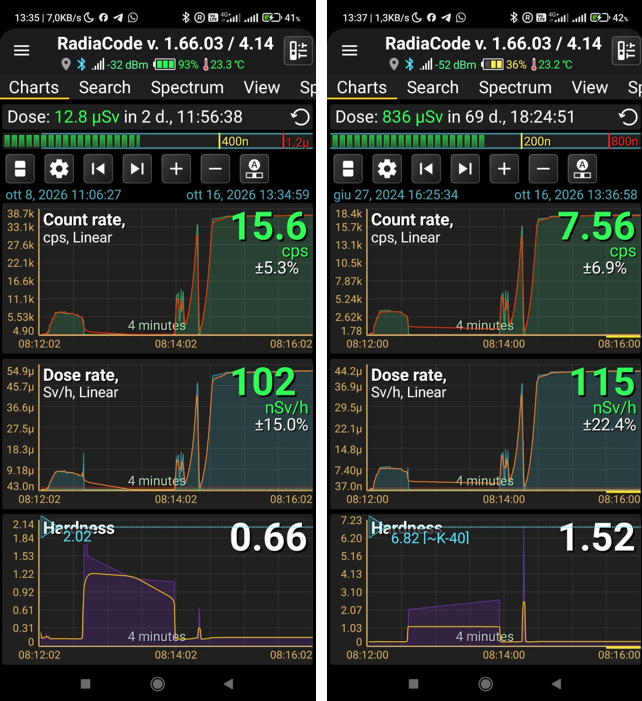
[If you are interested about the fine print: the top graphs show, for the R110 (left) and R103 (right), the count rate in counts per second; the left "blob" shows the preconditioning phase, where the count rate reaches about 6k/s in the 110 and 3k/s in the 103. The center graphs show the dose rate, which has slightly different forms (with a small peak detected at the end of the preconditioning in the 110), but the rate measurements are otherwise in great agreement. Bear in mind that the two instruments were placed side to side inside the 1mx0.5mx0.5m enclosure, but even a few centimeters of difference in positioning may matter significantly for the irradiation the two units were subjected to. The third graph on the bottom is also interesting, showing how the "hardness" of the detected radiation is very low during operation of the x-ray machine - since these are soft x-rays, their average energy is low compared to natural backgrounds.]
After the visit to the x-ray machine, I briefly visited my office at LTU, where I have on display a few mineral specimens. Among them, the only one that exhibits a bit of above-background radiactivity is a piece of blue apatite. I decided to use it as a testbed of the procedure I usually perform on new samples - when I slowly pass the radiation counter over the specimen to verify if it gives an increase in count rate. Here the difference between R110 and R103 is quite telling, as you can see in the video below.
Basically, the R103 remains oblivious of the slightly-above-background emissivity of the specimen, with a very quick scan. It is harder to fool the R110 - the latter correctly peaks up the extra counts, producing an alarm. With a slower pace on top of the source, both counters correctly detect it instead.
Overall, the RadiaCode 110 performs as expected from these and other tests I ran: it is a beefed-up version of the R103, with a higher sensitivity and no degradation of the all-important energy resolution capabilities of the latter instrument. The battery is also improved, such that even if the counting rate is 2.5 times higher, the R110 will still have 80 extra hours of battery life when the R103 is out of juice. Basically, you can give this instrument a charge on January first, and take 1 hour of data every day, and only have to worry about recharging it on September 30 or so. If you are like me a bit distracted with keeping instruments in full power, this feature is very welcome!