Ionizing radiation is all around us. We do not notice it: we have not developed any sense to detect it. Yet it may affect us in very serious ways, particularly because its effect on living cells and organisms is cumulative: a progressive degradation. The human body has ways to cope with the attack from various kinds of poisons, by progressively eliminating them; but it can do nothing against radiation damage. An analogy could be a computer screen: you can periodically remove dust and stains with a soft cloth and retain the functionality of the screen, but you cannot repair scratches and dents as they accumulate and little by little worsen the image quality.
To explore the topic of ionizing radiation for a moment here, before I introduce you to Radiacode's new product, we can and should distinguish two kinds of radiation: charged particles, such as electrons and protons, and light quanta (photons). While charged particles endowed with high kinetic energy may pose significant threats to biological tissue, they are relatively rare on Earth's surface, and I will not discuss them further here.
Instead, photons -which carry no electric charge- are the vectors of electromagnetic radiation, and they are everywhere. Not all of them are harmful, of course: only the most energetic photons, which get their own name (x rays and gamma rays), are a concern because of their penetrating power. Ultraviolet light is next: while less energetic than x rays, it can still damage your skin and indeed cause tumors if absorbed in large doses. The sketch below shows the enormously wide range of light wavelengths.
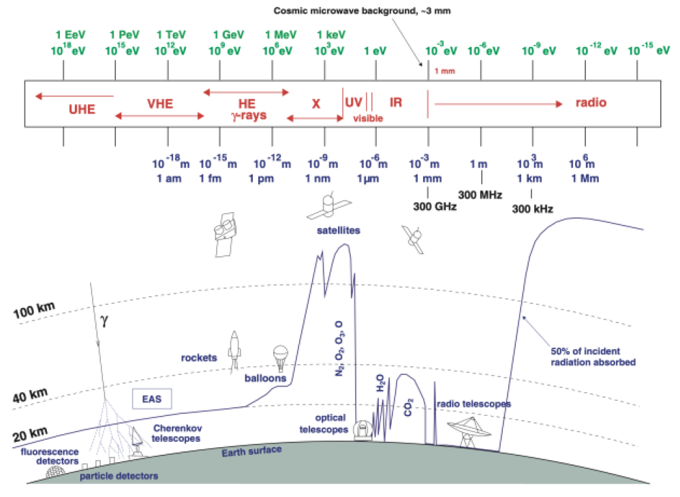
The top scale shows the energy of photons, from ultra-high (left) to ultra-low (right). The radiation we are discussing here, from radioactive decays, is in the gamma-rays - x-rays region from 1000 eV to a billion eV: a narrow, but very relevant region where a lot happens. Indeed, where do x-rays and gamma rays originate from? We get some of them from our Sun and other stars, but fortunately Earth's atmosphere shields most of them; if you were in outer space we should worry about those sources, but as long as we stay in our thin biosphere (and if we do not destroy the Ozone layer of our atmosphere) we are safe from them.
Most of the energetic photons you get exposed to in your everyday life come from the decay of radioactive substances in rocks: particularly Thorium and its own decay products. These emit gamma rays that may penetrate through your clothes and your skin, and leave harmful energy depositions and ionization in your body. As Thorium emits Radon gas in its decay, and radon itself is a gamma emitter, and is much heavier than ordinary air, you can find it most often contaminating non-ventilated underground or basement enclosures. Do you need a radiation detector to verify the safety of your basement? Yes, but if you don't sleep in it you probably don't need to worry about Radon - the typical radiation levels from Thorium decay are not very worrisome.
Other everyday sources of radiation include particular materials that were used in the past, and in some cases are still used. Some kind of glass contains uranium, for example; old watches have radioactive paint on the arms; and even food can be mildly radioactive. But again, these will hardly kill you.
Radiation in larger amounts, which may actually kill you, may instead come from human-made sources: in particular, nuclear weapons, nuclear reactors if there are leakages due to accidents, and uranium-based artillery shells. So imagine a scenario when some regional nuclear skirmish takes place, and a few tactical nuclear weapons explode a few kilometers away from where you are. Or a nuclear plant explodes, and distributes harmful radioactive gases around. Where to go? Stay put inside your house with closed windows, or escape following the diminishing gradient of the radiation field?
I am sure most of us would prefer fleeing rather than caving in - it is a more direct way to reduce the threat. Staying where you are would slowly kill you. But in order to escape, you would need a radiation detector sensitive enough to indicate the amount of radiation in real time, as you move on the ground: just putting miles between the source of radiation and you does not help, because airborne contaminants travel in not-easy-to-predict directions.
In a situation such as the one depicted above, most commercial radiation counters cease to be useful, because they are built to be very sensitive to low levels of radiation, but they get blinded by too strong a signal. If you move 100 meters left or 100 meters right and you still get an off-scale reading, you know you have the wrong instrument in your hand.
Enter Radiacode zero
Radiacode zero has exactly the characteristics needed to face an immediate exposure threat like the one I described above. It is a technology-packed device but it is very robustly built. With a weight of 76 grams it is small enough to be wearable, e.g. can be added to your key chain if you purchase a silicone outfit and hook. And its large, sensitive scintillation crystal and readout system allow it to precisely measure very high levels of radiation without ceasing to operate. Its range is up to 9 Sievert per hour - a radiation level that will give you a lethal dose in just 20 minutes of exposure, and importantly (and luckily), a level that you will be unlikely to meet even in the most disastrous scenario. By comparison, the Radiacode 102/103 units will saturate at 0.001 Sievert per hour, and similar counters available on the market will similary start to misreport the radiation levels above that threshold.
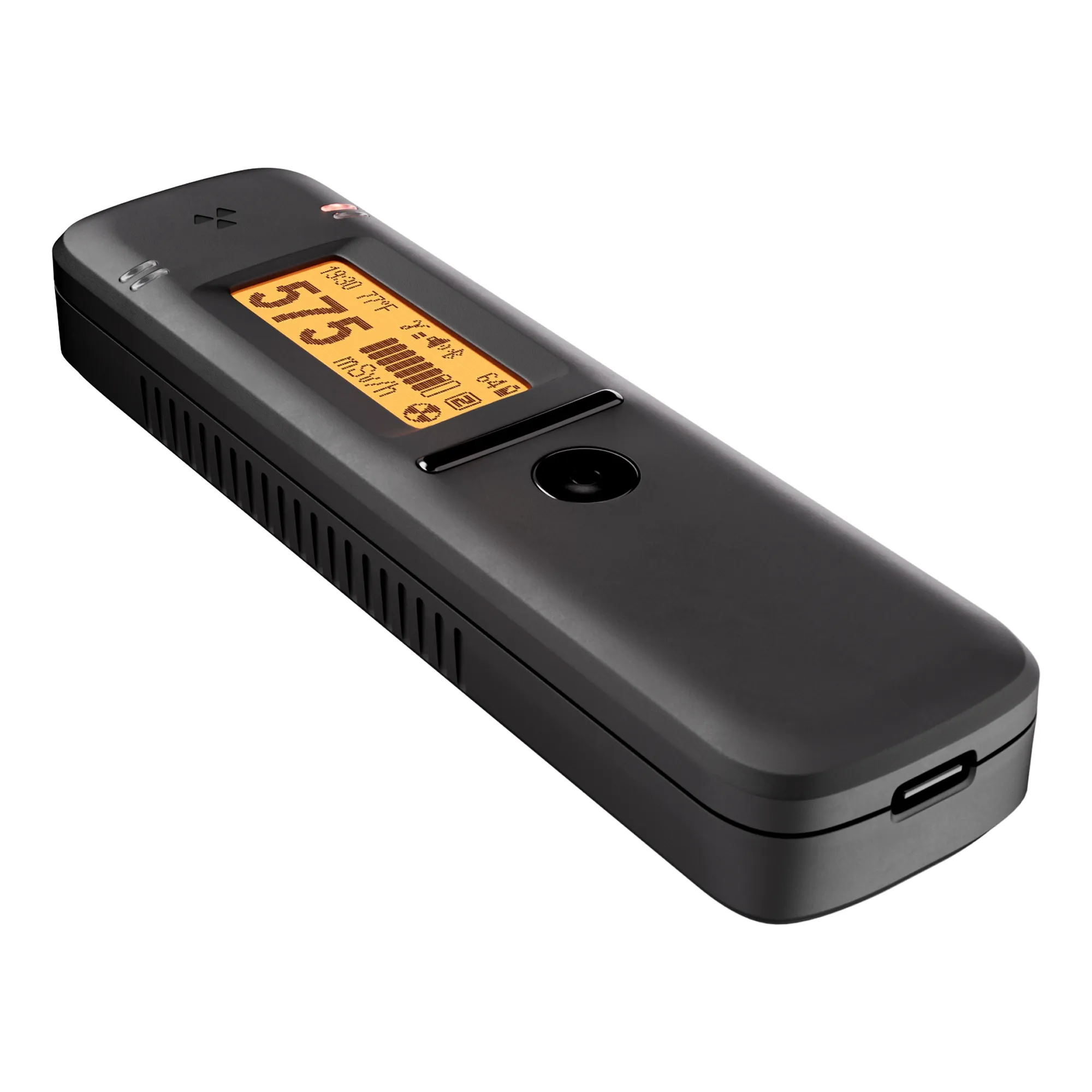
An increase of the upper range by a factor of 9000 is enormous, and to pull it off Radiacode had to invent a readout that switches between count-based and energy-based depending on the exposure rate. Radiacode zero is therefore a different class of instrument, and covers ground that other instruments cannot reach.
The feature mentioned above is the one strongly motivating the existence of this member of the Radiacode family, and indeed it would justify its purchase alone, but the Radiacode zero has much more to offer. At a lower price (US$ 299) than the Radiacode 102 / 103 and the newly announced Radiacode 110 (which I hope I will be able to soon review in this column too), it still offers many of the extremely nice features of those low-range models. One feature I love is the possibility to map the radiation levels on the ground continuously, obtaining colourful maps that betray the composition of soil and a lot of other detail about the landscape.
Unlike the 102/103 models, the Radiacode zero does not present itself as a spectrometer: it does not track the energy of individual gamma rays for external consumption, so the fancy energy spectra that the 102/103 can produce are not available. I must say that as a physicist I like that feature, so I feel its absence in the menu of the Radiacode zero; however, I understand the rationale behind not providing it. Why losing your time checking whether it is from Cobalt or Iodium that you are getting a harmful dose, when all you need to do is run toward where the counts decrease? There is also another reason why I suspect the designers of R0 kept it out of the features list: offering an instrument that can remain alive and kicking in very strong radiation fields, and report accurate measurements of the dose rate in the multi-Sievert range, is incompatible with offering an accurate spectrum measurement in those same conditions.
So there - if you want a reliable instrument that will guide you to the safe exit in a nuclear emergency, Radiacode zero is the thing to have handy. All the while, you can have endless fun with it by mapping the radiation in your surroundings, checking old watches or glass, surprising your friends by diagnosing unhealthy basements, or just walking around with it, getting notified if the person next to you is under isotope treatments. That, by the way, did happen to me once! And I got a dose by simply sitting back-to-back with a person that must have just been injected with some radioisotope... Thanks to the Radiacode 103 I had with me, which was turned on but with alarms set to off, I got to know that, although not as quickly as I would have if the alarms had been enabled! Lesson learned.
In the next post I will describe more in detail some of the Radiacode zero features - I think otherwise this post would become too long here. When I do, I will forward-link to the new pieces here.