As I explained previously, these days I am testing a new radiation detector from the Radiacode family: Radiacode Zero. While cheaper than other models, this new instrument beats all others on a very important aspect - its dynamical range is astounding, making it an emergency instrument much more reliable than almost any other pocket device on the market. It can detect and measure gamma and x radiation at just a hundred nanoSieverts per hour - a flux that equates to 1.6 counts per second of x-rays of 500 keV. That flux corresponds roughly to half of the ambient background in most places on the Earth's surface. However, Radiacode Zero can still effectively measure and report radiation fields that are 90 million times larger without blinking! That is as if you had a scale that could measure just as reliably your body weight and the weight of a speck of dust.
[Below, the contents of the shipment still in their factory packaging]
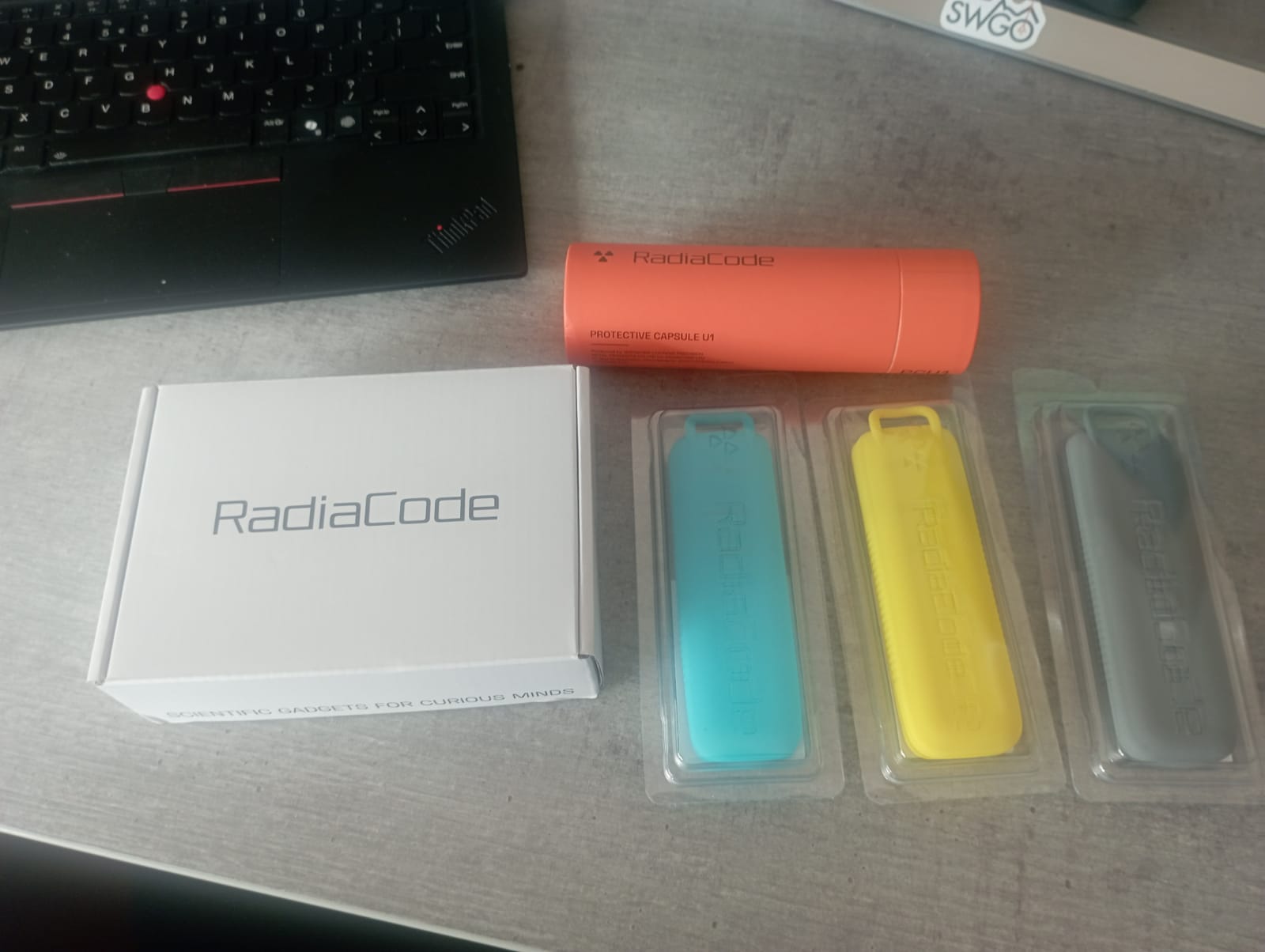
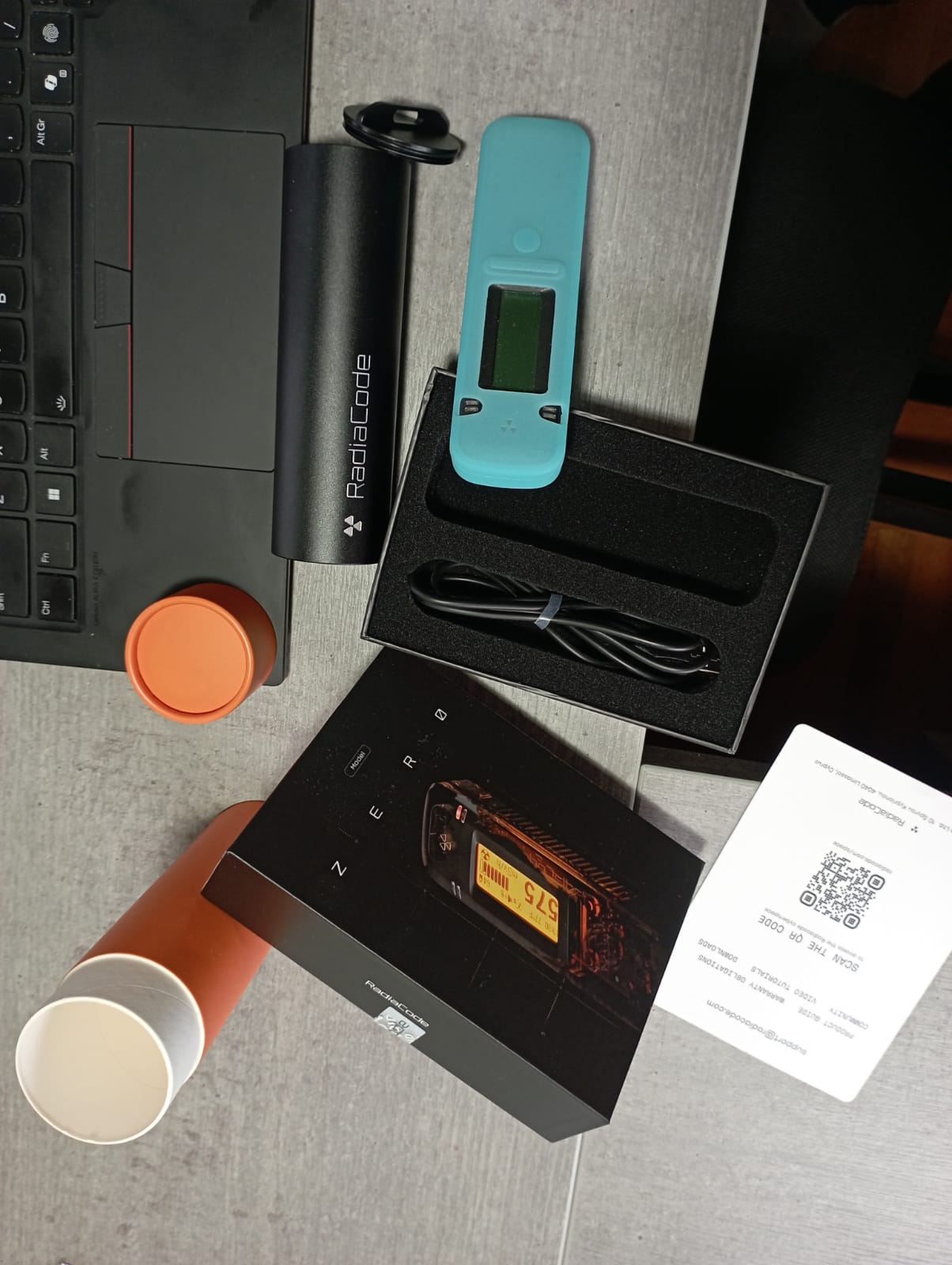
[Above, the package contents and the Radiacode zero already inserted in a blue silicone casing.]
The instrument arrived well-packaged in a cardboard box, which was just the protective casing for a nice black box worth keeping for it's own sake. The latter contains the instrument and a USB-C cable that can be used to recharge it. You won't use that much, though, because the detector will run for days on end without needing a refill - and it does not make sense to keep the unit running if you are sitting at home anyway. I also received a nice aluminum container, which can be useful if you package the instrument for a field trip, and a few cool silicone cases - really useful to avoid potential damage from falls, although the unit looks sturdy enough to sustain a fall from normal height.
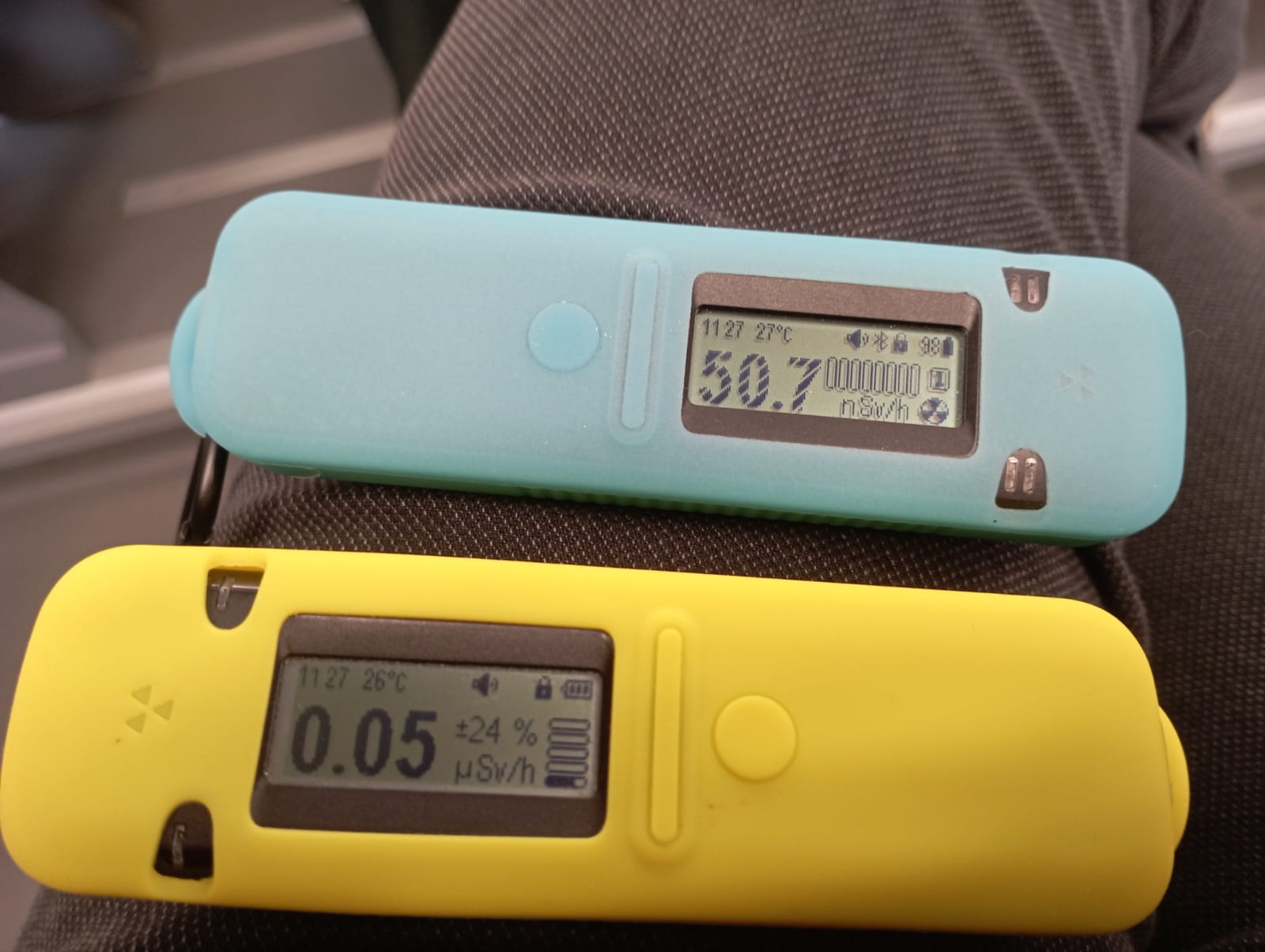
[Above, the Radiacode Zero in a blue silicone casing, and the Radiacode 103 in a yellow outfit. You can see the different style of the display, as well as the dose rate reported in nSv/h by the Radiacode, which matches the reported level by the 103 but offers two more significant digits.]
As I turned the instrument on, I noticed that the liquid crystal screen design has been improved from the 103 model I have tested in this blog a few years ago. I find the new design more appealing, and also -emphasizing the superior dynamical range- the designers made it report dose rates down to "XX.X" nSv/hr, which is really a low radiation level. My initial reaction was "oh well, this instrument does not have sensitivity down to such levels", but that is not true. In fact, if you leave the unit undisturbed to measure for a while, it will average the observed radiation and end up reporting a very precise estimate. I could test this by comparing the Radiacode Zero to the Radiacode 103, set side by side on my desk. At the beginning, their readings differ by tens of nSv/hr, but slowly they both converge to higher precision estimates. Then, having the display report the reading in nSv/hr (down to "XX.X nSv/hr) rather than microSv/hr like the 103 (with readings like "0.XX uSv/hr", down to 0.01) does make sense.
The back-lit display is very intuitive and informative, as it not only reports the dose rate - the main reading, in larger fonts - but also the time, the temperature, whether alarms are on or off, the charge level in percentage, and an analogic bar-chart of radiation level.
The radiacode is endowed with several sound alarms (optional, but I strongly advise you to set them to a high-enough level that never fires accidentally due to spurious events like direct hits from cosmic rays, as otherwise that defies part of the instrument's functions) and with a nice "geiger counter" click when it detects particles - so that you can move around and be guided by the intensity of the clicks, even if you are below alarm level. Of course that can be safely turned off, but it is a nice feature. It also has two multi-colour leds, one flashing every time a particle reading occurs, and another flashing during alarms or during charging time.
From a dummy-user perspective, the instrument is really easy to operate. You just press the big button for a couple of seconds, and the Radiacode zero turns on, greeting you (if you set sounds on) with a couple of beeps. Everything is customizable from the app, but I will speak about the app in a separate post. Here I will only mention that the big button must be pushed again briefly to "unlock" the options that can be selected with an additional "up-down" smaller switch. That one selects the main options for field operation, but again, a lot more can be done through the smartphone app, or even better, with a computer if you connect the unit with it through the USB-C.
For a first test, I brought the instrument around with me as I had a walk in the center of Padova, the town where I work. The result is the map shown below, which nicely displays different radiation levels in different parts of the town. I know what the higher radiation spots are by now, after a few years of playing with the Radiacode 103: the old town has granite bricks paving the streets, and these are very mildly radioactive, giving the path in the picture below the orange-red colours it displays in some places.
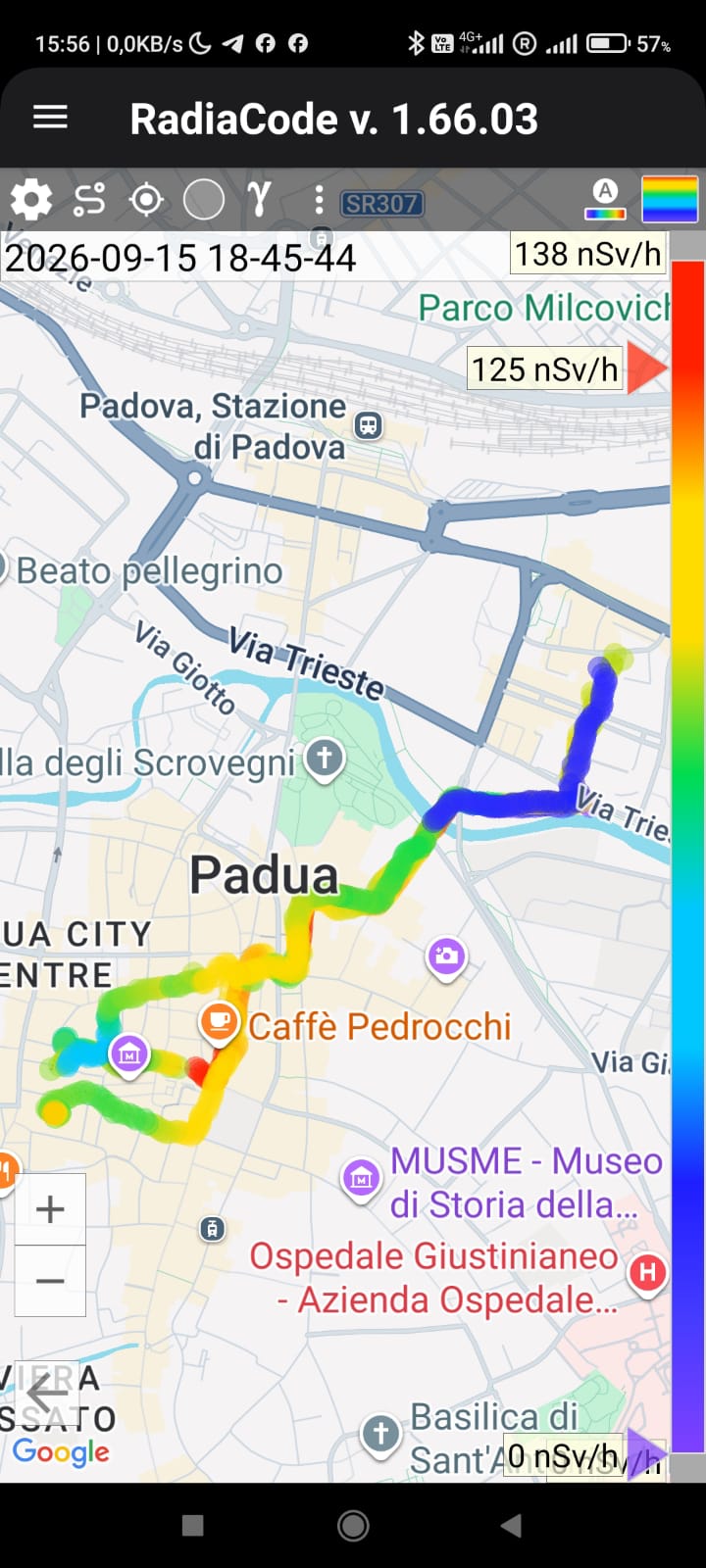
I kept the R0 and the R103 working close together for some time, and I later compared their reported radiation readings. The two instruments confirm one another very nicely at the small radiation levels you find in normal environments. But I wanted to try and test the R0 in very high-radiation fields, so I asked my colleague Luca Silvestrin to check a few sources in his lab at the Department of Physics.
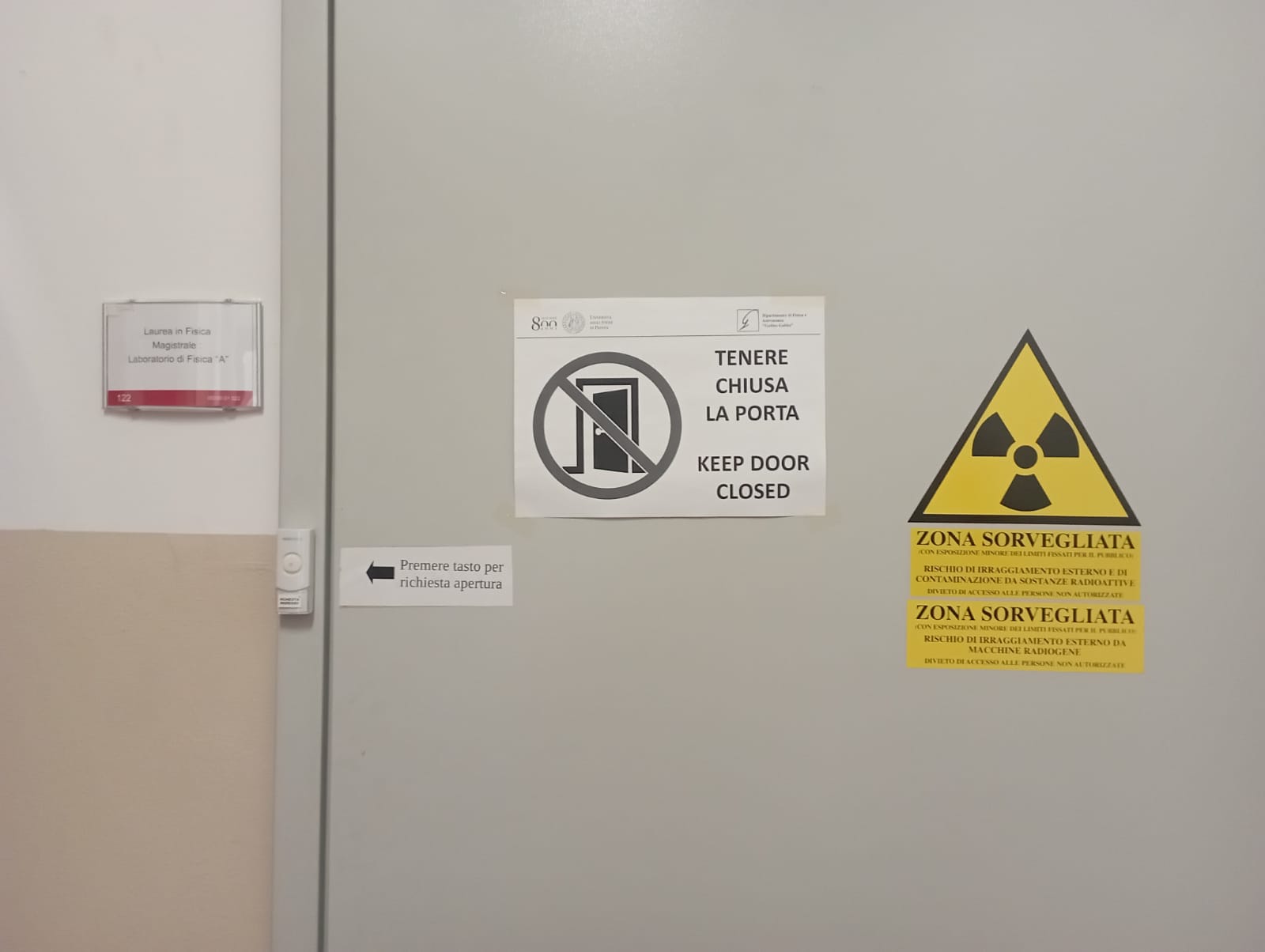
[Above, the entrance door to the lab where we tested the counter with a few sources.]
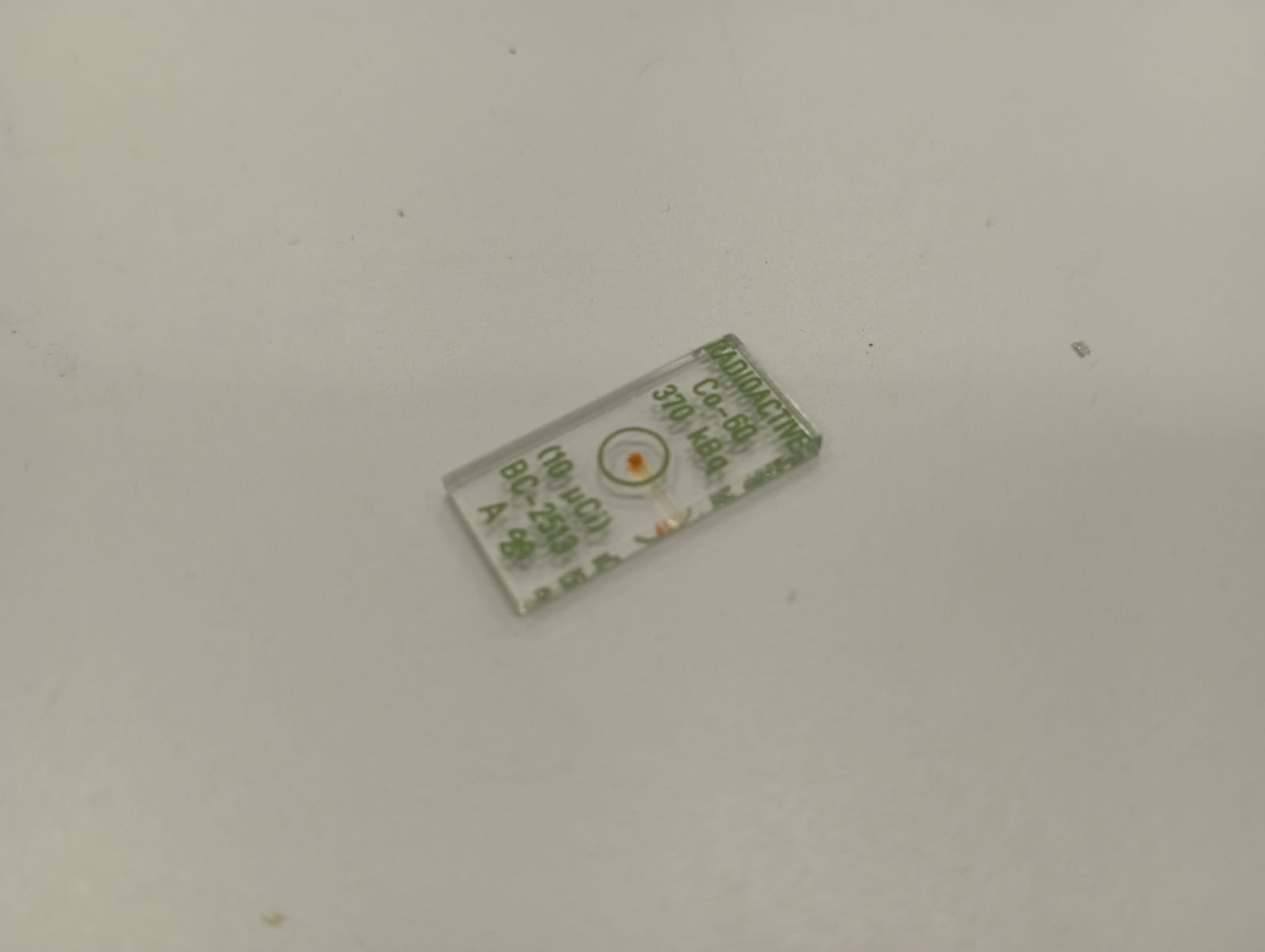
We tested three gamma-ray sources: Na-22, Eu-152, and Co-60. None of these were strong enough to reach the saturation point of the Radiacode 103, which if I understand correctly sits at about 1 mSv/hr. The highest level of exposure we could reach, with the Eu-152 source, was of about half a mSv/hr. In the highest tested radiation conditions - by putting the instruments very close to the source - I could see that the R0 was reporting a systematically higher reading than the R103, and I tentatively interpreting as a sign of impending saturation of the R103, but to be honest I cannot say that for sure. All the while, the R103 was providing beautiful spectrum measurements of the various lines of the sources, so that may have been a fluke.
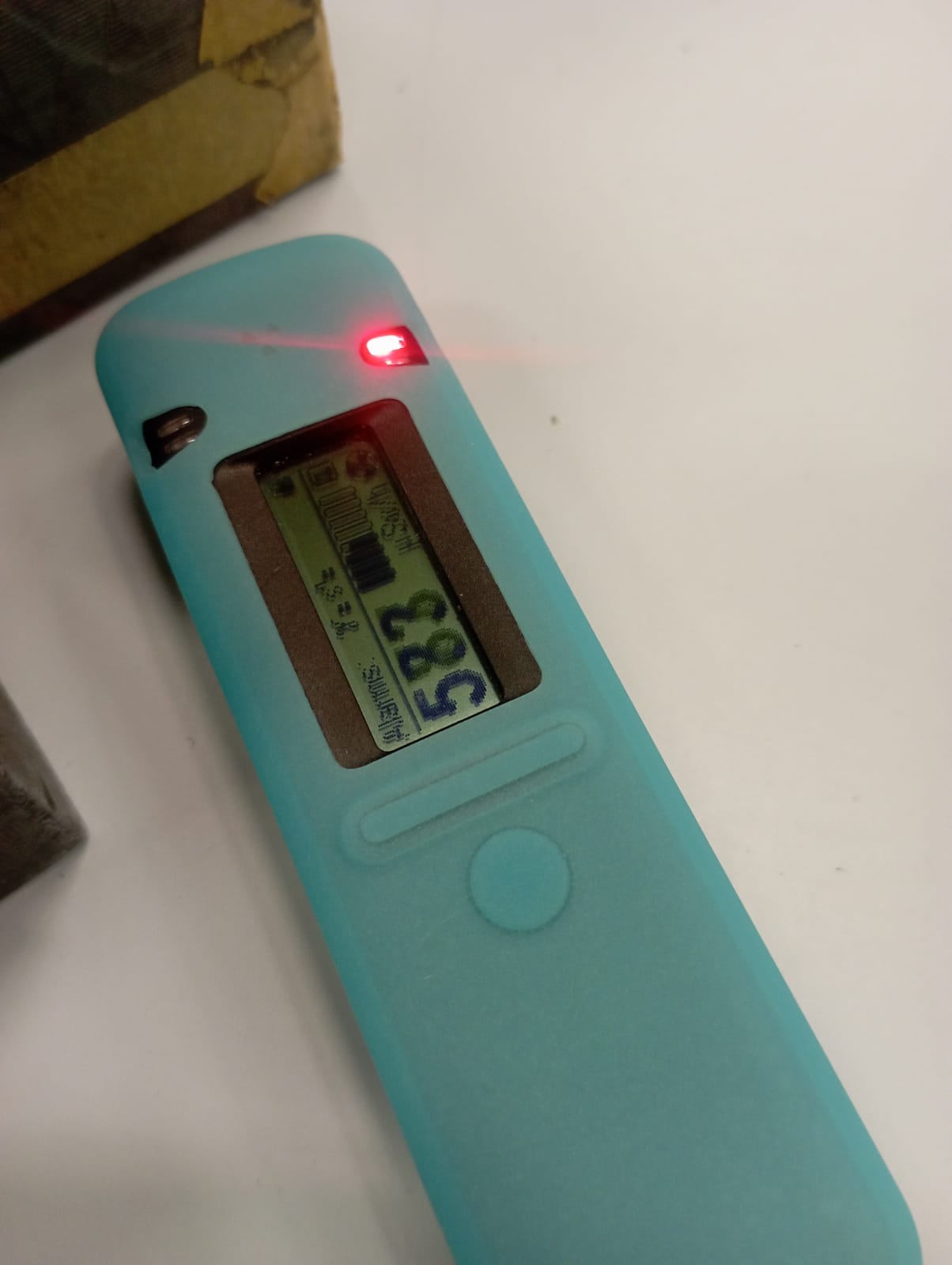
[The Radiacode zero goes "half-scale" in the bar chart of dose rate, when exposed to a significant 600-microSievert/h radiation field.]
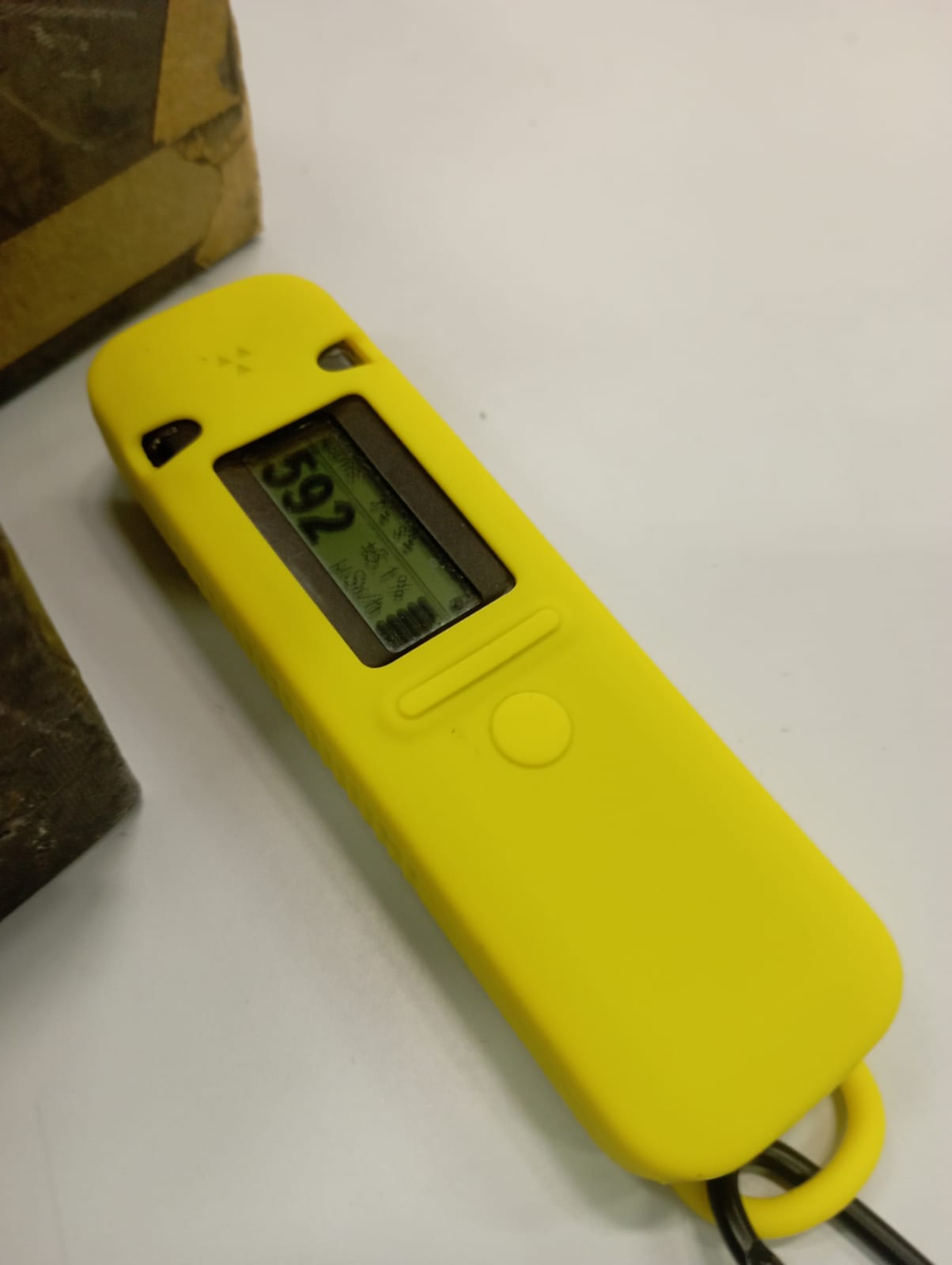
[Note how the bar chart in the Radiacode 103 is all-black, indicating we are close to saturation; compare to the one in the Radiacode zero from the previous picture.]
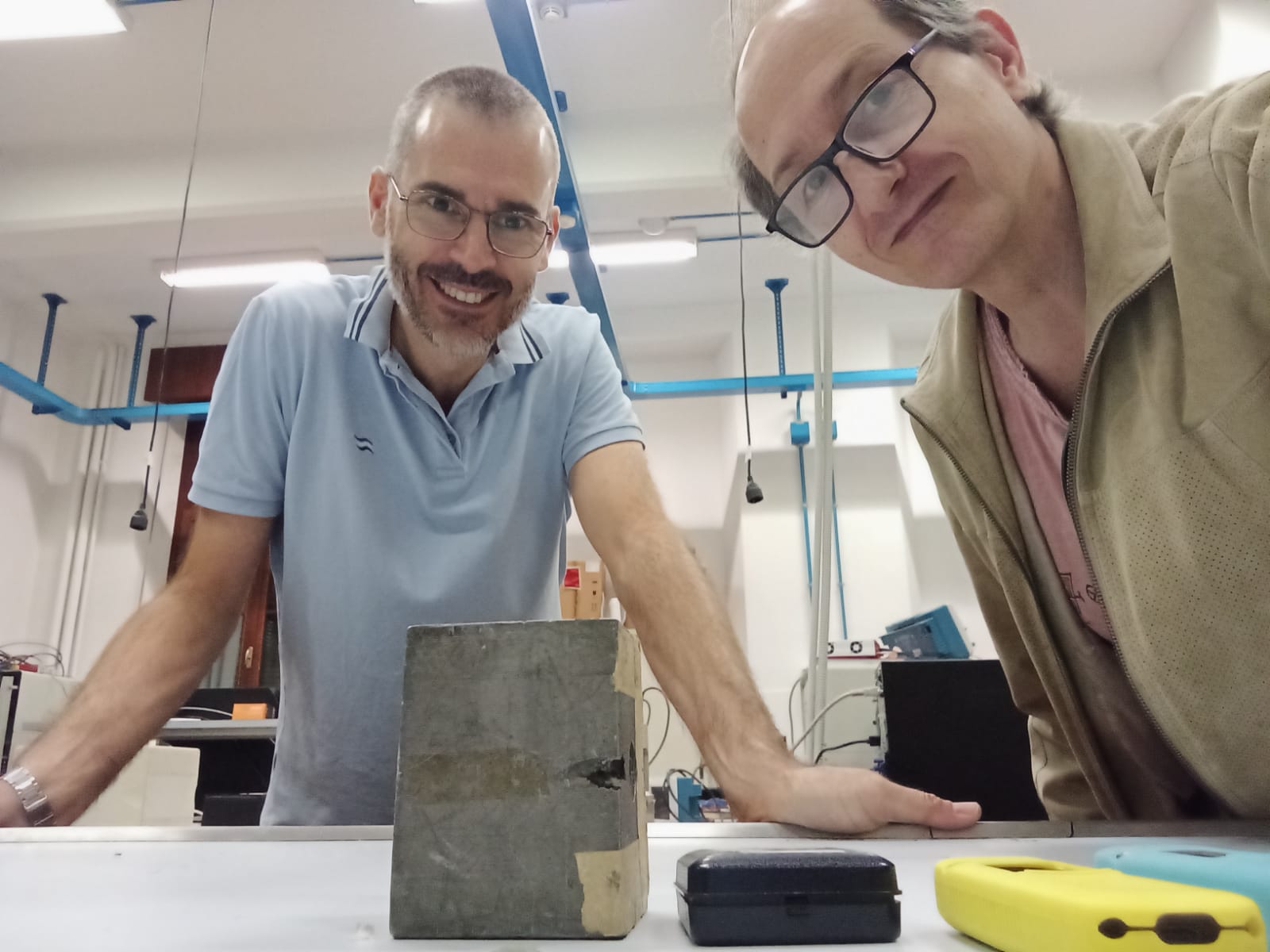
[Above, Luca and I in front of a few sources and instruments. We had a some lead bricks to screen the most harmful directions of emission, but we still took a small dose of radiation by setting up this pic!]
Below are a few spectra taken with the Radiacode 103 from the sources. Just a few seconds of exposure were sufficient to get these!
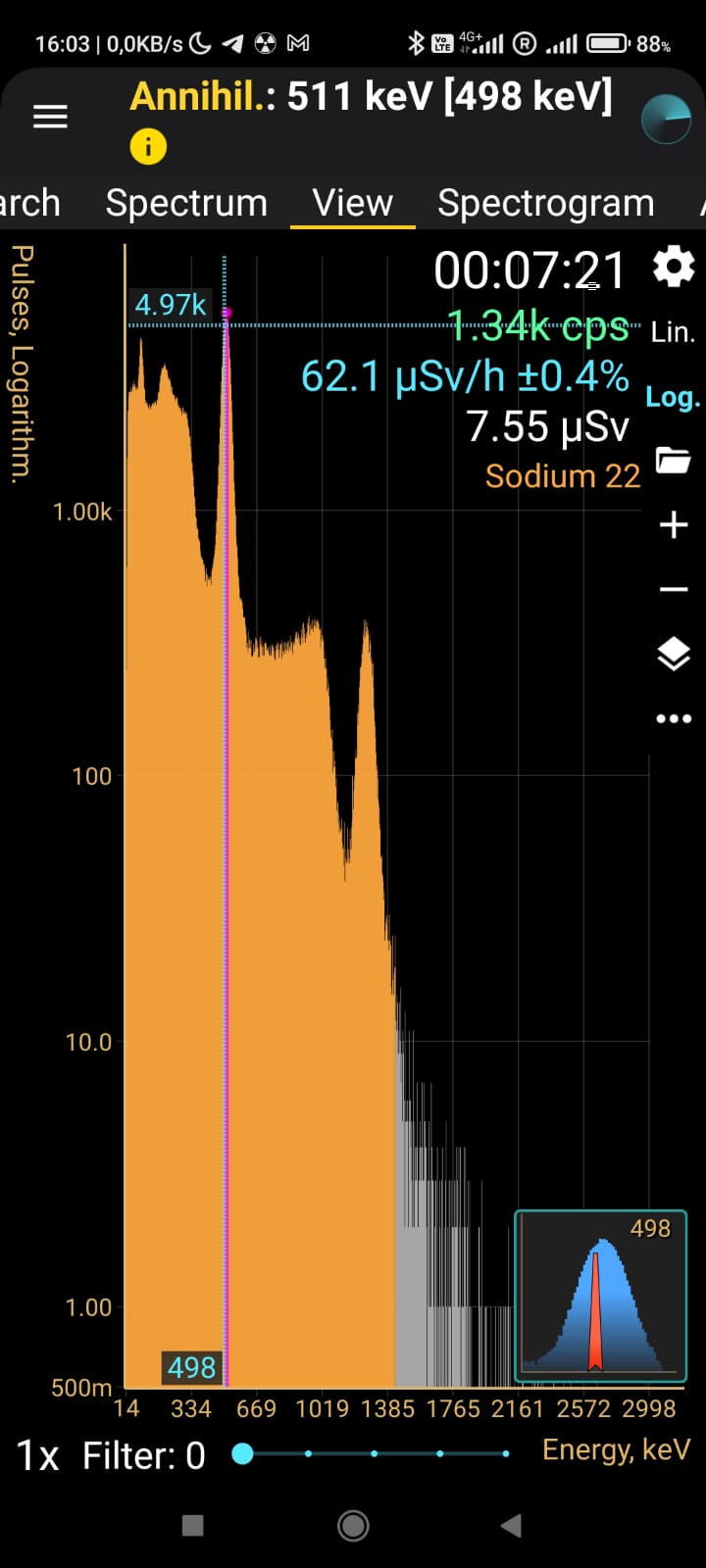
[Above: the Na-22 source has a strong annihilation peak visible at 511 keV.]
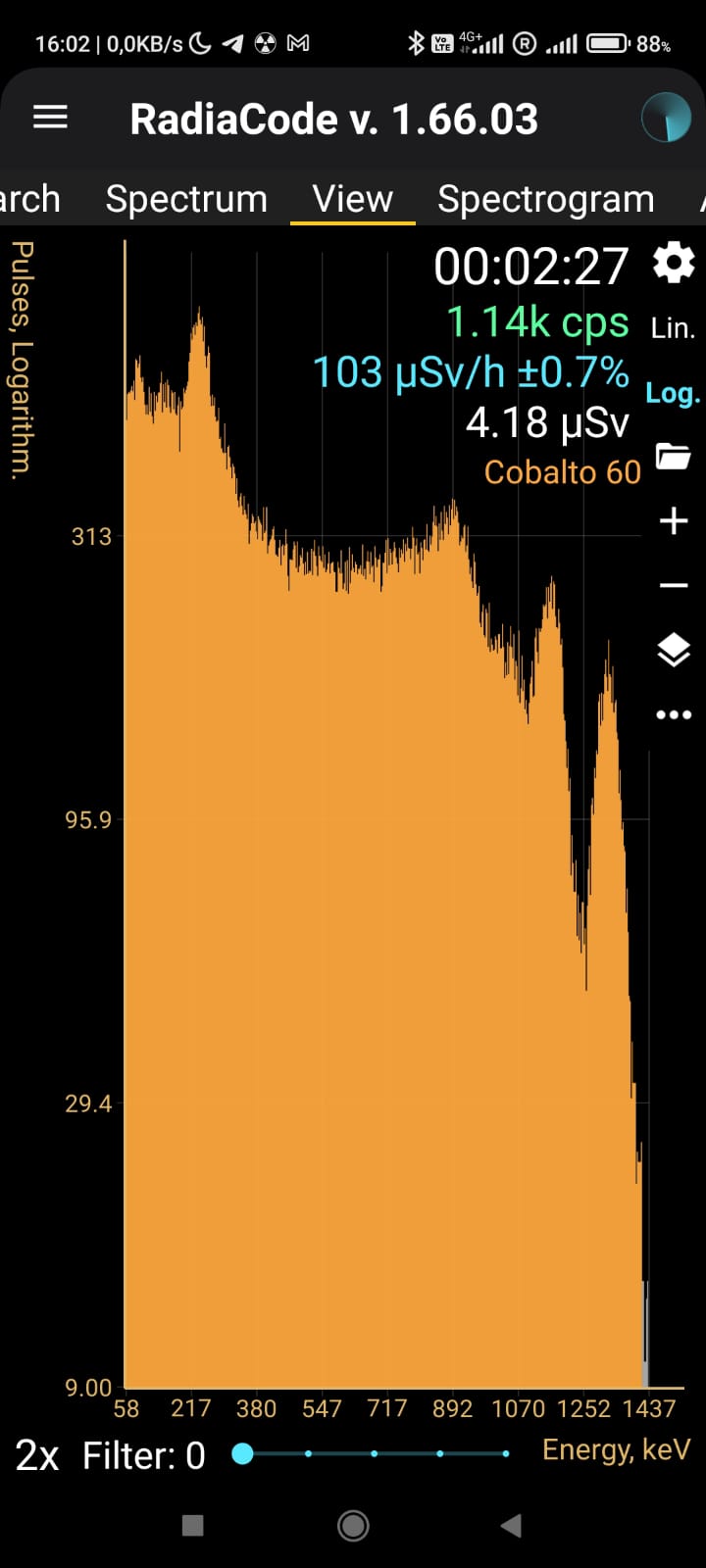
[Above: the Co-60 spectrum]
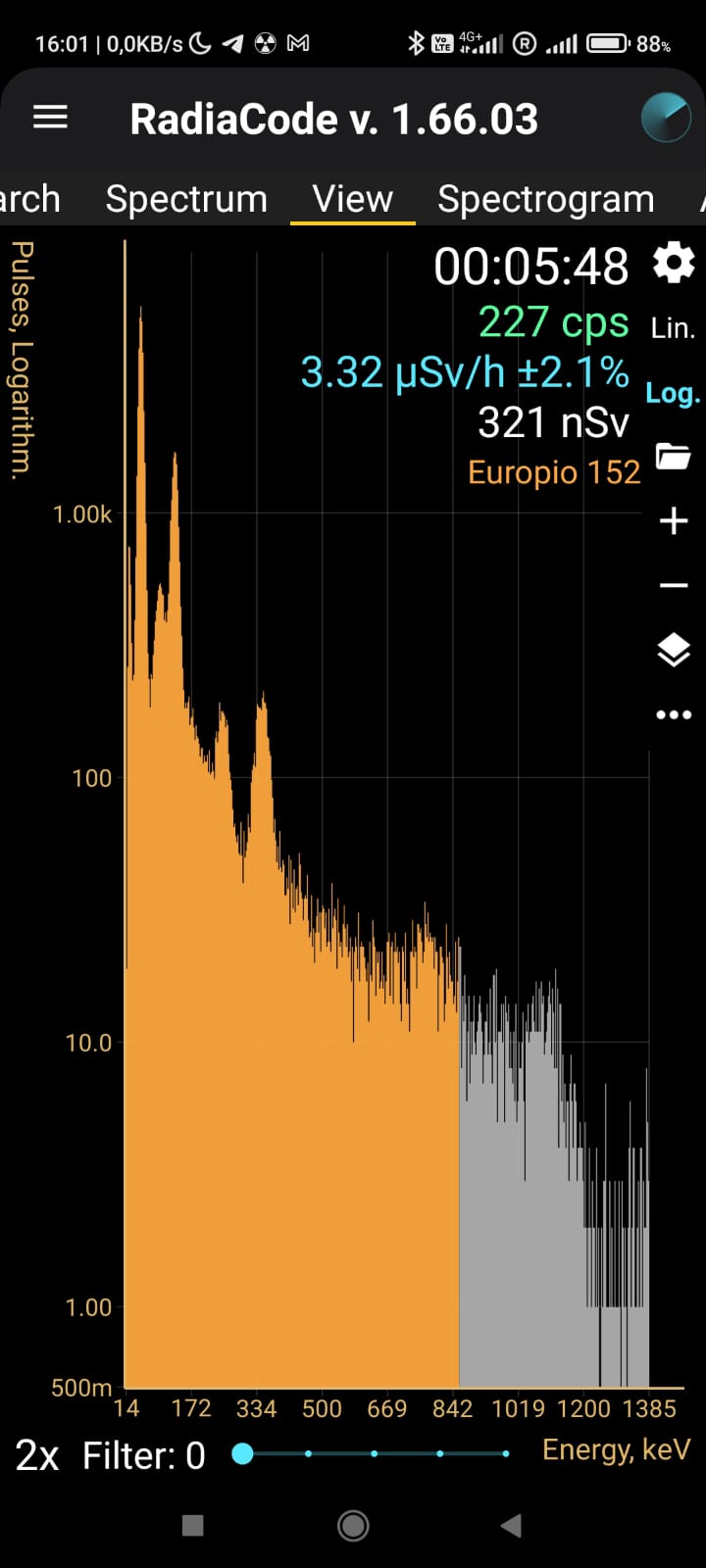
[Above, the Eu-152 spectrum.]
Meanwhile, I could also test an older Radex RD-1503 dose rate meter from Quarta, on the same sources. That instrument only reports up to 9.99 microSv/hr and thereafter saturates. While this is useful in many non-real-emergency situations, just consider: the Radiacode zero will continue to operate and report correct dose rate levels that are a million times higher!! How does that instrument pull this off? To understand this, we must talk a bit of Physics.
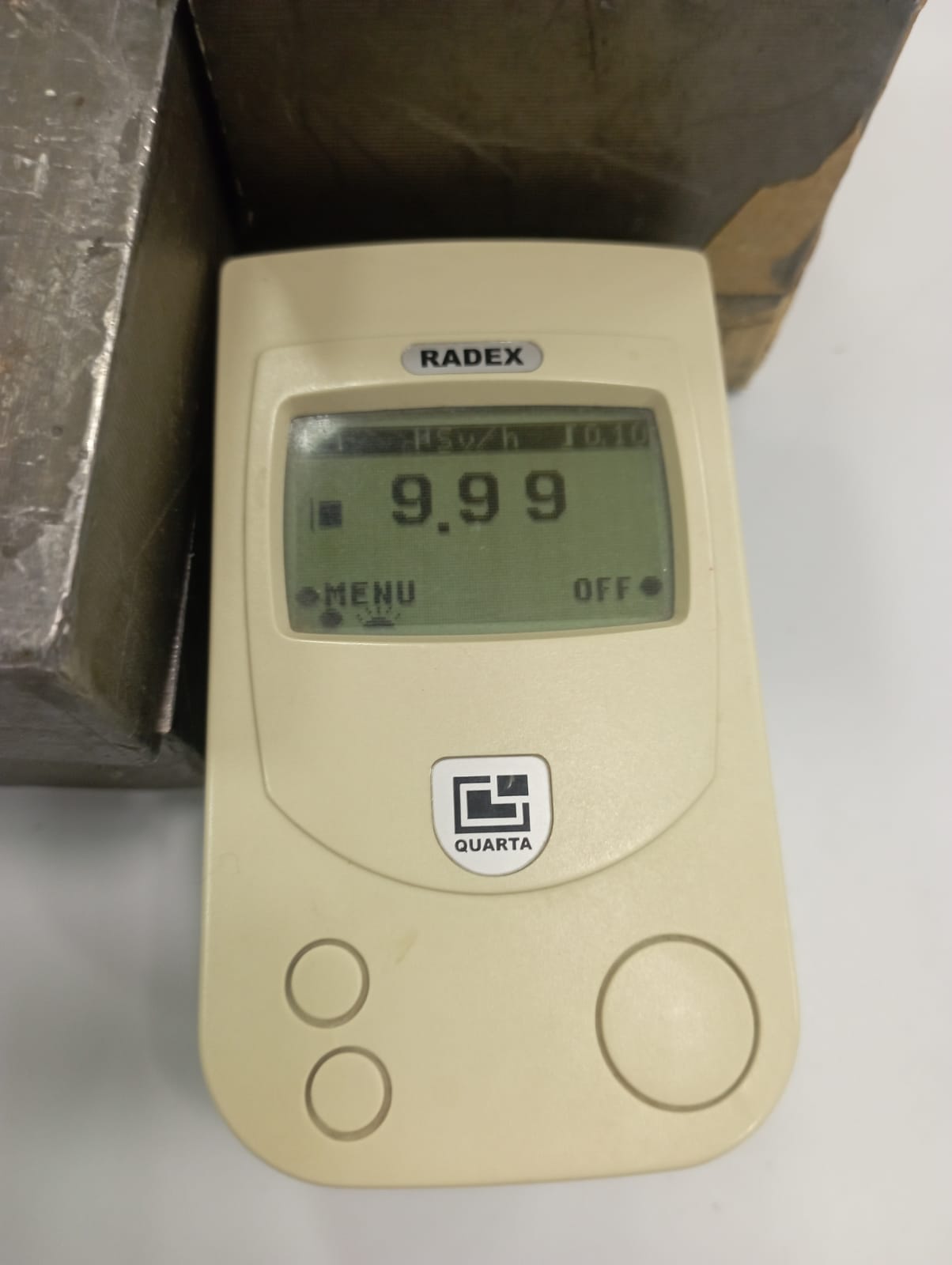
[Above, the Radex counter saturates its reading when placed over a relatively weak source. Both the Radiacode 103 and the Radiacode zero instead kept measuring precisely the dose rate in the same conditions.]
X-rays and gamma rays are photons of very high energy. These particles interact with matter mainly in two ways: with atomic electrons, through what is called Compton scattering, when the electron is usually released from the atom it was sitting in; and with the atomic nuclei, by producing electron-positron pairs out of the vacuum. The latter trick can only take place if the photon has a sufficient energy (only the highest-energy gamma rays can do that). In all cases, the net effect is that some charged particles will absorb momentum and get moving. In materials called scintillators, this kinetic energy partly produces visible or near-ultraviolet light when it is reabsorbed by the medium. So the polystyrene crystal in the Radiacode zero gets lit up, in a way that is proportional to the deposited energy.
Now, if we are talking about a single photon hitting an electron, the process may produce maybe a few tens or hundreds of visible photons. That is something that you can detect with a silicon photomultiplier, whereby you will convert the collected light back into the energy deposited in the scintillator crystal. Since this whole thing can be done in the matter of nanoseconds, with good enough electronics readout, you may conclude that a good instrument can count a single gamma ray every nanosecond or so - that means a billion gamma rays per second. But if the radiation incident in our scintillator is much higher than that, something happens: the crystal is perennially lit up, and counting individual gamma rays becomes impossible. That is what limits most pocket detectors.
The Radiacode Zero is smarter. When radiation levels become too high, the readout switches to a different mode of operation, when the energy released in the crystal is measured by assessing the total light flux out of the sensor. This switch requires an intercalibration and a considerably more complex electronics, making the R0 an exceptional instrument.
I am planning to put the R0 and the R103 in a x-ray chamber soon. If I am successful, I should be able to see the R103 saturate while the R0 still operates. Or, if I make wrong calculations, I will end up burning both sensors and their electronics. In fact, the x-ray chamber I am going to use is designed exactly to reproduce the radiation-damage conditions of extremely high fields. We'll see what happens!