Genomicron

T Ryan Gregory

T Ryan Gregory

I am an evolutionary biologist specializing in genome size evolution at the University of Guelph in Guelph, Ontario, Canada. Be sure to visit Evolver Zone. Subscribe to this column: Genomicron
RSS Feed
Do you understand evolutionary trees? (Part Two)

Do you understand evolutionary trees? (Part Two)

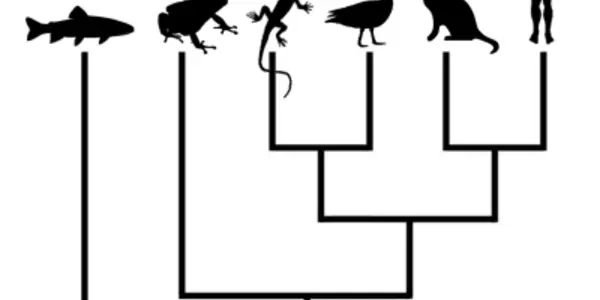
In the first installment of this series, we encountered the common misconception that the order of the terminal nodes ("tips") on an evolutionary tree reflects the actual relatedness among the species represented. Simply rotating some internal nodes without affecting the branching order ("topology") of the tree -- and thus, making no change to the relationships among species -- showed that that the order of tips on a tree is actually arbitrary. What matters is the way that the species are connected through their common ancestors.

Should evolution be taught in high school?

Should evolution be taught in high school?

Microbiologist Carl Woese is well known as an iconoclast. Indeed, few biologists have so thoroughly shaken the tree of life as he did when he proposed that there are not two major branches -- prokaryotes, whose cells lack nuclei, and eukaryotes who possess nuclei, including all animals, plants, fungi, and protists -- but rather three. "Prokaryotes", Woese argued, do not represent a cohesive category, and should be split into two deeply divergent lineages: the Bacteria, with which everyone is reasonably familiar, and the Archaea, superficially similar organisms that are less commonly encountered as many of them reside in extreme environments. What's more, studies of genetic data suggested that the Archaea are actually more closely related to eukaryotes -- including humans -- than they are to bacteria.

Woese's three-domain tree of life. From Wikimedia Commons.
At 79 years of age, Woese is still shaking things up. Most recently, he stated in an interview with Wired that,My feeling is that evolution shouldn't be taught at the lower grades. You don't teach quantum mechanics in the grade schools. One has to be quite educated to work with these concepts; what they pass on as evolution in high schools is nothing but repetitious tripe that teachers don't understand.

MASHing junk DNA

MASHing junk DNA

The Korean War lasted from June 1950 to July 1953. It served as the basis of the 1968 book MASH: A Novel About Three Army Doctors by Richard Hooker (pen name of former army surgeon H. Richard Hornberger), describing the experiences of surgeons at a Mobile Army Surgical Hospital during the war. This was adapted into a film (MASH) starring Donald Sutherland in 1970, which in turn inspired the TV series M*A*S*H starring Alan Alda.

Do you understand evolutionary trees?  (Part One)

Do you understand evolutionary trees? (Part One)

A single figure graces the pages of Charles Darwin's groundbreaking work On the Origin of Species, first published in 1859. The figure in question depicts a tree-like sequence of branchings through time as hypothetical lineages diverge and new species arise. To be sure, the metaphor of a tree was important in Darwin's thinking about the history of life. He wrote in the Origin,

And Water Bear It Is!

And Water Bear It Is!

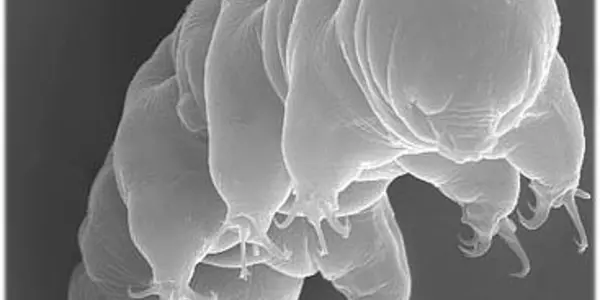
As large, visually-oriented mammals, we have long had a tendency to consider biological diversity primarily in terms of what we can see. There is, however, an entire world of creatures rarely encountered but no less unique and intriguing for it. Sometimes, one only needs the right tools, or the proper motivation, to recognize a group of organisms well worth our attention.It is in this spirit that I am pleased to introduce you to Hypsibius dujardini, one of about 700 known species in the Phylum Tardigrada, commonly known as a "water bears" due to their ursine appearance.

Junk DNA: function and non-function

Junk DNA: function and non-function

It is commonly suggested by anti-evolutionists that recent discoveries of function in non-coding DNA support intelligent design and refute "Darwinism". This misrepresents both the history and the science of this issue. I would like to provide some clarification of both aspects.

Bacterial genomes and evolution

Bacterial genomes and evolution

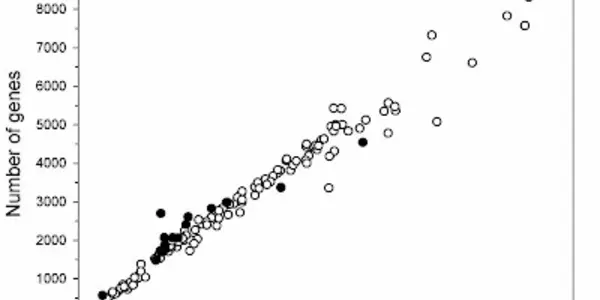
The seminar that I give most often when I am invited to speak at other universities begins with a brief introduction to genomes, sets up some comparisons between bacteria and eukaryotes, and then moves into a short overview of bacterial genome size evolution before spending the remainder of the time on genome size diversity and its importance among animals. The main things that I have to say about bacterial genomes are: 1) Unlike in eukaryotes, bacterial genome size shows a strong positive relationship with gene number (in other words, bacterial genomes contain little non-coding DNA). 

Is most of the human genome functional?

Is most of the human genome functional?

I first became interested in genome size because of its tie-ins with important evolutionary questions in which I was (and still am) interested, such as punctuated vs. gradual patterns, levels of selection, and adaptive vs. non-adaptive processes.

What I didn't realize was that one component of the question, the quantity of DNA that is non-functional (but not necessarily inconsequential) with regard to the phenotype of the organism, is such a hot-button issue. I had vague inklings at first that young-earth creationists would object to the idea of non-functional DNA -- because God, as they say, don't make no junk. (Why intelligent design proponents, who purport to take a strictly scientific view of the question, also assume that non-coding DNA cannot be non-functional remains unstated).

And of course there has always been a persistent undertone in biology that non-coding DNA must be doing something or it would have been deleted. This latter view, which derives directly from a hardcore adaptationist approach, destroys the argument by creationists that "Darwinism" has prevented researchers from considering functions for non-coding DNA.

Genome size, code bloat, and proof-by-analogy

Genome size, code bloat, and proof-by-analogy

I recently did an interview with New Scientist for what, I am happy to say, was one of the most reasonable popular reviews of "junk DNA" that has appeared in recent times (Pearson 2007). My small section appeared in a box entitled "Survival of the fattest", in which most of the discussion related to diversity in genome size and its causes and consequences.

It even included mention of "the onion test", which I proposed as a tonic for anyone who thinks they have discovered "the" functional explanation for the existence of vast amounts of non-coding DNA within eukaryotic genomes.

Popularize Or Perish

Popularize Or Perish

In November 2007, Donald Kennedy, then-editor of the prestigious journal Science, announced that for the next five issues, each of the research articles would include a brief "author's summary" written in plain language.

Evolution as fact, theory, and path

Evolution as fact, theory, and path

The new journal Evolution: Education and Outreach is now available online and free to download. My contribution to the first issue is "Evolution as fact, theory, and path". Feel free to distribute this and any other papers from the journal as widely as you like, but please link to the journal website rather than re-posting papers.There are now several available articles that discuss this important subject:

Are you a cat genome person or a dog genome person?

Are you a cat genome person or a dog genome person?

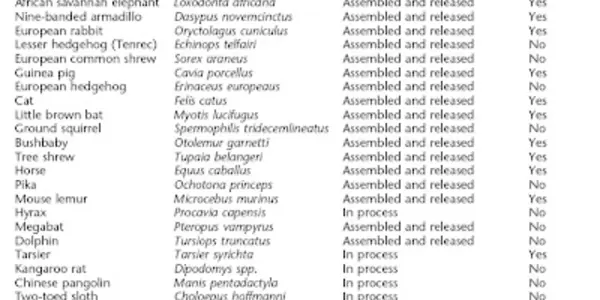
A recent issue of Genome Research contains a report of the cat genome sequence (Pontius et al. 2007), adding Felis catus to the rapidly growing collection of animal genome sequences. One of the reasons that the number of mammal sequences is increasing so quickly is that there have been reduced standards for sequence coverage.

To wit, the cat is one of 24 mammal species approved by NHGRI for "low redundancy" sequencing, meaning that the sequence will be covered only 2-fold (vs. up to 7x coverage in dog, chimp, human, mouse, and rat).