Gerhard Adam

Gerhard Adam

Gerhard Adam

I'm not big on writing things about myself so a friend on this site (Brian Taylor) opted to put a few sentences together: Hopefully I'll be able to live up to his claims. "I thought perhaps you wouldn't mind if I wrote it for you... Prolific contr…
RSS Feed
Computers And A Philosophy Of Biology

Computers And A Philosophy Of Biology

Biology consists of much detailed information regarding genetics, molecular biology, biochemistry, and a variety of other components.  This has provided a great deal of insight into how life functions, evolves, and reproduces.  However, there are other realms of biology that attempt to find order where perhaps none exists.  In discussions of topics like "selfish genes", or "kin selection", or Hamilton's rule, we are getting into areas where causation is being sought where none may specifically exist or at least, not of a general type.

The Problem Of Machine Intelligence

The Problem Of Machine Intelligence

There have been many discussions relating to transhumanism and augmenting intelligence as well as just intelligence itself.  However, at the heart of many of these discussions the subject of Artificial Intalligence (AI) emerges.  This raises the question of whether AI is possible and what it actually means.There is no question that machines can be built to perform many intelligent-like acts and simulate human intelligence, but I would argue that there is a fundamental difference that isn't often mentioned.

Natural Selection: Individual Vs Group

Natural Selection: Individual Vs Group

In this article I am going to suggest that this arbitrary separation is meaningless.  Much like physics had to come to terms with wave-particle duality, biology must consider the same perspective where the answer depends very much on the question and how it is asked.

Halloween Fears And Phobias

Halloween Fears And Phobias

A recent article addressed the issue of children being frightened of costumed characters and some of the other fears they might experience.  In some cases, this fear escalated into a phobia. However, comments like "fears likely helped our ancestors survive" generate more alarm than comfort to me. Besides being pretty obvious, it raises the question of why fear should be considered such a bad thing, especially for children.I can certainly understand that an unreasonable fear that has escalated all of out proportion and become debilitating can be problematic. I suspect that the vast majority of fears and phobias don't actually fall into that category.

Ghosts And Hauntings

Ghosts And Hauntings

In looking at the concept of a ghost, the first problem one encounters is defining exactly what is meant by such an apparition.  It seems that the general view over history is that ghosts represent some aspect of a once living individual that may have occasion to make itself known.  This is generally considered to be a soul, or some animating spirit, so for our purposes that loose definition will do.I won't consider the problems of why such an entity would be geographically confined, or even what such a thing means.  Instead let's consider what it takes for a ghost to engage in a haunting.

Economics: The Purpose Of Business

Economics: The Purpose Of Business

If the question were asked, what is the primary purpose of business, the most likely response would be "to make money".  However, this is an unsatisfactory answer since it clearly doesn't provide sufficient justification for businesses to exist.  There is no question that we all need and use money in our daily lives, but similarly this would be an unsatisfactory answer to justify why we work.If we considered economics from the barter perspective, the answer of "making money" would seem peculiar because we could only loosely translate it as "wanting stuff".  Clearly if we were bartering for goods and services there would be more specific items that we want and need, but also what is our personal motivation in such a scenario?

Another Second Hand Smoke Study

Another Second Hand Smoke Study

While I can appreciate the usefulness of smoking bans, especially as it relates to non-smokers (or even smokers for that matter).  I'm not convinced that the science is establishing a sound cause and effect linkage.There is little doubt that smoking is not a healthy activity, but similarly we should be aware of all forms of air pollution.  A recent study suggested that even a relatively brief exposure to second hand smoke could precipitate a heart attack1.  Unfortunately, I haven't seen how such a study or determination was made, so it is impossible to assess their methodology.  Consider the following quote:

Public Risk: The Trust Factor

Public Risk: The Trust Factor

It seems simple enough to answer the question whether something poses a risk or not.  The answers can only be "yes", "no", or "we don't know".  A "yes" response would then be qualified by the probability or likelihood of risk entailed, as well as the context in which it exists.  A "no" should be definitive and not have any exceptions, while a "we don't know" is ambiguous enough to suggest that there is no definite answer, as yet.A recent article on the risks of cell phones illustrates one of the reasons why the public tends to be distrustful of many of these findings.  It is clear that games are being played and agendas being driven.

Computing Speed: Parallel Processing

Computing Speed: Parallel Processing

There is a common misconception when assessing computers in suggesting that parallel processing increases speed.  This simply isn't true.   Parallel processing is intended to increase throughput by addressing queuing delays that may be experienced by "ready" units of work that are waiting for access to the processor.  Each processor is essentially a hardware server for instructions to be processed.  In modern computers there are actually multiple points of parallelism and overlap processing, but the primary point is to avoid delays.

The Speed Of Computing

The Speed Of Computing

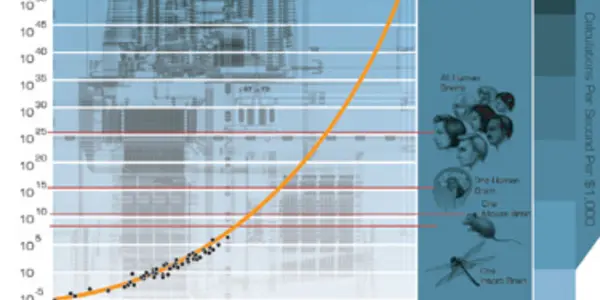
A recent LiveScience article 'Computers Faster Only for 75 More Years' has indicated that new research conducted by two physicists have placed a speed limit on what's attainable regardless of the size of the components.  Moore's Law1 has often been touted as representing an infinite curve of progress, but this explanation clearly indicates that nothing proceeds indefinitely.  In addition, depending on technological developments in computer design and architecture, that limit may actually occur within 20 years according to Scott Aaronson, an assistant professor of electrical engineering and computer science at MIT.

Considering Free Will: Moral Responsibility

Considering Free Will: Moral Responsibility

In the last article we considered the formation of choices as providing a set of predetermined responses to various situations.  It is this phase of data gathering and assessment that sets the groundwork for our moral responsibility.Specifically it is erroneous to consider that choices are evaluated and determined solely at the point of action, but rather, default states may well be set within the brain based on our training and indoctrination.  It is these default states that represent the possibility of choices that we can base a decision on.