About a third of the world's corn production uses a legacy hybrid rather than modern science and a new study finds that grain yield in intermediate-maturity hybrids could be plagued by a crippling genetic weakness.
That segment of corn breeding relies on "hybrid vigor" - heterosis. When parents from different heterotic, groups are crossed, the hybrid offspring is superior to either parent’s performance in the field. It's been fine so far, for decades new corn hybrids have succeeded using stiff-stalk (SS) and non-stiff-stalk (NSS) heterotic groups. They are genetically distinct from one another yet the inbred lines within each group are genetically similar.
That may be the problem. As market segments like "organic" and ethanol have taken off, the strongest performing lines being used as parents had led to gradual reduction in overall genetic variability. It hasn't happened yet but with lower in-group variation, crosses between the groups would no longer guarantee strong hybrids.
To get answers, the teams examined the genetic variation underlying multiple plant traits in 13 stiff-stalk and 28 non-stiff-stalk inbreds representing early-, intermediate-, and late-maturing types. They grew 162 single-cross hybrids in over 30 U.S. and Canadian locations, gathering phenotypic data across maturity groups. Then they looked for variations related to grain yield, plant height, and days to silking and anthesis and learned that genetic variability related to yield was lacking in intermediate-maturity stiff-stalk lines, the most commonly grown maturity group in the U.S. Corn Belt.
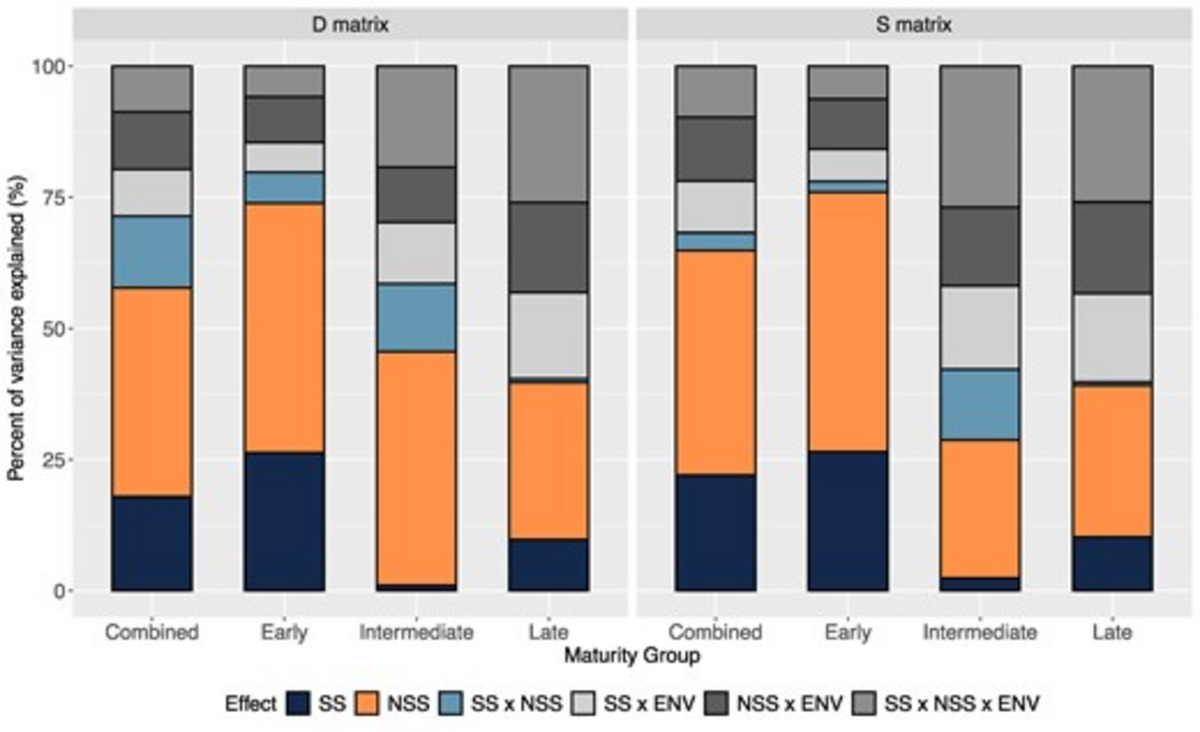
Percentage of variance explained for grain yield (GY, tha−1). Variance components were estimated from the GBLUP-based multikernel model described in Equation (9), using either the D or the S matrices. SS: general combining ability (GCA) of Stiff Stalk (SS) inbred lines used as seed parents, reflecting additive effects; NSS: GCA of Non-Stiff Stalk (NSS) inbred lines used as pollen parents, reflecting additive effects; SS × NSS: specific combining ability (SCA) of single-cross hybrids between SS and NSS inbred lines, reflecting nonadditive effects; SS × ENV: interaction between SS inbred lines and environments; NSS × ENV: interaction between NSS inbred lines and environments; SS × NSS × ENV: three-way interaction among SS, NSS, and environments, representing the interaction between SCA and environments; D: dominance genomic relationship matrix for single-cross hybrids derived from all possible crosses between parental inbred lines; S: covariance matrix derived from additive genetic relationships between parental inbred lines. Results are shown for all hybrids (combined) as well as separately by maturity group (early, intermediate, and late).
If their work holds up, this legacy hybrid heterotic group could show diminishing returns in development of new hybrids that meet yield goals. It's not an issue yet, there is plenty of genetic variation in breeding germplasm and a lot of genetic variability remaining across traits in early- and late-maturing inbreds in both stiff-stalk and non-stiff-stalk groups. There was also sufficient variability for yield in intermediate-maturity inbreds in the non-stiff-stalk group.
Citation: Jenifer Camila Godoy dos Santos, Jode Edwards, Elizabeth Lee, Mark A Mikel, Samuel B Fernandes, Candice N Hirsch, Sydney P Berry, Alexander E Lipka, Martin O Bohn, Dissecting genetic variance structure and evaluating genomic prediction models for single-cross hybrids derived from Stiff Stalk and Non-Stiff Stalk maize heterotic groups, G3 Genes|Genomes|Genetics, 2026;, jkag163, DOI:10.1093/g3journal/jkag163