Gather 'round, listeners, and learn of the storytelling ape.
A new paper suggests that storytelling may have have been why human communication evolved from the ape-like systems our primate cousins still use to complex human language.
The debate about the greatest invention of humans being fire or the wheel or agriculture can go in circles, but most won't say language. Sir Charles Darwin did, in his 1871 book The Descent of Man, but some say they were always entwined. Rather than stories emerging from an existing human proto-language, the desire for stories may have taken language to a level no one else in the universe has attained. And that happened thanks to the light of a fire in the evening, when people weren't working but spent time together.
The reasoning is that language didn't need to evolve the way it has. Many problems in day-to-day life can be addressed without language. Baser animals gather and forage without it. In terms of basic needs, human language doesn't provide much that is necessary, or even useful. That may be why other animals have not invented algebra or written 30 sequels to Godzilla.
The authors argue that social time in the evenings, aided by a communal campfire, may have been the catalyst. They say firelight led to more interaction and socializing because it is not blue light, like tablet screens, and didn't impact sleep or work the next day. It is instead infrared and longer infrared wavelengths pass through the skin and promote circulation. It is also well-matched to the peak sensitivities of our long-wavelength cones. Blue light kills bacteria pretty well but some people report sleep disruptions if they read that way in bed.
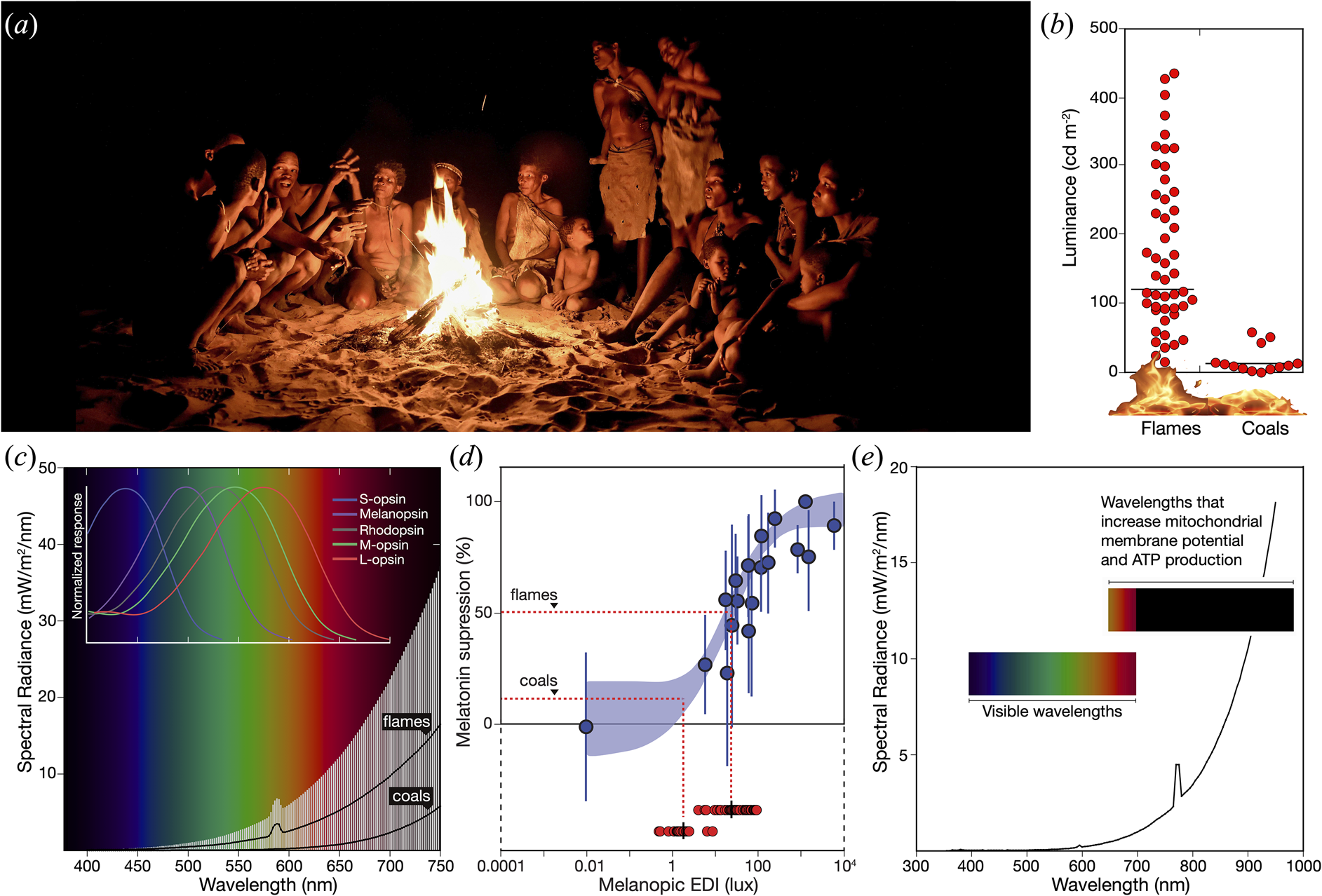
The fireside niche is a dynamic light environment and social space. (a) Storytelling by firelight among the Ju/'Hoansi-San of //Xa/oba, Namibia. Photographer: Fabian Von Poser, reproduced with permission. (b) Variation in the luminance of flames and coals. Horizontal lines represent median values. (c) Variation in the emission spectra of flames and coals. Dark lines represent median spectra; vertical white lines represent ±1 s.d.. The inset illustrates normalized absorbances of selected photopigments. (d) Blue circles: published data on light exposure and melatonin suppression (whiskers represent ±1 s.d.); red circles: melanopic equivalent daylight illuminance (EDI) lux values of coals (mean = 1.8 melanopic EDI) and flames (mean = 30.4 melanopic EDI); dashed lines connect the mean values with approximate levels of melatonin suppression. (e) Firelight emission spectrum. Mitochondria absorb near-infrared wavelengths, improving performance. Time in the firelight niche could have extraordinary photometabolic benefits, reducing need for calories and sleep, while offsetting cognitive processing costs.
Their core premise is that there are shared differences across cultures related to the structure of storytelling with practical speech. Narrative is part of that structure because unlike practical communications, gestures don't work in low light. Even the beats of stories correlate to the rhythm of the flicker of the fire.
Citation: Catherine Hobaiter, Nathaniel J. Dominy; Firelight and the origins of spoken language. Proc. R. Soc. B 1 September 2026; 293 (2078): 20260602. 10.1098/rspb.2026.0602