A recent experiment asked people to look at images of 60 everyday objects and measured their pupil diameter while participants were told to evaluate images in two different ways; rating their glossiness or attractiveness.
They found that images which were designated as glossier were accompanied by greater pupil constriction one second after stimulus but images deemed more attractive had more delayed pupil dilation.
Beauty really is in the eye of the beholder - at least when it comes to pupillary responses.
We all know that pupils get larger when it's dark and smaller when conditions are bright but some experiments have shown that attention, emotion, and even the goal of looking at objects has influence. When we look at objects, we generally perceive attractiveness, which is subjective, but also visual properties such as glossiness. To test that out, the team enrolled 24 people in an experiment. The 60 objects were rated on a seven-point scale in terms of how glossy and how attractive they were over three seconds, while their pupil diameter was recorded. Because lighting matters, the authors controlled the mean and variance of luminance for all the participants.
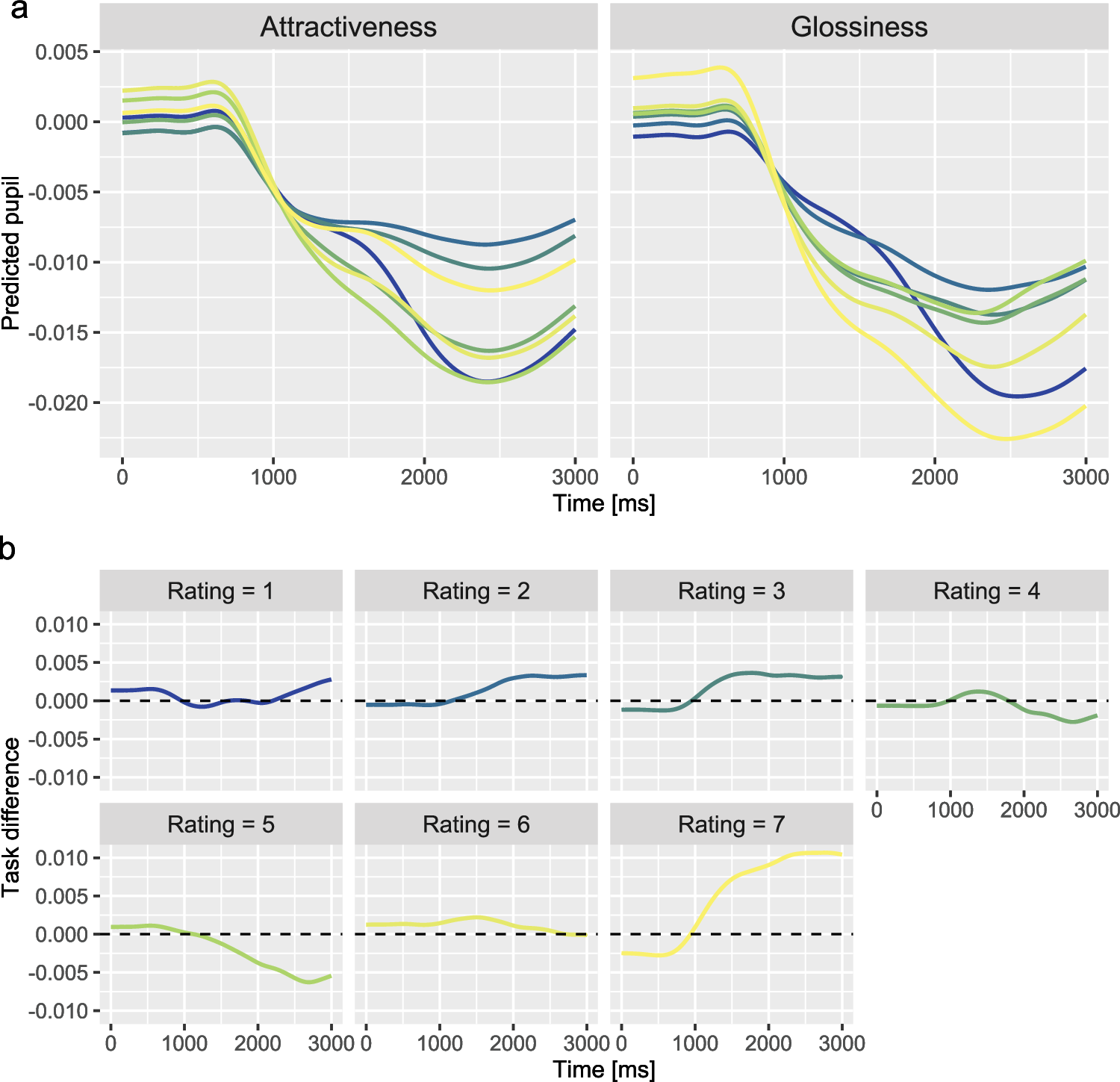
Time-resolved modulation of pupil responses as a function of the rating and task. (a) Line-slice representations of the predicted pupil responses (Factor 1) over time for each rating level (1–7); the results are shown separately for the attractiveness and glossiness tasks. Within each task, the temporal profile of the pupil response varies systematically with the rating, indicating the continuous modulation of pupil dynamics across the rating range. (b) Task differences (attractiveness–glossiness) in each rating level, shown as time-resolved line plots. Positive values indicate stronger responses in the attractiveness task, whereas negative values indicate stronger responses in the glossiness task. The direction and magnitude of the task differences vary across both time and rating level, showing a structured task × rating × time interaction rather than effects confined to a specific rating level.
The results were that pupils constricted when images were shown but the difference in recovery depended on how the viewers were evaluating the objects. When asked to evaluate glossiness, high-gloss images were linked to faster pupil dilation than we people were evaluating attractiveness.
Analysis of the results revealed that the relationship between ratings and responses was common across tasks and time.
So what we see matters in ocular response, but also why we are looking at things.
Citation: Hideki Tamura, Shigeki Nakauchi, Tetsuto Minami; Task-dependent pupillary responses to glossiness and attractiveness judgments. Journal of Vision 2026;26(9):1. DOI: 10.1167/jov.26.9.1.