You Feel Colder As You Age: The Science Reason Why
Older people report feeling colder, enough that it is clearly happening, but why has been a mystery. Until now.
Older people report feeling colder, enough that it is clearly happening, but why has been a mystery. Until now.


Web sites that foster online communication and interaction are not merely vapid echo chambers of self-promotion, according to a new study in American Behavioral Scientist.In fact, just the opposite is true. Interactions on Facebook, Twitter and other social networking sites positively impact real-life and the intersection between online communication and the offline world forms two halves of a support mechanism for local communities.
Some solar physicists have suggested that prolonged low solar activity could offset the effects of anthropogenic global warming. But a new Grand Minimum of solar activity would decrease the rise of global mean temperature caused by human greenhouse gas emissions by at most 0.3 degrees Celsius until the end of the century, according to a recent study in Geophysical Research Letters. The projected temperature drop is less than ten percent of the rise projected under “business as usual” scenarios of the Intergovernmental Panel on Climate Change (IPCC).
University of Birmingham scientists have discovered that the gene DAF-16 plays an important part in determining the rate of aging and average lifespan of the laboratory worm Caenorhabditis elegans (C. elegans) and its close evolutionary cousins. DAF-16 is found in many other animals, including humans, and it is possible that this knowledge could open up new avenues for altering ageing, immunity and resistance to stresses in humans. The research was published this week in PLoS One
The authors of a new paper in Current Biology say they have found the first concrete evidence that shows how gene duplications can lead to functional diversity in organisms. In the study, researchers examined how duplications of a gene called FLOWERING LOCUS T, or FT, could have evolved and interacted to prolong a sunflower's time to grow. A longer flower growth period means a bigger flower -- presumably an attribute of great value to the plant's first breeders.
Princeton Electrical Engineers have developed a new technique for revealing images of hidden objects. The method, a new type of stochastic resonance, relies on the ability to clarify an image using rays of light that would typically make the image unrecognizable, such as those scattered by clouds, human tissue or murky water. The discovery may one day help pilots navigate through fog and doctors peer into the human body without surgery. The findings were reported online in Nature Photonics.
ASU Biodesign Institute researchers are using the unique conditions of spaceflight to examine how cells remain healthy or succumb to disease, particularly in the face of stress or damage. Their experiment will be launched into low earth orbit on April 5 aboard the space shuttle Discovery on mission STS-131.The team hopes to provide fundamental new insight into the infectious disease process, and further undestanding of other progressive diseases, including immune disorders and cancer. The Results of the current study will also be used to help mitigate infectious disease risks to the crew, who are particularly vulnerable to infection, due to reduced immune function during spaceflight missions.

Although they only account for a fraction of the synapses in the visual cortex, neurons in the thalamus get their message across loud and clear by coordination -- simultaneously hitting the "send" button—according to a computer simulation developed by researchers at the Salk Institute for Biological Studies.Their findings may hold important clues to how the brain encodes and processes information, which can be applied to a wide variety of applications, from understanding psychiatric disorders to the development of novel pharmaceuticals and new ways of handling information by computers or communication networks. The results are published in Science.
If our eyes could see radio waves, the nearby galaxy Centaurus A (Cen A) would be one of the biggest and brightest objects in the sky, nearly 20 times the apparent size of a full moon. What we can't see when looking at the galaxy in visible light is that it lies nestled between a pair of giant radio-emitting gas plumes ejected by its supersized black hole. Each plume is nearly a million light-years long.NASA's Fermi Gamma-Ray Space Telescope maps gamma rays, radiation that typically packs 100 billion times the energy of radio waves. Nevertheless, and to the surprise of many astrophysicists, Cen A's plumes show up clearly in the satellite's first 10 months of data. The study appears today in Science Express.
A team of paleontologists said this week that some sauropod species went through drastic changes in skull shape during normal growth. Researchers came to the conclusion after examining the The skull of a juvenile sauropod dinosaur, rediscovered in the collections of the Carnegie Museum of Natural History. The fossil offers a rare chance to look at the early life history of Diplodocus, a 150 million-year-old sauropod from western North America.The researchers believe these changes in skull shape may have been tied to feeding behavior, with adults and juveniles eating different foods to avoid competition. Young Diplodocus, with their narrower snouts, may also have been choosier browsers, selecting high quality plant parts.
Tracking 18- to 21-year-old men enlisted in the Israeli army, researchers from Tel Aviv University say they have demonstrated an important connection between the number of cigarettes young males smoke and their IQ--young men who smoke are likely dumber than their non-smoking peers.The average IQ for a non-smoker was about 101, while the smokers' average was more than seven IQ points lower at about 94, the study determined. The IQs of young men who smoked more than a pack a day were lower still, at about 90. An IQ score in a healthy population of such young men, with no mental disorders, falls within the range of 84 to 116.
Small sales taxes on soft drinks are insufficient to reduce consumption of soda or curb obesity among children, according to a new a new study in Health Affairs. Such small taxes may reduce consumption in some subgroups, such as children at greater risk for obesity. But to reduce overall soda consumption, the taxes would have to be downright draconian, structured as excise taxes that would increase the shelf price of the product rather than sales taxes collected at the cash register. An 18 percent soda tax proposed and then dropped from New York's Executive Budget last year, for example, could help prevent excessive weight gain between third and fifth grades by 20 percent, the authors say.
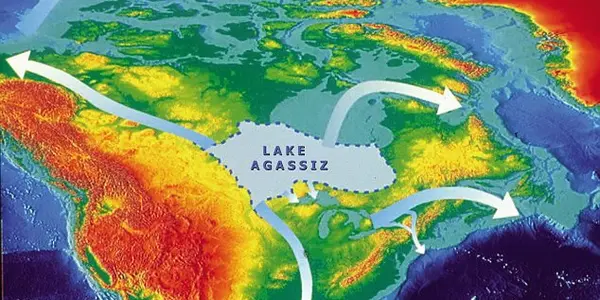
Geologists have long thought that the rapid global cooling period nearly 13,000 years ago known as the Younger Dryas (Big Freeze) was triggered by the melting Laurentide ice sheet. But geological evidence for that theory has been lacking so far. Now researchers writing in Nature say they have identified the mega-flood path across North America that channeled melt-water from the giant ice sheet into the oceans, triggering the Younger Dryas cold snap.