What if the forbidden could be controlled? The green shimmer of the geomagnetic storms we call the Aurora Borealis is due to a quantum jump that physicists call 'forbidden' but it is really only frowned upon by nature.
Quantum jumps are not forbidden, they are just unlikely - a billion times weaker than ordinary “allowed” transitions.
A new study controlled forbidden transitions in single isolated nitrogen molecules without destroying them and while the potential for more accurate clocks isn't exciting in an applied sense, in the science world it is.
Weakness is their strength
Forbidden transitions already underpin today’s most precise clocks, because they have an exceptionallywell-defined frequency. Molecules have more complex energy levels so they are more difficult to find and control. The new work did that, in single trapped molecules. And used a calcium ion as the messenger.
They studied molecular ions - nitrogen molecules that carry a positive electrical charge. Forbidden vibrations in a molecular ion have been observed but the chemical detection methods destroy the sample of molecules in every measurement cycle.
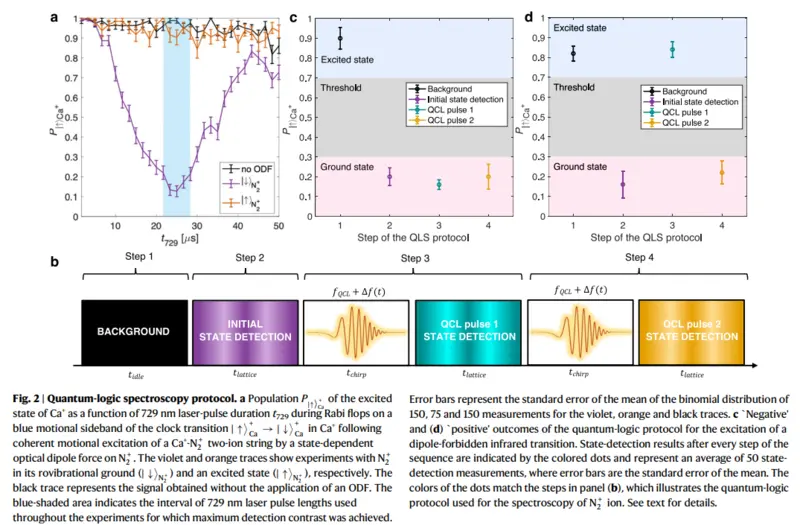
Enter quantum-logic spectroscopy, in which they trap a single charged nitrogen molecule together with a charged calcium atom. The second ion acts as a messenger. The nitrogen molecule doesn't emit detectable light but the calcium atom will glow using laser light.
Fine tuning sets things in motion
The tuned laser sets the pair in motion when the nitrogen molecule is in its lowest energy state of vibration and rotation and by observing the calcium ion’s response, they can study the nitrogen molecule’s state without changing it. So they varied the frequency of another laser to find the light frequencies that excite the molecule’s “forbidden” vibrations, and with that success, they used the right frequency pulse to excite the vibration and then a second pulse returns the molecule to its initial state.
No destruction involved. The process is reversible so the same molecule can be measured repeatedly, which lets faint spectral lines, the frequencies at which the molecule absorbs light, be marked.
Using that to analyze different components of the transition, the team was able to determine the fundamental vibrational frequency of the molecule ten times more precisely than previous measurements.
Citation: Aleksandr Shlykov, Meissa L. Diouf, Richard Karl, Mikolaj Roguski, Umesh C. Joshi & Stefan Willitsch, 'Quantum-logic spectroscopy of forbidden vibrational transitions in single nitrogen molecular ions', Nat Commun (2026). DOI:10.1038/s41467-026-78680-w