Our body temperatures don't change as we age but thermoregulation - ability to keep our core temperature steady — becomes more different.
New research has tackled the factors that impact thermoregulation. Feeling cold as we age is so multifactorial it almost feels like guessing: some argue the hypothalamus becomes less sensitive as we age and doesn't adjust quickly to external temperature changes. Others say the key driver is thinner skin. Lower muscle density is plausible, since muscles produce 25 percent of our body heat. It may be poor blood circulation leading to colder hands and feet.
A new paper posits the chief culprit is thermogenic fat which, unlike white fat, stores calories and turns them into energy to produce heat. The work used mice, and mice are not little people so it is only EXPLORATORY, but it reveals that immune and nerve cells change the balance between active and inactive fat cells.
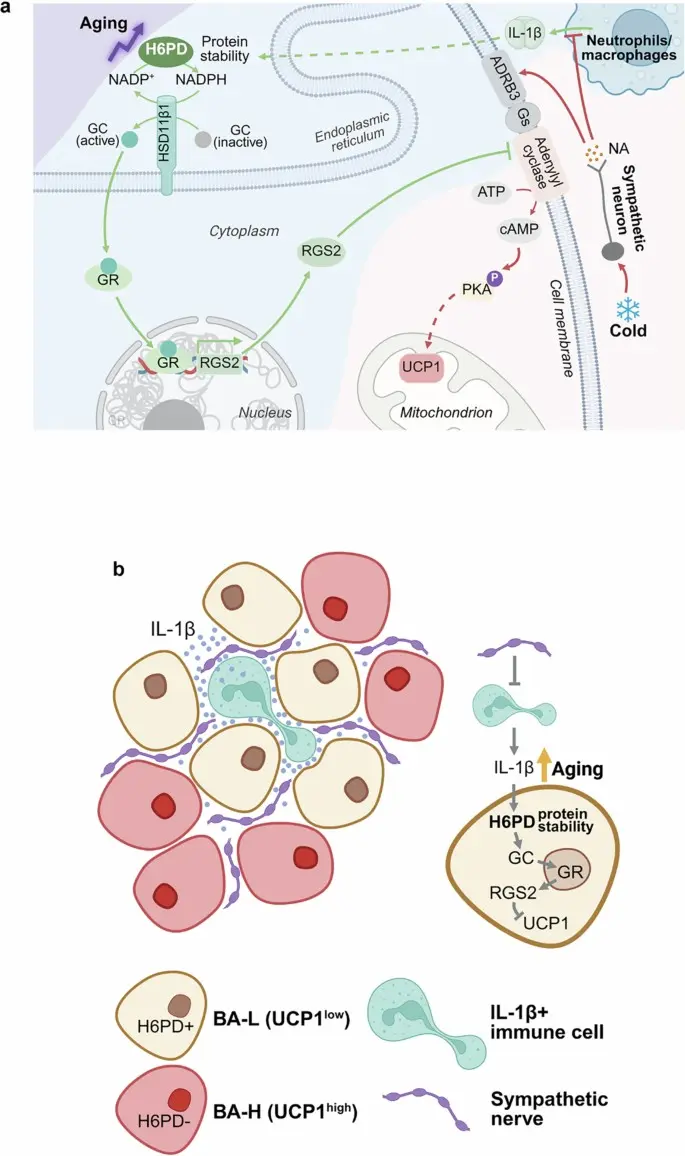
Key (1) at bottom.
With age, this regulatory system becomes less nimble and thermogenic fat is slower to fire up the internal furnace when temperatures drop. This variation is due to levels of the protein UCP1, which is a heat generation signaler.
If the system slows down, heat will still get produced but it takes longer.
In an experiment, they restored heat production in older mice with mifepristone but it is an abortion pill which progesterone, so if someone starts promoting it on TikTok to keep you warmer, believe it even less than you believe anything else on Chinese media. The science take-home is that they were able to reverse the decline in thermogenic fat activity. Since thermogenic fat burns glucose and white fat, it could also help stave off obesity and the conditions that arise from it, like type 2 diabetes.
Citation: Anying Song, Yifan Wang, Guan Wang, Marie Bae, Zhichao Wang, Guoming Gao, Zhuyin Wu, Geming Lu, Jieyi Meng, Jiayu Yu, Soojin Park, Adolfo Garcia-Ocaña, Patrick T. Fueger, Loredana Rao, Andrea Frontini, Yong Liu, Lei Jiang, Yi Zhu & Qiong A. Wang, Bistable regulation of adipocyte heterogeneity governs thermogenesis. Nature (2026). DOI: 10.1038/s41586-026-11308-7
(1) a, Molecular mechanism for the maintenance of the BA-L state. BA has two stable states, low and high thermogenesis, based on UCP1 expression. BA states are governed by their spatial proximity to IL-1β+ immune cells (mainly neutrophils and macrophages), which integrate signals from sympathetic neurons and immune cells to determine whether H6PD protein levels should be stabilized or degraded. Green arrows illustrate how BA-L cells are stabilized in a low-thermogenic state: IL-1β enhances the protein stability of H6PD in thermogenic adipocytes, thereby boosting the production of active glucocorticoids. Glucocorticoid activates the expression of its target RGS2, which inhibits adenylyl cyclase and reduces cAMP production, thereby reducing UCP1 expression. Red arrows illustrate how BA-L cells switch into BA-H cells upon cold exposure: cold stimulation activates sympathetic neurons, which decrease local BAT IL-1β levels; lower IL-1β levels lead to H6PD protein degradation, turning BA-L into BA-H. The purple arrow illustrates that in aged individuals, IL-1β is elevated in BAT. High IL-1β levels persistently prevent H6PD degradation, desensitizing BAs’ cold response by locking them in BA-L states. Illustration created with BioRender; Wang, Q. https://BioRender.com/basqx8x (2026). b, Bistable regulation of BA heterogeneity in a spatiotemporal manner governs thermogenic activity. We report that IL-1β-secreting immune cells, mainly neutrophils and macrophages, stabilize the surrounding BAs in a low-thermogenic state by preventing H6PD degradation; BAs farther from IL-1β+ cells are stabilized in a high-thermogenic state. Specifically, H6PD is a functional marker of BA-L cells and boosts the production of active GC. GC then activates the expression of its target, RGS2, which inhibits adenylyl cyclase, reducing cAMP production and, in turn, UCP1 expression. This bistable regulation dynamically and precisely controls cellular heterogeneity in response to signalling from sympathetic nerves and the immune system, managing thermogenesis at the tissue level. Increased IL-1β levels in the BAT of aged individuals lock BAs in a low-thermogenic state, thereby lowering thermogenic activity and leading to cold intolerance. Illustration created with BioRender; Wang, Q. https://BioRender.com/mj195m9 (2026).