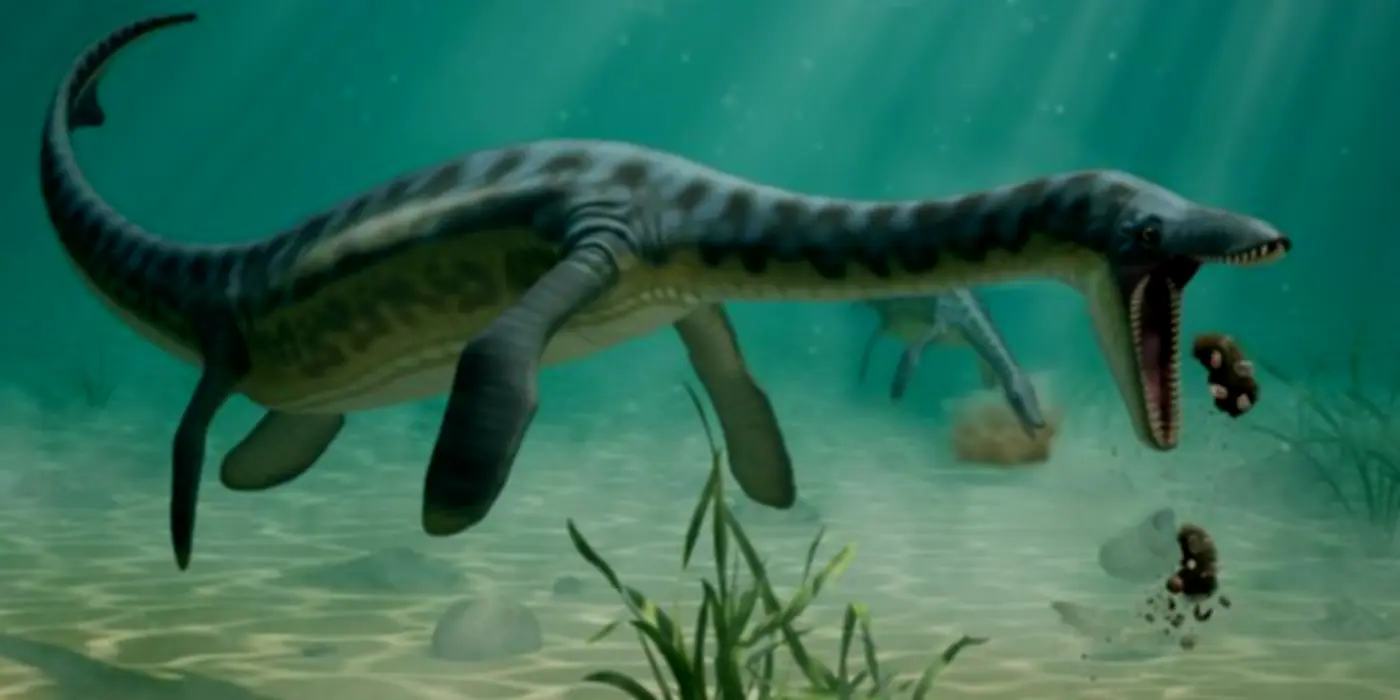
Jurassic Puke: Plesiosaurs Knew Not To Vomit Where They Eat
Jurassic monsters sometimes needed to vomit. When they did, they went to shore.
Jurassic monsters sometimes needed to vomit. When they did, they went to shore.


Technology-development studies at Cornell University and Jefferson Laboratory are showing how to use the brightest X-ray light ever generated for the scientific examination of everything from human proteins to forged art.
X-ray beams from an energy-recovery linac (linear accelerator) could be both a thousand times brighter and a thousand times faster--with pulses as brief as one ten-thousandth of a billionth of a second--than current state-of-the-art synchrotron X-ray sources.
"We're closer than ever to building a kind of universal toolkit for all the science and engineering disciplines," says Joel D. Brock, a Cornell University professor of applied and engineering physics.

The ruya, an inspirational night dream, is a fundamental part of the militant jihadist movement among Muslims, according to a study by Dr. Iain Edgar, a social anthropologist at Durham University.
The problem? He used the reported dreams of al-Qaeda and Taliban leaders who are, after all, in the business of inspiring terrorism. It may be that militant leaders do touchy-feely things like report their dreams accurately, but unlikely.
Speaking at the Cheltenham Science Festival on the cultural significance of sleeping and dreaming, Edgar said: "Islam is probably the largest night dream culture in the world today. The night dream is thought to offer a way to metaphysical and divinatory knowledge, to be a practical alternative and accessible source of inspiration and guidance, to offer clarity concerning action in this world."

A new study in Neuroscience Letters says that short-wavelength light, including natural light from a blue sky, is highly effective at stimulating the circadian system while exposure to other wavelengths — and thus colors — of light may necessitate longer exposure times or require higher exposure levels to be as effective at stimulating our biological clocks.
In some instances, exposure to multiple wavelengths (colors) of light simultaneously can result in less total stimulation to the circadian system than would result if either color were viewed separately, a phenomenon known as "spectral opponency." The LRC scientists have shown that the circadian system shares neurons in the retina — which exhibit spectral opponency and form the foundation for our perception of color — with the visual system. Thus, in principle, the circadian system may be able to distinguish between lights of different colors.
More than meets the eye To demonstrate that the circadian system exhibited spectral opponency formed in the retina, the researchers exposed 10 subjects to three experimental conditions: one unit of blue light to the left eye plus one unit of green light to the right eye; one unit of blue light to the right eye plus one unit of green light to the left eye; and half a unit of blue light plus half a unit of green light to both eyes and then measured each individual's melatonin levels, a natural indicator of the circadian clock.
Was Judgment Day at hand? At noon, it was black as night, there was lunch by candle light, the night birds came out to sing while flowers folded their petals and the animals behaved strangely. They called it 'New England's Dark Day' and it's been a mystery for almost 230 years.
The mystery has been solved, according to researchers at the University of Missouri, who say evidence from tree rings reveals massive wildfires as the likely cause, one of several theories proposed after the event but previously dismissed as 'simple and absurd.'
Limited ability for long-distance communication prevented colonists from knowing the cause of the darkness.

Researchers at the Fraunhofer Institute have taken a page from sports physiology and developed a low-cost optical sensor to measure the force with which tiny, migrating somatic cells push themselves away from an underlying surface. Force analysis devices like these could help to identify specific cell types more reliably than using a microscope or other conventional methods.
The sensor consists of a smooth surface that is studded with 250,000 tiny plastic columns measuring only five microns in diameter, rather like a fakir’s bed of nails. These columns are made of elastic polyurethane plastic. When a cell glides across them, it bends them very slightly sideways. This deflection is registered by a digital camera and analyzed by a special software program.
The researchers working with project manager Dr. Norbert Danz of the Fraunhofer Institute for Applied Optics and Precision Engineering IOF in Jena have already shown that their ‘Cellforce’ sensor works. It will be the task of initial biological tests to show how different cell types behave.
Biology remains a wide-open field because it has accomplished a lot but still has a long way to go. The dominant view in cellular behavior, for example, has been that it is largely chemistry-driven but there is increasing recognition that the mechanical aspects are vital to our understanding also.
Developing fundamental math and mechanics models to explain life processes like embryo development, cellular migration and growth could open doors to a new frontier in biology, say a group of researchers.
"A lot of what the cell does is mechanical. It needs to move things around. It migrates," says Krishna Garikipati, an associate professor in the U-M Department of Mechanical Engineering and the Michigan Center for Theoretical Physics.
Researchers from Iowa State University have identified a factor that promotes the development of antibiotic resistance in a bacterial pathogen. The study explains that Mfd, a protein involved in DNA transcription and repair, plays an important role in the development of fluoroquinolone resistance in Campylobacter, a bacterial pathogen commonly associated with food poisoning in humans.
Development of antibiotic resistance in Campylobacter, especially to fluoroquinolone (a broad-spectrum antimicrobial), compromises clinical therapy and poses a public health threat. Previous studies have revealed that Campylobacter is highly mutable to antibiotic treatment and the number of fluoroquinolone-resistant Campylobacter is greatly increased in many regions of the world. But it has not been clear why Campylobacter is able to mutate at such a high frequency.
TreePeople, a Los Angeles-based nonprofit corporation that does not seem to be one of the groups filing lawsuits every time anyone recommended responsible forest management that would have prevented the numerous wildfires that have ravaged southern California in recent years, today announced that it has received a $1 million grant from The Boeing Company to launch a comprehensive California Wildfire Restoration Initiative in response to the numerous wildfires that have ravaged southern California in recent years.
The grant fulfills a pledge Boeing made in the wake of last year’s wildfires to contribute $1 million toward rebuilding efforts in the region.

Mathematicians and astrophysicists recently discovered that work on the Fundamental Theorem of Algebra and gravitational lensing had a common answer.
The Fundamental Theorem of Algebra (FTA), proofs of which go back to the 18th century, is a bedrock mathematical truth, elegant in its simplicity: Every complex polynomial of degree n has n roots in the complex numbers.
In the 1990s, Terry Sheil-Small and Alan Wilmshurst explored the question of extending the FTA to harmonic polynomials. In a surprising twist in 2001, Khavinson, together with G. Swiatek, applied methods from complex dynamics to settle one of the cases of Wilmshurst's conjecture, showing that for a certain class of harmonic polynomials, the number of zeros is at most 3n - 2, where n is the degree of the polynomial.

Until recently, the debate about intelligence had little in the way of data, with proponents of genetic factors in IQ squared off against proponents of environmental factors without any gaining much ground.
But new research, led by Swiss postdoctoral fellows Susanne M. Jaeggi and Martin Buschkuehl, working at the University of Michigan in Ann Arbor, suggests that at least one aspect of a person's IQ can be improved by training a certain type of memory.
Most IQ tests attempt to measure two types of intelligence--crystallized and fluid intelligence. Crystallized intelligence draws on existing skills, knowledge and experiences to solve problems by accessing information from long-term memory.
The last time you had a cappuccino, did you think 'I bet I can learn something about type-I superconductors here?' Well, a team of Ames Laboratory physicists did and have found that the bubble-like arrangement of magnetic domains in superconducting lead exhibits patterns that are very similar to everyday froths like soap foam or frothed milk on a fancy coffee.
The similarities between the polygonal-shaped patterns in conventional foams and "suprafroths," the patterns created by a magnetic field in a superconductor, establish suprafroths as a model system for the study of froths.
Ruslan Prozorov, Ames Laboratory physicist and primary investigator, discovered the suprafroth pattern last year, seeing an unexpected foam-like design when he applied a magnetic field to a lead sample in a magneto-optics system. Since the term "superfroth" was already in use for an unrelated product, Prozorov coined "suprafroths" in a nod to history: in the 1930s, superconductors were called "supraconductors."
If you're anything like us, you're wondering how shockingly bad films like Battle for the Planet of the Apes get made. The simple reason is that sequels, even bad ones, tend to make more money than original films, according to a new study in the July Journal of Business Research.
And timing is everything – the sooner the period between releases, the better.