A new review posits that the DNA damage response (DDR) of our cells that fights off cancer can also become overactivated - and cause our tissues to age faster.
The paper collates 16 candidate tumor suppressor–negative regulator axes into three evidence tiers and also proposes experiments designed to determine whether this "chronic DDR signaling" causes faster biological aging.
DNA damage response is just what it reads like - it looks for genomic damage and then organizes a biological clean-up crew. In most cases, DDR is temporary and after it fixes DNA double-strand breaks, replication stress or oxidative lesions it deactivates. Yet it has been shown that with aging, it may instead be activated by loss of telomeres or mitochondrial dysfunction, no cancer involved.
It may be that it creates a chronic state where that escalates aging more.
In this model, persistent DDR signaling stabilizes p53 and increase p21 and p16INK4a which leads to cell-cycle arrest and senescent cells which produce the senescence-associated secretory phenotype (SASP) that spread senescence to neighboring cells and help create systemic inflammaging. The tumor-suppressor genes remain intact, which leads to the “guardian paradox.”
Cancer and aging are contrasts in this model. Cancer reduces regulation through mutation and deletion while aging is due to persistent activation of otherwise intact pathways. That doesn't mean that aging is caused by DDR overactivation, only that DDR signaling may be linked to aging mechanisms, such as mitochondria-first, proteostasis-first and epigenetic-drift or reprogramming-centered models.
The paper notes 16 candidate tumor suppressor–negative regulator axes across three evidence tiers. Among the best-supported candidates are p53/MDM2, p16INK4a/BMI-1, SIRT1/DBC1, telomerase/TRF1, PTEN/PI3K-AKT-mTOR and NRF2/KEAP1. Other candidate axes involve FOXO3, AMPK, Klotho, PGC-1α, TFEB and additional regulators plus an Aging Axis Profile (AAP) that would combine proteomic, transcriptomic, epigenomic, senescence and telomere measurements to characterize individual pathways as functional, declining or dysfunctional.
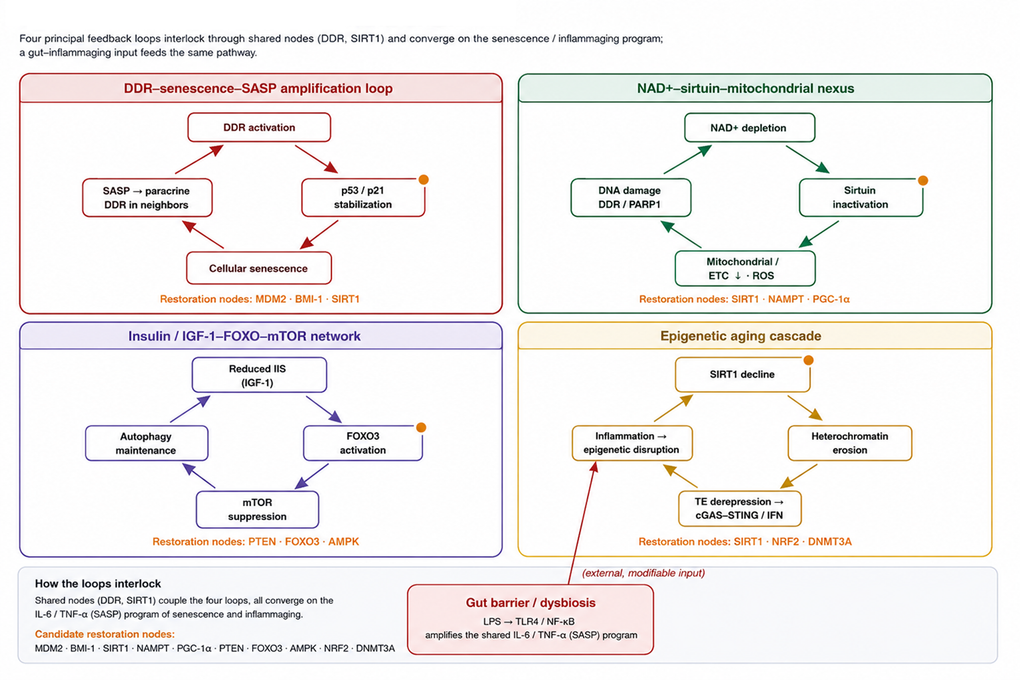
Cross-axis synergy and feedback architecture. Four principal feedback loops interlock through shared nodes and converge on the senescence/inflammaging program. Loop ① (DDR–senescence–SASP amplification): chronic DDR activation stabilizes p53 and p21, driving senescence and a senescence-associated secretory phenotype (SASP) that propagates paracrine DDR to neighboring cells; candidate restoration nodes are MDM2, BMI-1, and SIRT1. Loop ② (NAD+–sirtuin–mitochondrial nexus): NAD+ depletion inactivates sirtuins, impairing mitochondrial function and generating reactive oxygen species that feedback as DNA damage (SIRT1, NAMPT, PGC-1α). Loop ③ (insulin/IGF-1–FOXO–mTOR network): reduced insulin/IGF-1 signaling activates FOXO3 and suppresses mTOR to sustain autophagy (PTEN, FOXO3, AMPK). Loop ④ (epigenetic aging cascade): SIRT1 decline and heterochromatin erosion derepress transposable elements and trigger cGAS–STING/interferon signaling (SIRT1, NRF2, DNMT3A). Shared nodes (DDR and SIRT1) couple the loops, which converge on the IL-6/TNF-α SASP program of senescence and inflammaging; a gut-barrier/dysbiosis input (LPS → TLR4/NF-κB) acts as an external, modifiable amplifier of the same program. All candidate restoration nodes are illustrative and non-validated.
If validated, the next step would be toward restoration, perhaps using AAV-based gene delivery.
It's not happening soon, this is basic research and there is no human data that says this is anything except possible. But it is interesting to tackle a biological milieu where cellular programs that protect against cancer and genomic instability may become harmful when chronically engaged.
Citation: Sewell P. The guardian paradox: DNA damage response overactivation as an integrative driver of aging – a tumor suppressor–negative regulator framework. Aging (Albany NY). 2026; 18:1107-1146. DOI:10.18632/aging.206416