Some kids help others more than other kids. A lot of that is probably social learning. Yet a new paper reveals that being helpful may be a universal trait.
The data were 336 children aged four to nine from Germany, Argentina, Namibia, Kenya, and Bolivia - residents from top 10 industrial nation to small-scale farming and foraging kids.
To see how common helpful behavior is, they had pairs of kids play a marble game. One child who had completed overcoming issues like a box that wouldn't open or a spilled the marbles on the floor was observed to see if and how they helped. Things like explaining the solution ('teach a person to fish'), solving the problem hands-on ('give the person a fish'), or doing both at once.
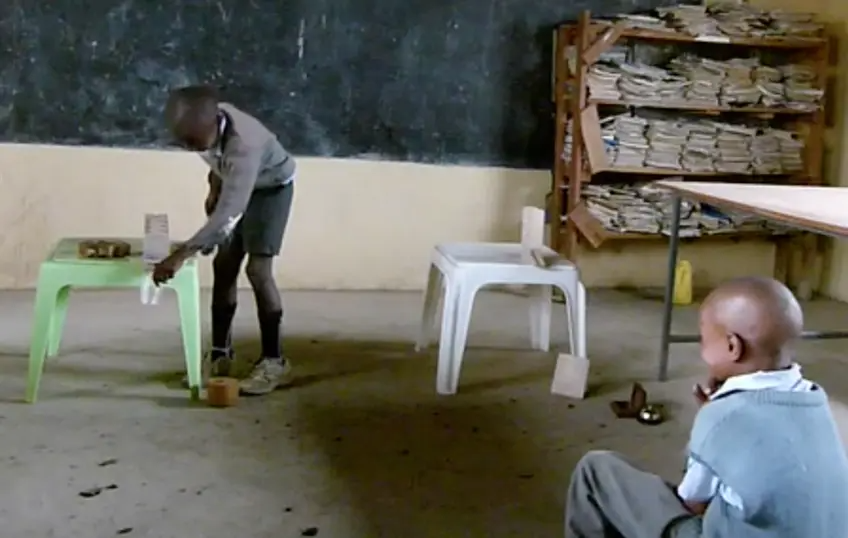
Credit: Henriette Zeidler
They found that across all the cultures, kids consistently helped and there was no difference between boys and girls. Younger ones generally did more than was needed, like helping open a box when picking up marbles was the one that was most beneficial. Older kids modulated that. They only provided assistance when it looked like the other child wanted help and they were more likely to explain that just doing it.
German kids were most likely to do both while Kikuyu children, one of the two groups from Kenya, explained rather than doing. This makes some sense. Kids in farming communities don't get a lot of explanation while Germans generally over-explain most things. They behave as they adults in their community behave. So helpful behavior is deeply rooted yet still culturally malleable in practice.
“Helping is one of the clearest expressions of our species' capacity for cooperation,” says Dr. Daniel Haun, one of the study's senior authors and anthropologist at the Max Planck Institute. “Our data show that this capacity reliably emerges in children everywhere, but it is fine-tuned by the specific social world in which each child grows up. Children don't just learn whether to help; they also learn how to help in ways that make sense within their own community.”
Citation: Henriette Zeidler, Marie Schäfer, Esther Herrmann, Patricia Kanngiesser, Luke Maurits, Daniel Haun, and Michael Tomasello, Children from six cultures reliably help their peers - but in different ways, PNAS, 28 September 2026, 10.1073/pnas.2515233123