Many people want to feel secure in a relationship but that does not mean people perceive it the same way. It is a bit of a moving target, finds new survey results.
Some feel that confidence in the relationship's future will bring closeness, connection, and trust. That derives from stability. If your partner likes to sing Dead Or Alive's "Brand New Lover" song, that is one thing. If they clearly want to live it, it is wise to not get attached.
The broader tribe culture shapes that as well. Acceptance by friends, family, and in many other countries society will also impact how secure each person feels. Which means how stable the other feels.
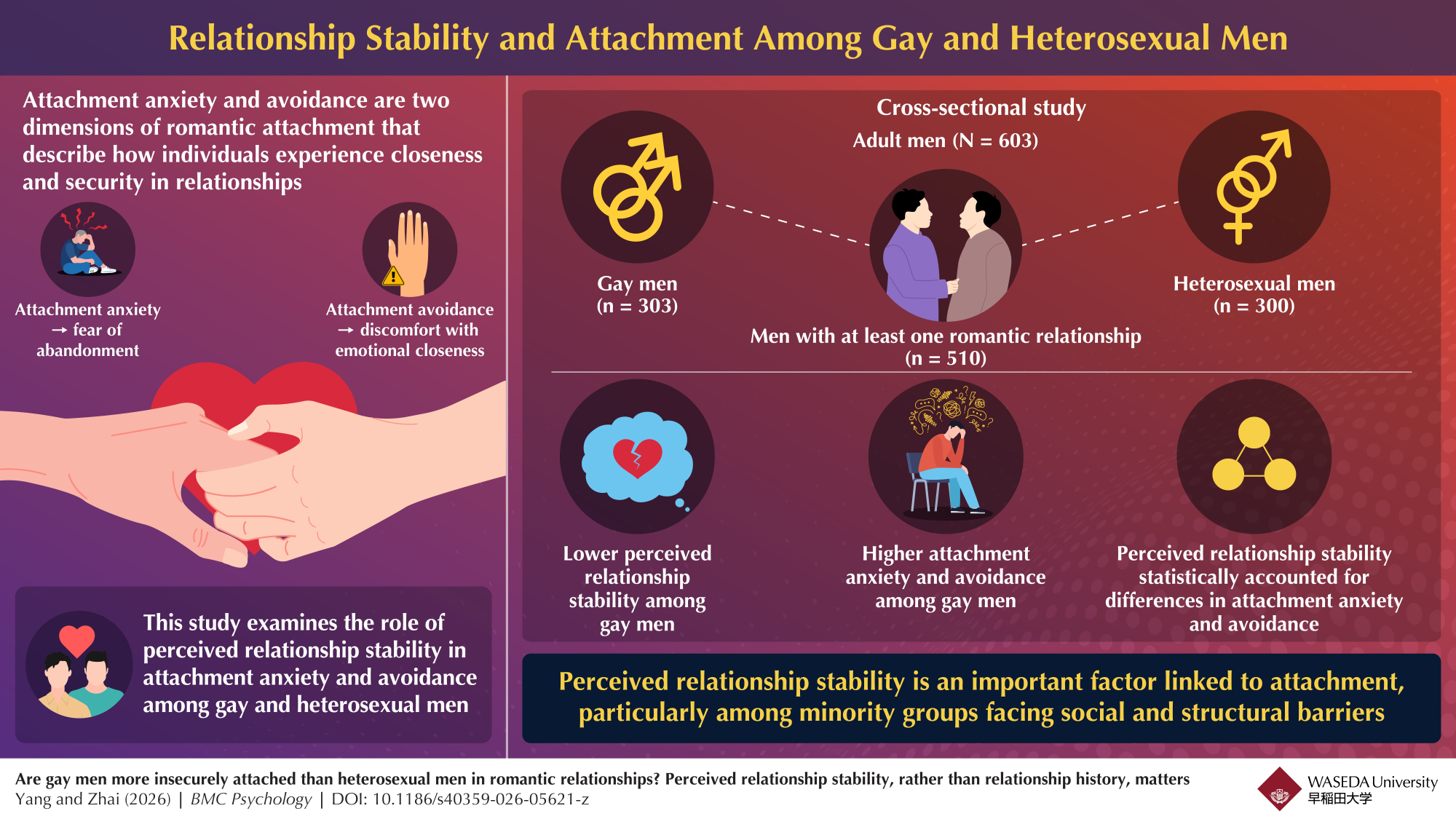
In this paper, humanities scholars wanted to see how gay and heterosexual men might differ in romantic attachment and to what extent perceived relationship stability might correlate to differences. So they targeted two attachment aspects: anxiety - concern about abandonment or the partner’s feelings - and avoidance - discomfort with emotional closeness or relying on a partner.
Credit: Assistant Professor Fan Yang from Waseda University, Japan
The survey population was 603 (303 gay, 300 heterosexual) men ages 20 to 29 living in Shanghai, China. Questions were designed to calibrate attachment anxiety, avoidance, perceived romantic relationship stability, and romantic history. 510 participants had experienced at least one romantic relationship and those were asked, from “very unstable” to “very stable”, how comfortable they considered the romantic relationships to be. Then, attachment anxiety and avoidance were assessed using a nine-item questionnaire designed to measure these two dimensions.
Eveb after accounting for other factors like differences in economic and occupational statuses, gay men reported higher levels of both attachment anxiety and attachment avoidance than heterosexual men - even though there was little difference in their relationship histories. Though they had similar similar numbers of romantic relationships and similar durations, the difference when asked how stable they considered their relationships to be was obvious. Gay men expressed lower perceived stability and higher attachment anxiety and avoidance than heterosexual men.
Security is in the eye of the beholder, but the other person can impact how confident relationships feel.
“The feeling that ‘this relationship has a future’ may be an important part of romantic security,” explains co-author Assistant Professor Fan Yang of Waseda University in Japan.