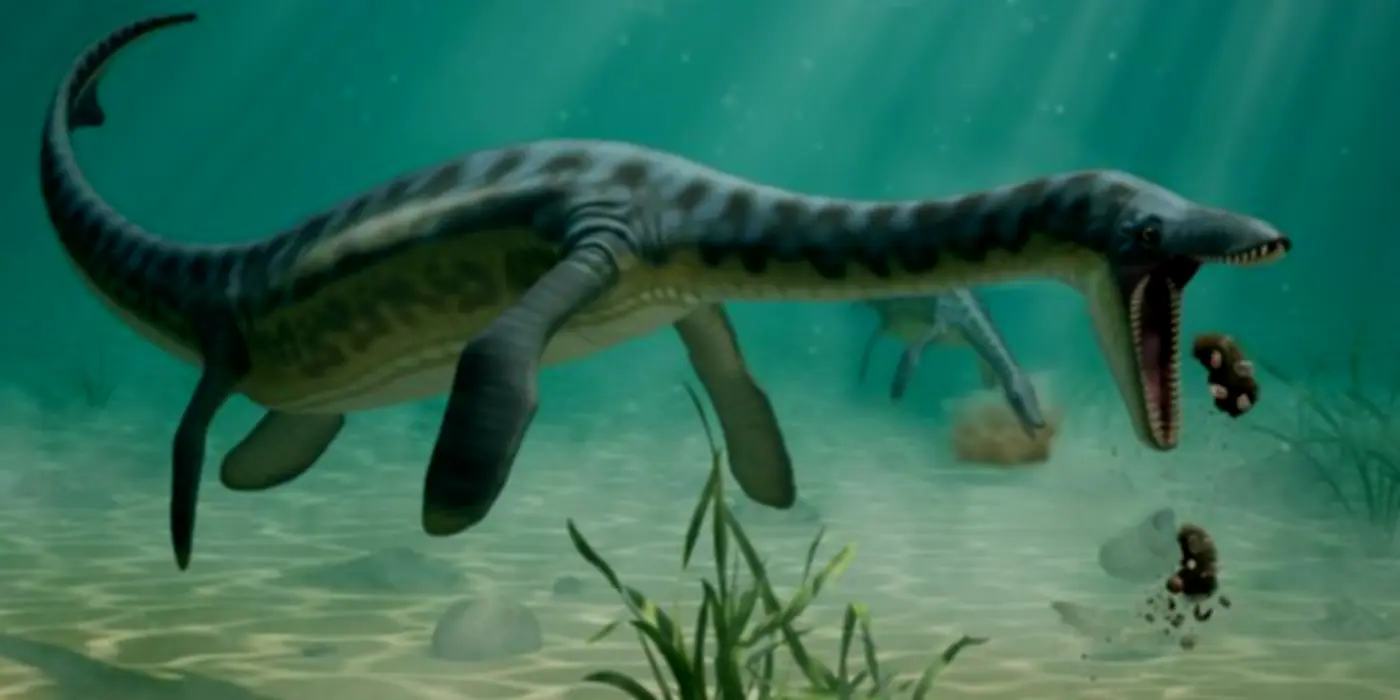
Jurassic Puke: Plesiosaurs Knew Not To Vomit Where They Eat
Jurassic monsters sometimes needed to vomit. When they did, they went to shore.
Jurassic monsters sometimes needed to vomit. When they did, they went to shore.


As the planet's population continues to grow, optimal crops need to be planted and harvested in order to feed people. One concern about widespread use of 'organic' cropping is that it would raise the price of food and have lower yields. Right now only rich people can afford organic food but if lower yields were worldwide only rich people could afford food at all, say critics.
It's not a huge issue, at least for some crops, say scientists at the University of Wisconsin-Madison and agricultural consulting firm AGSTAT. They say organic cropping systems are as productive as conventional systems for alfalfa and wheat and are almost as productive for corn and soybeans, according to research reported in Agronomy Journal.
One day soon patients may spit in a cup, instead of bracing for a needle prick, when being tested for cancer, heart disease or diabetes.
A major step in that direction is the cataloguing of the “complete” salivary proteome, a set of proteins in human ductal saliva, identified by a consortium of three research teams, according to an article published today in the Journal of Proteome Research. Replacing blood draws with saliva tests promises to make disease diagnosis, as well as the tracking of treatment efficacy, less invasive and costly.
Saliva proteomics and diagnostics is part of a nationwide effort to create the first map of every human protein and every protein interaction, as they contribute to health and disease and as they act as markers for disease states. Following instructions encoded by genes, protein “machines” make up the body’s organs and regulate its cellular processes.
AI or ANN? Designers of artificial cognitive systems have tended to adopt one of two approaches to building robots that can think for themselves: classical rule-based artificial intelligence or artificial neural networks.
Both have advantages and disadvantages, and combining the two offers the best of both worlds, say a team of European researchers who have developed a new breed of cognitive, learning robot that goes beyond the state of the art.
The researchers’ work brings together the two distinct but mutually supportive technologies that have been used to develop artificial cognitive systems (ACS) for different purposes. The classical approach to artificial intelligence (AI) relies on a rule-based system in which the designer largely supplies the knowledge and scene representations, making the robot follow a decision-making process – much like climbing through the branches of a tree – toward a predefined response.
Hormone replacement therapy (HRT) for peri- and postmenopausal symptoms increases disease recurrence in breast cancer survivors, according to an article published online March 25 in the Journal of the National Cancer Institute.
Previous studies have shown that HRT increases breast cancer incidence in healthy women, but its impact on breast cancer survivors has remained obscure. Observational studies and one small randomized trial had suggested that HRT had no effect or even might reduce recurrence. However, two-year follow-up data from the randomized HABITS (Hormonal Replacement After Breast Cancer —Is It Safe?) trial indicated that survivors who took HRT were more likely to suffer disease recurrence than those who did not take HRT.
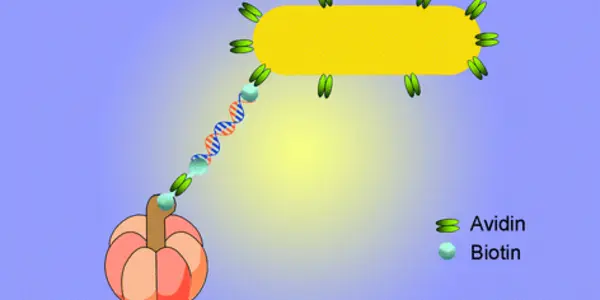
In the near future a bio-sensing nano-device developed by Arizona State University researcher Wayne Frasch could eliminate long lines at airport security checkpoints and revolutionize health screenings for diseases like anthrax, cancer and antibiotic resistant Staphylococcus aureus (MRSA) - and it will all happen with the world’s tiniest rotary motor.
Frasch works with the enzyme F1-adenosine triphosphatase, better known as F1- ATPase. This enzyme, only 10 to 12 nanometers in diameter, has an axle that spins and produces torque. This tiny wonder is part of a complex of proteins key to creating energy in all living things, including photosynthesis in plants. F1-ATPase breaks down adenosine triphosphate (ATP) to adenosine diphospahte (ADP), releasing energy. Previous studies of its structure and characteristics have been the source of two Nobel Prizes awarded in 1979 and 1997.
Dynamic connection: target DNA forms part of a bridge between molecular motor F1-ATPase (bottom left) and a gold nanorod.
Low doses of hydrogen sulfide, the toxic gas responsible for the unpleasant odor of rotten eggs, can safely and reversibly induce 'suspended animation', in mice, say Massachusetts General Hospital reseachers. They report that effects seen in earlier studies do not depend on a reduction in body temperature and include a substantial decrease in heart rate without a drop in blood pressure.
“Hydrogen sulfide is the stinky gas that can kill workers who encounter it in sewers; but when adminstered to mice in small, controlled doses, within minutes it produces what appears to be totally reversible metabolic suppression,” says Warren Zapol, MD, chief of Anesthesia and Critical Care at MGH and senior author of the Anesthesiology study. “This is as close to instant suspended animation as you can get, and the preservation of cardiac contraction, blood pressure and organ perfusion is remarkable.”

Some new research indicates that a key component of soybean plant defenses against leaf-eating insects go down as CO2 goes up.
The new study, led by University of Illinoise entomology professor and department head May Berenbaum, used the Soybean Free Air Concentration Enrichment (Soy FACE) facility at Illinois, an open-air research lab that can expose the plants in a soybean field to a variety of atmospheric CO2 and ozone levels – without isolating the plants from other environmental influences, such as rainfall, sunlight and insects.
High atmospheric carbon dioxide is known to accelerate the rate of photosynthesis. It also increases the proportion of carbohydrates relative to nitrogen in plant leaves.
Corn has long been a primary food crop in prehistoric North and Central America but, according to a new study, it was also an important part of the South American diet for much longer than previously thought.
PhD student Sonia Zarrillo and archaeology professor Dr. Scott Raymond report that a new technique for examining ancient cooking pots has produced the earliest directly dated examples of domesticated corn (maize) being consumed on the South American continent.
As we learn more and more about the human genome and delve into specifics about what makes certain people healthier than others at the genetic levl, it becomes possible for health care providers, insurers and even employers to use genetic information against individuals even when no health issue exists.
A policy monograph highlighting the need for federal protections against genetic discrimination in employment and insurance practices was released today by the American College of Physicians (ACP). The six policy positions ACP believes should be included in the federal protections are the focus of the policy paper.
“While they’re not quite there, Congress does continue to move closer to passing federal legislation that protects the use of genetic information in employment and insurance coverage decisions,” noted David C. Dale, MD, FACP president of the 125,000 member ACP. “This monograph is important for the ongoing discussion.”
ACP’s first two positions consider insurance providers:

There's no McAlgae drive-through, but coral have their own addiction to 'junk food' and, say researchers, we may be in the position of needing to halt global warming in order to keep that fast food coming. 200 million humans depend on it for their subsistence.
The symbiosis between coral, a primitive animal, and zooxanthellae, tiny one-celled plants, is not only powerful enough to build the largest living organism on the planet, the Great Barrier Reef, but also underpins the economies and living standards of many tropical nations and societies who harvest their food from the reefs or have developing tourism industries.
Enzymes are biological catalysts that are made from a string of amino acids, which fold into specific three-dimensional protein structures. Without them, life would not exist. They are a valuable model for understanding the intricate works of nature. These molecular machines are responsible for initiating chemical reactions within the body. Millions of years of natural selection have fine-tuned the activity of such enzymes, allowing chemical reactions to take place millions of times faster.
In order to create artificial enzymes, a comprehensive understanding of the structure of natural enzymes, their mode of action, as well as advanced protein engineering techniques is needed. A team of scientists from the University of Washington, Seattle, and the Weizmann Institute of Science, Israel, made a crucial breakthrough toward this endeavor.
They have succeeded in creating a new type of enzyme for a reaction for which no naturally occurring enzyme has evolved.
Using classical coding, a single photon will convey only one of two messages - one bit of information. In dense coding, a single photon can convey one of four messages - two bits of information.
University of Illinois researchers say they have broken the record for the most amount of information sent by a single photon using the direction of “wiggling” and “twisting” of a pair of hyper-entangled photons. Doing so, they have beaten a fundamental limit on the channel capacity for dense coding with linear optics.
“Dense coding is arguably the protocol that launched the field of quantum communication,” said Paul Kwiat, a John Bardeen Professor of Physics and Electrical and Computer Engineering. “Today, however, more than a decade after its initial experimental realization, channel capacity has remained fundamentally limited as conceived for photons using conventional linear elements.”