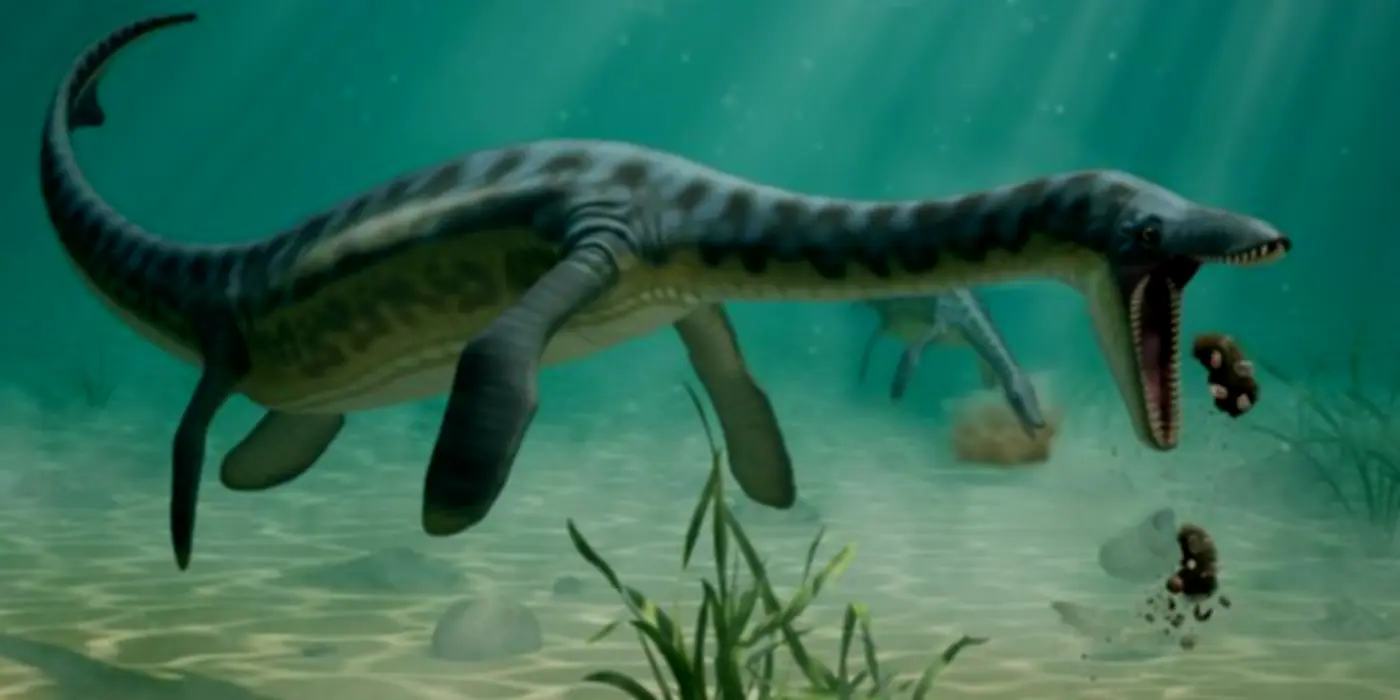
Jurassic Puke: Plesiosaurs Knew Not To Vomit Where They Eat
Jurassic monsters sometimes needed to vomit. When they did, they went to shore.
Jurassic monsters sometimes needed to vomit. When they did, they went to shore.


In the latest issue of Nature Biotechnology, EuroStemCell scientist Elena Cattaneo from University of Milano along with Mauro Toselli from University of Pavia, Elisabetta Cerbai from the University of Florence and Ferdinando Rossi of University of Torino have challenged findings published in the same journal last year that amniotic fluid-derived stem cells can produce cells of the nervous system.
Amniotic fluid is the liquid that surrounds the fetus during pregnancy.
Scientists in Japan have discovered a new species of bacteria, Microbacterium hatanonis, that can live in hairspray, according to the results of a study published in the March issue of the International Journal of Systematic and Evolutionary Microbiology.
“Contamination of cosmetic products is rare but some products may be unable to suppress the growth of certain bacteria,” says Dr Bakir from the Japan Collection of Microorganisms, Saitama, Japan. “We discovered a new species of bacteria called Microbacterium hatanonis, which we found contaminates hairspray.

Growing concern over increased levels of atmospheric carbon dioxide has prompted new interest in techniques for removing the gas from the smokestacks of such large-scale sources as coal-fired electric power plants. But to minimize their economic impact, the cost of adding such controls must be minimized so they don’t raise the price of electricity significantly.
Researchers have developed a new, low-cost material called hyperbranched aluminosilica for capturing carbon dioxide (CO2) from the smokestacks of coal-fired power plants and other generators of the greenhouse gas.

Transfer RNA is an ancient molecule, central to every task a cell performs and thus essential to all life. A new study from the University of Illinois indicates that it is also a great historian, preserving some of the earliest and most profound events of the evolutionary past in its structure.
Of the thousands of RNAs so far identified, transfer RNA (tRNA) is the most direct intermediary between genes and proteins. Like many other RNAs (ribonucleic acids), tRNA aids in translating genes into the chains of amino acids that make up proteins. With the help of a highly targeted enzyme, each tRNA molecule recognizes and latches onto a specific amino acid, which it carries into the protein-building machinery.
The discovery of the brain’s so-called melanocortin system and its central role in controlling appetite has paved the way for entirely new possibilities for treating obesity and anorexia. In the latest issue of the prestigious journal Nature Reviews Drug Discovery, Uppsala University researcher Jarl Wikberg and one of his associates present a review of pioneering research in this field that he and other scientists have conducted over nearly two decades.
The mapping of the melanocortin system was made possible by the cloning of genes for five different melanocortin receptors, which was performed by Jarl Wikberg in collaboration with other researchers in the early 1990s.
Ben Shneiderman of the University of Maryland, one of the world’s leading researchers and innovators in human-computer interaction, says it’s time for the laboratory research that has defined science for the last 400 years to make room for a revolutionary new method of scientific discovery.
He calls it Science 2.0. We couldn't agree more.
Yet he has apparently never read this website. He says Science 2.0 combines the hypothesis based inquiry of laboratory science with the methods of social science research to understand and improve the use of new human networks made possible by today’s digital connectivity. Through Science 2.0, the societal potential of such networks can be realized for applications ranging from homeland security to medical care to the environment.
Following last week’s study suggesting that new generation antidepressants aren’t all they’re cracked up to be, a special report in this week’s BMJ asks do we really know the truth about antidepressants? Or statins? Or any other drug on the market?
Lack of access to data is an ongoing problem in the United States, despite passage of the Food and Drug Administration Amendments Act (FDAAA) of 2007, which requires clinical trials to be registered in a public database, write Jeanne Lenzer and Shannon Brownlee.
Although it’s a positive step towards greater transparency, the act may not reduce the likelihood of dangerous or ineffective drugs remaining on the market as much as some people might have hoped, they warn. For example, not all trials have to be registered and access to full data is also constrained by trade secrecy laws.
In an important step towards a greener global future, Australia and China signed a formal international agreement for clean coal research today in Beijing.
The agreement, between CSIRO and China’s Thermal Power Research Institute (TPRI), will see TPRI install, commission and operate a post combustion capture pilot plant at the Huaneng Beijing Co-Generation Power Plant as part of CSIRO’s research program.
Post combustion capture (PCC) is a process that uses a liquid to capture carbon dioxide (CO2) from power station flue gases and is a key technology that can potentially reduce carbon dioxide emissions from existing and future coal-fired power stations by more than 85 per cent.
A brain network linked to introspective tasks -- such as forming the self-image or understanding the motivations of others -- is less intricate and well-connected in children, say researchers. They also showed that the network establishes firmer connections between various brain regions as an individual matures.
The scientists are working to establish a picture of how these connections and other brain networks normally develop and interact.
American history is referenced in news features, profiles and analysis pieces, giving meaning to current events, discoveries and individuals. A University of Missouri researcher recently completed a study on the use of historical references by journalists in the 19th century, a time when the United States had little or no published history records. The study revealed that 19th century American journalism was significantly influential in shaping the nation’s early history.
Betty Winfield, Curators’ professor of Journalism at MU, based the study on 2,000 magazine and newspaper headlines from various publications throughout the 19th century. Organizing titles into particular groups and tracking patterns, Winfield found an increase in historical references from the beginning of the century to 1900, when historians first began recording the nation’s past. Winfield said journalists created a particular national story by referencing certain people and events, which emerged as collective memory.

Researchers at Swansea University are developing a new, eco-friendly technology that could generate as much electricity as 50 wind farms.
Dr Dave Worsley, a Reader in the Materials Research Centre at the University’s School of Engineering, is investigating ways of painting solar cells onto the flexible steel surfaces commonly used for cladding buildings.
“We have been collaborating with the steel industry for decades,” explains Dr Worsely, “but have tended to focus our attention on improving the long-term durability and corrosion-resistance of the steel.

The U.S. legal system has long assumed that all testimony is not equally credible, that some witnesses are more reliable than others. In tough cases with child witnesses, it assumes adult witnesses to be more reliable. But what if the legal system had it wrong?
Researchers Valerie Reyna, human development professor, and Chuck Brainerd, human development and law school professor-- both from Cornell University -- argue that like the two-headed Roman god Janus, memory is of two minds -- that is, memories are captured and recorded separately and differently in two distinct parts of the mind.
Scientists found that humans exhibit two types of memory.